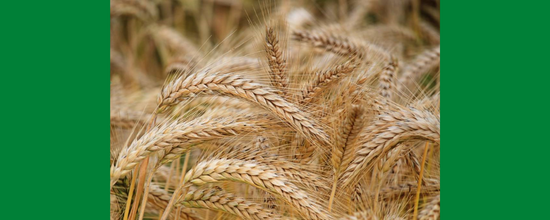
As post emergence weedicide, use 2, 4-D @ 1 ml per ltr of water for controlling broad leaf weeds in standing crop. Timing of application of 2, 4-D is critical to avoid injury to wheat. The critical period for 2,4-D applications is after wheat is Fully tillered but before Jointing Stage. Application before full tillering stage and after jointing stage may cause harm to the crop.

Spraying of weedicide in wheat crop Weedicide 2,4-D
The pre-dominant weeds associated with wheat crop are Anagallis arvensis (Krishananeel), Argemone mexicana (Satyanashi), Asphodelus tenuifolius (Piazi), Avena ludoviciana (Jangli Jai), Cannabis sativa (Bhang), Carthamus oxycantha (Pohli), Chenopodium album (Bathu), Cirsium arvense (Kateli), Convolvulus arvensis (Hirankhuri), Cornopus didymus (Pitpapra), Euphorbia jelioscopia (Dudhi), Fumaria parviflora (Gajri), Lathyrus aphaca (Matri), Malva parviflora (Gogisag), Medicago denticulata (Maina), Malilotus alba (Metha), Phalaris minor(Mandushi/Gulidanda), Poa annua (Poa ghas), Polygonum plebejum (Raniphul), Polypogon monspeliensis (Lomar ghas), Rumex retroflex (Jangli palak), Spergula arvensis (Bandhania), Vicia sativa (Chatri/Gegla). Phalaris minor is the major weed of wheat in rice wheat system. Sometimes its population is so high (2000-3000 plants / m2) that farmers are forced to harvest the wheat crop as fodder. Isoproturon (Arelon) was recommended for the control of Phalaris minor.
Some Useful Hints
Do’s-
Spray the herbicides, both pre and post emergence, when there is sufficient moisture in the soil. Spray the post-emergence herbicides when phalaris minor is at 2-3 leaf stage. Spray on clear and sunny days only when the leaves are dries. Use only flat fan nozzle especially for fenoxaprop. Remove phalaris minor before seed setting and use as fodder. Ensure complete coverage of the field.
Don’ts-
Do not use Sulfosulfuran in mixed cropping system of wheat and mustard or other crops. Never apply these post emergence herbicides by mixing with sand, urea or soil. Do not mix Clodinafop and Fenoxaprop with 2,4-D.
Gujhia Weevil (Tanymecus indicus)
Identification: Weevils are earthen grey about 6.8 mm in length and 2.4 mm in width and Larvae are fleshy and creamy white. The pest is active from June to December and undergoes larval or pupal diapause during rest of the year in the soil.

Nature of Damage
Only adults feed on leaves and tender shoots of the host plants. They cut the germinating seedlings at the ground level. Often the crop is re-sown. The damage is particularly serious during October-November when the rabi crops are germinating.


Management of Gujhia Weevil
Cultural Control:
- Plough the fields in summer to expose and kill the pupae of Gujhia Weevil by Sun light and heat.
Chemical Control:
- Seed treatment with Chlorpyriphos 20 EC @ 4.5 ml per kg of seed.
- Mixing of dust like Lindane 1.3 D @ 25-30 kg/ha in soil before sowing.
- Foliar spray with Chlorpyriphos 20 EC @ 2-3 ml/litre of water as and when infestation is noticed in the field.
Leaf Rust (Brown)
Symptoms:
The first symptom of the disease is the appearance of minute, round, orange sori, irregularly distributed on the leaves, rarely on the leaf sheath and stem. The sori turn brown with maturity.


Management of Leaf Rust (Brown)
Chemical Control:
- Seed dressing with Plantvax @2.5 g/kg of seed.
- Foliar Spray with Plantvax 20 EC @ 2 ml/lit of water OR
- Propiconazole 25 EC @ 1 ml/lit of water OR
- Zineb 75 WP OR Mancozeb 75 WP @ 2 g/lit of water to control the leaf rust of wheat.
- Apply 20-25kg/ha nitrogen for better growth and development of wheat crop.
Leave a Reply