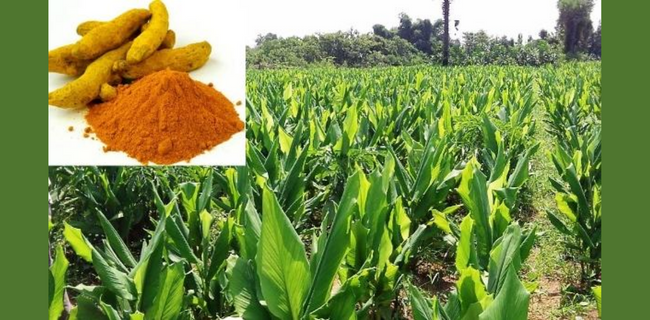
Turmeric (Curcuma longa) (Family: Zingiberaceae) is used as condiment, dye, drug and cosmetic in addition to its use in religious ceremonies. India is a leading producer and exporter of turmeric in the world. Andhra Pradesh, Tamil Nadu, Orissa, Karnataka, West Bengal, Gujarat, Meghalaya, Maharashtra, Assam are some of the important states cultivates turmeric, of which, Andhra Pradesh alone occupies 35.0% of area and 47.0% of production.
Climate:
- It is a tropical herb which grows in both tropics and subtropics.
- It can grow from sea level to 1500m above the sea.
- It grows at a temperature range of 20-35°c with an annual rainfall of 1500mm or more.
- It requires a humid climatic condition.
- It is grown under rain-fed or irrigated conditions.
Soil:
- Soil used for Turmeric cultivation should be rich and friable.
- It grows best in well drained sandy or clayey loam with a little higher sand content.
- It grows on different types of soils from sandy loam, light black, clay loams to red soils with a pH range of 4.5-7.5 and should have a good organic status.
Sandy soil:

Sandy Soil is light, warm, dry and tends to be acidic and low in nutrients. Sandy soils are often known as light soils due to their high proportion of sand and little clay (clay weighs more than sand).
These soils have quick water drainage and are easy to work with. They are quicker to warm up in spring than clay soils but tend to dry out in summer and suffer from low nutrients that are washed away by rain.
The addition of organic matter can help give plants an additional boost of nutrients by improving the nutrient and water holding capacity of the soil.
Clay Soil:

Clay Soil is a heavy soil type that benefits from high nutrients. Clay soils remain wet and cold in winter and dry out in summer.
These soils are made of over 25 percent clay, and because of the spaces found between clay particles, clay soils hold a high amount of water.
Because these soils drain slowly and take longer to warm up in summer, combined with drying out and cracking in summer, they can often test gardeners.
Loam Soil

Loam soil is a mixture of sand, silt and clay that are combined to avoid the negative effects of each type.
These soils are fertile, easy to work with and provide good drainage. Depending on their predominant composition they can be either sandy or clay loam.
As the soils are a perfect balance of soil particles, they are considered to be a gardener best friend, but still benefit from topping up with additional organic matter.
Soil treatment:
Apply organic manure like FYM/compost/well-decomposed press mud (about 15-20 t/ha FYM.
Benefits of soil treatment:

Water benefits:
- Healthy soil acts as a sponge: more rainwater is absorbed and stored in the ground, where it recharges groundwater and aquifers.
- Healthy soil prevents run-off and erosion, and reduces evaporation.
- Healthy soil improves water quality by filtering pollutants.
Nutritious food:
- Healthy soil increases the nutritional value of food and forage.
- Healthy soil provides plants with the nutrition they need and strengthens plants natural resistance to pests and diseases.
Economic security:
- Healthy soil improves farm productivity and provides stability.
- Healthy soil cuts down on inputs, which increases profit.
- Healthy soil helps withstand extreme weather, floods and drought.
Environmental and health benefits:
- Healthy soil helps reverse global warming by absorbing carbon from the atmosphere where it acts as a greenhouse gas.
- Healthy soil provides habitat for soil microbes to flourish.
- Healthy soil supports greater biodiversity and species stability.
Preparation of land:
- Minimum tillage operations should be adopted while preparing the land in Turmeric Farming.
- To give at least 50cm spacing between beds, beds should be prepared with a height of 15cm, 1m width and suitable length.
- In case of irrigated crops, rhizomes should be planted in shallow pits on the top of the ridges and ridges and furrows should be prepared.
- Solarization of beds is useful to check the multiplication of pests and diseases causing organisms.
- After the work is completed Polythene sheets which is used for soil solarisation should be kept away safely.
Characteristics of improved turmeric varieties:
| Sl.No. | Variety | Mean yield (fresh)(t/ha) | Crop duration (days) | Dry recovery (%) | Curcumin (%) | Oleoresin (%) | Essential oil (%) |
| 1 | Suvarna | 17.4 | 200 | 20.0 | 4.3 | 13.5 | 7.0 |
| 2 | Suguna | 29.3 | 190 | 12.0 | 7.3 | 13.5 | 6.0 |
| 3 | Sudarsana | 28.8 | 190 | 12.0 | 5.3 | 15.0 | 7.0 |
| 4 | IISR Prabha | 37.5 | 195 | 19.5 | 6.5 | 15.0 | 6.5 |
| 5 | IISR Prathibha | 39.1 | 188 | 6.2 | 6.5 | 16.2 | 6.2 |
| 6 | Co-1 | 30.0 | 285 | 19.5 | 3.2 | 6.7 | 3.2 |
| 7 | BSR-1 | 30.7 | 285 | 20.5 | 4.2 | 4.0 | 3.7 |
| 8 | Krishna | 9.2 | 240 | 16.4 | 2.8 | 3.8 | 2.0 |
| 9 | Sugandham | 15.0 | 210 | 23.3 | 3.1 | 11.0 | 2.7 |
| 10 | Roma | 20.7 | 250 | 31.0 | 9.3 | 13.2 | 4.2 |
| 11 | Suroma | 20.0 | 255 | 26.0 | 9.3 | 13.1 | 4.4 |
| 12 | Ranga | 29.0 | 250 | 24.8 | 6.3 | 13.5 | 4.4 |
| 13 | Rasmi | 31.3 | 240 | 23.0 | 6.4 | 13.4 | 4.4 |
| 14 | Rajendra Sonia | 42.0 | 225 | 18.0 | 8.4 | – | 5.0 |
| IISR Alleppey | |||||||
| 15 | Supreme | 35.4 | 210 | 19.3 | 6.0 | 16.0 | 4.0 |
| 16 | IISR Kedaram | 34.5 | 210 | 18.9 | 5.5 |
Turmeric Planting Methods
Ridge and Furrow Method:
- Ridges and furrows are opened at 75 cm distance.
- Planting of sprouted mother sets is done on both sides of the ridge at about 1/3rd above the bottom of the furrow.
- Only one set is planted at each spot by facing eye bud in upward direction.
- Sets are planted at 20 to 25 cm distance from each other.
- After planting sets are covered by soil.
- Irrigation is given just before or after planting.
Broad Ridge Method:
- In this method, the channels are opened at 1.5 meter distance from each other with the help of ridger.
- The raised bed of 20 to 30 cm high and 75 to 100 cm wide at the top are prepared.
- The length of bed depends upon the slope of the land.
- Mother sets are planted on the top of the bed at 30 x 30 cm spacing.
- At each spot one set is planted 10 cm deep and covered by soil.
- Irrigation is given immediately after planting.
- This method give 30 to 35 percent higher yield than ridge and furrow method.
Spacing:
- In the beds, with a hand hoe small pits are made in rows with a spacing of 25cm x 30 cm and it is covered with soil or dry powdered cattle manure.
- The adequate spacing in furrows and ridges should be between 45-60cm and 25cm between the plants.
Sowing time and seed rate:
- Depending upon the variety and time of sowing, well grown turmeric crop is ready to harvest in 7-9 months.
- The crops can be planted in April- March with the arrival of pre-monsoon showers where the rainfall comes early.
- For planting one hectare of turmeric a seed rate of 2500 kg of rhizomes is required
Seed material:
Whole or split mother and finger rhizomes are used for planting and well developed healthy and disease free rhizomes are to be selected. Small pits are made with a hand hoe on the beds with a spacing of 25 cm x 30 cm. Pits are filled with well decomposed cattle manure or compost, seed rhizomes are placed over it then covered with soil. The optimum spacing in furrows and ridges is 45-60 cm between the rows and 25 cm between the plants. A seed rate of 2,500 kg of rhizomes is required for planting one hectare of turmeric.
Manuring and fertilizer application:
Farmyard manure (FYM) or compost @ 30-40 t/ha is applied by broadcasting and ploughed at the time of preparation of land or as basal dressing by spreading over the beds or in to the pits at the time of planting. Fertilizers @ 60 kg N, 50 kg P2O5 and 120 kg K2O per hectare are to be applied in split doses as given. Zinc @ 5 kg/ha may also be applied at the time of planting and organic manures like oil cakes can also be applied @ 2 t/ha. In such case, the dosage of FYM can be reduced. Integrated application of coir compost (@ 2.5 t/ha) combined with FYM, biofertilizer (Azospirillum) and half recommended dose of NPK is also recommended.
Fertilizer schedule for turmeric (per ha):
| Schedule | N | P2O5 | K2O | Compost/cowdung |
| Basal application | – | 50 kg | – | 30-40 tonnes |
| After 45 days | 30 kg | – | 60 kg | – |
| After 90 days | 30 kg | – | 60 kg | – |
Irrigation:
- Irrigation is done depending upon the soil and climatic conditions for turmeric.
- In case of medium heavy soils, 15-25 irrigations are given depending on the rainfall.
- In case of light textured red soils, 35-40 irrigations are needed.
Mulching
The crop is to be mulched immediately after planting with green leaves @ 12-15 t/ha. Mulching may be repeated @ 7.5 t/ha at 45 and 90 days after planting after weeding, application of fertilizers and earthing up.
Weeding and irrigation
Weeding has to be done thrice at 60, 90 and 120 days after planting depending upon weed intensity. In the case of irrigated crop, depending upon the weather and soil conditions, about 15 to 23 irrigations are to be given in clayey soils and 40 irrigations in sandy loams.
Mixed cropping
Turmeric can be grown as an intercrop in coconut and arecanut plantations. It can also be raised as a mixed crop with chillies, colocasia, onion, brinjal and cereals like maize, ragi, etc.
Plant protection
Diseases
Leaf blotch:
Leaf blotch is caused by Taphrina maculans and appears as small, oval, rectangular or irregular brown spots on either side of the leaves which soon become dirty yellow or dark brown. The leaves also turn yellow. In severe cases the plants present a scorched appearance and the rhizome yield is reduced. The disease can be controlled by spraying mancozeb 0.2%.
Leaf spot:
Leaf spot is caused by Colletotrichum capsici and appears as brown spots of various sizes on the upper surface of the young leaves. The spots are irregular in shape and white or grey in the centre. Later, two or more spots may coalesce and form an irregular patch covering almost the whole leaf. The affected leaves eventually dry up. The rhizomes do not develop well. The disease can be controlled by spraying zineb 0.3% or Bordeaux mixture 1%.
Rhizome rot:
The disease is caused by Pythium graminicolum or P. aphanidermatum. The collar region of the pseudostem becomes soft and water soaked, resulting in collapse of the plant and decay of rhizomes. Treating the seed rhizomes with mancozeb 0.3% for 30 minutes prior to storage and at the time of sowing prevents the disease. When the disease is noticed in the field, the beds should be drenched with mancozeb 0.3%.
Nematode:
Root knot nematodes (Meloidogyne spp.) and burrowing nematode (Radopholus similis) are the two important nematodes causing damage to turmeric. Root lesion nematodes (Pratylenchus spp.) are of common occurrence in Andhra Pradesh. Wherever nematode problems are common, use only healthy, nematode- free planting material. Increasing the organic content of the soil also checks the multiplication of nematodes. Pochonia chlamydosporia can be applied to the beds at the time of sowing @ 20 g/bed (at 106 cfu/g) for management of nematode problems.
Insect pests
Shoot borer
The shoot borer (Conogethes punctiferalis) is the most serious pest of turmeric. The larvae bore into pseudostems and feed on internal tissues. The presence of a bore-hole on the pseudostem through which frass is extruded and the withered central shoot is a characteristic symptom of pest infestation. The adult is a medium sized moth with a wingspan of about 20 mm; the wings are orange- yellow with minute black spots. Fully-grown larvae are light brown with sparse hairs. Spraying malathion (0.1%) at 21 day intervals during July to October is effective in controlling the pest infestation. The spraying has to be initiated when the first symptom of pest attack is seen on the inner most leaf.
Rhizome scale
The rhizome scale (Aspidiella hartii) infests rhizomes in the field (at later stages of the crop) and in storage. Adult (female) scales are circular (about 1mm diameter) and light brown to grey and appear as encrustations on the rhizomes. They feed on sap and when the rhizomes are severely infested, they become shrivelled and desiccated affecting its germination. Treat seed material with quinalphos (0.075%) (For 20-30 minutes) before storage and also before sowing in case the infestation persists. Discard and do not store severely infested rhizomes.
Minor pests
Adults and larvae of leaf feeding beetles such as Lema spp. feed on leaves especially during the monsoon season and form elongated parallel feeding marks on them. The spraying of malathion (0.1%) undertaken for the management of shoot borer is sufficient to manage this pest.
The lacewing bug (Stephanitis typicus) infests the foliage causing them to turn pale and dry up. The pest infestation is more common during the post monsoon period especially in drier regions of the country. Spraying dimethoate (0.05%) is effective in managing the pest.
The turmeric thrips (Panchaetothrips indicus) infests the leaves causing them to roll, turn pale and gradually dry up. The pest infestation is more common during the post monsoon period especially in drier regions of the country. Spraying dimethoate (0.05%) is effective for the management of the pest.
Harvesting
Depending upon the variety, the crop becomes ready for harvest in 7-9 months after planting during January-March. Early varieties mature in 7-8 months, medium varieties in 8-9 months and late varieties after 9 months.
The land is ploughed and the rhizomes are gathered by hand picking or the clumps are carefully lifted with a spade. The harvested rhizomes are cleared of mud and other extraneous matter adhering to them.
Processing
Curing
Fresh turmeric is cured for obtaining dry turmeric. The fingers are separated from mother rhizomes. Mother rhizomes are usually kept as seed material. Curing involves boiling of fresh rhizomes in water and drying in the sun.
In the traditional method of curing, the cleaned rhizomes are boiled in water just enough to immerse them. Boiling is stopped when froth comes out and white fumes appear giving out a typical odour. The boiling should last for 45-60 minutes when the rhizomes turn soft. The stage at which boiling is stopped largely influences the colour and aroma of the final product. Over cooking spoils the colour of the final product while under-cooking renders the dried product brittle.
In the improved scientific method of curing, the cleaned fingers (approximately 50 kg) are taken in a perforated trough of 0.9 m x 0.5 m x 0.4 m size made of GI or MS sheet with extended parallel handle. The perforated trough containing the fingers is then immersed in a pan; 100 litres of water is poured into the trough so as to immerse the turmeric fingers. The whole mass is boiled till the fingers become soft. The cooked fingers are taken out of the pan by lifting the trough and draining the water into the pan. The water used for boiling turmeric rhizomes can be used for curing fresh samples. The processing of turmeric is to be done 2 or 3 days after harvesting. If there is delay in processing, the rhizomes should be stored under shade or covered with sawdust or coir dust.
Drying
The cooked fingers are dried in the sun by spreading them in 5-7 cm thick layers on bamboo mats or drying floor. A thinner layer is not desirable, as the colour of the dried product may be adversely affected. During night time, the rhizomes should be heaped or covered with material which provides aeration. It may take 10-15 days for the rhizomes to become completely dry. Artificial drying, using cross-flow hot air at a maximum temperature of 60oC also gives a satisfactory product. In the case of sliced turmeric, artificial drying has clear advantages in giving a brighter coloured product than sun drying which tends to undergo surface bleaching. The yield of the dry product varies from 10-30% depending upon the variety and the location where the crop is grown.
Polishing
Dried turmeric has a poor appearance and a rough dull outer surface with scales and root bits. The appearance is improved by smoothening and polishing the outer surface by manual or mechanical rubbing.
Manual polishing consists of rubbing the dried turmeric fingers on a hard surface. The improved method is by using a hand operated barrel or drum mounted on a central axis, the sides of which are made of expanded metal mesh. When the drum filled with turmeric is rotated, polishing is effected by abrasion of the surface against the mesh as well as by mutual rubbing against each other as they roll inside the drum. Turmeric is also polished in power operated drums. The yield of polished turmeric from the raw material varies from 15-25%.
Colouring
The colour of the processed turmeric influences the price of the produce. For an attractive product, turmeric powder (mixed with little water) may be sprinkled during the last phase of polishing.
Preservation of seed rhizomes
Rhizomes for seed purpose are generally stored by heaping in well ventilated rooms and covered with turmeric leaves. The seed rhizomes can also be stored in pits with saw dust, sand along with leaves of Strychnos nuxvomica (kanjiram). The pits are to be covered with wooden planks with one or two openings for aeration. The rhizomes are to be dipped in quinalphos (0.075%) solution for 15 minutes if scale infestations are observed and in mancozeb (0.3%) to avoid storage losses due to fungi.
| Name of the Disease | Part Affected | Stage Affected |
|---|---|---|
| Shoot Borer | Pseudostem and growing shoots | All stages of growth |
| Leaf roller | Leaves | 2-5 months |
| Rhizome scales | Rhizomes | Rhizome formation |
| Lace wing bug | Leaves | 2-5 months |
| Bihar hairy caterpillar | Leaves | 2-5 months |
| Rhizome fly | Rhizomes | Rhizome formation |
Leave a Reply