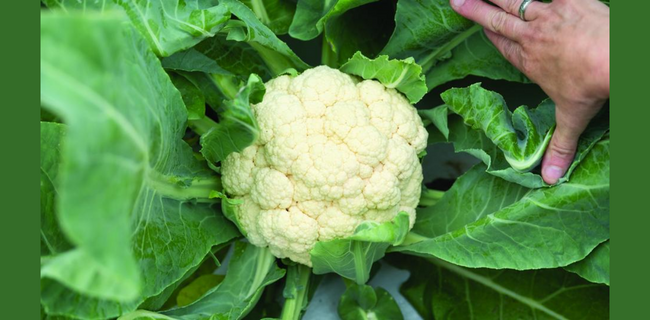
Cauliflower is popular vegetable and this belongs to family Cruciferous. It work as anti-cancer agent. It promotes heart health, lower cholesterol levels. The major cauliflower producing states are Bihar, Uttar Pradesh, Orissa, West Bengal, Assam, Haryana and Maharashtra.

Stem Leaves
The heads grow in the centre of a ruffle of large green leaves. All of these parts or not only edible, they are delicious and highly nutritious. Some eaters (including this one) actually prefer the stalks and leaves of cauliflower plants to the more commonly eaten head.
Stem:
Cauliflower plants are shallow rooted with a small, thickened stem. The ribbed leaves branch off the top of the stem and are light green in colour.
Floret:
A good head of cauliflower will have tight florets of an even, pale white colour. Yellow or brown spots should be avoided, though if they’re minor, you can trim them off, no problem. Look at the leaves as well; they should remain tight around the base and appear bright pale green, with no yellow or wilted spots.
Head:
Cauliflowers are annual plants that reach about 0.5 metre (1.5 feet) tall and bear large rounded leaves that resemble collards (Brassica oleracea, variety acephala). As desired for food, the terminal cluster forms a firm, succulent “curd,” or head, which is an immature inflorescence (cluster of flowers).
Climatic requirement:
Temperature: 12-30oC
Rainfall: 120-125mm
Sowing temperature: 25-30oC
Harvesting temperature: 12-18oC
Suitable soil pH requirement: 6-7.
Soil:
Cauliflower can be grown in all types of soil with good fertility and good regime. In light soil, the plants are most sensitive to drought and therefore, adequate moisture supply is important. For early crops, the light soils are preferred, while, loamy and clay loam soils are more suitable for mid-season and late maturing types.
Land preparation:
Bring soil to fine tilth by ploughing land thoroughly. Add well decomposed cow dung and mixed well in soil at time of last ploughing
Sowing:
Time of sowing
| Maturity Group | Sowing time | Transplanting Time |
| Extra Early | End of February | March |
| Early I (A) | Mid May | July beginning |
| Early I (B) | May end-June end | Mid July |
| Mid early | July end | Sept. beginning |
| Mid late | Aug. end | Sept. end |
| Late | Sept. end – mid Oct. | Oct. end –mid Nov. |
Spacing:
- Early crop: 45 x 30 cm
- Mid and Late crop: 60 x 45 cm.
Sowing Depth: Sow seeds at depth of 1-2 cm.
Method of sowing:
For Sowing dibbling method and transplanting methods can be used.
Sow seeds in nursery and apply irrigation, fertilizer dose as per requirement. Seedlings are ready to transplant within 25-30 days after sowing. For transplantation use three to four weeks old seedlings.
Dibbling Method:

Dibbling is a method of putting a seed or a few seeds or seed materials in a hole or pit or pocket, made at predetermined spacing and depth with a dibble or planter or very often by hand or by any convenient implements such as spade, hoe etc. and covering them with soil.
The dibbling method is suitable for wider spaced planted crops requiring a specific area for their canopy development or cultural practices such as weeding, earthing up, and irrigation in furrows. Seeds may be dibbled in level fields or on ridges or the sides of the ridges or in localized pits or pockets that form hills, rings, or stations distinctly separated from each other.
Advantages of Dibbling method:
- For such a seeding method, the entire field need not be prepared for the seedbed but only the seeding zone. Moreover:
- It facilitates the practice of conservative tillage and reduces the chances of soil erosion.
- It requires fewer seeds, and it gives rapid and uniform germination with good seedling vigor.
- Intercultural practices like weeding, earthing up, and care of individual plants can be facilitated.
- When proper and uniform spacing is maintained, it becomes effortless to calculate the plant population and thereby expected yield.
Disadvantages of Dibbling method:
- Uniform germination is not possible if all seeds are not placed at a uniform depth. Besides, dibbling is a more laborious, time-consuming, and expensive process compared with broadcasting.
Seeds Rate:
Early varieties: 600-700gm/ha.
Mid-Early varieties: 500gm/ha.
Mid-Late varieties: 400gm/ha.
Late varieties: 300gm/ha.
Seed Treatment:

Before sowing dip seeds in hot water (50°C for 30 min) or streptocycline@0.01 gram per litre of water for two hours. After treatment dry them in shade and then sow on bed. Black rot mostly observed in Rabi. As a preventive measure seed treatment with mercury chloride is essential. For that dip seeds in Mercury chloride@1 gram per litre of water solution for 30 min after that dry them in shed. Crop grown in sandy soils are more prone to stem rot. To prevent it do seed treatment with Carbendazim 50%WP @3gm/kg of seed.
Fertilizer:
Apply well decomposed cow dung@40 tonnes per acre in soil along with Nitrogen@50 kg, Phophorus@25 kg and Potash@25 kg in form of Urea@110 kg, Single Superphosphate@155 kg and Muriate of Potash@40 kg. Apply whole quantity of cow dung, SSP and MOP and half quantity of Urea before transplanting. Apply remaining quantity of Urea four week after transplanting as top dressing.
To get better flower (Curd) set and to obtain good yield, spray Water Soluble Fertilizer (19:19:19)@5-7 gram per litre of water during the early plant growth. 40 days after transplanting take spray of 12:61:00@4-5 gram + microneutrients@2.5 to 3 gram + Boron@1 gram per litre of water. To improve curd quality, apply Water Soluble Fertilizer 13:00:45@8-10 gram per litre of water at the time of curd development.
Do soil testing and if Magnesium deficiency is observed to overcome Mg deficiency apply Magnesium sulphate@5 gram per litre of water, 30-35 days after transplantation and for Calcium deficiency apply Calcium Nitrate@5 gram per litre of water, 30-35 days after transplanting.
If Hollow and sometimes discoloured stems are observed, Also curds become brown and leaves may get roll and curl it is due to Boron deficiency, apply Borax@250 gm-400 gram per acre.
Use of plant growth regulators:
| PGR | Method of application | Attributes affected |
| IBA@ 10ppm | Seedling treatment | Increase in yield |
| GA@ 100ppm +NAA@ 120ppm+Mo@ 2% | Foliar spray | Increase in yield |
| GA@ 50ppm +Urea @1% | Foliar spray | Increase in yield |
| GA3 @50ppm | Foliar spray | Increase in yield |
| NAA 10ppm | Seedlings treatment | Plant stand in the field and vegetative growth. |
| GA4 + GA7 @ 80 mg/l | Foliar spray | Shortens the period from transplanting to the harvest |
Weed management:
To check weed control apply Fluchloralin (Basalin) 800ml/150-200Ltr water before transplantation followed by hand weeding 30 to 40 days after transplanting. Apply Pendimethalin@1Ltr/acre one day before transplanting of seedlings.
Irrigation management:
Immediately after transplanting, give first irrigation. Depending upon soil, climatic condition, apply irrigation at interval of 7-8 days in summer season and 10-15 days during winter season.
Varieties:
SBECF – 102 (Sabour Agrim) Source: BAU, Sabour; 2014

• Early; form curd at average temp. 22-27 oC, plants are erect to semi spreading; 65 – 68 days for 50% curd (450g) maturity, yield potential of 150-200q/ha.
• Seed rate: 400-450 g/ha. Sowing time: Kharif (June-July)
• States: M.P., Maharashtra and Goa
DC 31
•Source:IARI,Pusa,NewDelhi;2014

• Suitable for July transplanting and reaches marketable maturity during October. Curds compact with retentive white colour. Curd weight 500-600g with yield potential of 160-180q/ha.
• Seed rate: 400-450 g/ha. Sowing time: Kharif (June-July)
• States: Punjab, U.P., Bihar and Jharkhand
Hybrid: KTH-301 • Source: IARI (RS), Katrain; 2019

• Suitable for cultivation in the mid-season with the harvesting of curd in the month of November-December; Yield: 390 q/ha.
• Seed rate: 400-450 g/ha. Sowing time: Kharif (June-July)
• States: J&K, H.P., Uttarakhand, Rajasthan, Gujarat, Haryana and Delhi.
Pusa Deepali:
- Developed at IARI, New Delhi.
- Recommended for Northern India particularly Delhi and Punjab.
- Early maturing variety, curds compact, self-blanching, white, medium sized and almost free from riceyness.
- Curds ready for harvest in late October.
- Average yield is 12 t/ha.
Early Kunwari:
- Recommended for Haryana, Punjab, and Delhi.
- Very early variety.
- Curds hemispherical with even surface, ready for harvesting from mid-September to mid-October.
- Average yield is 8 t/ha.
Punjab Giant-26:
- Main season variety.
- Curds solid, white, medium-sized. Ready for harvesting from mid-November to December.
- Average yield is 17 t/ha.
Punjab Giant-35:
- Main season variety.
- Curds white, compact medium sized.
- Ready for harvesting from mid-November to December.
- Average yield is 17 t/ha.
Pant Shubhra:
- Recommended for cultivation in Northern India.
- Early growing variety.
- Curds are compact, slightly conical and creamish white.
- Ready for harvest in November.
- Average yield is 20 t/ha.
Pusa Snowball-1:
- Late maturing variety.
- Curds very compact, medium in size and snow white in colour.
- Ready for harvesting from January to April.
- Average yield is 25-30 t/ha.
- Susceptible to black rot.
Sonwball-16:
- Ideal for cooler climates of North Indian states.
- Late maturing variety.
- Curds medium sized, solid, having attractive white colour.
- Ready for harvesting from January to March.
- Average yield is 25-30 t/ha.
Pusa Early Synthetic:
- Main season variety. Curds somewhat creamy white to white and compact.
- Ready for harvest from mid-December to mid-January.
- Average yield is 11 t/ha.
Pant Gobhi-2:
- Early maturing variety.
- Curds compact, composite and creamy white.
- Curds ready for harvesting from November to December.
- Average yield is 12 t/ha.
Pant Gobhi-3:
- Early maturing variety.
- Curds medium sized and solid white.
- Curds ready for harvest from October.
- Average yield is 10 t/ha.
Dania Kalimpong:
- Commonly grown in eastern parts of India.
- Late season variety.
- Curds are medium-large, compact, attractive and white.
- Less sensitive to fluctuations of environment.
- Ready for harvesting from January to April.
- Average yield is 25-30 t/ha.
Physiological Disorders:
Cauliflower suffers from a number of physiological disorders, which manifest in different type of disease syndromes. . Important physiological disorders, affecting cauliflower are described below:
Riceyness: It manifests in the elongation on peduncle wearing flower buds, rendering curds, granular, loose and somewhat velvety. A premature initiation of floral bud is characterized by riceyness in cauliflower and is considered to be of poor quality for marketing. It can be controlled by cultivation of genetically pure seed and appropriate varieties with recommended cultural practices.
Fuzziness: It appears as the flower pedicels of velvety curds elongate. The anomaly is both hereditary and non-hereditary. Cultivation of cauliflower, out of their normal season encourages fuzziness. Sowing good quality seed in right season under proper cultural practices, minimized fuzziness.
Leafiness: This disorder is commonly seen by formation of small thin leaves from the curd which reduces quality of curd. Extremely small green leaves appear in between the curd segment due to inheritable or non-heritable factors. Prevalence of high temperatures during curding phase aggravates leafiness. Certain varieties are more sensitive to leafiness or bracketing than other. It can be controlled by selection of varieties according to their adaptability.
Browning (Brown Rot or Red Rot): It is caused by boron deficiency which is influenced by soil pH. The availability of boron decreases at neutral soil reaction. It is characterized by sign on the young leaves that become dark green and brittle. The old leaves puckered, chlorotic and often drops off. This may be controlled by application of borax or sodium borate or sodium tetra borate at the rate of 20 kg/ha a soil application. In case of acute deficiency, spray of 0.25 to 0.50 per cent solution of borax at the rate of 1 to 2 kg/ha depending upon growth, soil reaction and extent of deficiency.
Whiptail: Deficiency of molybdenum causes ‘whiptail’ syndrome, especially, in highly acidic soils. Because high manganese concentrations in such soils hinder the uptake of molybdenum which seldom occurs when the soil pH is 5.5 or higher. The young cauliflower plants become chlorotic and may turn white, particularly along the leaf margins. They also become cupped and wither. And extent of deficiency. In older plant, the lamina of the newly formed leaves are irregular in shape, frequently, consisting of only a large bare midribs and hence, the common name “whiptail”. It can be corrected by application of lime or dolomite limestone to raise the soil pH up to 6.5 or higher. Sodium or Ammonium molybdate at the rate of 1-2 kg/ha as soil application can also control “whiptail” of cauliflower.
Buttoning: Development of small curds with inadequate foliage in cauliflower is known as buttoning. It is also referred to as premature heading. The leaves are so small that cannot cover the former head. Causes of buttoning are
Transplanting of more than 6 week-old seedlings.
Planting as early variety in late vice versa leads buttoning.
Hot and dry weather is unfavourable for vegetative growth of plants, but favourable for inducing curd formation and inhibits further enlargement. Curds remain very small in size like buttons.
When soil moisture becomes limiting factor.
Transplanting of seedlings, obtained from poorly managed nursery bed.
Slow plant growth in the nursery, overcrowding, insufficient water, lack of weeding, bad condition of the soil, excessive crowding, insufficient water, lack of weeding, bad condition of the soil, excessive salt concentrations, low lying area or field with shallow and poor top salt may also cause buttoning.
It can be controlled by using quality seedlings and proper cultural management practices.
Diseases in Cauliflower:
Bacterial soft rot:

Symptoms:
Water-soaked lesions on leaves and flower heads which expand to form a large rotted mass; surface of lesions usually crack and exude slimy liquid which turns tan, dark brown or black on exposure to air.
Management:
Chemical treatments are not available for bacterial soft rot, control relies on cultural practices; rotate crops; plant in well-draining soils or raised beds; only harvest heads when they are dry; avoid damaging heads during harvest.
Blackleg:
Symptoms:
Damping-off of seedlings; round or irregularly shaped gray necrotic lesions on leaves with dark margins; lesions may be covered in pink masses in favorable weather conditions.
Management:
Use disease free seed or treat with hot water to remove fungus prior to planting; remove and destroy crop debris after harvest or plow deeply into soil.
Black rot:
Symptoms:
Irregularly shaped dull yellow areas along leaf margins which expand to leaf midrib and create a characteristics “V-shaped” lesion; lesions may coalesce along the leaf margin to give plant a scorched appearance
Management:
Primary method of controlling black rot is through the use of good sanitation practices; rotate crops to non-cruciferous crops every 2 years; plant resistant varieties; control cruciferous weed species which may act as a reservoir for bacteria; plant pathogen-free seed.
Clubroot:
Symptoms:
Slow growing, stunted plants; yellowish leaves which wilt during day and rejuvenate in part at night; swollen, distorted roots; extensive gall formation.
Management:
Once the pathogen is present in the soil it can survive for many years, elimination of the pathogen is economically unfeasible; rotating crops generally does not provide effective control; plant only certified seed and avoid field grown transplants unless produced in a fumigated bed; applying lime to the soil can reduce fungus sporulation.
Downy mildew:
Symptoms:
Small angular lesions on upper surface of leaves which enlarge into orange or yellow necrotic patches; white fluffy growth on undersides of leaves.
Management:
Remove all crop debris after harvest; rotate with non-brassicas; it is possible to control downy mildew with the application of an appropriate fungicide.
Powdery mildew:
Symptoms:
Small white patches on upper and lower leaf surfaces which may also show purple blotching; patches coalesce to form a dense powdery layer which coats the leaves; leaves become chlorotic and drop from plant.
Management:
Plant resistant varieties; rotate crops; remove all crop debris after harvest; remove weeds; avoid excessive application of nitrogen fertilizer which encourages powdery mildew growth; powdery mildew can be controlled by application of sulphur sprays, dusts or vapours.
Sclerotinia stem rot:

Symptoms:
Irregular, necrotic grey lesions on leaves; white-grey lesions on stems; reduced pod set; shattering seed pods.
Management:
Rotate crop to non-hosts (e.g. cereals) for at least 3 years; control weeds; avoid dense growth by planting in adequately spaced rows; apply appropriate foliar fungicides.
White rust:
Symptoms:
White pustules on cotyledons, leaves, stems and/or flowers which coalesce to form large areas of infection; leaves may roll and thicken.
Management:
Rotate crops; plant only disease-free seed; apply appropriate fungicide if disease becomes a problem.
Cauliflower mosaic:
Symptoms:
Mosaic patterns on leaves; veinclearing and or veinbanding; stunted plant growth; reduced head size.
Management:
Control cruciferous weeds which can act as a reservoir for the virus; control aphid populations on plants by applying an appropriate insecticide.
Ring spot:
Symptoms:
Small, purple spots surrounded by a ring of water-soaked tissue on leaves which mature to brown spots with olive green borders 1-2 cm across; spots may develop numerous fruiting bodies which give them a black appearance or develop a concentric pattern; heavily infected leaves may dry up and curl inwards.
Management:
Refrain from planting in areas known to have had disease previously; rotate crop to non-brassicas; sanitize tools and equipment regularly; apply appropriate fungicide if disease is identified in crop.
Wirestem (Damping-off):
Symptoms:
Death of seedlings after germination; brown-red or black rot girdling stem; seedling may remain upright but stem is constricted and twisted (wire stem).
Management:
Plant pathogen-free seed or transplants that have been produced in sterilized soil; apply fungicide to seed to kill off any fungi; shallow plant seeds or delay planting until soil warms.
Insect-pest of cauliflower:
Beet armyworm:


Symptoms:
Singular, or closely grouped circular to irregularly shaped holes in foliage; heavy feeding by young larvae leads to skeletonized leaves; shallow, dry wounds on fruit; egg clusters of 50-150 eggs may be present on the leaves; egg clusters are covered in a whitish scale which gives the cluster a cottony or fuzzy appearance; young larvae are pale green to yellow in color while older larvae are generally darker green with a dark and light line running along the side of their body and a pink or yellow underside.
Management:
Organic methods of controlling the beet armyworm include biological control by natural enemies which parasitize the larvae and the application of Bacillus thuringiensis; there are chemicals available for commercial control but many that are available for the home garden do not provide adequate control of the larvae.
Cabbage aphid:

Symptoms:
Large populations can cause stunted growth or even plant death; insects may be visible on the plant leaves and are small, grey-green in color and soft bodied and are covered with a white waxy coating; prefer to feed deep down in cabbage head and may be obscured by the leaves.
Management:
If aphid population is limited to just a few leaves or shoots then the infestation can be pruned out to provide control; check transplants for aphids before planting; use tolerant varieties if available; reflective mulches such as silver coloured plastic can deter aphids from feeding on plants; sturdy plants can be sprayed with a strong jet of water to knock aphids from leaves; insecticides are generally only required to treat aphids if the infestation is very high – plants generally tolerate low and medium level infestation; insecticidal soaps or oils such as neem or canola oil are usually the best method of control; always check the labels of the products for specific usage guidelines prior to use.
Cabbage looper:

Symptoms:
Large or small holes in leaves; damage often extensive; caterpillars are pale green with a white lines running down either side of their body; caterpillars are easily distinguished by the way they arch their body when moving; eggs are laid singly, usually on the lower leaf surface close to the leaf margin, and are white or pale green in colour.
Management:
Looper populations are usually held in check by natural enemies; if they do become problematic larvae can be hand-picked from the plants; biological controls such as spraying with Bacillus thuringiensis can be effective at controlling looper numbers; application of appropriate insecticide also controls looper populations; selective insecticides help to protect populations of natural enemies on crop.
Cucumber beetles:

Symptoms:
Stunted seedlings; damaged leaves, stems and/or petioles.
Management:
Monitor new planting regularly for signs of beetle; apply appropriate insecticides.
Cutworm:

Symptoms:

Stems of young transplants or seedlings may be severed at soil line; if infection occurs later, irregular holes are eaten into the surface of fruits; larvae causing the damage are usually active at night and hide during the day in the soil at the base of the plants or in plant debris of toppled plant; larvae are 2.5–5.0 cm (1–2 in) in length; larvae may exhibit a variety of patterns and coloration but will usually curl up into a C-shape when disturbed.
Management:
Remove all plant residue from soil after harvest or at least two weeks before planting, this is especially important if the previous crop was another host such as alfalfa, beans or a leguminous cover crop; plastic or foil collars fitted around plant stems to cover the bottom 3 inches above the soil line and extending a couple of inches into the soil can prevent larvae severing plants; hand-pick larvae after dark; spread diatomaceous earth around the base of the plants (this creates a sharp barrier that will cut the insects if they try and crawl over it); apply appropriate insecticides to infested areas of garden or field if not growing organically.
Diamond moth:


Symptoms:
Young larvae feed between upper and lower leaf surface and may be visible when they emerge from small holes on the underside of the leaf; older larvae leave large, irregularly shaped shot-holes on leaf undersides, may leave the upper surface intact; larvae may drop from the plant on silk threads if the leaf is disturbed; larvae are small (1 cm/0.3 in) and tapered at both ends; larvae have to pro-legs at the rear end that are arranged in a distinctive V-shape.
Management:
Larvae can be controlled organically by applications of Bacillus thurengiensis or Entrust; application of appropriate chemical insecticide is only necessary if larvae are damaging the growing tips of the plants.
Flea beetles:

Symptoms:
Small holes or pits in leaves that give the foliage a characteristic “shot-hole” appearance; young plants and seedlings are particularly susceptible; plant growth may be reduced; if damage is severe the plant may be killed; the pest responsible for the damage is a small (1.5–3.0 mm) dark coloured beetle which jumps when disturbed; the beetles are often shiny in appearance.
Management:
In areas where flea beetles are a problem, floating row covers may have to be used prior to the emergence of the beetles to provide a physical barrier to protect young plants; plant seeds early to allow establishment before the beetles become a problem – mature plants are less susceptible to damage; trap crops may provide a measure of control – cruciferous plants are best; application of a thick layer of mulch may help prevent beetles reaching surface; application on diamotecoeus earth or oils such as neem oil are effective control methods for organic growers; application of insecticides containing carbaryl, spinosad, bifenthrin and permethrin can provide adequate control of beetles for up to a week but will need reapplied.
Large cabbage white (Cabbageworm):

Symptoms:
Large ragged holes in leaves or bored into head; green-brown frass (insect feces) on leaves; caterpillar is green in color and hairy, with a velvet-like appearance; may have faint yellow to orange stripes down back; slow-moving compared with other caterpillars.
Management:
Plant cHand-pick caterpillars from plants and destroy; scrape eggs from leaves prior to hatching; apply appropriate insecticide if infestation is very heavy.
Thrips:

Symptoms:
If population is high leaves may be distorted; leaves are covered in coarse stippling and may appear silvery; leaves speckled with black faces; insect is small (1.5 mm) and slender and best viewed using a hand lens; adult thrips are pale yellow to light brown and the nymphs are smaller and lighter in colour.
Management:
Avoid planting next to onions, garlic or cereals where very large numbers of thrips can build up; use reflective mulches early in growing season to deter thrips; apply appropriate insecticide if thrips become problematic.
Root knot nematodes:
Symptoms:
Galls on roots which can be up to 3.3 cm (1 in) in diameter but are usually smaller; reduction in plant vigour; yellowing plants which wilt in hot weather.
Management:
Plant resistant varieties if nematodes are known to be present in the soil; check roots of plants mid-season or sooner if symptoms indicate nematodes; solarizing soil can reduce nematode populations in the soil and levels of inoculum of many other pathogens.
Harvesting, Yield and Storage:
Cauliflower curds need to be blanched as they mature. This protects them from sun exposure resulting in a white, tender head. As cauliflower plants begin to mature and the curd starts to form, gather together and tie the leaves over the curd with soft twine, tape, or rubber bands. Blanching should be done when the curd is dry to prevent disease development. There are some “self-blanching” types of cauliflower available where the leaves curl naturally over the curd when grown in cool weather; however, some tying of the leaves may still be necessary, even in varieties of different colours.
The cauliflower curd, like the broccoli head, is actually a group of tightly clustered flower buds. Harvest the curd when it reaches the desired size (approximately 6 inches in diameter) but before the buds begin to separate. This will be about two months after transplanting. When cutting the curd, leave at least two wrapper leaves with the curd.
Cauliflower can be stored in a refrigerator for up to two weeks. High humidity of at least 95 percent is necessary to prevent wilting.
Leave a Reply