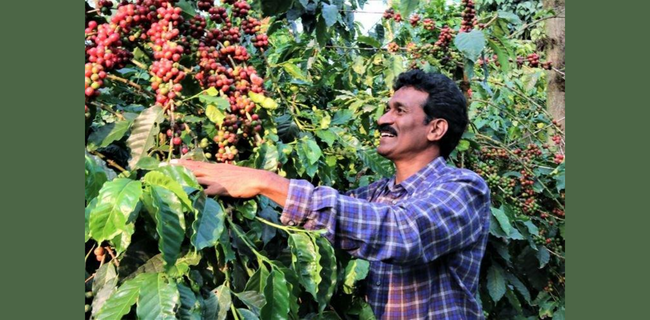
In India, coffee is traditionally grown in the Western Ghats spread over Karnataka, Kerala and Tamil Nadu. Coffee cultivation is also being expanding rapidly in the nontraditional areas of Andhra Pradesh and Odisha as well as in the North East states. Coffee is predominantly an export oriented commodity and 65% to 70% of coffee produced in the country is exported while the rest is consumed within the country. Indian coffee has created a niche for itself in the international market and the Indian Coffees are earning high premium, particularly Indian Robusta which is highly preferred for its good blending quality. Arabica Coffee from India is also well received in the international market.
Coffee is an export product with low import intensity and high employment content. This is evident from the fact that more than six lakh persons are directly employed and an equal numbers of individuals get indirect employment from this sector.
The two main varieties of coffee viz.,
Arabica and Robusta are grown in India.
Arabica is mild coffee, but the beans being more aromatic, it has higher market value compared to Robusta beans.
Robusta has more strength and is, therefore, used in making various blends. Arabica is grown in higher altitudes than Robusta.

Temperature-
The cool and equable temperature, ranging between 150C to 250C, is suitable for Arabica while for Robusta, hot and humid climate with temperature ranging from 200C to 300C is suitable.
Coffee plant and its management-

An understanding of the coffee plant, its make-up and how it grows is essential to understanding how to manage the coffee tree. Management, like the growing environment and the variety planted, has a very big influence on coffee quality and yield. Much of the rest of this manual deals with practical management of the coffee tree from planting to harvest.
- Vertical or orthotropic branches have nodes at a regular distance and carry opposite leaves. These branches are called suckers at the developing stage and stems at the final stage. Each leaf pair is cross-positioned to the next leaf pair. In the axil of each leaf, are four to six serial buds and directly above them, one slightly bigger bud called ‘extra-axillary bud’ because of its relatively distant position. This extra-axillary bud develops into a plagiotropic or lateral, horizontal branch.
- Lateral or plagiotropic branches grow almost at right angles from the main stems. No other bud in the same axil can grow into a lateral branch, which means that if such a branch is cut off, no lateral regeneration can occur on the node of a main vertical stem. Laterals are usually called primaries. Each serial bud on a primary can develop into an inflorescence (flower) or into a secondary branch, which has a similar structure to the primary branch with serial buds that develop either into flowers or tertiary branches. If a secondary branch is cut or removed, another secondary on the same axil can replace it, so regeneration of secondaries on primaries is possible.
Each branch has a terminal bud. In the nodes are a fixed number of buds that have the potential to form 40 fruits depending mainly on the species and nutritional conditions. At each leaf node there are 5 buds each with 4 flowers, which may form 20 fruits.
The white flowers appear in small bunches at the nodes. After pollination, a fruit develops into a cherry about 10 to 15 mm long containing two seeds (the coffee beans). Technically, the flowers form on the one-year-old wood that is only slightly hardened. The fruits comprise pulp (coloured skin and a fleshy mesocarp called mucilage), then parchment, then the silverskin (seed coat) and finally the coffee bean.
The root system
The role of the root system is to ensure that the plant is firmly anchored in the soil and to take up a supply of water and minerals. The root system consists of:
- a short taproot (40 to 60 cm) long;
- vertical, coaxial roots which are often very long (particularly in light soils) lateral roots with numerous absorbing root hairs, particularly in the upper, humus-bearing layer (30 cm)

It is necessary to stress the importance of growing techniques (pricking out in nurseries, weeding, mulching, irrigation and planting layouts) on the distribution and function of the roots. The first three years are critical for the root system development when it is vital that plants are well supplied with nitrogen, phosphorous, calcium, magnesium and sulphur.
Phenology (Crop cycle)
The phenological cycle chart on page 70 indicates the timings for key management activities in relation to the various development stages, for example, growth, flowering, fruiting.
The phenology of the coffee plant refers to the physical and physiological developmental stages of the coffee plant throughout the year. Phenology is often referred to as the crop cycle or the phenological cycle of the plant.
Coffee, like all plants responds to the changing environment (temperature, rainfall, drought, day length) in which it grows as influenced by the seasons. As the seasons change, the coffee tree switches from vegetative (root and shoot growth) to reproductive growth and as the plant grows, it flowers, sets fruit, matures the fruit and is ready for harvest and re-growth for the next cycle.
The phenological cycle gives excellent indicators of when to fertilise, irrigate, withhold water, prune, take leaf and soil analyses, check for pests and diseases and apply controls for them. Timing is very important when using these practices to optimise production from the coffee tree.
Coffee Cultivation general Practices-
Sandy soil-

Sandy Soil is light, warm, dry and tends to be acidic and low in nutrients. Sandy soils are often known as light soils due to their high proportion of sand and little clay (clay weighs more than sand).
These soils have quick water drainage and are easy to work with. They are quicker to warm up in spring than clay soils but tend to dry out in summer and suffer from low nutrients that are washed away by rain.
The addition of organic matter can help give plants an additional boost of nutrients by improving the nutrient and water holding capacity of the soil.
Nursery

- Procure seeds only from authorized sources.
- Do not procure seeds from coffee berry borer infected areas.
- Sow the seeds soon after procurement as they have short viability.
Soil & Water Conservation
Conservation of soil and moisture is very crucial in coffee plantations.
Problems related to soil conservation
- Monsoon season: Soil erosion due to sloping terrain
- Post-monsoon season: Lack of moisture (i.e., drought) can adversely affect the normal growth of coffee.
Prevention of soil erosion:
- Contour planting/terracing in moderate to steep slopes.
- Planting of soil binding grasses like Vetiver, Paspalum etc. across the slope at suitable intervals.
Soil enrichment
- Growing of leguminous green manure crops like Crotalaria, Tephrosia, cowpea, horsegram etc. in the initial years of planting may be adopted.
- Green manure crops should be sown during May-June and incorporated into soil before flowering.
Supressing weed growth
- Cover digging during the first year of planting (Oct.-Nov.). However, in sloppy terrain avoid digging and adopt only manual weeding.
- Scuffling during post-monsoon (Oct.-Nov.) from 2nd to 4th year of planting helps in for conservation of soil moisture. Avoid scuffling in slopy terrain.
- No soil cultivation like digging, scuffling should be practiced in established fields.
- Take up cradle pits/trenches in staggered manner across the slope in established fields to conserve soil and moisture.
- Mulch the base of young plants with dry leaves, for conserving moisture during dry months.
Weed Control-

In early stages of establishment of plantation, cultural practices like cover digging, scuffing, cover cropping with cowpea, horsegram etc. would be highly useful in suppressing weed growth.
In established fields, integrated measures of weed control involving pre-monsoon weedicide spray, mid-monsoon slash weeding and post-monsoon weedicide spray will give satisfactory weed control. In the case of chemical weeding, use either contact weedicide Gramoxone or systemic weedicides like Glycel or Round Up in a rotation.
Shade Management

- Avoid indiscriminate timber extraction for short term gains.
- Maintain a two-tier shade canopy consisting of temporary dadaps and permanent shade trees like Ficus, Albizzia, Jackfruit etc.
- At higher altitudes, temporary shade trees may be phased out once the coffee is well established.
- Regulate shade every year instead of once in 3-4 years to minimise damage to coffee bushes.
Bush Management

- Proper bush management is essential to minimise year-to-year yield fluctuations and also facilitating effective management of pests and diseases.
- Light pruning every year after harvest is essential to maintain the framework of the plants.
- Handling, centering and desuckering during June-July and if necessary during Sept.-Oct. help in maintaining adequate cropping wood.
- Rejuvenation of disease susceptible/ off type plants by top working would ensure uniformity and increased productivity.
Nutrition Management


Nutrients are recycled within the environment. A ‘closed’ environment such as a rainforest, recycles its own nutrients and is more or less self-sufficient. However, where plants are grown in a commercial situation, it is necessary to replenish the nutrients that are removed from the system. Without additional nutrients in some form of fertiliser, coffee yields will remain very low as nutrients are removed with the coffee beans. Unshaded plants of dwarf, high-yielding varieties such as Catimor, will quickly develop dieback and die if adequate nutrients and water are not added to the soil. Plants with mild to moderate dieback will recover with timely good fertilising, watering and weed management.
In India, it was found that for every 6,000 kg of ripe coffee cherry (1 tonne of green bean) removed from the plants, approximately 40 kg nitrogen (N), 2.2 kg phosphorus (P) and 53 kg potassium (K) must be replaced yearly.
There are 16 natural elements (nutrients),that are essential for plant growth (see table below). Three elements (carbon, hydrogen and oxygen) make up 94% of the plant tissues and are obtained from air and water. The other 13 elements are obtained from the soil and are divided into two broad categories – ‘macro’ and ‘micro’. These terms do not refer to the importance of the elements; macronutrients are required in greater amounts than micronutrients for normal plant growth.
Pests & Diseases Management-
Insect pests
Green coffee scale
Green coffee scale (Coccus viridis) is a common and serious problem. Scales suck the plant sap resulting in reduced growth and crop yield. Sooty mould (a black, loose, sooty-like cover) often develops on leaves. It grows on the sweet exudate from the scales (honeydew) that also attracts ants.
Symptoms
Green oval shaped scales about 2 to 3 mm long. Often found concentrated on leaf veins and tips of new shoots. Infestations then produce spots of honeydew, which become covered with a black sooty mould. Defoliation of badly affected trees can occur.
Control
Preventative:
There are a number of natural predators of coffee scale such as wasps, ladybugs and Verticillium fungus. In many instances, these will reduce the level of scale infestation.
Chemical:
Mineral spraying oils at 200 ml/ 20 L water applied as a spray to affected plants. Only spray if 10 or more leaves are infested with one or more scales. The spray must completely wet and cover the scales. Do not use automotive oil!
Carbaryl 85 % wettable powder at 20 g/10 L water applied as a spray. Apply weekly until scales disappear.
Traditional:
1 kg strong tobacco per 2 L water. Soak for 2 nights. Then remove tobacco. Add 500 g of washing powder and make up to 20 L. Spray weekly until scales disappear.


Scale. Green coffee scale on leaf (top); ants, black sooty mould and scale (centre) and severe infestation on branch (bottom)
Aphids
Aphids (Toxoptera aurantii) can occur in large numbers on new shoots in the rainy season. Aphids suck sap from young shoots and cause damage to these developing shoots.
Symptoms
Large numbers of small black aphids (2 to 3 mm long) concentrated on new growth. Often associated with black sooty mould.
Control
Generally not warranted.
Chemical:
Neem oil 10 to 20 ml/L, plus soft, finely grated laundry soap at about 7 g/L water.
Stemborers

There are two species of stemborer present in Lao PDR.
Red stemborer (Zeuzera coffeae)-
The adult has white and black spotted wings. The red coloured larvae tunnel through the coffee branches, normally in the upper part of the coffee trees. Branches and the top part of the main stem easily break off, but the tree usually survives.
White stemborer (Xylotrechus quadripes)-
The adult is a black and white banded beetle (about 1 to 2 cm long); the head of the male beetle has distinctive raised black ridges. Adults are active during daylight. Damage is caused by the white larvae, which hatch from eggs deposited in cracks and crevices and under loose scaly bark of the main stem and thick primary branches, especially on plants exposed to sunlight. Young larvae feed on the corky tissue just under the bark, which splits making the stem appear ridged. Later, larvae enter the heartwood and tunnel in all directions, even into the roots.
Symptoms


Stemborer damage-
Red stemborer (top), white stemborer (centre), general severe damage in a field (bottom)
Wilting of leaves and dead trees or branches. Affected branches are easily broken off. When trees are first infested there maybe evidence of frass (sawdust-like residues) on the ground. The trunk may be ringbarked. The lifecycle of both pests is completed during the rainy season, but often damage is more evident during the dry season.
Larvae remain inside the tree and are normally not seen. Usually damage is not economically important, although individual trees can be lost.
Control
Preventative:
Less damage occurs under conditions of good shade.
Higher altitude (above 800 m.a.s.l.) seems to reduce the incidence of infestation.
Burn affected trees or branches with borers inside.
Do not plant trees with twisted taproots. These deformed roots result in weak trees that have been shown to have a high incidence of stemborer infestation.
Chemical:
No effective chemical control known. Biological control is not known at this time.


White stem borer. Adult (above) and larva (below)


Red stemborer. Adult moth and larva
Coffee berry borer
Coffee berry borer (Hypothenemus hampei) is a relativity new, but very serious problem in Lao. It is causing significant damage, with perhaps as high as 50% yield loss. The adult is a small black beetle (about 2.5 mm long) and covered in thick hairs. The female beetle bores into berries through the navel region. Cherries are attacked in various stages but tunnelling and laying of about 15 eggs occurs only in hard beans. The eggs hatch in about 10 days and the larvae feed on the beans making small tunnels. Beetles in the cherries either on the plant or on the ground, can survive for more than five months.
Symptoms


Coffee bearer borer. Beetle on a bean (top), damage to berries (centre) beetles (bottom)
Fruit drop of young, green cherries. A small hole is evident on the cherry. Cherries that do not drop often have defective, damaged beans.
Control
Orchard hygiene (keeping the area clean, removing dropped cherries, removing carry-over fruit from coffee bushes are suggested), but it is reported to have limited impact and can be expensive. Cherries on the ground and old berries remaining on the trees are sources of new infection.
There are few natural enemies of the borer. One wasp (Phymastichus coffea) has shown promise in Columbia, but its effectiveness and that of other wasps is not yet fully known. The wasp may make a contribution in an IPM system. Lao should procure this and other effective parasitoids from Cenicafe in Colombia and technical biocontrol support.
Interest is now focused on the commonly found fungus, Beauverai bassiana. Research in South America has shown promising results, but it is not a cheap alternative to chemicals and has to be re-applied.
Research is required to develop the best means of bio-control.
Chemical control is difficult as the borer spends most of its life cycle deep inside the coffee berry. Endosulfan 35 EC at a rate of 6 ml/4.5 L of water applied at early fruit set (2 mm cherry size) and later 120 to 150 days after fruit set if required. Cypermetrin and Deltametrin, pyrethroids (0.01%) at 26 ml/15L of water are an alternative, or Chlorpyrifos used at recommended rate on label.
Quarantine. The pest cannot migrate any distance on its own. Do not allow cherries or coffee bags from other farms onto the farm property. Crop bags should be fumigated before being transported to other coffee growing areas.
Ethyl alcohol and methyl alcohol at a rate of 1:1 is effective in trapping CBB and can be used most effectively at processing/ washing places to prevent re-infestation. Place traps in the first five rows of coffee growing near the processing area.
Coating pieces of plastic with axle grease and engine oil and attaching these to pulpers and machines in the coffee processing area can also be used to capture CBB.
Careful drying of coffee cherry or parchment reduces reproduction of the pest as they cannot survive in coffee beans that are properly dried to 12% moisture.

Coffee berry borer trap. There are many ways to make these simple traps
Mealybug
Mealybugs (Planococcus spp.) are small sucking insects (about 3 mm long) covered with a white mealy wax that feed on young shoots and young roots. There are several species similar in appearance to the naked eye. They are generally more of a problem in the dry season when water is lacking. However, serious infestations of mealybug are often found where there has been use of insecticide sprays, especially highly toxic organo-phosphate sprays. These kill almost all insects, including natural enemies of mealybug.


Mealybug large white mealybug a leaf Mealybug cherry infestation
Symptoms
White waxy colonies are usually found on the underside of tender leaves and in soft stem areas around berries. Also, they are found on young roots near the main root, especially where soil is loose around the trunk. Mealybugs are often associated with a heavy infestation of sooty mould.
Control
Biological:
Normally sufficient. In other countries, the most important predator is the mealybug ladybird Cryptolaemus montrouzieri. The adults are reddish brown with black wings and about 4 mm long. A parasitic wasp, Leptmastix dactylopii, is also very effective. Lacewings such as Oligochrysa lutea are also predators of mealybug.
Chemical:

Cryptolaemus montrouzieri. Mealybug ladybird adult feeding on scale, spray Chlorpyrifos on the soil around the tree to kill ants. Ants disrupt the natural enemies of the mealybug. Malathion and Carbaryl sprays can also be effective. Apply according to label recommendations.

Sooty mould. The black mould is often present with mealybugs
Leaf miner

Leaf miner. Leaf is also distorted
Leaf miner (Leucoptera coffeina) is often present, especially in shaded coffee.
Symptoms
Transparent areas in the leaf; larvae are present on the underside of the coffee leaf. Fully-grown larvae are about 6 mm long.
Control
Normally a minor problem with no control warranted.
Termites

Termite attack. Dead wood encourages termites to build nests
Termites (Macrotermes spp.) can be a problem on older coffee and shade trees with dead wood where termites breed.
Control
Plant coffee in clean ground where all tree parts, including roots have been removed. Termites cannot survive as there is no dead wood on which to feed.
Effective pruning of dead wood on coffee trees. Remove all dead wood from the coffee plantation.
Permetrin 60 to 80 g/L sprayed on the ground and on base of coffee trees after planting will assist.
Diseases
A number of diseases can affect coffee plants in the nursery as seedlings, in the field while young and later as bearing trees.
Nursery diseases
Coffee seedlings are susceptible to two main diseases in the nursery – Damping-off and Cercospora leaf spot (brown eye spot).
Damping-off

Damping off. Note the brown, rotting stems

This disease occurs on young coffee seedlings in the germination bed, after germination and before transplanting. It is caused by a Pythium spp. fungus.
Symptoms
Patches of coffee die quickly. Coffee stem is soft and rotten.
Causes:
Soil borne fungi.
Soil too wet.
Too much shade (insufficient drying of soil).
High planting density (too many plants in a small area).
Control
Preventative:
Don’t use old soil from nursery beds or bags as disease is soil borne and can be carried over. Use new soil for nursery beds and potting-up.
Avoid over-watering.
Do not plant seed too close; seeds should be 25 mm apart in rows 100 mm apart.
Chemical control:
Soil drenches of either Benlate (Benomyl) or Captan (Follow label directions as formulations differ).

Seed planting. Do not plant seed too
Cercospora leaf spot (brown eye spot)

Close-up. Nursery plants affected with Cercospora
Cercospora leaf spot is a fungus that occurs on leaves when plants are under stress. The fungus can develop both in seedbeds and after plants have been transplanted into bags. It is the most common nursery disease and a sign of poor management.
Symptoms
Brown spots on leaves gradually expanding with reddish brown margin.
Spots on both sides of the leaf.
When there are many spots, leaves appear to have been burnt.
Causes
Soil too wet.
Too much shade or too much sun.
Lack of air movement.
Lack of nitrogen and potassium.
Control
Preventative:
Avoid over-watering.
Maintain 50% shade cover.
Space plant bags to allow air movement.
Proper fertiliser application (refer section on nursery management).
Chemical:
Copper sprays such as the following will give control:
| Copper Cupravit (85% WP) | 80 g/20 L water |
| Copper oxychloride | 80 g/20 L water |
| Copper hydroxide | 40 g/20 L water |
Field diseases and disorders
There are several field diseases and disorders affecting leaves and berries. Diseases include Cercospora leaf spot (all ages of coffee); coffee leaf rust (all ages but more on bearing coffee); black sooty mould (all ages) and Anthracnose (more prevalent on bearing coffee). The severe disorder, overbearing dieback, occurs on bearing coffee.
Cercospora (berry blotch & brown eye spot)
This occurs on the leaf but can also occur on berries where it is known as berry blotch.
Symptoms
Brown spots on leaves gradually expanding with reddish brown margin.
Spots on both sides of the leaf.
Brown sunken lesion on green berries surrounded by a bright red ring (berry blotch).
Causes
Low leaf nitrogen and potassium. Insufficient shade.
Stress from drought, sun exposure, poor fertiliser management, excessive weed competition.
Control
Preventative:
Maintain well-fertilised plants with 50% shade cover.
Chemical:
Should not be needed with good management.
Copper sprays such as the following will give control in severe cases on isolated plants:
| Copper Cupravit | (85% WP) |
| 80 g/20 L water | |
| Copper oxychloride | 80 g/20 L water |
| Copper hydroxide | 40 g/20 L water |

Cercospora. Affected berries (top) and leaves (bottom)

Coffee leaf rust
Coffee leaf rust (Hemileia vatatrix) occurs on leaves and can cause leaf drop if severe.
Symptoms
The first symptom is the formation of pale yellow spots up to 3 mm in diameter on the underside of the leaves.
As the spots expand, they become powdery and yellow to orange in colour and may reach 20 mm in diameter. Occasionally the whole leaf becomes covered with rust spots.
Older rust spores become brown at the centre surrounded by powdery orange spots.
Leaf drop occurs, which if severe, can lead to dieback and berry loss and a loss of both yield and quality.
Berries tend to be very small, not fully ripe and turn black.
Causes
Variety: Catimor is rust resistant. Java, Typica and many other Arabicas are susceptible under poorly shaded conditions and at altitudes of less than 1000 m.a.s.l.
Plant health: Healthy plants are less susceptible.

Rust spots. Early symptoms (top) and more advanced disease (bottom)

Control
Preventive:
Continued coffee leaf rust
Plant Catimor selections or other more tolerant varieties such as good selections of S 795.
Follow the recommended nutrition programme.
Plant pure Arabica at high elevation only and always use good shade.
Chemical:
Monthly copper sprays (May to October). See label directions for rates.

Leaf rust. Advanced symptom
Sooty mould


Sooty mould (Capnodium spp.) develops when the plant is infested with scale, mealybugs, aphids or other sucking insects.
Symptoms
Leaves covered with black, powdery soot.
The fungus grows on honeydew produced by green coffee scale and sucking insects. Ants care for the scales and spread the sooty mould.
Control
Preventative:
Reduce levels of coffee scale, aphids and mealybugs by using recommended control procedures.
Chemical:
Not needed if sucking insects are controlled. Control the insects, not the disease.
Anthracnose

Twig dieback. Note the brown stems

Brown blight. Note the brown sunken lesions on berries
Anthracnose (Colletotrichum gloeosporioides Penz.) is a minor flower, twig and cherry disease. It can cause three different coffee diseases – twig dieback, brown blight of ripening cherries and leaf necrosis.
Symptoms
Twig dieback – yellowing and blight of affected leaves. Twigs wilt, defoliate and die at the tips.
Brown blight – brown sunken lesions on fully developed cherries which turn black and hard (can be confused with Cercospora).
Leaf necrosis – round brown necrotic spots up to 25 mm diameter. Worse on sun-burnt or injured leaves.
Control
Maintain healthy coffee plants.
Other control measures are not warranted.
Overbearing or dieback

Overbearing. Plant cannot support the extremely heavy crop
Not a true disease but a physiological problem.
Symptoms
Severe leaf loss and branch dieback.
Root dieback.
Cherries ripen prematurely and become hard and black.
Dieback causes alternating bearing (heavy crop one year and poor crop the next).
Plants decline and eventually die if the problem is not corrected in early stages.
Note
Coffee needs one leaf pair to support five to six berries through to maturity.
If there are too many cherries and not enough leaves, all the food goes from the leaf to the developing cherry. Leaves then drop off, causing dieback. Some varieties, especially dwarf Catimors, are more susceptible to this condition. Loss of leaf depletes plant carbohydrate reserves resulting in weakened plants.
Roots also die back, then the tree cannot take up enough nutrients and water, thus more leaves are lost and cherry quality is reduced.
Plant health decline continues and if plants are not well cared for with adequate watering and nutrients, the plants will succumb and die.
Causes

Dieback. Note the dieback in tips and lack of leaves on stems

Dieback. Whole plant affected through the roots; healthy plant (left) diseased
Insufficient nutrition.
Insufficient shade.
Insufficient irrigation.
Variety
Dwarf Catimors are much more susceptible.
Control
Preventative:
Once the problem exists it is very hard to break the cycle if it is left too long.
Maintain good plant health. Maintain good shade (50%). Plant only recommended varieties.
Use a well-balanced fertiliser programme and apply adequate nitrogen and potassium as recommended earlier.
Post-Harvest: Quick Facts
Coffee is processed either by wet method to produce ‘Plantation / parchment coffee’ or by dry method to obtain ‘Cherry coffee’.
- For preparation of both these types of coffee, picking of just ripe fruits is essential.
- Over ripe or green (unripe) berries result in poor cup quality after processing. If, for any reason coffee could not be harvested as and when it ripens, the over ripe and green fruits should be sorted out and processed separately as ‘cherry’.
- The pulper, washing machines, tank, vat, trays etc., should be kept clean.
- Pulp the fruits on the same day of the harvest.
- Prolonged heaping of fruits and delayed pulping should be avoided.
- Clean water should be used for washing coffee.
- Soak the parchment under water overnight for enhancing the quality of coffee.
- Clean the pulper machine, vats, etc., after the day’s work.
- Sort out all pulper-cuts, naked beans, blacks and other defective beans during drying of parchment.
- Initially, dry parchment coffee on wire mesh trays to drain off the excess water rapidly.
- Later dry the coffee on clean, tiled or concrete drying yards.
- Cover the coffee during night to avoid re-wetting.
- Dry the coffee to the prescribed test weight or moisture standards.
- Store the coffee in clean gunny bags, in well-ventilated and clean go downs, free from dampness. Line the floor with wooden planks.
- Do not store coffee along with fertilizers, pesticides and such other materials, which may contaminate the bean.
- Dispatch the coffee to the curing works at the earliest opportunity.
Organic Coffees in India
Organic coffee are those coffees produced by such management practices which help to conserve or enhance soil structure, resilience and fertility by applying cultivation practices that use only non-synthetic nutrients and plant protection methods. Further, although many producers grow coffee without use of synthetic agro-chemicals, this passive approach is not sufficient to be considered organic in the absence of credible certification by an accredited certification agency.
Scope for Organic Coffee Production in India
There is a good potential for production of organic coffee in India, as the conditions are far more favorable than in any other coffee producing country. Some of the natural advantages in India are;
- Coffee is mainly cultivated in deep fertile jungle soils under a two tier mixed shade canopy comprising of evergreen leguminous and non-leguminous shade trees. Growing under shade has several advantages. Shade trees provide a natural habitat for vast population of birds and natural enemies of insect pests/diseases, help in reducing the soil erosion, contribute towards the fertility of coffee soils by recycling nutrients from deep soil in the form of leaf litter and finally protect the coffee bushes from vagaries of changing weather conditions.
- Traditional farming practices such as use of cattle manure, composting, manual weeding etc., are in vogue in vast majority of small holdings.
- Availability of sufficient skilled manpower for labour intensive operations like manual weeding, shade regulation and soil conservation measures etc.
- The horticultural practices followed in Indian coffee plantations are considered as one of the best in the world, in which emphasis is mainly towards manipulation of microclimate and plant health, so as to reduce excessive dependence on agro- chemical inputs.
Apart from these natural advantages, the Indian coffee industry is characterised by predominantly small holdings. Majority of these small holdings especially in Idukki zone of Kerala, Bodinayakanur zone of Tamil Nadu and all the tribal holdings in Andhra Pradesh and the North-Eastern states are basically organic by default. These small and tribal coffee growers do not use chemical fertilizers and plant protection chemicals due to their poor economic status and due to their belief in natural farming. Consequently the yields are low and are only at subsistence levels. Thus, there exists a good scope for converting these small and tribal holdings into certified organic without much change in the existing cultivation practices.
The growth of organic coffee sector in India is not very encouraging despite the fact that the conditions here are ideally suitable for organic coffee production. Some of the constraints identified are as follows:
- Many smallholder groups, especially in Kerala, have opted for organic farming during the great coffee price crisis period 1999-2003 mainly to reduce cost of inputs. But unfortunately, majority of the area was Robusta coffee, which is not very much preferred in the international market.
- The quality of coffee produced by smallholder groups was often not upto expectation of specialty coffee market.
- The agencies which were behind the formation of smallholder groups also did not possess necessary marketing skills to promote their certified product in the International market.
- During the late 1990’s, organic coffee were fetching a good premium in the international market. But the premiums started narrowing down to about 15% in recent years. Considering the disadvantage Indian coffee faces with regard to the logistics to main organic coffee importer i.e., USA the premiums are not very attractive for Indian organic coffee.
- From 2004 onwards coffee prices remained attractive and prices offered in the regular market are high enough for the producers to sell their produce at farm gate rather than in the export market.
Despite the slow growth, some of the producers of organic coffee especially in the medium and large grower category have been successful in realizing high premiums in the international market for their organic coffee. This is because of their constant efforts in improving quality of coffees as well as marketing. Even incase of smallholder groups, organic farming has offered good benefits through attractive premiums for pepper, vanilla etc., which are grown as intercrops in their coffee holdings.
Coffee Board has developed a package of practices for organic coffee production based on field experiments, surveys and case studies. The Board has also brought out various publications on organic farming from time to time. These publications can be obtained from the Assistant Librarian, Central Coffee Research Institute, Coffee Research Station Post, Chikmagalur- 577 117, India.
Leave a Reply