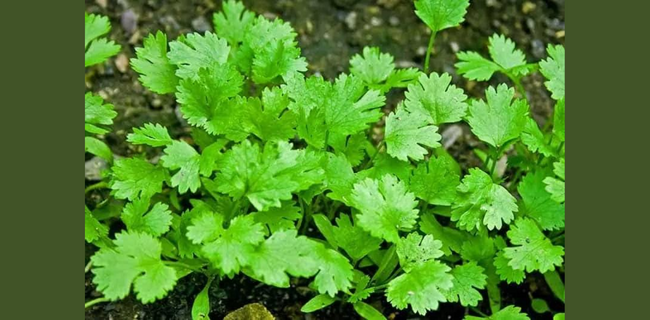
Coriander is an annual herb plant used as a spice in kitchen. It is mostly grown for its fruit and green leaves to provide flavor in dishes. Dry seeds of coriander contain essential oils which are used in confectionary, to mask offensive odours in pharmaceutical industry and for flavoring liquors. Green leaves are good source of Vitamin C and are used for making chutney, soups and sauces etc. Coriander also has good medicinal value. Tamil Nadu, Karnataka, Madhya Pradesh and Rajasthan are major producers of Coriander in India.
Anatomy of a coriander plant-

Leaf-

The leaves are compound (made up of two or more discrete leaflets, the leaves are simple (i.e., lobed or unlobed but not separated into leaflets). Leaf arrangement is alternate: there is one leaf per node along the stem. he edge of the leaf blade has lobes, or it has both teeth and lobes, the edge of the leaf blade is entire (has no teeth or lobes).
Flowers-

There is only one way to evenly divide the flower (the flower is bilaterally symmetrical), there are five petals, sepals, or tepals in the flower, both the petals and sepals are separate and not fused and total number of Stamens in flower is five (5)number.
Fruit-

Fruit type in general is dry but does not split open when riped and fruit length is up to 2–6 mm.
Annual Normal Rainfall- 75-100mm
The critical mean temperature range:
| Temperature | 15-28°C |
| Harvesting Temperature | 15-25°C |
| Sowing Temperature | 22-28°C |
SOIL
It can grow in all types of soil but well drained loamy soils are suitable for good growth.
Loam soil-

Loam soil is a mixture of sand, silt and clay that are combined to avoid the negative effects of each type.
These soils are fertile, easy to work with and provide good drainage. Depending on their predominant composition they can be either sandy or clay loam.
As the soils are a perfect balance of soil particles, they are considered to be a gardeners best friend, but still benefit from topping up with additional organic matter.
Suitable Soil pH range: The optimum pH range is 6-8 in soil is best suited for its cultivation.
The pH can control the availability of nutrients, biological functions, microbial activity, and the behavior of chemicals. Because of this, monitoring or controlling the pH of soil, water, and food or beverage products is important for a wide variety of applications.
In the pH scale, pH 7.0 is neutral. Below 7.0 is acidic and above 7.0 is basic or alkaline. Soil pH affects nutrients available for plant growth. In highly acidic soil, aluminum and manganese can become more available and more toxic to plant while calcium, phosphorus, and magnesium are less available to the plant.

Popular varieties with their yield
Local: Its average height is about 60 cm. Its flowers are of white color and fruits are of light green to yellowish color. It is ready to harvest in 175-180 days. Gives average yield of 3.5qtl/acre.
Punjab Sugandh: Variety having green leaves of medium size with excellent aroma. It gives four cutting of green leaves. It gives average yield of 150qtl/acre for green leaves and 3.5qtl/acre of seed yield.
Other state varieties:
GC 1: Grains are of medium size, round and yellow colored. Ready to harvest in 112 days. It is tolerant to wilt and powdery mildew. Gives average yield of 4.5qtl/acre.
GC 2: Tall and semi-spreading variety with medium size grains. It is tolerant to wilt and powdery mildew. Gives average yield of 5.8qtl/acre
CO 1: Dwarf variety with small size brown grains. Ready to harvest in 100-120 days. Gives average yield of 2qtl/acre.
CO 2: Medium size yellowish brown grains, Ready to harvest in 90-100 days. Gives average yield of 2.08qtl/acre.
CO 3: Dual purpose variety, less susceptible to grain moulds and wilts. Duration is 3 months, yield is about 650 to 700 kg/ha.
CS 2: High yielding dual purpose variety, very tolerant to drought 90 to 100 days, yield of 600 to 700 kg/ha can be expected.
CS 287: Small, bold grain, highly tolerant to wilt and grain moulds, suits for rainfed tracts.
Seed treatment-
Soak the seed in water for 12 hours for better germination. Treat the coriander seeds with azospirillum @ 1.5 kg/ha for better crop establishment and to control wilt disease, trichoderma viride @ 50kg/ha.
Land preparation

Land should be prepared well by giving 2-3 deep ploughing followed by planking to make uniform and leveled beds. Before last ploughing, add 40qtl/acre of well decomposed cow dung in soil.
SOWING
Time of sowing
For vegetable purpose, optimum time for sowing is first week of october and when grown for seed purpose, complete sowing in last week of october to first week of november.
Spacing

Keep row to row distance of 30 cm and plant to plant spacing of 15 cm.
Sowing Depth

Depth of soil should not more than 3 cm.
Method of sowing
Use Pora method for sowing.


SEED
Seed Rate
For sowing one acre land, seed rate of 8-10kg is used.
Seed treatment

For quick germination, before sowing crushed, break seeds into 2 parts. Before sowing, soak seeds in water for 8-12 hr. To prevent crop from wilt , root rot and damping off disease, treat seeds with Trichoderma viride/ Pseudomonas fluorescens @4gm/kg of the seeds before sowing.
FERTILIZER

Fertilizer Requirement (kg/acre)
| UREA | SSP | MURIATE OF POTASH |
| 90 | On soil test results | On soil test results |
Nutrient Requirement (kg/acre)
| NITROGEN | PHOSPHORUS | POTASH |
| 40 | – | – |
Apply Nitrogen@40kg in the form of Urea@90kg/acre in three splits. Apply half at the time of sowing and remaining in two equal splits after first and second cutting of leaves. When crop is grown for seed purpose, apply Nitrogen@30kg/acre i.e 65kg/acre in two doses, half at sowing time and remaining at time of flower initiation.
To attain fast growth 15-20 days after germination take spray of Triacontanol hormone@20ml/10Ltr. Also one spray of N:P:K(19:19:19) fertilizer@75gm/15Ltr of water at 20 days of sowing helps in good and faster growth of crop. For obtaining more yield, spray Brassinolide@50ml/acre in150Ltr water, 40-50 days after sowing. Take second spray after 10 days. Also one spray of Mono ammonium Phosphate 12:61:00@45gm/15Ltr of water at leaf and branches growing stage helps in good growth and increases yield.
WEED CONTROL

At initial growth stage of coriander, weed is a serious problem. Take one or two weeding operations to keep field weed free. Take first weeding 4week after sowing and second 5-6week after sowing.
IRRIGATION

Irrigation should be given according to soil moisture present in the soil. First irrigation should be given immediately after sowing of seeds. Subsequent irrigations should be given at 10 to 12days interval.
PLANT PROTECTION

Pest and their control:
Aphid:
If Infestation of Aphid is observed, to control take spray of Imidacloprid@6ml/10Ltr water or Thiamethoxam@4gm/10Ltr of water.
Disease and their control:
Powdery Mildew:

Patchy, White powdery growth appears on upper surface of leaves.
If infestation is observed take Spray of water soluble Sulphur@20gm/10Ltr of water. If needed repeat spray with interval of 10 days or take spray of Propiconazole 10 EC (Topas) @ 200ml/acre in 200Ltr of water.
Grain Mould: To prevent crop from grain mould, take spray of Carbendazim@200gm/acre 20 days after grain set.

Root rot:

To protect crop from root rot, as preventive measure do soil application of Neem Cake@60gm/acre. Also treat seeds with Trichoderma viride@4gm/kg of seed.
If infestation of root rot, observed in field to control, drenched soil with Carbendazim @5gm/Ltr of water or Copper oxychloride@2gm/litre of water.
HARVESTING
When crop attained 20-25 cm height harvesting for green leaves can be started. Three to four cutting can be taken. When crop is grown for seed purpose, it is ready for harvesting in April month. Harvest when capsule gets matures but having green color. Over ripe capsule fetch lower price.
POST-HARVEST
After harvesting allowed crop to dry in sunlight for 6-7 days. After proper drying, carry out threshing after then cleaning operation.
Leave a Reply