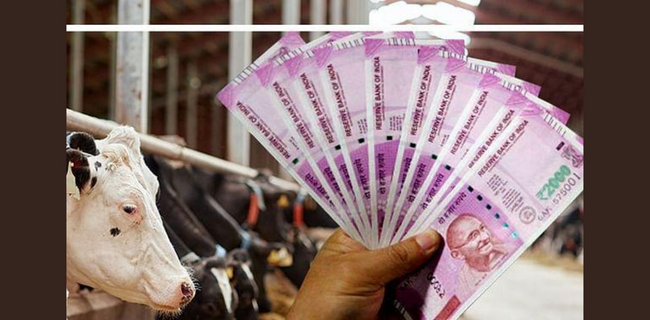
If you want to start any business idea, then before that you have to know that how much is its demand in the market. But if you start Dairy Farming Business then you do not need it, the demand for milk is always there. Even in the Corona period, the demand for milk remained. Whatever may be the situation, the demand for milk remains, because at least children in every household will drink milk. That is, even if there is a recession, your dairy business will continue to flourish. However, the only condition is that the quality of your milk should remain excellent, there should not be any deterioration in it. So let’s know how to do Dairy Farming Business, in which you will also get subsidy (subsidy in Dairy Farming Business) from the government.
First know how much subsidy is available?
Different states are promoting dairy business at their own level. For this, subsidy ranging from 25 to 50 percent is given by all the state governments. You can get an idea of the subsidy amount in your state from the milk cooperative society of your own state. There are many branches of Milk Committee, you can get information about this from any branch. Even if the branch secretary does not have the information, he will make that information available to you from the cooperative society. Contact the milk cooperative society of your state and find out what documents will be required.
How much will it cost?
Let us assume that you start a dairy farming with 10 cows or buffaloes. In this case, you will need at least 10*50 feet space for 10 cows. We are assuming that a cow will occupy a space of 10*5 feet. If you are a farmer and you have land, then you can build a shed on it, otherwise you will have to buy land. Let’s assume that you are a farmer and you have this much land. You will have to spend around 70-80 thousand rupees to make such a big shed. At the same time, space will also have to be made for the buffalo to eat. Let us assume that your expenditure will come up to Rs.1 lakh.
If you buy a cow that gives 10 liters of milk daily, then you will have to pay around Rs 50,000 per cow. That means you will have to spend about Rs 5 lakh to buy a cow. By the way, you can get a subsidy of 1.5 to 2.5 lakh rupees on these cows, but even if you do not get it, there is nothing to worry about. In the maintenance of cows, you will spend up to Rs. 1500 per month per cow. Means 15 thousand rupees will be spent on the maintenance of 10 cows. Let’s assume that your expenditure comes to 20 thousand rupees. In this way, you will have to spend about 6 lakh rupees once to buy a cow and get a shed made and then about 20 thousand rupees will be spent every month.
How much can you earn by selling milk?
If a cow is giving 10 liters of milk, then you will get 100 liters of milk from 10 cows. It is not necessary that every cow is giving milk, so let us assume that on an average 7 cows would be giving milk daily. In this way you will have 70 liters of milk daily and about 2000 liters of milk in a month. If you sell milk at a government dairy, you will get a rate of around Rs 40 per litre. On the other hand, if you are near a city and sell fresh milk directly to people’s homes, then your milk will be easily sold up to Rs.65-70. However, you have to keep the quality of your milk better, making any mistake in it will stall your business even before it is built.
Suppose you sell 2000 liters of milk at the rate of Rs.70 in a month. That means your milk will be sold for around Rs 1.4 lakh. In this, you will have to spend about 20 thousand rupees every month on the maintenance of cows. Also, let’s assume that every month you will have to spend 20 thousand rupees more on other works including transportation. In this way every month you will get a profit of 1 lakh rupees. For the dairy business, you had spent about Rs 1 lakh in the shed and about Rs 5 lakh in buying a cow. That means in 6 months all your money will be returned. After this, the 1 lakh rupees that you will get every month is your profit, by which you can increase your business.
Source: yourstory.com
Leave a Reply