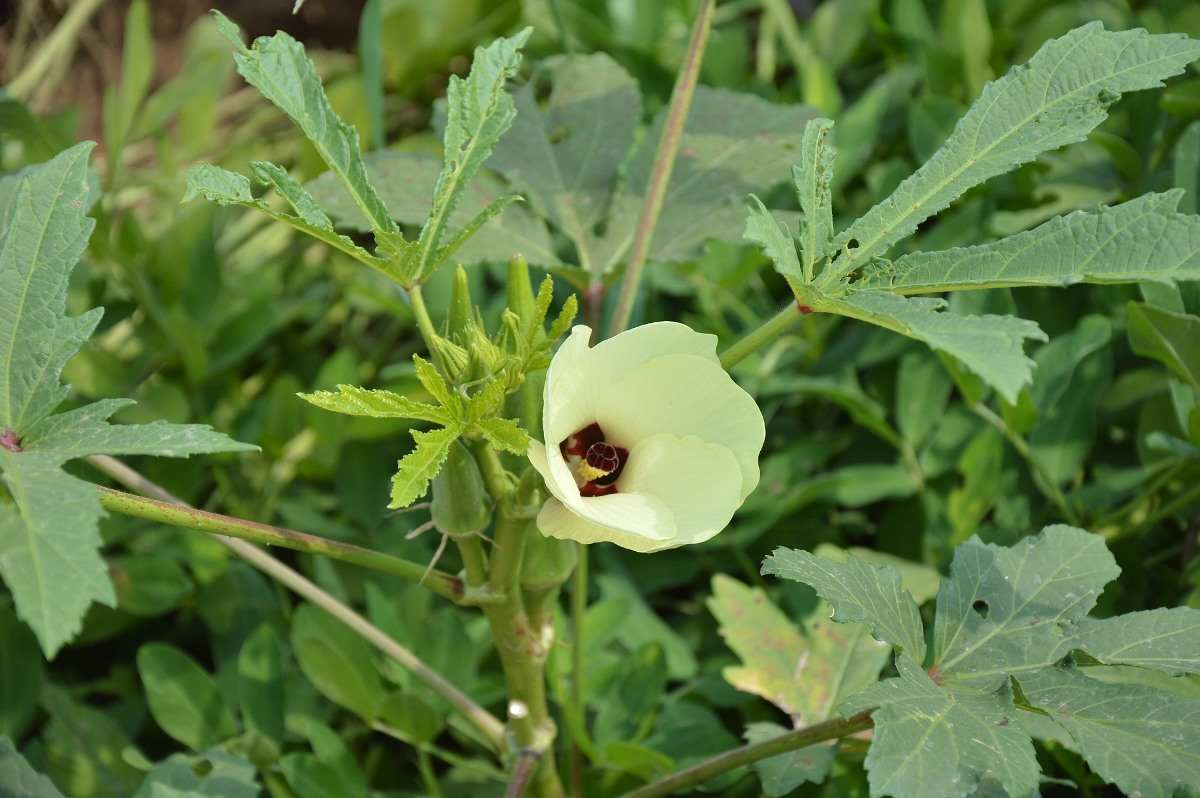
Second split application of hybrid okra-
Hybrid okra requires a last dose of nitrogen to support flowering and fruit production. Apply the second and last split of urea at a rate of 44kg/acre, at the start of flowering.
Monitor your field for these insect/pests infestation-
Spotted bollworm-
Marks of identification
The moths of E.vitella have pale white upper wings with broad greenish band in the middle; while in-case of E.insulana the forewings are completely greenish in colour. The months measure about 10 mm. The caterpillars of both the species are brownish white with a dark head and prothorasic shield. They have a number of black and brown spots on the body and hence name. A full fed larva measures 18 mm in length.
Nature of damage-
The larvae bore into the tender shoots, flower buds and fruits. As a result, the shoots dry and flower buds and fruits drop prematurely. Fruits remaining on the plants are deformed and often show exit holes of the larvae.
Life history
Greenish eggs are laid on tender shoots, flowers, buds and young fruits. A single female lays about 60-432 eggs. Incubation period is 3-7 days. Larval period is 9-11 days in summer and 20 days in winter. The full-grown larva pupate in the tough silken cocoons either on host or in soil or among the fallen leaves and 30-31 days in winter. There are as many 12 broods in a year.
Control measures-
- Removal and destruction of infested shoots, fruits and shed material helps in reducing the intensity of infestation and
- Spraying with 0.2% carbaryl or 0.1% Malathion or 0.06% endosulfan or 0.01% cypermethrin or 0.01% fenvalerate, 0.25% detamethrin at 10-15 days interval
- Use of Resistant/tolerant lines.
Blister beetle:

The beetle feed on pollen, petals and flower buds. If infestation is observed, collect and destroy adults and take spray of Carbaryl@800gm/150Ltr of water or Malathion@400ml/150Ltr of water or Cypermethrin@80ml per 150Ltr of water is effective.
Integrated pest management practices
- Sowing of YVMV resistant cultivars viz. parbhani kranti, makhmali, tulsi, Anupama-1, Varsha Uphar, Hisar Unnat, Arka anamika, Hisar Naveen and Sun-40 etc. especially during the kharif season of the crop.
- Seed treatment with imidacloprid 70WS or thiomethoxam 30FS @ 5gm/ kg of seed.
- Grow maize/sorghum on borders as a barrier to prevent the entry of shoot & fruit borer adults.
- Set up yellow sticky and delta traps for whiteflies.
- Erection of bird perches @10/acre in the field for facilitating bird predation.
- Give two to three sprays of NSKE @ 5% alternating with sprays of pesticides, if needed, against leafhopper, whitefly and mites etc.
- Install pheromone traps @ 5/ acre for monitoring of Earias vittella moth emergence. Replace the lures after every 30-40 days interval.
- Release egg parasitoid Trichogramma chilonis @1-1.5 lakh/ ha starting from 30-35 days after sowing, 4-5 times at weekly interval for shoot & fruit borer.
- Shoot & fruit borer, Earias vittella if crosses ETL (5 % infestation), spray cypermethrin 25 EC @ 200 g a.i/ha or spinosad 45SC @ 0.3 ml/lit or emamectin benzoate 25WG @ 0.4 gm/lit is effective against.
- Rogue out the YVMV affected plants, if any, from time to time.
- Periodically remove and destroy the borer affected shoots and fruits.
- Need based application of chemical pesticides viz. imidacloprid 17.8SL @ 150 ml/ha, cypermethrin 25EC @ 200 g a.i/ha (0.005%), quinalphos 25EC @ 0.05% or propargite 57 EC @ 0.1 % for control of leafhoppers, whiteflies, borers and mites.
- Removal and destruction of alternate weed hosts near the surrounding field.
Leave a Reply