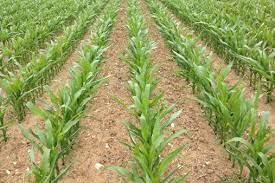
Nitrogen split fertilization at 6 leaves-
Once your maize plants have developed 6 leaves, apply 33 kg/acre of urea. It will be more efficient if you apply side dressing. If this is not possible, broadcast the fertilizer.
Rapid nitrogen uptake by the maize plant begins about 5 weeks after germination (30-40 days) and will continue for about 4-6 weeks. Nitrogen fertilizer needs to be available during these stages.
Nitrogen split fertilization at 10 leaves
Once your maize plants have developed 10 leaves, apply 39 kg of urea per acre.
You can either apply side dressing or broadcast the fertilizer.
Rapid nitrogen uptake by maize plant begins about 5 weeks after germination (30-40 days) and will continue for about 4-6 weeks. Nitrogen fertilizer needs to be available during these stages.
Monitor your field for some disease and insect/pest incidence-
Stem borer: Chilo partellus (Crambidae: Lepidoptera)
Distribution and status: India, Pakistan, Sri Lanka, Indonesia, Iraq, Japan, Uganda, Taiwan, Sudan, Nepal, Bangladesh and Thailand.
Host range: Jowar, bajra, sugarcane and rice
Damage symptoms: It infests the crop a month after sowing and upto emergence of cobs. Central shoot withering leading to “dead heart” is the typical damage symptom. Bore holes are visible on the stem near the nodes. Young larva crawls and feeds on tender folded leaves causing typical “shot hole” symptom. Affected parts of stem may show internally tunnelling caterpillars.
Bionomics: The adult moth is medium sized, straw coloured. It lays flat oval eggs in batches on the under surface of leaves near the midribs. The fecundity is about 25 eggs per female.

Management
- Grow resistant cultivars like Him 129, Ganga 4,5,7 and 9, Ganga safed 2, Deccan 101 and 103, Him 123, Ageti, C 1, 3 and 7, Kanchan, Kundan
- Sow lab lab or cowpea as an intercrop to minimise the stem borer damage (Maize : Lablab 4:1).
- Set up light trap till midnight to attract and kill the stemborer moths.
- Mix any one of the following insecticides with sand to make up the total quantity of 50 kg and apply in the leaf whorls – phorate 10 G 8 kg, carbofuran 3 G 17 kg, carbaryl + lindane 4G 20 kg, endosulfan 4 D 10 kg (or) spray endosulfan 35 EC 750 ml (or) carbaryl 50 WP 1 kg (500 L. spray fluid/ha).
- Collect the stubbles after harvest and burn to destroy diapausing borers.
Common Rust:
Causal organism: Puccinia sorghi

Symptoms:
- Circular to elongate golden brown or cinnamon brown, powdery, erumpent pustules appear on both leaf surfaces
- As the crop matures brownish black pustules containing dark thick walled two celled teliospores develop. In severe cases infection spreads to sheaths and other plant parts.
Control measures
- Plant hybrids like Deccan, Ganga-5, Deccan Hybrid Makka-103 and DHM – 1 which are resistant to this disease to minimise the disease intensity.
- Spray Mancozeb 2.5g/lit or Dithane M-45 spray can be taken (0.4%) as soon as first symptoms are observed and it can be repeated at 10 days interval till flowering.
Nitrogen deficiency-
The typical symptom of nitrogen deficiency is the plant turns pale green; a ‘V’ shaped yellow coloration on leaves. This pattern starts from leaf end to leaf collar. The symptom begin from lower to upper leaves.

Phosphorous deficiency
The deficient plants are dark green and lower leaves show reddish-purple discoloration.

Sulfur deficiency
Symptom appears on younger leaves where we will see yellow color striping (interveinal chlorosis).
Potassium deficiency-
The leaf margins turn yellow and brown which appears like firing or drying. The symptoms progress from lower leaves to upper leaves.
Leaf Blight: Exserohilum turcicum & Helminthosporium maydis


Turcicum Leaf Blight Symptoms:
- The fungus affects the crop at young stage.
- Early symptoms are oval, water-soaked spots on leaves.
- Mature symptoms are characteristic cigar shaped lesions that are 3 to 15cm long.
- Lesions are elliptical and tan in color, developing distinct dark areas as they mature that are associated with fungal sporulation.
- Lesions typically first appear on lower leaves, spreading to upper leaves and the ear sheaths as the crop matures.
- Under severe infection, lesions may coalesce, blighting the entire leaf.
Maydis Leaf Blight Symptoms:
- Small yellowish round or oval spots appear on the leaves.
- These spots enlarge, become elliptical and the center becomes straw coloured with a reddish brown margin.
- Conidia and conidiophores are formed in the center.
Favourable Conditions:
- Optimum temperature for the germination of conidia is 8 to 27˚C provided with free water on the leaf; Infection takes place early in the wet season.
Management
- Rogue out affected plants.
- Resistant cultivers– Deccan, VL 42, Prabhat, KH-5901, PRO-324, PRO-339, ICI-701, F- 7013, F-7012, PEMH 1, PEMH 2, PEMH 3, Paras, Sartaj, Deccan 109, COH-6.
- Soil application of P. fluorescens (or) T. viride @ 2.5 kg / ha + 50 kg of well decomposed FYM (mix 10 days before application) or sand at 30 days after sowing
- Spray Matalaxyl 1000 g / Mancozeb 2 g/liter at 10 days interval after first appearance of the disease.
Southern corn leaf blight (Bipolaris maydis)

Symptoms
Foliar symptoms vary with hybrid and different fungal isolate; lesions on leaves may be tan and elongated and run between leaf veins; lesions may have a buff or brown colored margin; another race of the fungus causes tan, spindle shaped or elliptical lesions with a water-soaked margin that turns into a yellow halo.
Causes
Fungus overwinters in corn debris in soil; disease occurs worldwide but is emergence favors areas with a warm, damp climate.
Management
The most effective method of controlling the disease is to plant resistant hybrids; cultural control methods include plowing crop debris into soil after harvest and rotating crops.
Leave a Reply