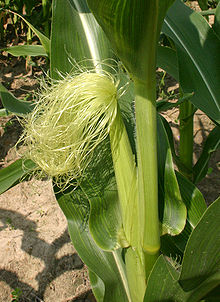
Nitrogen split fertilization at tasseling-
Apply 26 kg of urea per acre at this time in your cropping cycle. You can either apply side dressing or broadcast the fertilizers.
Maize produces a tassel of silks at the top of each ear when the plants are ready to start producing. The tassels produce the pollen that pollinates the ears so that they can form the kernels this stage is crucial for your later harvest.
Water your plants during flowering stage-
Flowering and post-flowering are the most susceptible stages for moisture stress.
Irrigate your crop with approximately 5-5.7 cm of water.
Irrigate again if there is inadequate soil moisture during the flowering and post-flowering (i.e grain filling) stages.
Monitor your field for some diseases incidence-
Charcoal rot: Macrophomina phaseolina

Symptoms:
- The pathogen affects the plant mostly after flowering and the disease is named as Post Flowering Stalk Rot (PFSR).
- The stalk of the infected plants can be recognized by greyish streak.
- The pith becomes shredded and greyish black minute sclerotia develop on the vascular bundles.
- Shredding of the interior of the stalk often causes stalks to break in the region of the crown.
- The crown region of the infected plant becomes dark in colour.
- Shredding of root bark and disintegration of root system are the common features.
- High temperature and low soil moisture (drought) favours the disease

Management
- Follow crop rotation
- Avoidance of water stress at flowering time reduced disease incidence
- Avoid nutrient stress.
- Apply potash @ 80 kg/ha in endemic areas
- Soil application of P. fluorescens (or) T. viride @ 2.5 kg / ha + 50 kg of well decomposed FYM (mix 10 days before application) or sand at 30 days after sowing.
Leave a Reply