Bio fertilizers:
- Bio fertilizers not only played an important role in maintaining good health of the plants, but also served as a natural source of plant nutrient to increase productivity.
- Some of the bio fertilizers are Pseudomonas, Trichoderma, Phosphate solubilizing bacteria (PSB) are applied at 5kg per acre along with FYM at the time of land preparation.
Dormancy Breaking- Cut the tubers in pieces having at least three healthy eyes and dip in 1% solution of thiourea for one hour. The planting should be done just after treatment or kept in wet gunny bags for one night.
Planting potato practices-
- Furrows of 40-50 cm should be opened. Apply 50 per cent of recommended dose of nitrogen, full dose of recommended phosphorus and potassic fertilizers 10 cm away from both furrow and tubers.
- Then place the tubers at an interval of 20 cm.
- Provide light irrigation immediately after sowing.
Apply basal dose of 1 bag Urea, 5 bag DAP & 2 bag MOP with sulphur 10 kg, Ca & Mg 5 kg each/acre and micro-nutrients for better developments of tubers.

Intercultivation and Earthing up-

- Potato tubers are modified underground stems which use to synthesize anthocyanin and chlorophyll if exposed to sunlight, therefore, it is essential to cover the tubers fully with soil because with chlorophyll formation the tubers stop accumulation of starch and remain smaller and the solanin formation in green tubers results into bitter taste of tubers which is harmful, if consumed.
- Number of earthling and height of ridges after earthling depends upon method of planting and soil type
- In case of flat-bed planting two earthings – one at 25-35 days and second 45-50 days after sowing are given.
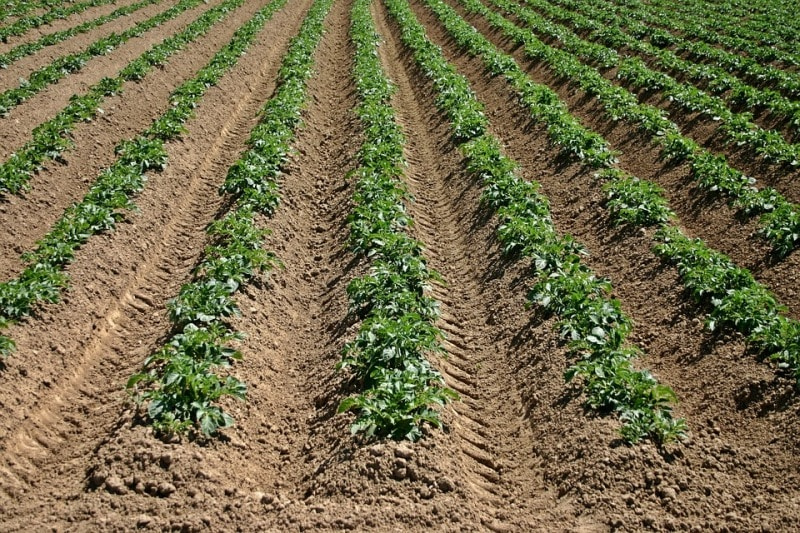
- In case of furrow planting method light ridging is done up to the height of 10-15 cm soon after sowing and second earthing is done about 30-35 days after sowing.
- While earthing it is essential to loosen the soil around the plants, then fertilizer, needed for top dressing is mixed with the soil after which the ridges are made.
- Since the roots are disturbed and partly damaged it is required to provide light irrigation.
- The integrated weed management programme has been recommended by adopting appropriate agronomic practices for the rapid growth of potato plants along with the combination of cultural and chemical methods of weed control to reduce the weed infestation in potato crop below the threshold level.
- Herbicide also provides timely weed control which is not possible by hand weeding over large areas.
- A weed free environment during the early stages of crop growth can be provided only by use of herbicides.
- During rainy season, whenever weeding is not feasible, the use of herbicides can be highly advantageous.
- The tuber yield of potato is increased by pre-emergence application of pendimethalin at 0.75 kg a.i./ha, alachlor at 1.0 kg a.i./ha or matribuzin at 0.50 kg a.i./ha.
- These herbicides were most efficient in controlling the weed growth in potato throughout the crop growth.
- The above herbicides were equally effective with cultural practice of hand weeding twice at 20and 35 DAS + earthing up at 35 DAS in respect of tuber yield per hectare.
Leave a Reply