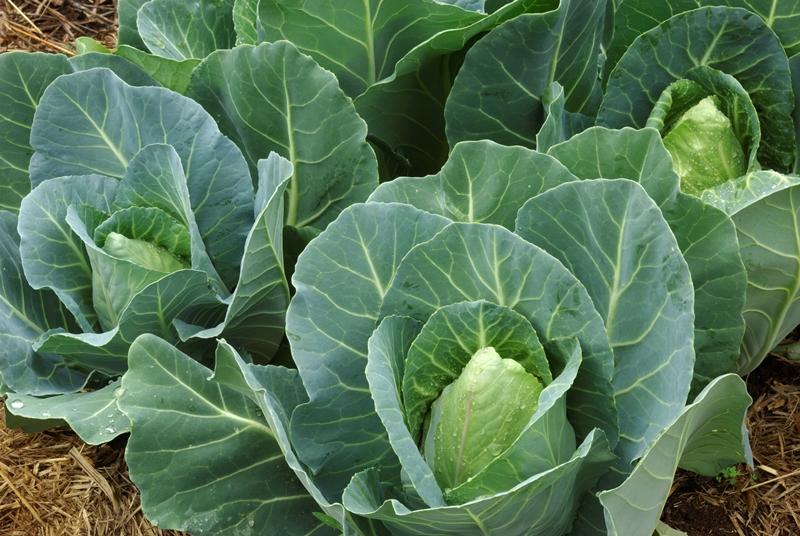
Cabbage Crop
Cabbage (Brassica oleracea var capitata) is a small, leafy biennial producing a compact globular mass of smooth or crincled leaves wrapped over each other known as head. The outer leaves are generally larger than the inner. The stem is short and stout. Plants flower generally after winter.
Leaves are low in calories (27 per cent), fat (0.1 per cent) and carbohydrates (4.6 per cent). It is a good source of protein (1.3 per cent) which contains all essential amino acids, particularly sulphur containing amino acids. Cabbage is an excellent source of minerals such as calcium (39 mg), iron (0.8 mg), magnesium (10 mg), sodium (14.1 mg), potassium (114 mg) and phosphorus (44 mg). It has substantial amounts of β carotene provitamin A), ascorbic acid, riboflavin, niacin and thiamine. Ascorbic acid content varies from 30-65 mg per 100 g fresh weight.

Flavor in cabbage leaves is due to the glycoside sinigrin. Cabbage contains goitrogens which cause enlargement of thyroid glands.
Major cabbage producing states are-
- Uttar Pradesh
- Odisha
- Bihar, Assam
- West Bengal
- Maharashtra
- Karnataka.
Climate-
In India, cabbage is grown in large areas having a cool and moist climate. A temperature range of 15o-21o C is considered as optimum for growth and head formation of the crop. The intensity of flowering depends upon the age of the plants and the period for which they are exposed to low temperatures.
Soil-
Cultivation of cabbage is done mainly on sandy to heavy soils rich in organic matter. Early crops prefer light soil while late crops thrive better on heavier soils due to retention of moisture. On heavy soils, plants grow more slowly and the keeping quality is improved. A pH range of 6.0-6.5 is considered as optimum for growing cabbage. Plants growing in saline soils are prone to diseases.
Sandy soil-

- Sandy Soil is light, warm, dry and tends to be acidic and low in nutrients. Sandy soils are often known as light soils due to their high proportion of sand and little clay (clay weighs more than sand).
- These soils have quick water drainage and are easy to work with. They are quicker to warm up in spring than clay soils but tend to dry out in summer and suffer from low nutrients that are washed away by rain.
- The addition of organic matter can help give plants an additional boost of nutrients by improving the nutrient and water holding capacity of the soil.
pH range-
The pH can control the availability of nutrients, biological functions, microbial activity, and the behavior of chemicals. Because of this, monitoring or controlling the pH of soil, water, and food or beverage products is important for a wide variety of applications.
In the pH scale, pH 7.0 is neutral. Below 7.0 is acidic and above 7.0 is basic or alkaline. Soil pH affects nutrients available for plant growth. In highly acidic soil, aluminum and manganese can become more available and more toxic to plant while calcium, phosphorus, and magnesium are less available to the plant.

| Soil pH | Plant growth |
| >8.3 | Too alkaline for most plants. |
| 7.5 | Iron availability becomes a problem on alkaline soils |
| 7.2 | 6.0 to 7.5- acceptable for most plants6.8 to 7.2- near neutral |
| 7.0 | |
| 6.8 | |
| 6.0 | |
| 5.5 | Reduced soil microbial activity |
| <4.6 | Too acid for most plants |
Application of liming or acidifying materials will ensure that soil pH is near the agronomic target pH. Yet, it is also important to consider the critical pH before making soil pH management decisions. The critical pH is defined as “the maximum soil pH value at which liming increases crop yield”. The critical pH reflects the practical and economic considerations of changing soil pH to the value most suited for plant growth.
Seed Rate-
For sowing use seed rate of 200-250 gm per acre is required.
Seed Treatment-

Before sowing dip seeds in hot water (50°C for 30 min) or streptocycline @ 0.01gm/Ltr for two hours. After treatment dry them in shade and then sow on bed. Blackrot mostly observed in Rabi. As a preventive measure seed treatment with Mercury chloride is essential. For that dip seeds in Mercury chloride@1gm/Ltr solution for 30 min after that dry them in shed. Crop grown in sandy soils are more prone to stem rot. To prevent it do seed treatment with Carbendazim 50%WP@3gm/kg seed.
Popular varieties of Cabbage:
- Golden Acre
- Pusa Mukta
- Pusa Drumhead
- K-1
- Pride of India
- Kopan hagen, Ganga
- Pusa Synthetic
- Shriganesh Gol
- Hariana, Kaveri
- Bajrang
- Midseason Market
- September Early
- Early Drum head
- Late large drum head
- K1.
Propagation-
Nursery Bed Preparation-


The seeds are generally sown in a seed bed and 4-6 week old seedlings are transplanting to the field. Cabbage seeds are sown on nursery beds to raise seedlings for transplanting in the field. Raised beds of size 3 x 0.6 m and 10-15 cm in height are prepared. About 70cm distance is kept between two beds to carry out intercultural operations such as watering, weeding, etc. The surface of beds should be 2 smooth and well levelled. Well-decomposed FYM @ 2-3 kg/m is added at the time of bed preparation. Raised beds are necessary to avoid problem of water logging in heavy soils. To avoid mortality of seedlings due to damping off, drenching of the beds with Bavistin (15-20g/10 litres of water) is effective.
Season of Planting
Sowing time depends upon the variety and the agro-climatic conditions prevailing in a particular region. Early cabbage is sown during July-November in plains and April-August in hills, as these require a longer period for their head formation.
Raising of Seedlings


About 300-500g of seed is sufficient for raising nursery required to plant one hectare. Prior to sowing seeds are treated with fungal culture of Trichoderma viride (4 g/ kg of seed) or Thiram (3g/ kg of seed) to avoid damage from damping-off disease. Sowing should be done thinly in lines spaced at 5-7 cm distance. Seeds are sown at a depth of 1-2 cm and covered with a fine layer of soil followed by light watering by water can. The beds should then be covered with dry straw or grass or sugarcane leaves to maintain required temperature and moisture. The watering should be done by water can as per the need till germination is completed. The cover of dry straw or grass is removed immediately after emergence of seed sprout. If there is over crowding of seedling due to thick sowing, the extra seedlings should be thinned out.
The seedlings should be transplanted within 4-6 weeks of sowing. Older seedlings when transplanted result in poor growth and yield.
Planting
Land Preparation


The field is ploughed to fine tilth by giving four to five ploughing with a sufficient interval between two ploughing. Planking should be done for proper levelling. The transplanting is done on the flat land, ridges or in furrows depending on climate and soil conditions. For early planting, ridge method is suitable especially in areas where the rains occur at the time of planting. In saline soils, planting in furrows and in dry areas transplanting on flat beds is recommended.
Spacing


The planting distance may vary according to variety, planting season and soil conditions. The following distances are generally recommended on the basis of maturity of varieties:
Early maturity varieties: 45 x 45 or 60 x 30 cm
Mid: 60 x 45 cm
Late: 60 x 60 cm or 75 x 60 cm
Method of Planting-


Transplanting should be done preferably in the morning or late evening. Before transplanting, the roots of the seedlings are dipped in a solution of Bavistin (2g/litre of water). Irrigation should be given immediately after transplanting. In some parts of the country, beds are first irrigated and then the seedlings are transplanted.
Manures and fertilizers

The fertilizer dose depends upon the fertility of soil and amount of organic manure applied to the crop. For a good yield, 15-20 tonnes of well-decomposed FYM is incorporated into the soil about 4 weeks before transplanting. Generally, application of 80-120 kg N, 60-100kg P2O5 and 60-120 kg K2O is recommended for optimum yield. Half the dose of N and entire amount of P and K is given at the time of transplanting. The balance N is given six weeks after transplanting or at the time of earthing up.
Irrigation


First irrigation is given just after transplanting of seedlings and subsequent irritations are given at an interval of 10-15 days depending upon the season and soil conditions. Care should be taken to avoid water stress from the time of head formation to the head maturity period. At the time of crop maturity, irrigation should be avoided as excess irrigation at this stage causes splitting of heads.
Intercultural Operations

Normally, the crop is kept free of weeds by 2-3 hand weedings and 1-2 hoeings. Pre-emergence application of Fluchloralin (1-2 litres a.i. in 600-700 litres of water) or Nitrofen (2kg a.i./ha) followed by a hand weeding 60 days after transplanting effectively checks the weed population. If necessary, earthing up is done 30 days after transplanting. At the time of earthing up the plants are supported with soil to avoid toppling of the plant during head formation.
PLANT PROTECTION
Cut-worm:

The caterpillars are 3 to 4 cm long, gray or brown to almost black with various markings. They hide in daytime and feed at night. They cause damage by biting the foliage and by cutting down the young seedlings just above the ground level.
Management:
- Picking and destruction of the larvae at the early stage of the crop.
- Growing of paired rows of mustard after every 25 rows of the crop.
- As a preventive measure apply Methyl Parathion or Malathion (5% dust)@10kg/acre in soil before sowing.
Leaf Eating Caterpillar:

They feed on leaves.
Management-
- To control leaf eating caterpillars take spray of Dichlorvos@200ml/150Ltr water or Flubendiamide 48%S.C@0.5ml/3Ltr of water.
Diamond back moth:

It is the serious pest of cabbage. They lay eggs under surface leaves. Larva of greenish color with hair on body feed on leaves and make hole. In case of lack of proper control measures, it causes loss upto 80-90%.
Management:
- Grow mustard as intercrop as 20:1 ratio to attract diamond back moths for oviposition. Periodically spray the mustard crop with insecticide to avoid the dispersal of the larvae.
- Install pheromone traps at 12 Nos/ha.
- Spray NSKE 5 % after primordial stage.
- Release parasite Diadegma semiclausum at 50,000/ha, 60 days after planting.
- At initial stage take spray of Neem Seed Kernel Extract@40gm/Ltr of water at head initiation stage. Repeat this spray with interval of 10-15days. Avoid spraying at curd formation.
- Take spray of Bt formulations@200gm/acre at 35 and 50 days after planting. In severe infestation take spray of Spinosad 2.5%SC@80ml/150Ltr of water.
- Sucking pest: They suck the sap from the leaves resulting in yellowing and drooping of leaves. Thrips results in curling of leaves, leaves become cup shaped or curved upward.
- If incidence of sucking pest like Aphid and Jassid is observed take spray of Imidacloprid 17.8SL@60ml/acre using 150Ltr water. Dry weather causes infestation of sucking pest. Spray Thiamethoxam@ 80gm/150Ltr water for effective control.
Disease and their control:
Leaf spot/blight:

Management-
- If infestation of leaf spot or blight is observed, to control take spray of Metalaxyl 8% + Mancozeb 64%WP@ 250gm/150Ltr of water along with sticker or Mancozeb@400gm/150litre or Carbendazim@400gm/150litre of water.
Downy Mildew:

Appearance of purplish-brown spots observed on lower side of leaves along with greyish white mold on leafs underside.
Management-
- Sanitation and crop rotation help in reducing infection.
- If infestation of downy is observed, it can be controlled by combined spraying of (Metalaxyl + Mancozeb)@2gm per litre. Spray three times with 10 days interval.
Black rot:

Management-
- To protect crop from black rot, do seed treatment with Mercury chloride. Dip seeds in Mercury chloride@2gm/Ltr solution for 30min. After this dry them in shed.
- If infestation is observed in field take spray of Copper oxychloride @300gm + Streptomycin@6gm/150Ltr for better control.
Harvesting and Yield-


Cabbage is ready for harvest at 90-120 days after planting. Cabbage should be harvested promptly when the heads are firm and mature. Delaying harvest, even a few days beyond maturity can result in split heads and increased incidence of field disease.
Harvesting immature heads, however, reduces yield, and the heads are too soft to resist handling damage. Immature heads also have a shorter shelf life than mature heads.
The head is harvested by bending it to one side and cutting it with a knife. The stalk should be cut flat and as close to the head as possible, yet long enough to retain two to four wrapper leaves. Extra leaves act as cushions during handling and may be desired in certain markets. The head should not be removed by snapping or twisting it since this practice damages the head and results in inconsistent stalk length. Broken stalks are also more susceptible to decay. As the heads are not ready for harvest at the same time, therefore they are harvested in stages based on the maturity of the heads.
Harvested produce should always be stored in shade before packing.
Yield
Yield of the cabbage varies greatly depending upon variety, maturity group and season of cultivation. Average yield obtained from early varieties is 25-30 t/ha and that of late type is 40-60 t/ha.
Leave a Reply