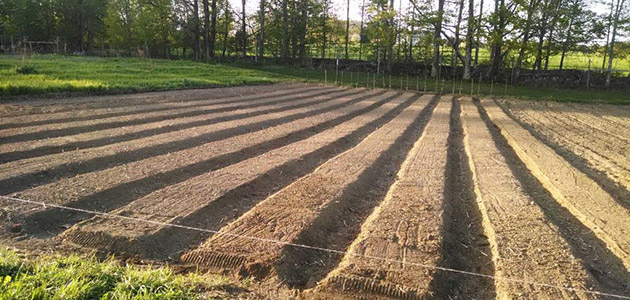
2 weeks before planting-
Ideal soil and weather conditions for tomato crop-
SOIL-
It can be grown in varied types of soil ranging from sandy loam to clay, black soil and red soil having proper drainage. It gives best results when grown under well drained sandy soil with high organic content. For good growth pH of soil should be 7-8.5. It can tolerate moderate acidic and saline soil. Avoid cultivation in high acidic soils. For early crops, light soil is beneficial where for heavy yields clay loam and silt-loam soils are useful.
Red soil-

This type of seen mainly in low rainfall areas, also known as Omnibus group. They are porous, friable structure, absence of lime, kankar (impure calcium carbonate), also deficient in lime, phosphate, manganese, nitrogen, humus and potash. Color is red because of Ferric oxide. The lower layer is reddish yellow or yellow. Texture: Sandy to clay and loamy.
Black soil-

Most of the Deccan is occupied by Black soil. It has high water retaining capacity. Swells will become sticky when wet and shrink when dried. Self-ploughing is a characteristic of the black soil as it develops wide cracks when dried. Rich in Iron, lime, calcium, potassium, aluminum and magnesium. Deficient in Nitrogen, Phosphorus and organic matter. The Color is deep black to light black.
Sandy Soil-

It consists of small particles of weathered rock. Sandy soils are one of the poorest types of soil for growing plants because it has very low nutrients and poor water holding capacity, which makes it hard for the plant’s roots to absorb water. This type of soil is very good for the drainage system. Sandy soil is usually formed by the breakdown or fragmentation of rocks like granite, limestone and quartz.
Clay soil-

This soil has very good water storage qualities and makes it hard for moisture and air to penetrate into it. It is very sticky to the touch when wet but smooth when dried. Clay is the densest and heaviest type of soil which does not drain well or provide space for plant roots to flourish.
| Temperature | 10-25°C |
| Rainfall | 400-600mm |
| Harvesting Temperature | 15-25°C |
| Sowing Temperature | 10-15°C |
Soil treatment if needed-
- Make sure to mix these products well with the soil while adding organic manure during field preparation.
- Trichoderma viride 1.5% WP is applied at a rate of 2 kg per acre.
- Neem cake (1-2% oil) is applied at a rate of 1 kg per 2-3 square meters.
Varieties selection-
POPULAR VARIETIES WITH THEIR YIELD
Punjab Ratta:
Ready for first picking in 125days from transplanting. Gives average yield of 225qtl/acre. This variety is suitable for processing.
Punjab Chhuhara:
Fruits are seedless, pear-shaped, red and firm with thick walls or skin. Marketable quality remains for 7days after harvesting and thus suitable for long distance transportation and processing. It gives an average yield of 325qtl/acre.
Punjab Tropic:
Plant height is about 100cm. Ready to harvest in 141days. Fruits are of large size and round shape, they are borne in clusters. Gives average yield of 90-95qtl/acre.
Punjab Upma:
Suitable for cultivation in the rainy season. Fruits are oval shaped, medium size and of firm deep red color. Gives average yield of 220qtl/acre.
Punjab NR -7:
Dwarf variety having medium size juicy fruits. It is highly resistant to fusarium wilt and root knot nematodes. Gives average yield of 175-180qtl/acre.
Punjab Red cherry:
Developed by Punjab Agricultural University. These cherry tomatoes are used in salads. These are of deep red color and in future it will be available in yellow, orange and pink color. Sowing is done in August or September and the plant is ready to harvest in February and gives yield up to July. Its early yield is 150 qtl/acre and total yield is 430-440 qtl per acre.
Punjab Varkha Bahar 2:
Ready to harvest in 100 days after transplanting. It is resistant to leaf curl virus. Gives average yield of 215 qtl/acre.
Punjab Varkha Bahar 1:
After transplanting, ready to harvest in 90 days. It is suitable for sowing in the rainy season. It gives resistance to leaf curl virus. Gives average yield of 215qtl/acre.
Punjab Swarna:
Released in 2018. It has dark green foliage. It has oval shaped fruits which are orange in color and medium in size. First picking should be done after 120 days of transplanting. It gives an average yield of 166qtl/acre till end-March and gives total yield of 1087qtl/acre. The variety is suitable for table purpose.
Punjab Sona Cherry:
Released in 2016. It gives an average yield of 425qtl/acre. The fruits are yellow in color and bears in bunches. The average weight of the fruit is approximately 11gm. It contains 7.5% sucrose content.
Punjab Kesari Cherry:
Released in 2016. It gives an average yield of 405qtl/acre. The average weight of the fruit is approximately 11gm. It contains 7.6% sucrose content.
Punjab Kesar Cherry:
Released in 2016. It gives an average yield of 405qtl/acre. The average weight of the fruit is approximately 11gm. It contains 7.6% sucrose content.
Punjab Varkha Bahar-4:
Released in 2015. It gives an average yield of 245qtl/acre. It contains 3.8% sucrose content.
Punjab Gaurav:
Released in 2015. It gives an average yield of 934qtl/acre. It contains 5.5% sucrose content.
Punjab Sartaj:
Released in 2009. It has round shaped fruit, moderate and hard. Suitable for the rainy season. It gives an average yield of 898qtl/acre.
TH-1:
Released in 2003. The fruits are dark red in color, round hard and approximately 85gm weight. It gives an average yield of 245qtl/acre.
Punjab Swarna:
Released in 2018. It has dark green foliage. It has oval shaped fruits which are orange in color and medium in size. First picking should be done after 120 days of transplanting. It gives an average yield of 166qtl/acre till end-March and gives total yield of 1087qtl/acre. The variety is suitable for table purpose.
HS 101:
Suitable for growing in north India during winter conditions. Plants are dwarf. Fruits are round and medium size and juicy. Fruits are borne in clusters. It is resistant to Tomato Leaf Curl Virus.
HS 102:
Early maturing variety. Fruits are small to medium in size, round and juicy.
Swarna Baibhav Hybrid:
Recommended for cultivation in Punjab, Uttarakhand, Jharkhand, Bihar and Uttar Pradesh. It is sown in September- October. Fruit keeping quality is good so suitable for long distance transport and processing. Gives yield of 360-400 qtl/acre.
Swarna Sampada Hybrid:
Recommended for cultivation in Punjab, Uttarakhand, Jharkhand, Bihar and Uttar Pradesh. Suitable timing for sowing is August – September and February-May. It is resistant to bacterial wilt and early blight. It gives a yield of 400-420 qtl/acre.
Keekruth:
Plant height is about 100cm. Ready to harvest in 136 days. Fruits are medium to large size, round shape, deep red color.
Keekruth Ageti:
Plant height is about 100 cm. Fruits are medium to large size, round shape having a green shoulder which disappears on ripening.
Sterilize the seedbeds using solar radiation-
Solarization is an easy, safe and cost effective way to sterilize the soil and produce healthy seedlings. It consists of utilizing the radiation from the sun to create unfavorable conditions for pathogens and weeds in the seedbed soil. This process will reduce soil-borne diseases and break the life cycle of insects, pests and seeds of weeds. The best time for solarization is during the dry season with high temperatures. To solarize soil, follow these steps:
- Apply water to moisten seedbed soil.
- Cover the soil with transparent plastic sheets for 3-4 weeks.
- Bury the edges of the sheets in the soil.
- After 3-4 weeks, remove the plastic sheets and plough the soil lightly.
- About 2-3 days later, level the soil and sow the seeds.
How to prepare raised seed beds for plant nurseries-
- Choose an open, protected, sunny and well drained area of the field. If you have a short growing season, you should consider making your seedbed inside a greenhouse.
- Mark the seedbed plots (2-3m x 1m) and mix the soil in the selected area thoroughly with a rake to soften its structure. Remove any weed and debris that you may see. Wooden planks may be used.
- Incorporate well-decomposed farmyard manure at a rate of 4-5 kg/m2 into soils.
- Form raised seed beds 15cm or higher, 2-3 m in length and 80-100 cm wide to improve drainage. Water reasonably to ensure good seed-to-soil contact.
- Cover the soil with a plastic sheet and leave it for 10 days (solarization). This sterilizes the soil partly and warms it up for a better germination.
- Set up a net-tunnels structure above the seedbeds with 32-60 mesh nylon netting to protect seedlings against rain, sun and insect pests. The seedbeds are now ready for sowing.
Seed Treatment-

To protect crops from soil borne disease and pest, before sowing do seed treatment with Thiram @3gm or Carbendazim @ 3gm of seeds. After chemical treatment, treat seed with Trichoderma @5gm/kg of seeds, keep it in shade and use it for sowing.
| Fungicide/Insecticide name | Quantity (Dosage per kg seed) |
| Carbendazim | 3 gm |
| Thiram | gm |
Fertilize seedbeds for a kick-start of your plants-
Besides the addition of FYM into the seedbed soil (2-4 kg/m2 of bed) to improve its structure and organic content, it is recommended to provide nutrients to the seedlings to give them a kick-start and strengthen them for the rest of the season. Around 7-10 days after the thinning of seedlings, if the leaves turn pale yellow-green I color, apply one of the products below to the seedbed:
Nitrogen: 40g/m2 ammonium sulfate or 0.25% urea solution (2.5g/l).
Phosphorus: 50g/m2 of superphosphate.
Potassium: 30g/m2 of potassium chloride.
Weed free seedbed-
A smart way to rid the seedbed of possible weeds is to prepare the soil as usual and then delay the sowing until the first weeds have emerged. This first flush of weeds can then be killed by a sharp and shallow hoeing. Cultivation should be shallow to avoid bringing buried weed seeds to the surface. For this, it is important that the soil is moist and warm enough to encourage the weeds to germinate. Once the soil surface is cleaned, the seeds of your crop of interest can be sown. After that, keep the nursery seedbed free of weeds until transplanting by removing the weeds manually.
Leave a Reply