3 weeks before planting
Management before planting-
Avoid planting carrots in fields last planted to cereals or in fields with known infestations of perennial weeds; available herbicides do not effectively control perennial weeds. To prevent the buildup of weed seed in the soil, cultivate weeds before they set seed in rotation crops. After harvest of the rotation crop, clean-cultivate the field or plant a green manure crop to prevent weed infestations. In a typical farm mix of crops, carrots should be planted in the most weed-free fields.
Soil solarization can be used to control most weeds in carrots. It will also control or suppress some other important pests, such as nematodes. Soil solarization requires a summer fallow season for treatment; it fits in best with a fall-planted crop.
Metam sodium is used in carrot fields principally for control of soil-borne fungal diseases and nematodes. It will also kill emerging weeds, ungerminated weed seed that has become softened by irrigation, and nutsedge shoots. Application is made about 2 weeks after a pre-irrigation, which should be made before planting the crop. The typical application method is through solid-set sprinklers or into flood irrigation. The minimum time allowed between application and planting the crop is 14 days, and can be up to 60 days, depending upon environmental conditions, so planning ahead is important.
To control nutsedges, EPTC may be used during the fallow season, if allowed. Apply it in summer before a fall carrot crop to reduce nutsedge tuber populations. Be sure to use it according to label directions; the herbicide must be applied 90 days before carrot sowing, and the field must be irrigated 30 days before planting.
About 2 weeks before planting carrots, pre-irrigate the field, to germinate weed seedlings, and cultivate to destroy them. Carry out this operation as close to planting time as possible to assure that soil temperature and climatic conditions are similar to those that will occur during the crop germination period, thus maximizing the number of weeds controlled. Cultivate as shallowly as possible to avoid bringing up dormant weed seed from deeper soil layers.
Herbicides that are available to use pre-plant in carrots include paraquat (Gramoxone) and glyphosate (Roundup). These products can be used to control emerging weeds just before planting or before the crop emerges. Be sure the crop has not emerged, however, because emerged plants will be killed if contacted by these herbicides. Glyphosate has been particularly helpful in controlling perennial weeds when used as a pre-plant treatment.
Trifluralin is a commonly-used pre-plant incorporated herbicide in carrots. It will control many annual weeds when used for the entire carrot production season.
2 weeks before planting
Ideal soil and weather conditions for carrot crop-
Soil type for carrot-
Carrots can be grown well in a wide variety of soils. However, commercial carrot farming’s ideal soil should be deep, loose, well-drained, and rich in humus. Loamy or sandy loam soils with sufficient quantities of humus are well suited to the cultivation of carrots. The ideal pH range for obtaining a good yield is 5.5-6.5. Soils with pH up to 7.0 can also be used, but too alkaline or acidic soils are unsuitable for this crop.
Loamy Soil

Loam soil is a mixture of sand, silt and clay that are combined to avoid the negative effects of each type.
These soils are fertile, easy to work with and provide good drainage. Depending on their predominant composition they can be either sandy or clay loam.
As the soils are a perfect balance of soil particles, they are considered to be a gardener’s best friend, but still benefit from topping up with the additional organic matter.
Sandy soil

Sandy Soil is light, warm, and dry and tends to be acidic and low in nutrients. Sandy soils are often known as light soils due to their high proportion of sand and little clay (clay weighs more than sand).
These soils have quick water drainage and are easy to work with. They are quicker to warm up in spring than clay soils but tend to dry out in summer and suffer from low nutrients that are washed away by rain.
The addition of organic matter can help give plants an additional boost of nutrients by improving the nutrient and water-holding capacity of the soil.
Soil treatment:
- 20-25 metric tonnes of well-rotted manure.

Benefits of soil treatment- Some benefits of soil treatment are given below-
Water benefits-
- Healthy soil acts as a sponge: more rainwater is absorbed and stored in the ground, where it recharges groundwater and aquifers.
- Healthy soil prevents run-off and erosion and reduces evaporation.
- Healthy soil improves water quality by filtering pollutants.
Nutritious food-
- Healthy soil increases the nutritional value of food and forage.
- Healthy soil provides plants with the nutrition they need and strengthens plants natural resistance to pests and diseases.
Economic security-
- Healthy soil improves farm productivity and provides stability.
- Healthy soil cuts down on inputs, which increases profit.
- Healthy soil helps withstand extreme weather, floods and drought.
Environmental and health benefits-
- Healthy soil helps reverse global warming by absorbing carbon from the atmosphere where it acts as a greenhouse gas.
- Healthy soil provides a habitat for soil microbes to flourish.
- Healthy soil supports greater biodiversity and species stability.
Climate Requirement for Carrot Farming:
Carrot is a cold-weather crop, and it also does well in warm climates.
The optimum temperatures for excellent growth are between 16 to 20 °C, while temperatures above 28°C drastically reduce top growth.
Temperatures lower than 16°C affect the development of colour and result in long slender roots, while higher temperatures produce shorter and thicker roots.
The temperatures between 15 and 20°C result in attractive roots with excellent red colour and quality.
Week before planting
Land preparation:
Tractor-drawn cultivator:

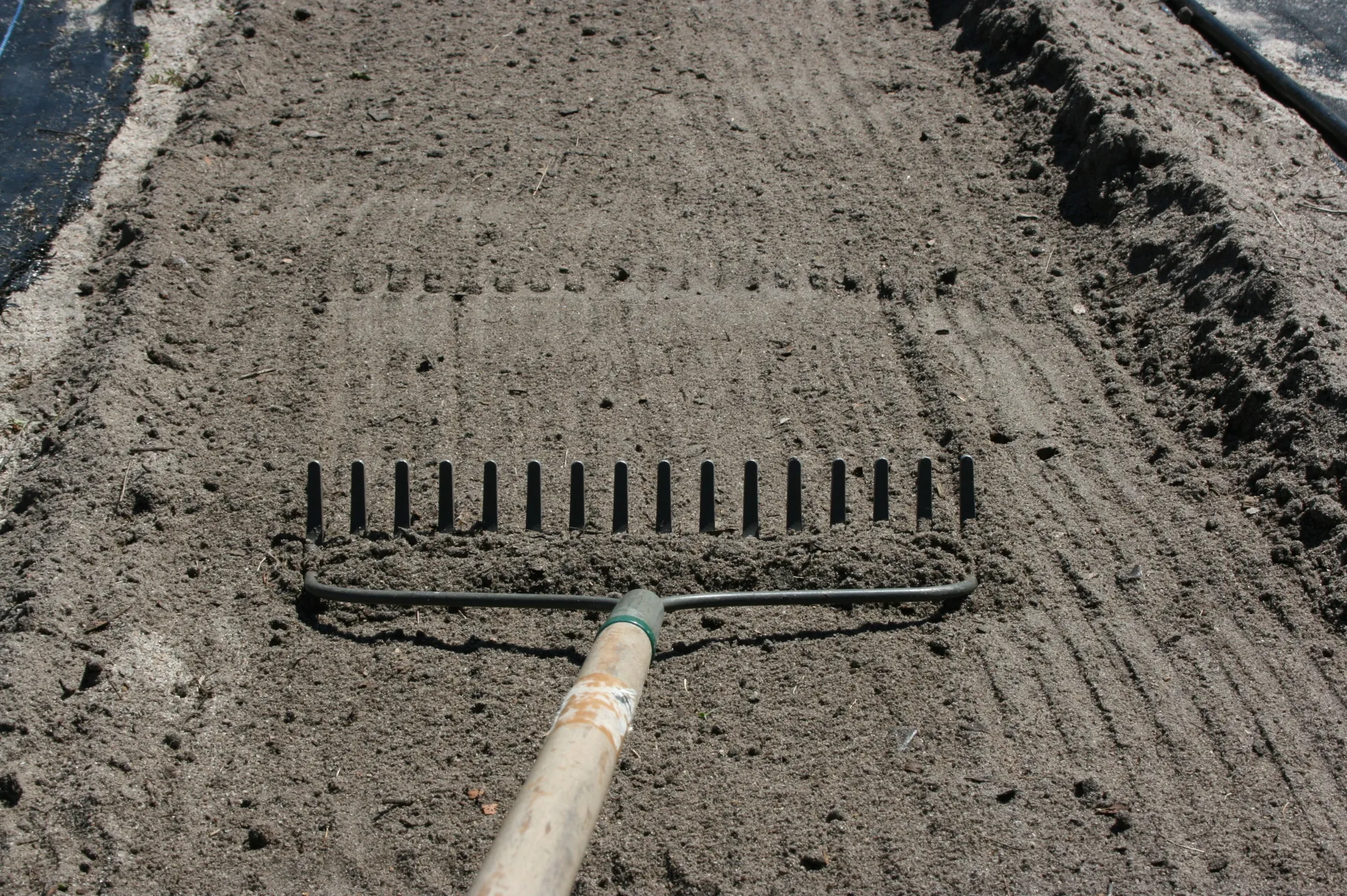
Cultivator is an implement used for finer operations like breaking clods and working the soil to a fine tilth in the preparation of seedbed. A cultivator is also known as a tiller or tooth harrow. It is used to further loosen the previously ploughed land before sowing. It is also used to destroy weeds that germinate after ploughing. The cultivator has two rows of tynes attached to its frame in staggered form. The main object of providing two rows and staggering the position of tynes is to provide clearance between tynes so that clods and plant residues can freely pass through without blocking. Provision is also made in the frame by drilling holes so that tynes can be set close or apart as desired. The number of tynes ranges from 7 to 13. The shares of the tynes can be replaced when they are worn out.
Disc Harrow:

The disc plough bears little resemblance to the common mould board plough. A large, revolving, concave steel disc replaces the share and the mould board. The disc turns the furrow slice to one side with a scooping action. The usual size of the disc is 60 cm in diameter and this turns a 35 to 30 cm furrow slice. The disc plough is more suitable for land in which there is much fibrous growth of weeds as the disc cuts and incorporates the weeds. The disc plough works well in soils free from stones. No harrowing is necessary to break the clods of the upturned soil as in a mould board plough.
Laser Land Leveler:

Laser Land Leveler is a more advanced technique for smoothing the land surface from its average height with a certain degree of the desired slope using a guided laser beam throughout the field. Laser Land Leveling is an important technology for good agronomic, the highest possible yield, crop management, and water-saving.
Advantages of soil preparation-
- It loosens the soil.
- It aerates the soil.
- It prevents soil erosion.
- It allows easy penetration of roots into the soil.
Disadvantages of soil preparation-
The downside of tilling is that it destroys the natural soil structure, which makes soil more prone to compaction. By exposing a greater surface area to air and sunlight, tilling reduces soil’s moisture-retaining ability and causes a hard crust to form on the soil surface.
- For irrigated land, prepare ridges and furrows separated by the appropriate distance.
Divide the field into smaller plots at your convenience to facilitate the irrigation.
Sowing time and Seed Rate:
Carrots are sown from the beginning of March to September, the optimum time being August in cold areas while from the middle of August to November in warm areas. The seed rate varies from 7 to 9 kg per hectare according to the thickness of sowing/ broadcasting.
Seed treatment:
| Active Ingredients (Applied rate) | Major Pests |
| Thiram (2.50 g ai/kg) Iprodione (5.00 g ai/kg) | Soil Borne Fungal Disease Alternaria |
| Mefenoxam (0.075 g ai/kg), Fludioxonil (0.025 g ai/kg), Azoxystrobin (0.025 g ai/kg) Iprodione (5.00 g ai/kg) | Pythium/Phytophthora, Fusarium/Rhizoctonia, Soil/Seed Borne Fungal Disease Alternaria |
| Mefenoxam (0.075 g ai/kg), Fludioxonil (0.025 g ai/kg), Azoxystrobin (0.025 g ai/kg), Iprodione (5.00 g ai/kg) Thiamethoxam (0.05 mg ai/seed) | Pythium/Phytophthora, Fusarium/Rhizoctonia, Soil/Seed Borne Fungal Disease, Alternaria Systemic Insecticide (aphids, beetles, certain seed and root maggots, flea beetles, white fly, and wireworms) |
Leave a Reply