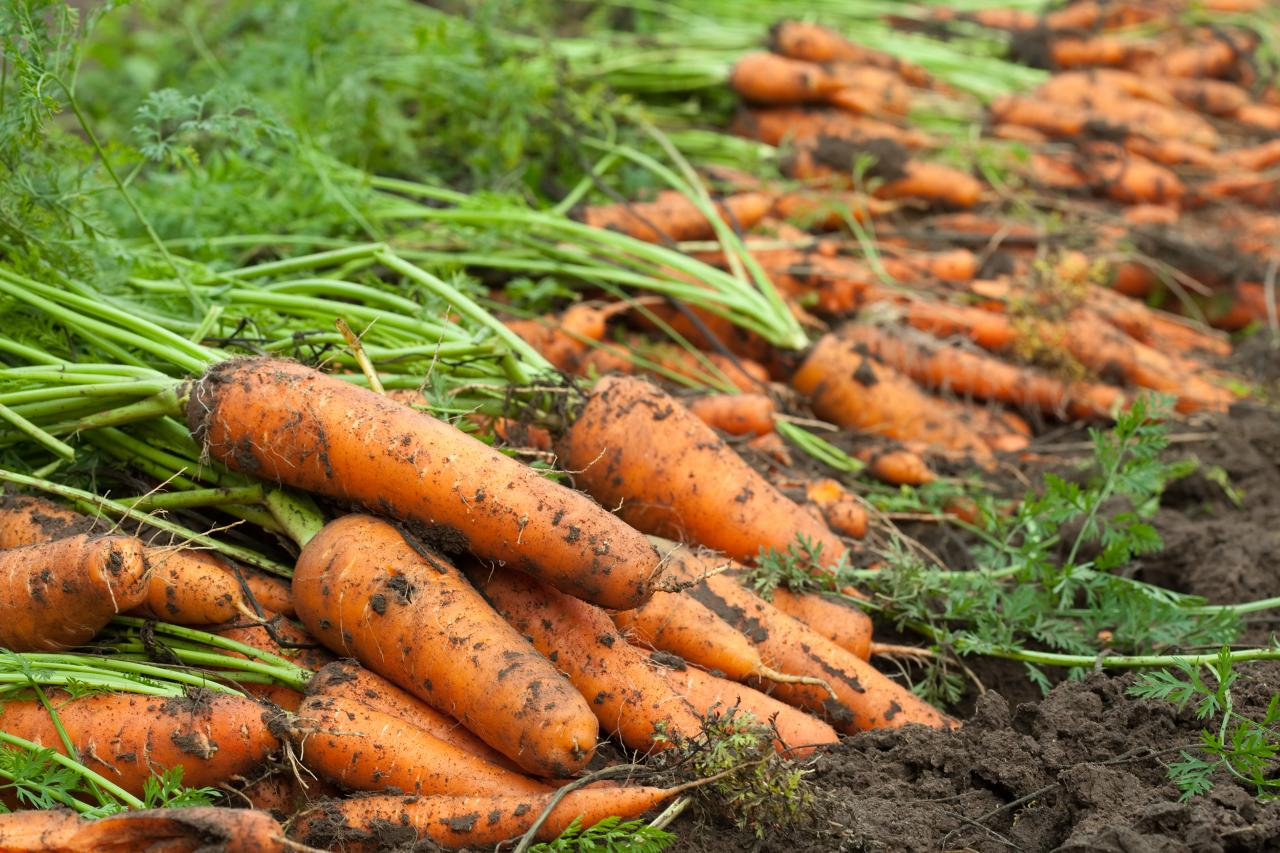
Early carrots are harvested when they are partially developed. For distinct markets, otherwise, they are retained in the soil till they reach the full maturity stage; they should not be retained at the full maturity stage because they become hard and unfit for consumption.
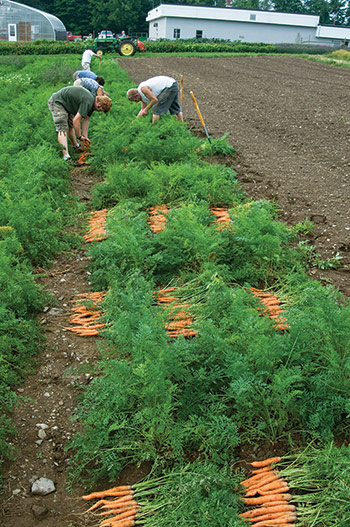
Postharvest handling of carrots:
Storage conditions:
- Minimum quality requirements are that carrots should be intact, sound, clean, free from attack by diseases, pests, mold, or rot, and without foreign smell or taste.
- Storage life depends on storage temperature and humidity.
- At 20°C and 60–70% relative humidity, carrots will keep for two to three days.
- At 4°C and 80–90% relative humidity, carrots will keep for one to two months.
- At 0°C and greater than 95% relative humidity, carrots will keep for up to six months.
- The ideal conditions for best-keeping quality are pre-cooling and storage at 0°C and 95–100% relative humidity.
- The recommended temperature for storage is 0 to 2°C.
General facts:
- Ideally, carrots should be cooled to below 5°C within 24 hours of harvest.
- Preferred cooling methods are hydro-cooling, forced-air cooling, or hydro-vacuum cooling.
- Ideal conditions for long-term storage are at 0°C and greater than 95% relative humidity.
- Carrots freeze at about –1.4°C.
Carrots are susceptible to dehydration. Silvering (‘white scale or white blush’) results from dehydration of the partially removed outer skin (periderm) of carrots. Further dehydration results in the development of phenolic browning in the tissue beneath the periderm. The use of liners during storage and transportation increases moisture retention, reduces dehydration, and hence reduces silvering and phenolic browning.
Brush polishing removes the periderm from carrots solving the silvering problem but exposing roots to phenolic browning. Browning is initiated by physical damage of the surface during harvest and postharvest brushing, thereby exposing the internal tissue to oxidation. Browning usually develops when carrots are on the market shelf after a period of cold storage.
Carrots are sensitive to ethylene, so avoid mixed storage with ethylene-producing produce such as tomatoes, melons, apples, pears, plums, kiwifruit, and avocados. Ethylene causes the development of bitter flavors by stimulating the production of compounds called isocoumarins.
Available chlorine at 50 to 100 parts per million (ppm) in clean rinse water reduces the likelihood of a bacterial and fungal breakdown. For chlorine to be effective, water pH has to be maintained from 7.0 to 7.6.
Leave a Reply