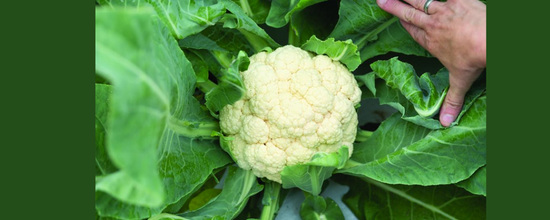
Cauliflower mosaic:

Symptoms:
Mosaic patterns on leaves; veinclearing and or veinbanding; stunted plant growth; reduced head size.
Management:
Control cruciferous weeds which can act as a reservoir for the virus; control aphid populations on plants by applying an appropriate insecticide.
Harvesting, Yield and Storage:
Cauliflower curds need to be blanched as they mature. This protects them from sun exposure resulting in a white, tender head. As cauliflower plants begin to mature and the curd starts to form, gather together and tie the leaves over the curd with soft twine, tape, or rubber bands. Blanching should be done when the curd is dry to prevent disease development. There are some “self-blanching” types of cauliflower available where the leaves curl naturally over the curd when grown in cool weather; however, some tying of the leaves may still be necessary, even in varieties of different colours.
The cauliflower curd, like the broccoli head, is actually a group of tightly clustered flower buds. Harvest the curd when it reaches the desired size (approximately 6 inches in diameter) but before the buds begin to separate. This will be about two months after transplanting. When cutting the curd, leave at least two wrapper leaves with the curd.
Cauliflower can be stored in a refrigerator for up to two weeks. High humidity of at least 95 percent is necessary to prevent wilting.
Leave a Reply