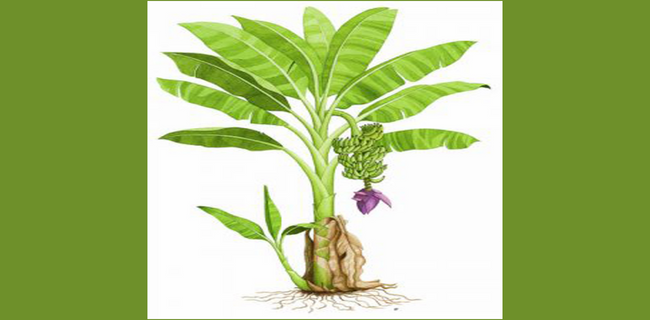
Banana plant
Banana (Musa sp.) is the second most important fruit crop in India next to mango. Its year round availability, affordability, varietal range, taste, nutritive and medicinal value makes it the favourite fruit among all classes of people. It has also good export potential. Banana is a nutritious gold mine. They are high in vitamin B6, which helps fight infection and is essential for the synthesis of heme, the iron containing part of hemoglobin. They are also rich in potassium and are a great source of fibre.

Origin
Banana evolved in the humid tropical regions of S.E.Asia with India as one of its centres of origin. Modern edible varieties have evolved from the two species – Musa acuminata and Musa balbisiana and their natural hybrids, originally found in the rain forests of S.E.Asia. During the seventh century AD its cultivation spread to Egypt and Africa. At present banana is being cultivated throughout the warm tropical regions of the world between 300 N and 300 S of the equator.
| Scientific classification | |
| Kingdom: | Plantae |
| Order: | Zingiberales |
| Family: | Musaceae |
| Genus: | Musa |

Description of banana plant-
| The banana plant is not a tree. It is a giant herbaceous plant with an apparent trunk that bends without breaking. |

An underground stem with suckers
Banana plant has an underground stem with adventitious roots. It is full of food for the plant. Alongside the main stem it has other stems called suckers. These stems grow into banana plants. The banana plant produces its fruit and dies, another sucker replaces it.

Banana leaf
The banana plant has large leaves closely rolled up one over the other. Together they look like a trunk, but they form only an apparent trunk.

Inside it there is a bud which produces leaves. After 7 or 8 months, when some 30 leaves have grown, the bud produces flowers. The flowers of banana plant form a large spike, it turns downward to the soil and opens. It bears male and female flowers.

A red bud at the end of the spike containing the male flowers; the male flowers die quickly and the bud slowly becomes smaller.

The banana plant yields fruits. These fruits are long in shape, with yellow or green skin. The spike produces many bananas. The banana on one spike are called bunch. On this bunch, the bananas are clustered in several hands.

The flesh of banana is light in colour, sweet and soft. In the middle of the fruit you can see little black specks; these are the seeds, but they will not germinate.
Agro-climatic requirements
Banana, basically a tropical crop, grows well in a temperature range of 15ºC – 35ºC with relative humidity of 75-85%. It prefers tropical humid lowlands and is grown from the sea level to an elevation of 2000m. above m.s.l.. In India this crop is being cultivated in climate ranging from humid tropical to dry mild subtropics through selection of appropriate varieties. Chilling injury occurs at temperature below 12ºC. High velocity of wind which exceeds 80 km /hr. damages the crop. Four months of monsoon (June to September) with an average 650-750 mm. rainfall are most important for vigorous vegetative growth of banana. At higher altitudes, banana cultivation is restricted to a few varieties like ‘Hill banana”.
pH range-
Soil with pH 6.5–7.5 is most preferred for banana cultivation.

Suitable Soils with texture ranges- Rich loamy, should have good drainage, adequate fertility and moisture. Saline solid, calcareous soils are not suitable for banana cultivation. A soil which is neither too acidic nor too alkaline, rich in organic material with high nitrogen content, adequate phosphorus level and plenty of potash is good for banana.
Loam soil-

Loam soil is a mixture of sand, silt and clay that are combined to avoid the negative effects of each type.
These soils are fertile, easy to work with and provide good drainage. Depending on their predominant composition they can be either sandy or clay loam.
As the soils are a perfect balance of soil particles, they are considered to be a gardeners best friend, but still benefit from topping up with additional organic matter.
Varieties Cultivated
Commercially, bananas are classified as dessert types and culinary types. The culinary types have starchy fruits and are used in the mature unripe form as vegetables.
Important cultivars include-
Dwarf Cavendish, Robusta, Monthan, Poovan, Nendran, Red banana, Nyali, Safed Velchi, Basrai, Ardhapuri, Rasthali, Karpurvalli, Karthali and Grand Naine etc.
Grand Naine, an imported variety from Israel is gaining popularity and may soon become the most preferred variety due to its tolerance to abiotic stresses and good quality bunches. Fruit develops attractive uniform yellow colour with better shelf life & quality than other cultivars.
Land Preparation
Prior to planting banana, green manuring crop like daincha, cowpea etc. may be grown. The land can be ploughed 2-4 times and leveled. Ratovator or harrow is used to break the clod and bring the soil to a fine tilt. During soil preparation basal dose of FYM (about 50 tonnes/ha before last harrowing) is added and thoroughly mixed into the soil.


Planting Material
About 70% of the farmers are using suckers as planting material while the rest 30% of the farmers are using tissue culture seedlings. Sword suckers with well developed rhizome, conical or spherical in shape having actively growing conical bud and weighing approximately 450-700 gm are commonly used as propagating material.
Suckers generally may be infected with some pathogens and nematodes. Similarly due to the variation in age and size of sucker, crop is not uniform, harvesting is prolonged and management becomes difficult. Therefore, in-vitro clonal propagation i.e. Tissue culture plants are recommended for planting. They are healthy, disease free, uniform in growth and early yielding.
Treatment of planting material
The roots and base of the planting material may be removed. The suckers are dipped in a solution of 0.5 % monocrotophos and bavistin (0.1%) before planting.

Planting season
Planting of tissue culture banana can be done throughout the year as per the market demand except when the temperature is too low or too high. The planting time may be adjusted so as to avoid high temperature and drought at the time of emergence of bunches (i.e. approx. 7-8 months after planting). The planting time for long duration cultivars is different from short duration ones.
Thus, the important seasons for planting followed in different states of India are:
| State | Planting time |
| Maharashtra | Kharif – June – JulyRabi – October – November |
| Tamil Nadu | February – AprilNovember – December |
| Kerala | Rainfed- April-MayIrrigated crop- August- September |
Traditionally banana growers plant the crop at 1.5m x 1.5m with high density; however plant growth and yields are poor because of competition for sunlight. The region like north India, coastal belt and where humidity is very high and temperature falls down upto 5-7ºC, the planting distance should not be less than 2.1m x 1.5m.

| Season | Spacing |
| Kharif | 1.5 x 1.5 m., 2 x 2 m. or 2.5 x 2.5 m. |
| Rabi | 1.5 x 1.2 m., 1.5 x 1.37 m. |
Banana planting is carried out on the basis of patta double line method. In this method, the distance between the two lines is 0.90 to 1.20 m. while plant to plant distance is 1.2 to 2 m. Due to this spacing, intercultural operations can be carried out easily and cost of drip irrigation is decreased. Experiments carried out recently show that good quality banana and heavy bunch can be achieved by keeping the planting distance at 1.8 X 1.8 m. However, to get maximum yield plantation is done at 1.2 X 1.5 m.
High Density Planting: High density planting is in practice to accommodate 4444 to 5555 plants per ha. and yield of plants is recorded to be in the order of 55-60 tonnes/ha. or even more. In general square or rectangular system of planting is a common practice followed by the cultivators. Planting 3 suckers / pit at a spacing of 1.8 x 3.6 m. (4,600 plants per ha.) for Cavendish varieties and 2 x 3 m. for Nendran (5000 plants per ha.) varieties are also followed.
Planting Method
System of Planting
Single row system
In single row planting, the distance within the row is close, whereas the distance between the row is wide.

This system allows good aeration to plant canopy, allowing wet leaves to dry more rapidly, reducing fungal disease severity.
In this, less number of trees occupied in the field and yield will automatically reduced .
Paired Row System
In this method, the distance between the two lines is 0.90 to 1.20 m. while plant to plant distance is 1.2 to 2 m.

Due to this spacing, intercultural operations can be carried out easily and cost of drip irrigation is decreased.
Square System
This is the most commonly followed system and is very easy to layout.

Banana is mostly cultivated by adopting 1.8×1.8m spacing
In this system, trees are planted on each comer of a square whatever may be the planting distance.
The central place between four trees may be advantageously used to raise short lived filler trees.
This system permits inter cropping and cultivation in two directions.
Triangular System
This system is best suited for tissue culture banana suckers.
In this, adopt spacing in between rows was 1.5m and plant to plant was 1.8m in the row.
The trees are planted as in square system but the difference being that those in the even numbered rows are midway between those in the odd rows instead of opposite to them.
The distance between any two adjacent trees in a row is equal to the perpendicular distance between any two adjacent rows.
When compared to square system, each tree occupies more area and hence it accommodates few trees per hectare than the square system.

Method of planting
- Pit Method
- Furrow Method
- Trench Planting
Pit Method
Pit planting is commonly followed in garden land system of cultivation. Pits of 60 cm x 60 x 60 cm x 60 cm size are dug, filled with a mixture of soil, sand and FYM (Farm Yard Manure) in a 1:1:1 ratio. Suckers are planted in the centre of the pit and soil around is compacted.
Planting is done from February to May whereas in North India, it is done during July-August. In South-India, it can be done any time of year except summer.This is mostly followed in biennial plantations for Dwarf Cavendish, Rasthali, Robusta, Poovan and Karpuravalli banana.
However this method is very laborious and expensive. The only advantage is that no earthing up is required as planting is done at the required depth. This practice is not very popular at present.
 |  |  |
| Pit Method | Pit Method | Pit Method |
Furrow Method
In Gujarat and Maharashtra, furrow planting is practised. After land preparation, 30-40 cm deep furrows are made, either manually or with a ridger.
Suckers are placed at required spacing; FYM is applied around, mixed with soil and tightly packed round the suckers.
Furrow planting is practised in annual panting system. In this method earthing up needs to be frequently done to cover the exposed rhizomes.
 |  |  |
| Furrow Method | Furrow Method | Furrow Method |
Trench Planting
Trench planting is practised in wet land cultivation of Cauvery delta region of Tamil Nadu. Land is prepared like paddy using plenty of water and gauge wheel.
Water is drained from the field allowing setting for a day. Planting is done by simple pressing the suckers into the wet field.
After a week 15 cm deep trenches are opened both ways maintaining 4 or 6 plants in each block.
Deepening of trenches by 20-25 cm is taken up every month after planting till suckers put forth 1-3 leaves.
During third month trenches are broadened and deepened to 60 cm. in rainy season some trenches are used as drainage channels. After about 2 months, trenches are cleaned; decayed manure is used for plants for organic cycling.
 |  |  |
| Trench Method | Trench Method | Trench Method |
High Density Planting
High Density Planting (HDP) is normally refers to planting at a spacing than the usual recommended spacing.
Choosing the correct planting density is very important for bridging the gap between the actual yield and the potential yield of banana from a unit area.
For the highest possible yields of good quality fruit, there is an optimum plant density, which should be maintained for sustaining the economic life of the plantation.
This optimum varies with the location, cultivator, soil fertility, management level and economic considerations.
These factors in turn influence more specific determinants of density choice such as prevailing climate, plantation vigour and its longevity.
 |  |  |
| High Density | High Density | High Density |
Plant canopy and light intersection
Unlike other fruits, the vegetative growth, flowering and fruit growth is not seasonal in banana and are largely influenced by time of planting, type and size of planting material and prevailing temperature.
Planting density and their interception- Reduced light intensity at ground level with increase in size energy conversion efficiency was maximum in 1.2 x 1.2m spacing and minimum in 2.1 x 2.1m spacing.
 |  |
| Light intersection | Light intersection |
Plant height and girth
- Height of pseudostem is invariably increased with reduction in spacing.
- Plant height is adversely influenced, depending upon cultivators.
- Stem girth is reduced with height on increase in density.
- Girth of Robusta banana was not influenced by varying plant density although tallest plants were produced under closer spacing of 1.2 x 1.2 m.
- In poovan cultivar, palnt height was significantly increased and grith reduced when spacing was brought down from 2.1 x 2.2m to 1.5 x 1.8m.
 |  |
| Plant height and girth | Plant height and girth |
Leaf number and leaf area index
Canopy characteristics such as leaf area index (LAI) and transmission of photosyntheically Active radiation (PAR) can be used to correlate with optimum density.
Leaf emergence is reduced under very close planting owing to lower temperature inside the canopy since temperature had significant influence on rate of leaf emergence.
 |  |
| Leaf number | Leaf number |
Sucker production and root growth
The number of suckers per plant was more in wider spacing compared to that in closer to that in closer spacing.
The suckers per plant decreased with reduction in planting distance with reduction in planting distance in Robusta and Poovan.
The length of fine roots increased with increase in plant density to shooting and declined thereafter.
 |  |
Sucker production and root growth
Weed growth
High planting density (4440 to 6950 plants/ha) coupled with initial check on weed population through intercropping of cowpea caused reduction in weed growth.
Under high density planting, at all stages of plant growth, weed growth was minimized and cowpea intercrop also improved the soil fertility besides suppressing weed growth.
 |
| Weed Growth |
Flowering and fruit maturity
Dwarf Cavendish banana required a minimum of 3.24m2 , which can be achieved by spacing at 1.8 x 1.8m or 2.7 x 1.2m.
With plant densities of 1600 to 10000 per hectare by spacing from 1.0 x 1.1 to 2.0×2.0m, significant delay in flowering and fruit maturity.
 |  |
Flowering and fruit maturity
Bunch weight and quality
Planting two plants per hole at spacing of 1.8 x 1.8m doubled the yield with little or no influence on bunch size and time of maturity on the plant crop in Dwarf Cavendish.
In Robusta banana also, double planting increased returns.
 |
| Bunch weight quality |
Fruit yield
High density planting in banana enabled to achieve higher yields.
High density planting coupled with practices like cowpea intercrop, timely irrigation and fertilization can bring phenomenal yield increase in Robusta banana without adverse effect on finger size and shape.
Different planting densities fertilizer requirement under HDP system (Nalina, 1997) with planting of three and four suckers per pit at spacing of 1.8 x3.6 m.
There were three NPK levels viz. 50,75 and 100% of the recommended doses.
 |  |
Fruit Yield
Diseases incidence
Sigatoka leaf spot is increased under high density planting especially in high rainfall and coastal regions.
Under North Karnataka conditions, wider spacing (2.4 x 2.4mm) resulted in less disease incidence during the second ratoon of Rajapuri banana, under Trichy conditions (Tamil Nadu) Sigatoka leaf disease was lesser in dense planting (3 suckers per hill) than in wide plantings, due to the adoption of wider spacings between hills and thus resulting in less relative humanity.
In paired row planting, higher plantn densities increased the relative humidity, kept the leaf moisture longer and thus increased the incidence.
 |  |
Disease Incidence
Pit planting is commonly followed in garden system of cultivation. A pit size of 0.5 x 0.5 x 0.5 m. is normally required. Small pits are dug in case of ridges and furrows. The pits are to be refilled with topsoil mixed with 10 kg of FYM (well decomposed), 250 gm of neem cake and 20 gm of carbofuran. Prepared pits are left open for 15-20 days for solar radiation to kill all the insects, soil borne diseases and for aeration before refilling. In saline alkali soil where pH is above 8, pit mixture is to be modified incorporating organic matter and gypsum.
The suckers are planted in the centre of the pit and soil around is compacted. Plants are planted in the pits keeping pseudostem 2cm below the ground level. Soil around the plant is gently pressed. Deep planting should be avoided. The field is irrigated immediately after planting.
Furrow planting is practiced in annual planting system in the states of Gujarat and Maharashtra. Trench planting is practiced in wet land cultivation of Cauvery delta region of Tamil Nadu.
Banana plant different growth stages-

Nutrition
Banana requires high amount of nutrients, which are often supplied only in part by the soil. Nutrient requirement (worked out on all India basis) is 10 kg FYM, 200 – 250gm N; 60-70gm P; 300gm K/plant. Banana crop requires 7-8 Kg N, 0.7- 1.5 Kg P and 17-20 Kg K per metric ton yield. Traditionally farmers use more of urea and less of phosphorous and potash. Urea is applied in three to four split doses.
About 100 g. of N/plant as top dressing in three equal split doses 60, 90 and 120 days after planting. Further application of 100 g. potash and also 40 g. of phosphorus are essential and applied at planting. Application of full dose of P and K at planting and N in three equal doses in shallow rings about 8-10 cm. deep are recommended.
Application of 150 g. N in vegetative phase and 50 g. N in reproductive phase enhances the yield. Application of 25% N as farmyard manure and 1 kg. neem cake is beneficial. The application of 25 % N in organic form, 75 % N in inorganic form along with growing green manure crops is found to be beneficial. The requirement of phosphorus is comparatively low. Superphosphate forms the major source of P followed by the application of rock phosphate 50-95 g./ plant at planting. In acidic soils, triple superphosphate or diammonium phosphate is recommended. Phosphorus is applied in single dose at the time of planting and quantity of P2O5 depends upon the soil type and varies from 20 to 40 g. /plant.
Potassium is indispensable in banana cultivation due to its role in vital functions. It is not stored and its availability is influenced by temperature. Thus continuous supply is required at finger filling stage. Application of K (100 g.) in two splits during vegetative phase and 100 g. in two splits during reproductive phase is recommended. Application of 200-300 g. K2O is recommended depending upon the cultivar. Plantains need higher K than other group of cultivars. Muriate of potash is generally used as a source of K. But in soils with pH above 7.5, potassium sulphate is advantageous.
Calcium influences yield through its interaction with N, P and K. In acidic soils, use of dolomite (Mg2CO3) and limestone (CaCO3) as soil amendments is common.
In case of acute Mg deficiencies, foliar application of Mg SO4 is found to be effective. Although sulphur deficiency in soils has been reported in some cases but is not a serious problem in case of banana. Sulphur uptake is active during sucker to shooting stage but after shooting sulphur supply comes from leaves and pseudostem.
Fertigation: In order to avoid loss of nutrients from conventional fertilizers i.e. loss of N through leaching, volatilization, evaporation and loss of P and K by fixation in the soil, application of water soluble or liquid fertilizers through drip irrigation (fertigation) is adopted. A 25-30% increase in yield is observed using fertigation. Moreover, it saves labour and time and the distribution of nutrients is uniform.
Micronutrients
Combined foliar application of ZnSo4 (0.5%), FeSo4 (0.2%), CuSo4 (0.2%) and H3Bo3 (0.1%) applied at 3,5 and 7 months after planting helps to increase yield and quality of banana.
Irrigation
Banana being a succulent, evergreen and shallow rooted crop requires large quantity of water for increasing productivity. Water requirement of banana has been worked out to be 1,800 – 2,000 mm per annum. In winter, irrigation is provided at an interval of 7-8 days while in summer it should be given at an interval of 4-5 days. However, during rainy season irrigation is provided if required as excess irrigation will lead to root zone congestion due to removal of air from soil pores, thereby affecting plant establishment and growth. In all, about 70-75 irrigations are provided to the crop.
Banana production should be supported by an efficient irrigation system like drip irrigation. Normal furrows, basin and trench systems are followed. Application of drip irrigation and mulching technology has reported to improve water use efficiency. There is saving of 58% of water and increasing yield by 23-32% under drip. Besides, the system also enables efficient fertilizer application through the fertigation technique.
Drip Irrigation
Application of irrigation through drip system helps to maintain the proportion of soil air and soil water which results in early and vigorous growth of bunches. Raw bunch gets matured earlier by 30-45 days and yield is increased by 15-30 % and 58-60 % of water is saved on irrigation, weed is less, cost on intercultural operations is saved and water soluble fertilizers can be applied.
Drip irrigation may be given @ 15 l. /plant /day from planting to 4th month, 20l. /plant/day from 5th month till shooting stage and 25 l./plant/day from shooting till 15 days prior to harvest.
Two methods are followed in case of drip irrigation:
i) Single line system: The spacing between the plants is 1.5 X 1.5 m. One lateral line and one dripper per plant is used.
ii) Double line system: The distance between the lines is 1 m., between two plants is 1.5 m. and between two double lines is 1.8m. each. One lateral and one dripper for two plants are arranged. The distance between the two lines may also be 2.1 X 2.4 m.
Intercultural Operations
The following inter-cultural operations are recommended for optimum productivity of the crop :
- Spraying of Glyphosate before planting @ 2 lit/ha is carried out to keep the plantation weed free.
ii) Four to five weedings are to be done whenever necessary.
iii) Harrowing the field three to four times to keep the soil loose. Earthing up should be done at 3-4 months after planting raising the soil level around the base of the plant by 10-12”. It is better to prepare a raised bed and keep the drip line on bed 2-3” away from the plant. It also helps to protect plants from wind damage and production losses to some extent.
Desuckering
Removal of unwanted suckers is a critical operation in banana for reducing internal competition with the main plant. Small suckers are removed on regular basis upto 7-8 months.
5.10 Propping- Due to heavy weight of bunch the plant goes out of balance and the bearing plant may lodge and production and quality are adversely affected. Therefore they should be propped with the help of two bamboos forming a triangle by placing them against the stems on leaning side. This also helps in uniform development of bunch.
Bunch cover & spray
Covering bunch using dried leaves of the plant is economical and prevents bunch from direct exposure to sunlight and also enhances the quality of fruit. But in rainy season this practice should be avoided. Sleeving of bunch is done to protect fruits against dust, spray residue, insect and birds. Transparent and perforated polythene sheets with 2% (during cool season) – 4% (during summer season) ventilation may be used to cover bunches. This may be combined with neem cake application (1 kg./ha.) . It increases the temperature around developing bunch and also helps in early maturity.
Spray of monocrotophos (0.2%) after emergence of all hands is effective in controlling the thrips. Thrips attack discolors the fruit skin and makes it unattractive.
Dehandling of false hands of bunch
Some incomplete hands in a bunch which are not fit for quality produce should be removed soon after bloom. This helps in improving the weight of other hands, finger size and improved skin: pulp ratio to meet the export standards.
Mulching
Use of wheat straw and banana straw as a mulch material (12.5 kg./plant) in banana orchards is useful in increasing the bunch weight and conservation of soil moisture. The mulch is applied at the beginning of summer (February).
Inter-cropping
Root system of banana is superficial and gets easily damaged by cultivation. Therefore, use of intercrop is not desirable. However short duration crops (45-60 days) like mung, cowpea, daincha are to be considered as green manuring crops. Leguminous crops, beetroot, elephant foot yam, ginger, turmeric and sunnhemp may be grown as an inter-crop during the first 3-4 months. However, growing of cucurbitaceous vegetables should be avoided as they are bearer of viruses. In coastal regions of Karnataka, Kerala and Andhra Pradesh, banana is grown in coconut and arecanut plantations with tall cultivars.
5.15 Growth regulators
In order to improve the grade of bunches 2,4 D @ 25 ppm. (25 mg./l.) may be sprayed after the last hand has opened. This also helps to remove the seeds in certain varieties e.g. Poovan and CO-1. Spraying with CCC (1000 ppm.) at 4th, 6th month after planting and plantozyme @ 2 ml./l. at 6th and 8th month after planting helps to achieve higher yield.
After full development of bunch, potassium dihydrogen phosphate (0.5%) and urea (1%) or 2,4 D solution (10 ppm.) is to be sprayed on the bunch so that banana size and quality is improved.
Other farm operations
Other farm operations include the following :
- Removal of dry leaves (green leaves should not be removed).
- During the winter months if temperature goes below 100 C, growth of the plant is affected. Under such circumstances, irrigation is to be provided at night or smoking is to be done by inducing fire.
- If neem cake of 1 kg. per plant is applied during winter months, the formation of bunch becomes easier.
- Plantation should be protected from strong winds by growing tall plants along the farm border.
- Bamboo poles or eucalyptus poles are used for giving support to the banana plant.
Plant Protection Measures
Insect Pests
The insect pests mostly observed are root stock/rhizome weevil (Cosmopolites sordidus) , stem borer (Odioporus longicollis), thrips, banana beetle ( Nodostoma subcostatum), banana aphid (Pentalonia nigronervosa) and nematodes. Selection of healthy planting material and suitable intercultural operations apart from application of 0.04% endosulfan, 0.1 % carbaryl or 0.05 % monocrotophos depending upon the type of pest infestation have been found to be effective in controlling the pests.
Diseases
The main diseases reported are panama wilt (Fusarium oxysporum), anthracnose (Gleosporium musarum), leaf spot (Sigatoka) [Mycosphaarella musicola & Cercospora musae] , shoot rot (Ceratostomella paradoxa) and viral diseases. Disease free planting material should be used and the infected plant parts destroyed. Spraying with 1 % Bordeaux, copper oxychloride or carbendazim in case of fungal infections has been found to give positive results.
Erwinia rot: Erwinia carotovora sub sp. carovora
Symptom:
- This disease is more pronounced on young suckers leading to rotting and emitting of foul odour
- Roting of crown region is a characteristic symptom followed by epinasty of leaves, which dry out suddenly
- If affected plants are pulled out it comes out from the crown region leaving the corm with their roots in the soil
- Splitting of pseudostem is common in late stage of infection in cultivars Robusta, Grand Naine and Thella Chakkerakeli
- When affected plants are cut open at collar region yellowish to reddish ooze is seen
- This soft rotting may spread radially towards growing point through the cortical tissues. The rotten corm emits foul smell
- The disease can be spread by infected plant debris, plant wounds and injuries. Hot and damp weather with plenty of rainfall trigger the disease to occur. Water is required for the bacteria to invade into the plant


Crown rottening Bacterial ooze
MANAGEMENT:
- Good drainage and soil conditioning can control the disease to some extent.
- Plant disease free suckers.
- Remove infected plants immediately.
- Remove plant residues after harvest.
- Dip suckers in copper oxychloride (40g/10l) + streptocycline (3g/10lit) for 30 min before planting.
Banana aphid, Pentalonia nigronervosa f. typica


Banana bunchy top Aphids on under surface of leaves

Winged adults
Symptoms of damage
- Leaves are bunched into a rosette appearance
- Leaf margins are wavy and upward rolling
- Stunted growth of the plant
- Do not produce bunches
- Vector of bunchy top disease.
- Seen in colonies on leaf axils and pseudostem
Identification of pest
- Nymphs – are dark in colour
- Adult – Brownish and has black veined wings
Management
- Ensure clean cultivation
- Use healthy and pest free suckers to check the pest incidence
- Destroy diseased plants with rhizome
- Spray methyl demeton 25 EC 0.05% or monocrotophos 36 SL 0.072%
- Direct the spray towards the crown and pseudostem base upto ground level
- Inject monocrotophos 36 SL 1ml/plant (1ml diluted in 4 ml of water)
- Avoid injection of monocrotophos after flowering
- Encourage activity of predators:
- Scymnus, Chilomenes sexmaculatus, Chrysoperla carnea and other coccinellids;
- Use entomopathogens, Beauveria bassiana
Inspect the field and if thrips are present in the banana field then use control measures as recommended. In this week irrigate the field two times or as needed.
Leaf Feeder
Castor hairy caterpillar, Pericallia ricini

Symptoms of damage
- Caterpillar scraping the chlorophyll content and windowing in unfurled leaves.
Identification of pest
- Larva – Black with brown head having long brown hairs
- Adult – Grey coloured with dark spots on the pinkish hind wings.
Management
- Collect and destroy egg masses and caterpillars
- Use burning torch to kill the congregating larvae
- Use light trap to attract and kill the adults
- Spray chlorpyriphos 20 EC or quinalphos 25 EC 2ml/lit
Cut worm, Spodoptera litura
Symptoms of damage
- Young larvae feed by scrapping the leaves from ventral surface
- Later on feed voraciously at night on the foliage.


scrabbing of larvae
Identification of pest


Larva Adult
- Larva – Pale greenish brown with dark marking.
- Yellow and purplish spots in the sub marginal areas.
- Fore wing – Stout moth with wavy white markings on the brown.
- Hind wings – white having a brown patch along the margin.
Management
- Hank pick and destroy the caterpillar
- Collect and destroy the damaged plant parts
- Summer ploughing to expose to the pupae
- Use light trap 1/ha
- Spray application of azinphosethyl, chlorphyriphos and monocrotophos
- Severe infestation – spot application of Bt
- Foliar spray with avanthe 1 ml in 100 ml of water
- Field release of egg parasitoid
- Telenomus spodopterae
- Telenomus remus
- Field release of entomopathogenic fungus, Nomuraea rileyi
Hard scale, Aspidiotus destructor
Symptoms of damage
- Grubs bore into the rhizome and cause death of the plant
- Presence of dark coloured tunnels in the rhizomes.
- Death of unopened pipe, withering of outer leaves


Banana Scale
Identification of pest
- Nymph – Oval translucent, Yellowish brown with waxy coating.
- Adult – Female circular, semi transparent and pale brown.

Adult and crawlers
Management
- Collect and destroy the affected plant parts
- Spray application of monocrotophos 36 WSC 0.04%
- Field release of coccinelid predators like Chilocorus nigritus, Symnus coccivora
Tingid or Lace wing bug, Stephanitis typicus


Yellowish spots on leaves Adult Leaf spot
Symptoms of damage
- Grubs bore into the rhizome and cause death of the plant
- Presence of dark coloured tunnels in the rhizomes.
- Death of unopened pipe, withering of outer leaves.
Identification of pest
- Nymphs – are yellow colour, occur in under surface
- Adult – yellow colour with minute fringed wings, seen in under surface of leaves
Management
- Collect and destroy the damaged leaves, flowers and fruits along with life stages
- Spraying with dimethoate 30 EC – 850 ml/ha or phosphamidon 85 WSC – 300 ml/ha
- Spray methyl demeton 25 EC 2ml/lit or monocrotophos 36 WSC 1ml/lit
- Use yellow sticky trap at 15/ha
- Spray carbendazim 3g/ litre of water Application of press mud at 5 kg per tree reduces the wilt incidence
Pseudo-stem borer, Odoiporus longicollis


Bore holes on pseudostem Adult
Symptoms of damage
- Grub bore into pseudostem making tunnels
- Cutting holes on outer surface
- Exudation of plant sap – initial symptom
- Blackened mass comes out from the bore hole
- Tunneled part decomposes and pseudostem becomes weak
- Wilting of the plant.
Identification of pest
- Eggs – are laid at random on cut ends of pseudostem, yellowish-white, cylindrical in shape
- Grub – Apodous, creamy white with dark brown head.
- Pupa – pale yellow colour, fibrous cocoon formed inside the tunneling on the periphery
- Adult – Robust, reddish brown and black weevil.
Management
- Remove dried leaves periodically and keep the field clean
- Prune the side suckers every month
- Use healthy and pest free suckers to check the pest incidence
- Do not dump infested materials into manure pit
- Uproot infested trees, chop into pieces and burn
- Use longitudinally split pseudostem trap at 65/ha
- Spray monocrotophos 36 SL @ 0.036%
- Dilute 50 ml of monocrotophos 36 SL with 500 ml of water and inject 4ml in the pseudostem
Bunchy Top: Banana bunchy top virus
Symptom:
- Initially, dark green streaks appears in the veins of lower portion of the leaf midrib and the leaf stem
- They appear to be “bunched” at the top of the plant, the symptom for which this disease is named.
- Severely infected banana plants usually will not fruit, but if fruit is produced, the banana hands and fingers are likely to be distorted and twisted.
- It is transmitted by infected suckers and banana aphid


MANAGEMENT:
- Use virus free planting materials
- Remove and rouging of infected banana plants
- Maintain clean, weed free field for early detection of infested suckers
- The plants should be injected with 4 ml of Fernoxone solution(50g in 400 ml of water).
- For vector controls Injection of plants with monocrotophos 4 ml (1:4) at 45 days interval from 3rd month till flowering.
- Spraying plants with phosphomidon 1ml /l or Methyldemeton 2ml/ l or monocrotophos 1ml /l.
Panama Wilt:Fusarium oxysporum f.sp cubense
Symptom:
- Externally, the first obvious signs of disease in most varieties are wilting and a light yellow colouring of the lower leaves, most prominent around the margins. They eventually turn a bright yellow colour with dead leaf margins.
- Splitting of pseudostem base is a characteristic symptom.
- When a cross-section is cut, the discolouration appears in a circular pattern around the centre of the rhizome where the infection concentrates due to the arrangement of the vessels. As symptoms progress into the pseudo-stem, continuous lines of discolouration are evident when the plant is cut longitudinally
- The disease is soil borne and the fungus enters the roots through the fine laterals.
- The pathogen is easily spread by infected rhizomes or suckers, farm implements or vehicles, irrigation water


Yellowing of the lower leaves Drying of leaves
MANAGEMENT:
- Proper care should be given when planting susceptible cultivators by selecting healthy suckers from disease fields.
- Remove and destroy infested plant material after harvest.
- Application Pseudomonas fluorescens @ 2.5kg/ha bactericide can also be applied along with farmyard manure and neem cake.
- About 60 mg of Pseudomonas fluorescens (in a capsule) can be applied in a 10 cm deep hole made in the corm.
- Paring (pralinge removal of roots and outer skin of corm) and dipping of the suckers in clay slurry and sprinkled with Carbofuran granules at 40g/corm
- Soil drenching of Carbendazim 0.1 per cent solution around the pseudostem at bimonthly intervals starting from five months after planting
Banana corm split trap


Management-
- Trap adult weevils with pseudostem chopped into small pieces kept near infested clump at 65/ha.
- Soil incorporation at the time of planting: carbofuran 3 G 10g, phorate 10 G 5 g/plant, lindane 1.3 D 20 g/plant.
- Before planting, the suckers should be dipped in 0.1 per cent quinalphos emulsion.
- Apply castor cake 250g or carbaryl 50g dust or phorate 10g per pit before planting also prevents infestation
- Severe attack dimethoate, methyl demeton, or phosphamidon may be sprayed around the collar region.
Yellow sigatoka:Mycospharella musicola
Symptom:
- Leaves show ellipthical spots where the centre of these spots turns to light grey colour surrounded by yellow halo
- The spots often coalesce to form large irregular patches of dried tissue
- Rapid drying and defoliation of leaves are the characteristic feature of this disease


Yellowish and greenish streaks Elliptical brown spots
MANAGEMENT:
- Removal and destruction of affected leaves.
- Keep the banana field as weed free and remove the suckers timely.
- Avoid planting at close spacing.
- Provide proper drainage and avoid water logging in the fields which favours infection.
- Spray 3 times with Carbendazim 0.1 per cent or Propicanozole 0.1 % or Mancozeb 0.25% and teepol (sticking agent) at 10-15 days interval, as the disease starting from initial appearance of leaf specks.
Rhizome weevil, Cosmopolites sordidus


Grub bore hole corm damage stem damage
Symptoms of damage
- Grubs bore into the rhizome and cause death of the plant
- Presence of dark coloured tunnels in the rhizomes.
- Death of unopened pipe, withering of outer leaves.
Identification of pest


Pupa adult
- Eggs – laid singly, white in colour, present on the upper part of rhizome
- Grub – Apodous, yellowish white with red head
- Pupa – white in colour, occur in inside the corm and tunneling
- Adult – Dark weevil, newly emerged weevil is red brown
Management-
- Select healthy sucker and plant
- Do not take regular crop in the same field to avoid initial infestation
- Ensure clean cultivation
- Removal of pseudo stems below ground level
- Trimming the rhizome
- Avoid growing Robusta, Karpooruvally, Malbhog, Champa and Adukkar
- Grow less susceptible varieties like Poovan, Kadali, Kunnan, Poomkalli
- Use cosmolure trap at 5/ha
Fruit rust thrips, Chaetanaphothrips signipennis
Symptoms of damage
- Rusty reddish discolouration on the fingers
- Yellowing of leaves and rusty growth over fruit.
Identification of pest-
- Adult – Yellowish white with shaded wings.
Management
- Destroy all volunteer plants and old neglected plantations
- Use healthy and pest free suckers for planting
- Hot water treatment prior to planting.
- Bunch covers (which cover the full length of the bunch) protection applied very early.
- Regular checking of fruit under the bunch covers is essential to ensure that damage
- Bunches, pseudostem and the suckers should be sprayed chlorpyrifos
- Soil application fipronil and bifenthrin
- Field release of coccinelid predators like lacewings, ladybird beetles
Harvesting and Yield
Banana is harvested when the fruit is slightly or fully mature depending on the market preferences. For long distance transportation, harvesting is done at 75-80 % maturity. The fruit is climacteric and can reach consumption stage after ripening operation.
The planted crop gets ready for harvest within 12-15 months of planting and the main harvesting season of banana is from September to April. Bunches attain maturity from 90-150 days after flowering depending upon variety, soil, weather condition and elevation. Bunch should be harvested when fingers of second hand from top are 3/4 rounded with the help of sharp sickle 30cm above the first hand. Harvest may be delayed upto 100-110 days after opening of the first hand. Harvested bunch should generally be collected in well padded tray or basket and brought to collection site. Bunches should be kept out of light after harvest, since this hastens ripening and softening. For local consumption, hands are often left on stalks and sold to retailers.
The dwarf varieties are ready for harvesting within 11 to 14 months after planting while the tall varieties take about 14 to 16 months. After harvest of bunch, only leaves are to be cut and plant system is retained for ratoon crop development. This improves the food supply and about 15 % can be saved on irrigation. For getting good quality banana, only 7 to 8 berries are to be retained in a bunch.
First ratoon crop would be ready by 8-10 month from the harvesting of the main crop and second ratoon by 8-9 months after the second crop. Thus over a period of 28-30 months, it is possible to harvest three crops i.e. one main crop and two ratoon crop. The yield of banana depends on a number of factors such as variety, plant density, management practices etc.
Variety-wise average yield of banana (tonnes/ha.)
| Varieties | Average yield (tones/ha.) |
| Basrai, Rasthali | 40-50 |
| Shrimanti | 70 |
| Grand Naine | 65 |
| Ardhapuri , Meanyham | 55 |
| Hirsal, Safed Velchi, Red banana, Lal Velchi | 45 |
| Poovan | 40-50 |
| Monthan | 30-40 |
| Dwarf Cavendish , Robusta Champa & Chini desi | 50-60 |
| Nendran | 30-35 |
POST HARVEST MANAGEMENT
Grading
Grading is mainly based on size, colour and maturity of the fruits. While grading, smaller fruits are separated from the larger ones in order to achieve uniform ripening. Immature, overripe, damaged and diseased fruits are discarded in the process of grading.
The fruits are generally harvested early in the season at a pre-mature stage to capture early market. Ethylene application is the best method to hasten ripening without loss in fruit quality and flavour. Mature fruits are ripened with lower doses of ethrel for uniform colour development (slow ripening under controlled condition at 150-180 C).
Storage
Mature green bananas can be stored for upto 3 weeks in ethylene free air or upto 6 weeks in a controlled atmosphere at 140 C.
Packing
Wooden or cardboard boxes, rectangular in shape and bamboo baskets are used for packaging and transportation of fruits. In some cases banana bunches are packed in old gunny bags wrapped with banana leaves. Due to poor packing quality the bananas deteriorate and fetch low price.
Packing of hands or dehanded fruits in polythene (about 100 gauge polythene bags with 0.2% holes ) enhance the shelf life under room temperature as well as in cold storage, while polythene bags without perforations develop fungal infections due to high humidity.
High quality bananas are generally exported. Firstly, fingers are removed from the bunch and washed in water. Then they are washed in dilute sodium hypochloride solution to remove the latex, dipped in 0.1 % of carbendazime solution and finally air dried. These fingers are graded on the basis of their length & girth and packed in plastic corrugated fibre board (CFB) cartons having capacity of about 13 to 14.5 Kg. A suitable packing material like foam etc. may be used. These boxes are kept at 13-150 C temperature and 80-90% humidity having cold storage. Bananas can be stored in such controlled atmosphere in a cooling chamber for a period of 20-25 days. The bananas are to be exported via cold chain of shipment at 130 C and refrigerated vans in the country.
Transportation
Road transport by trucks/lorries is the most popular mode of transport due to easy approach from orchards to the market. For distant markets rail wagons are used.
Marketing
Several intermediaries like wholesalers and commission agents, are involved in marketing of the fruit. Private traders carry out nearly 95% of the trade and even provide credit to farmers for cultivation, but at high rate of interest. Cooperatives account for the balance 5% of the volume of trade.


Leave a Reply