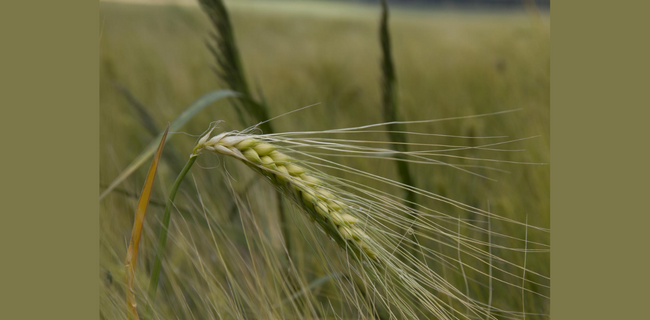
Barley is an important Rabi crop of northern plains of India. It is commonly grown in the states of UP, Rajasthan, MP, Bihar, Punjab, Haryana, HP and J&K. Barley thrives well in marginal, saline or alkaline soils and in water scarce areas as rain fed crop. It is also cultivated for malting and brewing purposes in Haryana, Western U.P., Punjab and Rajasthan with relatively better management to get good grain quality.


Roots:
Like other cereals, barley plants have a typical fibrous root system consisting of seminal roots and post-embryonic nodal roots. The former originate directly from the embryo radicle, whereas the latter are formed at later developmental stages from lower tiller nodes.
Leaves:
Barley is a type of grain that’s considered the fourth most important cereal crop around the globe (1). Also known as barley leaves and barley greens, barley grass is the leaf of the barley plant. It has been studied extensively for its beneficial health effects and is often featured in green juices and supplements.
Stem:
In the barley stem region, the vascular bundles are conjoint, collateral and closed. They also have the closed vascular bundles since they lack cambium in the stem. Cambium is the structure of cells that grow between the tissues of the xylem and the phloem. This cambium is used to form the secondary connective tissue between them in both the stem and the leaves.
Spike:
A raceme-like branchless shape and are therefore called a spike. Each spike is normally composed of spikelets arranged in two opposite rows along the main axis (rachis). Individual spikelets contain one or several florets, each producing one grain.
Awn:
Barley awns vary from awn less to awned with various shapes3. The awn shape can be hooded, crooked, leafy or straight. The hooded awns can be further distinguished into sub-types from normal hood-like to elevated hooded or subjacent hooded in shape. The straight awns can be single or branched, and long or short.
Glume:
Each flower of barley has two glumes, an outer and an inner one, surrounding the three stamens and the single ovary that later matures into the grain, which fills out the glumes and remains, in most cases, attached to them.
Climatic requirement:
Barley can be grown as summer crop as well as winter crop. This crop is mainly grown as summer crop in India. This crop requires temperature of 12oC to 16oC at growing stage and about 30oC to 32oC at maturity. This crop is very sensitive to frost at any stage of its growth. This crop yield is highly impacted by incidence of frost at flowering stage. Barley has very good tolerance to drought conditions.
Soil:
Sandy loam to loamy stand soils of Indo-Gangetic plains having neutral to mild saline reaction and medium fertility are the most suitable types for barley cultivation, however, it may be grown on a variety of soil types, viz; saline, sodic and lighter soils. Being salt resistant, its cultivation has become possible on saline coastal areas of Sun derban in West Bengal and saline black soils of canal irrigated areas of northern Karnataka.
Sandy Loam:

It is a combination of sand, silt and clay such that the beneficial properties of each are included. For instance, it has the ability to retain moisture and nutrients; hence, it is more suitable for farming. This soil is also referred to as agricultural soil as it includes an equilibrium of all three types of soil materials, being sandy, clay, and silt, and it also happens to have humus. Apart from these, it also has higher calcium and pH levels because of its inorganic origins.
Soil treatment:
Benefits of soil treatment- Some benefits of soil treatment are given below-
Water benefits-
- Healthy soil acts as a sponge: more rainwater is absorbed and stored in the ground, where it recharges groundwater and aquifers.
- Healthy soil prevents run-off and erosion, and reduces evaporation.
- Healthy soil improves water quality by filtering pollutants.
Nutritious food-
- Healthy soil increases the nutritional value of food and forage.
- Healthy soil provides plants with the nutrition they need and strengthens plants natural resistance to pests and diseases.
Economic security-
- Healthy soil improves farm productivity and provides stability.
- Healthy soil cuts down on inputs, which increases profit.
- Healthy soil helps withstand extreme weather, floods and drought.
Environmental and health benefits-
- Healthy soil helps reverse global warming by absorbing carbon from the atmosphere where it acts as a greenhouse gas.
- Healthy soil provides habitat for soil microbes to flourish.
- Healthy soil supports greater biodiversity and species stability.
Soil and land preparation:
In barley cultivation, field is prepared with disc harrow and cultivator followed by planking. As barley in sensitive to nitrogen and water hence, field should be well levelled. Levelling of field with laser land leveller is must for proper distribution and saving of water. Bunds are made to harvest and retain rain water in the field. In irrigated areas, field should be prepared after pre -sowing irrigation for proper germination. Farmers can sow barley on raised beds too with a specially designed raised bed planter for saving of seed, fertilizer and water.
Tractor drawn cultivator:

Cultivator is an implement used for finer operations like breaking clods and working the soil to a fine tilth in the preparation of seedbed. Cultivator is also known as tiller or tooth harrow. It is used to further loosen the previously ploughed land before sowing. It is also used to destroy weeds that germinate after ploughing. Cultivator has two rows of tynes attached to its frame in staggered form. The main object of providing two rows and staggering the position of tynes is to provide clearance between tynes so that clods and plant residues can freely pass through without blocking. Provision is also made in the frame by drilling holes so that tynes can be set close or apart as desirect. The number of tynes ranges from 7 to 13. The shares of the tynes can be replaced when they are worn out.
Disc Harrow :-
:

The disc plough bears little resemblance to the common mould board plough. A large, revolving, concave steel disc replaces the share and the mould board. The disc turns the furrow slice to one side with a scooping action. The usual size of the disc is 60 cm in diameter and this turns a 35 to 30 cm furrow slice. The disc plough is more suitable for land in which there is much fibrous growth of weeds as the disc cuts and incorporates the weeds. The disc plough works well in soils free from stones. No harrowing is necessary to break the clods of the upturned soil as in a mould board plough.
Laser Land Leveller:

Laser Land Leveller is a more advanced technique for smoothing the land surface from its average height with a certain degree of the desired slope using a guided laser beam throughout the field. Laser Land Levelling is an important technology for good agronomic, highest possible yield, crop-management, and water-saving.
Advantages of soil preparation-
- It loosens the soil.
- It aerates the soil.
- It prevents soil erosion.
- It allows easy penetration of roots into the soil.
Disadvantages of soil preparation-
The downside of tilling is that it destroys the natural soil structure, which makes soil more prone to compaction. By exposing a greater surface area to air and sunlight, tilling reduces soil’s moisture-retaining ability and causes a hard crust to form on the soil surface.
Selection of variety:
Most of the farmers even today are growing old barley varieties like Manjula, Azad, Jagriti (U.P.), BH 75 (Haryana), PL 172 (Punjab), Sonu & Dolma (H.P.) though their yield in quite low. Under such conditions farmer have to grow new varieties to get a better yield. An appropriate variety should be selected as per the requirement of the area, climatic & environmental conditions and use. In case of barley cultivation for industrial uses, proper malt type variety may be selected. Table containing improved barley varieties released in recent years has been given.
Barley varieties for different production conditions in India:
North Western Plains Zone (NWPZ): Punjab, Haryana, Delhi, Rajasthan (except Kota and Udaipur regions), Western UP, Tarai regions of Uttarakhand, Jammu and Kathua district of J&K and Una and Paonta valley of HP.
| Varieties | Production condition | Av. yield ( q/ha ) | Utility |
| RD 2794* | Irrigated, Timely sown,Salt tolerant | 29.90 | Feed |
| BH 946 | Irrigated, Timely sown | 51.96 | Feed |
| DWRB 92* | Irrigated, Timely sown | 49.81 | Malt |
| DWRUB 52* | Irrigated, Timely sown | 45.10 | Malt |
| RD 2668* | Irrigated, Timely sown | 42.50 | Malt |
| RD 2035 | Irrigated, Timely sown,Nematode resistant | 42.70 | Food & fodder |
| RD 2552 | Irrigated, Timely sown | 46.10 | Food & fodder |
| RD 2715 | Irrigated, Timely sown | 26.30 | Food & fodder |
| BH 902 | Irrigated, Timely sown | 49.75 | Food |
| BH 393( Haryana ) | Irrigated, Timely sown | 44.60 | Food |
| PL 426 (Punjab) | Irrigated, Timely sown | 25.00 | Food |
| RD 2592( Rajasthan ) | Irrigated, Timely sown | 40.10 | Food |
| RD 2052(Rajasthan) | Irrigated, Timely sown,Nematode resistant | 30.68 | Food |
| ND B 1173 | Irrigated, Timely sown,Salt tolerant | 35.20 | Food |
| DWRB 91* | Irrigated, Late sown | 40.62 | Malt |
| DWRB 73 | Irrigated, Late sown | 38.70 | Malt |
| DWRUB 64 | Irrigated, Late sown | 40.50 | Malt |
| RD 2508 | Rainfed, Timely sown | 23.10 | Food |
| RD 2624 | Rainfed, Timely sown | 24.89 | Food |
| RD 2660 | Rainfed, Timely sown | 24.30 | Food & fodder |
| PL 419 (Punjab) | Rainfed, Timely sown | 29.80 | Food |
North Eastern Plains Zone (NEPZ): Eastern U.P., Bihar, Jharkhand, Odisha, West Bengal, Assam and Plains of North Eastern States.
| BCU 73* | Irrigated, Timely sown | 21.60 | Malt |
| K 551 | Irrigated, Timely sown | 37.64 | Malt |
| RD 2794* | Irrigated, Timely sown,Salt tolerant | 29.90 | Feed |
| RD 2552 | Irrigated, Timely sown,Salt tolerant | 38.37 | Food & fodder |
| NDB 1173 | Irrigated, Timely sown,Salt tolerant | 35.20 | Food & fodder |
| K 508 (UP) | Irrigated, Timely sown | 40.50 | Food |
| NarendraBarley-1 (UP) | Irrigated, Timely sown,Salt tolerant | 22.30 | Food |
| NarendraBarley-3 (UP) | Irrigated, Timely sown,Salt tolerant | 35.00 | Food |
| NarendraBarely-2 (UP) | Irrigated, Late sown | 32.40 | Food |
| K 560 | Rainfed, Timely sown | 30.40 | Food |
| K 603 | Rainfed, Timely sown | 29.07 | Food |
| JB 58 (MP) | Rainfed, Timely sown | 31.30 | Food |
Northern Hills Zone (NHZ): Western Himalayan region of J&K (except Jammu & Kathua district), HP (except Una district andPoanta valley) Uttarakhand (except Tarai Regions) and Sikkim | |||
| BHS 400 | Rainfed, Timely sown | 32.71 | Feed |
| UPB 1008 | Rainfed, Timely sown | 26.44 | Feed |
| VLB 118 | Rainfed, Timely sown | 30.84 | Food |
| HBL 113* | Rainfed, Timely sown | 25.52 | Food |
| HBL 276** | Rainfed, Timely sown, Resistant to cold and rust diseases | 23.00 | Food & fodder |
| BHS 169 | Rainfed, Timely sown | 25.54 | Food |
| BHS 380 | Rainfed, Timely sown | 20.97 | Food |
| BHS 352** | Rainfed, Timely sown | 21.90 | Food |
| HBL 316 (HP) | Rainfed, Timely sown | 25.63 | Food |
| VLB 56( Uttarakhand ) | Rainfed, Timely sown | 25.80 | Food |
| VLB 85 | Rainfed, Timely sown | 15.60 | Food |
| Central Zone ( CZ): MP, Chhattisgarh, Gujarat, Kota & district of Rajasth an and Bundelkhand region of UP | |||
| RD 2786 | Irrigated, Timely sown | 50.20 | Food |
| PL 751 | Irrigated, Timely sown | 42.30 | Food |
| RD 2715 | Irrigated, Timely sown | 26.30 | Food & fodder |
| JB 58 (MP) | Rainfed, Timely sown | 31.30 | Food |
Seed and seed treatment:

Farmers have to use quality seed from better production. The better quality seeds could be obtained from National Seed Corporation (NSC), State Seed Farm Corporation (SFCI), research institutions agricultural universities and KVKs. Seed treatment is very essential to control the seed borne diseases in barley crop. For the control of loose smut (Kangiari), seed should be treated with Vitavax or Bavistin @2g/ kg seed. The covered smut can be controlled by seed treatment with 1:1 mixture of Thiram + Bavistin or Vitavax @ 2.5g per kg or 1gm Raxil/kg seed. Termite problem is observed in many fields, treat the seed with 150 ml of Chloropyriphos (20EC) or 250 in 5 litre of water for 100 kg of seeds to avoid the loss due to termite attack.
Seed rate, time of sowing, spacing and fertilizer requirement
| Production condition | Seed Time ofrate sowing(kg/ha) | Spacing(cm) | Fertilizerrequirement ( kg /ha ) | |
| Irrigated | ||||
| Timely sownMaltLate sown | 100100100 | 1-25 Nov.1-25 Nov.1-25 Dec. | 2318-2018-20 | 60 N:30 P:20 K80 N:40 P:20 K60 N:30 P:20 K |
| Rainfed | ||||
| PlainsHilly Region | 100100 | 25 Oct.-10 Nov. 20 Oct.-7 Nov. | 2323 | 30 N:20 P:20 K40 N:20 P:20 K |
In case of bold seeded varieties, seed rate should be kept higher.
N=Nitrogen, P= Phosphrous, K=Potash
Fertilizer application:
In irrigated areas, ½ N+ full P and K at the time of sowing and remaining ½ N after first irrigation. In rainfed condition, full NPK should be applied as basal at the time of sowing. In case of Zn deficiency, apply Zn SO4 @ 20 kg/ha. Application of other micronutrients should be done on the basis of soil testing and deficiency symptoms.
Method of sowing:
Sowing with a seed cum fertilizer drill is the best method of sowing. Another traditional method of line sowing in some areas is dropping seeds with a Chonga (a tube connected with a funnel like structure) behind country plough) attached to a desi-plough is also popular. Dropping seeds in open furrows behind desi-plough and broadcasting are found to be inferior compared to line sowing with seed drill. Soil should be made compact by planking or running a roller for better seed-soil contact.
Drilling method:

Seed drilling is a planting method that uses a seed drill to place seeds in the ground. The seed drill opens furrows in the soil and then deposits the seeds into the furrow. The seed drill also covers the seeds with soil to protect them from wind and animals.
Advantages of Drilling Method :-
- The seed rate becomes less.
- Drilling facilitates thinning and roughing of weak and diseased plants.
- The intercultural operations such as earthing up, manuring, irrigation, spraying etc. can be done successfully in the drilled crops.
- The drilled crops get light, air, nutrients equally as they are spaced at uniform distance.
- Harvesting of crops is easier and advantageous. So, harvesting cost becomes less.
- Drilling may be adopted for both sole cropping and intercropping situations.
- The cost of cultivation in drilled crop becomes less and the yield of drilled crop increases.
Disadvantages of Drilling Method
- Drilling requires more time, energy and cost.
- An expert technical person is required for running of a seed-drill.
- Drilling needs more time in comparison to broadcasting.
Broadcasting:

This method is as old as agriculture itself but it has several draw backs viz. all seeds do not get better soil moisture contact and do not germinate, a part of the seed is eaten up by birds and ants etc., which results in uneven and poor germination.
Advantages of broadcasting-
- It is an easy, quick, and cheap method of sowing seed.
- More land can be covered within a short time.
- No need for sowing implementation.
- Cost of sowing becomes less.
- Broadcasting is the usual method of sowing seed for mixed cropping.
- Broadcasting needs less labour.
Disadvantages of broadcasting
- The requirement of seed per area is more.
- The cost of weeding and thinning in the broadcast crop is more.
- The intercultural operations such as earthing up, manuring, irrigation, etc., cannot be carried out with ease.
- Broadcasting needs planking for covering the seed with soil. On the other hand, drilling needs no planking.
- Broadcast crops do not grow uniformly, and the desired yield is not possible. Moreover, the prediction of the expected outcome becomes erroneous.
Irrigation:
Barley can be grown under irrigated, rain-fed and limited irrigation conditions. Generally, it requires 2-3 irrigations for better yield. The malted barley requires 3 irrigations to ensure better yield, grain uniformity and grain quality. Depending upon the water availability irrigation should be given at suitable stages. In the dry area of Rajasthan, the number of irrigation should be increased to 5-6.
| No. of irrigation | Days after sowing | Stage of crop |
| 1 | 30-35 | CRI |
| 2 | 30-35, 65-70 | CRI, Panicle emergence |
| 3 | 30-35, 65-70, 90-95 | CRI, Panicle-emergence ,Grain formation |
Weed control:
Barley is a fast growing crop and generally weeds may not be able to compete if proper crop stand in maintained. If necessary weed control measures can be taken up.
| Nature of weeds | Herbicides | Dose(per / ha) | Method of application | |
| Narrow leaveAvena fatua (Wild Oat), Phalaris minor (Kanaki), Poa ghas, Lomar ghas | Pinoxaden (Axial 5 EC) | 87.5 ml | 30-35 days after sowing in 300 litres of water for one hectare. | |
| Broad leave Chenopodium album (Bathua), kharbathu, jangali 2,4-D (Weedmar) palak, maina, metha, malwa grass, makoi, kandai, Convolvulus arvensis (hirankhuri), Anagalis arvensis (krishna neel), Cronopus didymus (wild carrot), pyaji, chatari-matari | Metsulfuron (Algrip) | 10 gm 1250 gm | 30-35 days after sowing in 300 litres of water for one hectare. | |
| Both (broad and narrow leave) | Isoproturan1250 gm(Iso Guard 75 WP)Pendimethalin 3125(Stomp)3750 ml | 30-35 days after sowing in 300 litres of water for one hectare. 3 days after sowing |
Important points:
- Always use weed-free seeds for sowing.
- Spray herbicides at the proper time in the proper quantity with the appropriate spray technique.
- Rotate herbicides every year for better results.
- In crop rotations use forage crops such as berseem and oat for weed management.
- Use a flat fan nozzle for spray.
- In case of resistance in Phalaris minor against Isoproturan use Penoxaden (Axial) or Pendimethalin (Stomp).
Precautions:
- Do not mix Penoxaden with 2, 4 D, and spray 2, 4 D one week after the spray of Penoxaden.
- Do not use under/overdose of herbicide.
- Do not allow the seed formation of weeds in fields.
Spraying should be done within 30-35 days after sowing.
Insect-pests of Barley:
| S.No. | Name of Insects | Infected Crop Stage |
| 1 | Gujhia Weevil (Tanymecus indicus) | Seedling Stage |
| 2 | Termite (Macrotermes spp) | Soon after Sowing & near Maturity |
| 3 | Aphid (Opalsiphum maidis) | Growth Stages |
| 4 | Army Worm (Mythimna separata) | Milking Stage |
| 5 | Shoot Fly (Atherigona naqvii) | Seedling Stage |
Gujhia Weevil (Tanymecus indicus)
Identification: Weevils are earthen grey about 6.8 mm in length and 2.4 mm in width and Larvae are fleshy and creamy white. The pest is active from June to December and undergoes larval or pupal diapause during the rest of the year in the soil.

Nature of Damage
Only adults feed on the leaves and tender shoots of the host plants. They cut the germinating seedlings at the ground level. Often the crop is re-sown. The damage is particularly serious during October-November when the rabi crops are germinating.


Management of Gujhia Weevil
Cultural Control:
- Plough the fields in summer to expose and kill the pupae of Gujhia Weevil by Sunlight and heat.
Chemical Control:
- Seed treatment with Chlorpyriphos 20 EC @ 4.5 ml per kg of seed.
- Mixing of dust like Lindane 1.3 D @ 25-30 kg/ha in the soil before sowing.
- Foliar spray with Chlorpyriphos 20 EC @ 2-3 ml/litre of water as and when the infestation is noticed in the field.
Termite (Macrotermes spp)
Identification: Adults are creamy-coloured tiny insects resembling ants with dark-coloured heads. Newly hatched nymphs are yellowish-white and about 1 mm long.

Nature of Damage
Termites damage the crop soon after sowing and sometimes near maturity. They feed on roots, the stem of growing plants, and even dead tissues of plants and feed on cellulose. The damaged plants dry up completely and are easily pulled out. The plants damaged at later stages give rise to white ears.


Management of Termites-
Cultural Control:
- Deep ploughing of fields during summer.
- Three summer ploughings at 10 days intervals reduce the juvenile population of termites.
- Apply well rotten FYM only to discourage termite infestation. Avoid late sowing of crops. Destroy the crop residues which form the sources of infestation.
- Use of crude oil emulsion to destroy the termite colony in the termitarium.
Mechanical Control:
- Dismantle termitarium (termite mounds) around the field and kill the termite queen.
Biological Control:
- Apply Neem Cake @ 80 kg/acre.
- Spray Entomopathogenic nematodes (EPNs) @ 100 million nematodes per acre in termite-infested fields.
Chemical Control:
- Seed treatment with Dursban/Durmet 20 EC @ 4 ml per kg of seed is suitable for controlling termites.
- Dissolve 400 ml Chlorpyriphos 20 EC in 5 liters of water and spray it on one quintal seed and dry in shadow before sowing.
- Apply Chlorpyriphos 20 EC @ 2-3 litres/ha along with irrigation water into the field.
Aphid (Opalsiphum maidis)
Identification: Aphids are small, soft-bodied, pearl-shaped insects that have a pair of cornicles (wax-secreting tubes) projecting out from the fifth or sixth abdominal segment. Aphids are yellowish green, grey-green or olive green with a white waxy bloom covering the body.


Nature of Damage
The nymphs and adults suck the sap from plants, particularly from their ears. They appear on young leaves or ears in large numbers during cold and cloudy weather.


Management of Aphid
Cultural Control:
- The crop sown before 20th October escape the damage. Apply a recommended dose of fertilizers.
Mechanical Control:
- Destroy the affected parts along with the aphid population in the initial stage.
Biological Control:
- Releases of bioagent Chrysoperla carnea @ 50,000/ha two times at weekly intervals when aphid infestation is noticed.
Chemical Control:
- Foliar spray with Imidacloprid 17.8% @ 0.25 ml/lit of water OR Dimethoate 30 EC @ 1 ml/lit of water.
Major Diseases of Barley:
| S.No. | Name of Disease | Infected Crop Stage |
| 1 | Leaf rust (Brown) (Puccinia recondita triticina) | Vegetative Stage |
| 2 | Stripe rust (Yellow) (Puccinia striiformis) | Vegetative Stage |
| 3 | Loose smut (Ustilago nuda tritici) | Reproductive (Flowering Stage) |
| 4 | Powdery mildew – (Erysiphe graminis var. tritici) | Flowering, Fruiting, Seedling and Vegetative Stages |
Leaf Rust (Brown)
Symptoms:
The first symptom of the disease is the appearance of minute, round, orange sori, irregularly distributed on the leaves, rarely on the leaf sheath and stem. The sori turn brown with maturity.


Management of Leaf Rust (Brown)
Chemical Control:
- Seed dressing with Plantvax @2.5 g/kg of seed.
- Foliar Spray with Plantvax 20 EC @ 2 ml/lit of water OR
- Propiconazole 25 EC @ 1 ml/lit of water OR
- Zineb 75 WP OR Mancozeb 75 WP @ 2 g/lit of water to control the leaf rust of wheat.
Stripe Rust (Yellow)
Symptoms:
Mainly occurs on leaves then the leaf sheaths and stem. Bright yellow pustules (Uredia) appear on leaves at an early stage of the crop and pustules are arranged in linear rows as stripes. The stripes are yellow to orange-yellow.


Management of Stripe Rust (Yellow)
Chemical Control:
- Foliar spray with Mancozeb 75 WP OR Zineb 75 WP @ 2 g/lit of water OR Thiophanate Methyl 70 WP @ 1 g/lit of water OR
- Propiconazole 25 EC @ 1 ml/lit of water OR
- Tebuconazole 25 EC @ 1 ml/lit of water
Leaf Blight (Spot Blotch)
Symptoms:
Reddish-brown oval spots appear on young seedlings with a bright yellow margin. In severe cases, several spots coalesce to cause the drying of leaves. Primary spread is by externally seed-borne and soil-borne conidia. The secondary spread of this disease is by air-borne conidia.


Management of Leaf Blight (Spot Blotch)
Physical Control:
Sun Heating: The sun in May and June is very hot. The suspected grains are soaked in water in flat, shallow-bottomed basins with a water level about two inches above the level of the grain. The basins are placed in the direct rays of the summer sun for about 4 to 6 hours, say from 8 a.m. to 12 noon. During this period the dormant fungus mycelium becomes active. The water is then drained off. The softened grains are spread in thin layers on the brick floor in the midday sun to dry.
Chemical Control:
- Seed treatment with Carboxin 37.5 WP + Thiram 37.5 WP @ 1.5 g/kg of seed
- Foliar spray with Mancozeb 75 WP OR Zineb 75 WP @ 2 g/lit of water OR
- Propiconazole 25 EC @ 1 ml/lit of water at Boot Leaf Stage
Powdery Mildew of Wheat
Symptoms:
Greyish white powdery growth appears on the leaf, sheath, stem and floral parts. Powdery growth later becomes a black lesion and causes the drying of leaves and other parts.


Management of Powdery Mildew
Chemical Control:
- Foliar spray with Karathane 80 WP OR Triadimefon 25 WP @ 1 g/lit of water OR
- Bayleton 50 WP @ 0.5 g/lit of water at the appearance of the first symptom.
- Foliar spray with Imidacloprid 17.8% @ 0.25 ml/lit of water OR Dimethoate 30 EC @ 1 ml/lit of water.
Harvesting, threshing and storage
Barley crop gets ready for harvest by the end of March to the first fortnight of April. Since barley has shattering character, it should be harvested when it rips to avoid breaking of spikes due to dryness. Barley grain absorbs water from the atmosphere and should be stored at an appropriate dry place to avoid storage pest losses. For industrial purposes, choose an appropriate variety, sow and harvest timely with proper management.
Leave a Reply