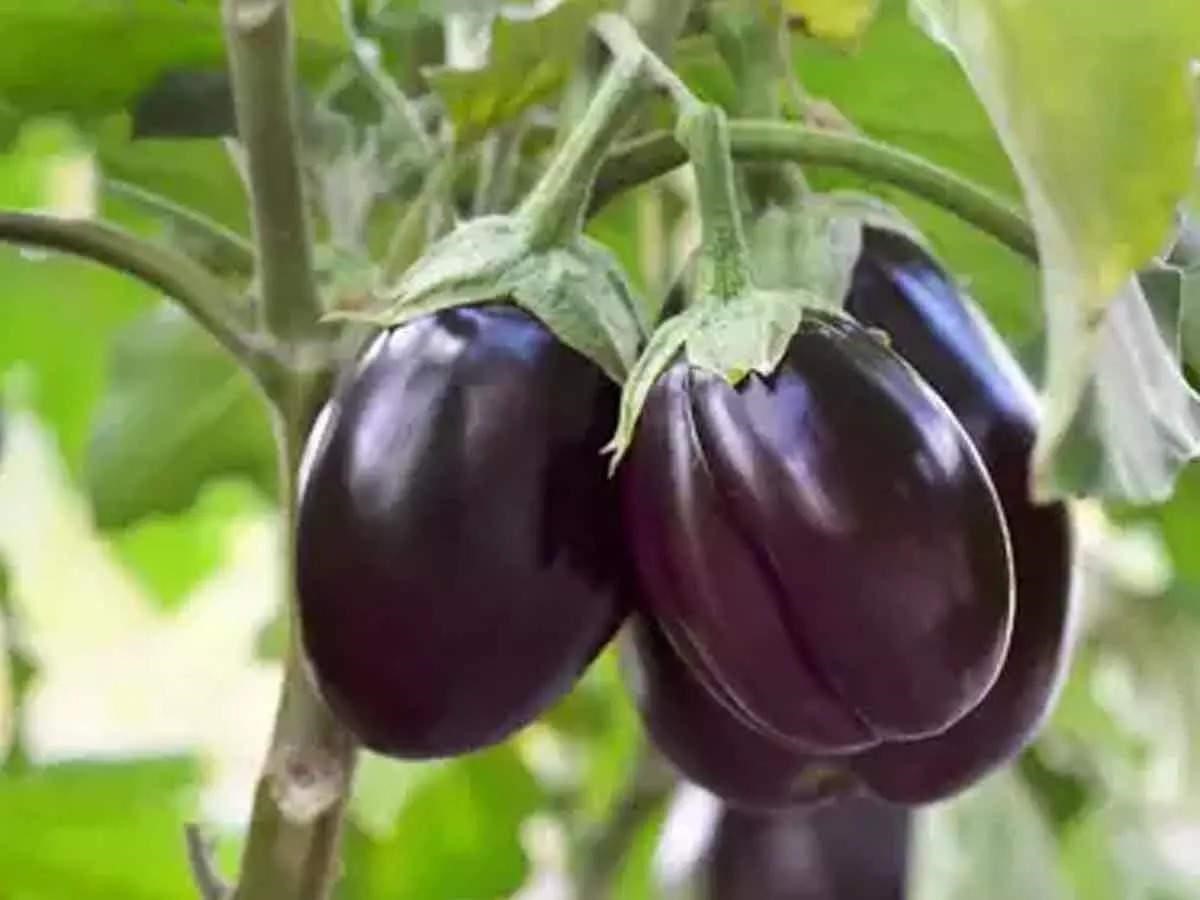
Irrigation should be applied in the brinjal field to save from water scarcity.
Attack of aphids can be seen during this period, check crop regularly for their infestation, if seen then apply safety precautions as given below-
Aphids


Nymph Adult
Description of Insect
Nymphs are small, yellowish or brownish on the undersurface of the leaves and on the terminal shoots and are mostly wingless. Adults are yellowish brown to black, 1.25 mm long with black cornicles and yellowish green abdominal tip. Both apterous (0.9-1.8 mm) and winged form (1.1-1.8mm) occur together.
Nature of Damage and Symptoms


Fig: 1&2- Colonies on undersurface of leaves.
- Both adults & nymphs suck sap from tender leaves, twigs & buds and weaken the plants.
- Complete reduction in reproductive growth.
Life History
Aphids live in colonies and the females multiply parthenogenetically and viviparously. In a day female may give birth to 8-22 nymphs. Nymphal period lasts for 7-9 days and the adults live for 12-20 days. In all, the pest has 12-14 generations per year. It is a polyphagous pest. Aphids produce sugary excretion called ‘honey dew’ on which sooty mould grows. Ant activity is associated due to the honey excretion by aphids. Ants transmit aphids from plant to plant. Aphids have a large host range with varying durations of development and reproductive rate.
Thrips


Description of Insect
- Eggs are minute, kidney shaped laid in slits in leaf tissues. Incubation period is 5 days.
- Nymphs are creamy to pale yellow in color, resemble adults but wingless.
- Nymphal Period: 5 days.
- Pupal period: 4-6 days.
- Adults are straw colored, yellowish brown and elongated
Nature of Damage and Symptoms
- Shrivelling of leaves due to scrapping of epidermis and desapping.
- Attacked terminal buds –have ragged edges.
- Silvery shine on the under surface of leaves.
Life History
Thrips thrive on the weeds during the off-season and migrate to cotton as soon as the seedlings emerge above ground. Males are rare and the reproduction is parthenogenetic. Eggs hatch in 5 days time, nymphal and pupal period lasts for 5 and 4-6 days, respectively. The preimaginal stage is spent in soil without feeding. The adults survive for 2-4 weeks. Life cycle of T. tabaci from egg to adult lasts for 13-19 days and they have about 15 overlapping generations per year including their development on wild plants. Thrips inhabit on leaves of cotton up to mid season and colonise on bolls during the late season.
Management-
- ETL: 50 nymphs or adults/50 leaves
- Seed treatment with imidacloprid 70 WS 7g/kg protect the crop from aphids, leafhoppers and thripsupto 8 weeks
- Spray any one of the following insecticides (500 l spray fluid/ha)
- Imidacloprid 200 SL @100 ml
- Methyl demeton 25 EC 500ml/ha
- Dimethoate 30 EC 500ml/ha
- NSKE 5% @ 2 kg/ha
Leaf eating caterpillar:

Some time Incidence of caterpillars is seen mostly at initial stage of crop.
To control spray with neem based pesticides. If those are not that effective and infestation become high then only take spray of chemicals pesticides like Emamectin benzoate@4gm or Lambda Cyhalothrin@2ml/1Ltr of water.
Fruit and Shoot Borer:

It is one of the major and serious insect pests of brinjal. A short pinkish caterpillar bores into the terminal shoot and eats internal tissue in initial stages, later it bores into the young fruit. The large holes can be seen on the infected fruits. The insect affected fruits become unfit for consumption. Scout field every week after transplanting for fruit and shoot borer infestation. Remove and destroyed infected fruits. Take spray of Triazophos@20ml/10Ltr water and Neem extract@50gm/Ltr, one month after transplanting. Repeat spray with interval of 10-15 days. When crop is in flowering stage take spray of Chlorantraniliprole 18.5%SC (Coragen) @ 5ml+Teepol @ 5ml in 12 Ltr of water, twice with 20 days interval.
In initial stage of infestation, take spray of 5% Neem extract@50gm/Ltr. If infestation is seen in field take sprayed of 25% Cypermethrin@2.4 ml/10Ltr of water on affected crops. For high population spray Spinosad@1ml/Ltr of water. Avoid spraying of Triazophos or any other insecticide after fruit maturation and harvest.
Leave a Reply