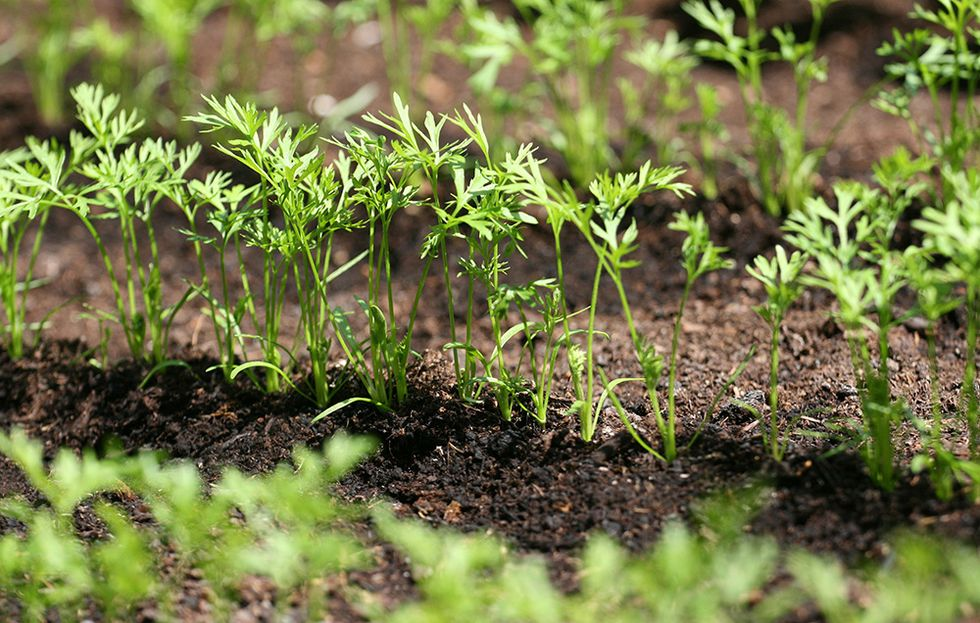
Method of sowing–
Carrots are sown in raised beds having a dimension of 1 meter breadth, any convenient length and raised from 15 to 30 cm. In order to have an evenly sown crop the seeds are mixed with dry/loose soil. Generally, there are two methods of sowing as described below:-
Broadcast Sowing:

In this method, the seeds are sown in lines with the help of a marker at a distance of 6 cm apart. The seeds are then covered with loose and friable soil of about 2-4 cm depending upon the rainfall and season. In this method, proper spacing is not maintained even after thinning out.
Row Sowing:

In this method, the seeds are sown in lines with the help of a marker at a distance of 6 cm apart. The seeds are then covered with loose and friable soil of about 2-4 cm again depending upon the rainfall and season, In this case, proper spacing can be maintained and after-care like weeding and thinning is easier.
Seed drill method:

Seed drilling is a planting method that uses a seed drill to place seeds in the ground. The seed drill opens furrows in the soil and then deposits the seeds into the furrow. The seed drill also covers the seeds with soil to protect them from wind and animals.
There are two main drilling methods of sowing seeds: push and pull drills. The push drill is operated by pushing the seed tube into the soil and then pulling it back out, while the pull drill is operated by pulling the seed tube through the soil. The choice of a push or pull drill depends on the type of soil and the amount of power available. In general, the push drill is better for harder soils, while the pull drill is better for softer soils.
Seeds Rate-
The carrot seeds that are Sowing or broadcast in the field with a seed rate of 5 to 6 kg /ha or it can be up to 6 to 9 kg/ha this depends upon carrot variety. The seeds are small, approximately 800 per gram. They remain viable for nearly three years and up to 85% germination. However, the germination of some local varieties may be inadequate. Therefore, it is necessary to ascertain the germination percentage when calculating the seed requirement. It is also necessary for the best results to procure clean, healthy, and viable seeds from reliable sources. The seeds take approximately 7-21 days for complete germination. The best seed germination occurs at 20-30°C. The best time for Carrots cultivation in India is in September.
Sowing depth-

Always plant your carrot seeds ¼ inch (6 mm) beneath the soil surface. Before planting, make sure the soil is tilled and loosened to a depth of at least 12 inches (30 cm). Never put your seeds right on top of the soil. They need to stay covered to properly germinate. Pushing your carrot seeds too deep into the soil will also prevent them from sprouting. Even if you do everything perfectly, garden carrots do not have a great germination rate. So, plant more seeds than you need. Then, thin each carrot plant once the seedlings start to grow.
Spacing

Rows are marked with spacing of 25 – 30 cm apart. Sow the seeds mixed with sand and it should be one part of seed with 4 parts of sand.
Fertilization management in carrot farming-
Fertilizer recommendations should be based on soil analyses.
Farm Yard Manure at the rate of 30 tonnes per hectare is applied at the final plowing, and dosage of 40 to 60 kg nitrogen, 25 to 50 kg of phosphorus, and 90 to 110 kg of potassium per hectare is recommended has a basal dosage, 2-3 tons of farmyard manure at the time of land preparation along with 50 kg nitrogen, 40 kg phosphorus, and 50 kg potash per hectare.
Half the dose of nitrogen and the full dose of phosphorus and potassium should be applied before sowing. The remaining nitrogen should be given 56 weeks after germination.
Carrot is a heavy potassium feeder. Potassium deficiency can affect the quality of the roots and disturb the overall metabolism of the plant. Potassium-deficient roots are less sweet, and the flesh does not have the desired luster.
Irrigation:
The first irrigation should be light and carried out immediately after sowing. Subsequent irrigations are given as needed.
Too much moisture causes short carrots with light color and a larger diameter. The frequency of irrigation depends upon soil type, season, and variety.
In general, one irrigation every 4-5 days in summer and 10-15 days in winter provides adequate moisture for the crop.
During the rainy season, only occasional irrigations are needed. Water stress should be avoided during root development to prevent cracking of the roots.
Management after planting-
Weeds must be controlled in a carrot field throughout the growing season, and require some post-plant control measures. Close cultivation and hand-hoeing are not practiced, because the injury to the crop is generally greater than the benefit received. An herbicide is generally applied before or after the crop emerges, depending on the weed species to be controlled.
Pre-emergence. Trifluralin can also be used as a pre-emergence herbicide in carrots. Sprinkler irrigation is required for incorporation and activation of the material, if it is applied after planting. This method will increase the activity on shallowly emerging weeds, such as common purslane, but will limit soil longevity and effectiveness on weeds germinating from deeper in the soil.
Linuron (Lorox) can be used for pre-emergence application. Crop safety is marginal; be careful not to exceed label recommendations on rate. This herbicide will control annual broadleaf weeds better than trifluralin, particularly nightshade, mustards, and sowthistle.
Monitor your field for some disease and insect/pest incidences-
Aphids:

Symptoms:
- Aphids of nymphs and adults stage suck the plant sap usually on the young growing and succulent plant parts.
- The young leaves, stems, buds, flowers, fruits or peaches get affected.
- The plants which are attacked by aphids show the symptoms of twisted, curled or swollen branches, leaves and stems.
Management:
Spray with Actara-0.5gm/lt or Dhanpreet -0.5gm/lt + Econeem plus-1ml/lt of water.
Aster leafhopper:

Nature and symptoms of damage:
Both nymphs and adults feed by inserting piercing and sucking the plant to extract sap. If a leafhoppers feed on an infested plant, it ingests the aster yellow pathogen. When the leafhopper moves to another plant to feed, it transmits the pathogen in its saliva. In carrots, disease symptoms appear about 3 weeks later. Symptoms may appear as early as 10 days after infection or as late as 40 days after infection.
Management:
Aster leafhoppers may effectively be controlled by excluding them from carrot planting with floating row covers. Place the yellow sticky cards in the field early in the spring when plants are newly sprouted. Remove weeds from the field edges as these may be reservoirs for the pathogen.
Leave a Reply