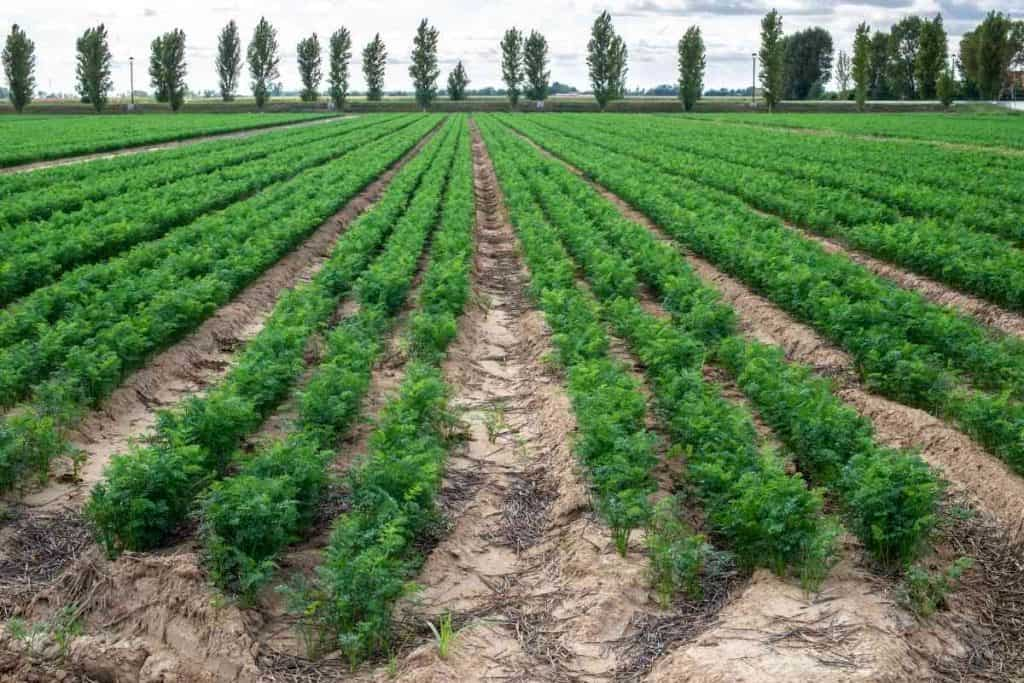
Control your crop weeds by following recommendations-
Post-emergence:
Following crop emergence, fluazifop-P-butyl (Fusilade) can be applied for grass control, and linuron (Lorox) for annual broadleaf weeds and yellow nutsedge. Fluazifop-P-butyl is effective in controlling small seedling annual grasses and some perennial grasses. Effectiveness is reduced when grasses are under moisture stress. Later growth stages of annual grasses are more difficult to control. Follow label instructions regarding the use of adjuvants with fluazifop-P-butyl.
Linuron can also be used as a post-emergence herbicide in carrots. It is applied over the top of the crop when the carrots are 3 inches tall. It controls emerged weeds, and also has soil residual activity against later emerging weeds. Linuron will control (suppress) yellow nutsedge, but has little to no effect on purple nutsedge. A repeat application is allowed, but a total of 3 lb a.i./A is the limit per season. Some carry-over can occur under certain conditions, creating a plant-back problem. Consult the herbicide label before application.
Irrigate your crop at this stage for better growth and development. Water supply is particularly important during this period of time.
Leaf hoppers (Plant hoppers):

Symptoms:
- The wedge shaped pale green leafhoppers lay eggs on the leaves.
- Later both adults and nymphs suck the sap from undersides of the leaves, from green stems and remove tissues from infested parts.
- While infesting they secrete and leave toxic sticky saliva called honeydew that may cause sooty mold to develop.
- The leaves of infested plants turn yellow with white spots,get twisted, and the plants become stunted.Under severe infestations the leaves may get burned which is often referred as “hopper burn”/”Tip burn”
Management:
Spray with Sanvex sp-1.5-2gm/lt or Media-0.75-1ml/lt + Econeem plus-1ml/lt of water.
Cercospora Leaf Blight (Cercospora carotae):

The disease produce severe blighting on carrot leaves and petioles if wet weather is prolonged during the growing season. Entire leaves and petioles may die on severely infected plants. The symptoms first appear along the margins of the leaves, often causing the leaves to curl. Spots inside the leaf edges are small, roughly circular, and tan or gray to brown with a dead center. As the lesions increase in number and size, the entire leaflet withers and dies. The fungus attacks younger leaves and plants in preference to older ones. In heavily infested fields, however, both older and younger leaves are subject to attack. The pathogen also produces lesions on the petioles and stems. The lesions may merge and girdle the stems, causing the leaves to die.
Control:
The leaf blight pathogens can survive from one year to the next in infected plant debris. Therefore, a two-to three-year rotation is recommended to allow for natural decline in the pathogen population. The use of disease-free seed is strongly recommended because the fungus can survive on or in the seed. Early applications of Foltaf (0.2%), Copper Oxychloride (0.3%), starting at the first sign of infection, effectively control leaf blights on carrots. Best control is achieved when fungicides are applied at high pressure and in sufficient water to reach the lower leaves in a dense canopy
Powdery Mildew (Erysiphe polygoni):

The symptoms appear as white powdery growth on the leaves and petioles causing the leaves to turn brown and wilt.
Control:
Spraying Bavistin (0.1%) or Benlate (0.1%) at an interval of 8-10 days effectively controls the disease.
Leave a Reply