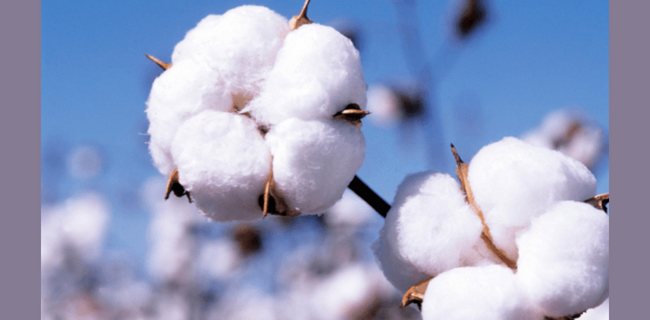
Types of cotton–
There are four commercially grown species of cotton, all domesticated in antiquity:
- Gossypium hirsutum – upland cotton, native to Central America, Mexico, the Caribbean and southern Florida (90% of world production)
- Gossypium barbadense – known as extra-long staple cotton, native to tropical South America (8% of world production)
- Gossypium arboreum – tree cotton, native to India and Pakistan (less than 2%)
- Gossypium herbaceum – Levant cotton, native to southern Africa and the Arabian Peninsula (less than 2%)
Growth stages of Cotton
Cotton is an indeterminate plant exhibiting overlapping vegetative and reproductive growth phases and these phases cannot be clearly demarcated. The duration of the different phases depends upon the variety, latitude, climate and management practices. These phases can broadly be differentiated into:

Germination phase
Under optimum ambient conditions, the germination and the emergence are completed in 4-7 days.
Early vegetative phase
This phase is characterized by a rapid root growth, slow growth of the main shoot and emergence of the first true leaves. This is followed by the growth of main stem and the differentiation of early monopodial branches.
Squaring
The first square (flower bud) appears between 35 and 70 days after germination depending on the variety location and crop husbandry. The squaring continues till maturity.
Flowering
The first flower appears about 20-35 days after appearance of the first square and flowering continues for about 60-80 days or more depending upon the availability of soil moisture. However, the peak flowering period is from 70-100 days after germination.
Boll development
This period commences from flowering and continues till maturity. During the first 15-18 days after the fertilization of the flower, bolls attain 90 per cent of their final size. The elongation of lint fibres in the boll is completed in 21-24 days. During the subsequent phase of approximately the same direction, the cell wall thickens due to the deposition of cellulose. The boll cracks on maturity along the locules and the fibres ultimately dry out and become ready for picking.
Climatic Requirements
A daily minimum temperature of 16o C is required for germination and 21o C to 27o C for proper crop growth. During the fruiting phase, the day temperature ranging from 27o C to 32o C and cool nights are needed.
The cotton picking period from mid-September to November must have bright sunny days to ensure a good quality of the produce.
Roots-

- Cotton has a taproot grows quickly and it can reach a depth of 20-25 cm before the seedling has even emerged above ground. After emergence and unfolding of cotyledons, lateral roots begin to develop; they first grow side ways and then down wards. The taproot continues to grow rapidly.
- Final depth of root system depends on soil moisture, aeration, temperature and variety but is usually about 180-200 cm.
- Under dry growing conditions, cotton roots have been known to reach a depth of 3-4 m.
- When soil moisture is adequate, most of the lateral roots are concentrated in the upper soil layer to a depth of 30-35 cm and may extend laterally to 100 cm and more. Under dry growing conditions lateral roots penetrate much more deeply.
- Factors affecting vegetative growth also influenced root growth of cotton plant.
- The growth of tap root as well as lateral roots is affected by excessive, moisture, hard dry soil layer and degree of soil alkalinity. Lateral roots adjust their quantum to the plant spacing and soil moisture regimes.
- Under conditions of water saturation and submersion, the laterals get asphyxiated and die but are regenerated when the optimum conditions reappear.
Stem-

- Cotton plant consists of an erect main stem and a number of lateral branches. The stem has a growing point at its apex, with an apical bud. As long as this bud remains active, lateral buds situated below the apical bud, remain dormant. The main stem carries branches and leaves but no flowers.
- Length and number of internodes determine the final height of the plant. As a rule plant with short internodes are early maturing.
- Length of internodes is determined mainly by the moisture supply while the number of internodes is usually a function of nitrogen supply to the plant.
- At the axil of each leaf are two buds, the axillary bud from which most vegetative and fruiting branches develop and a lateral bud on one side of axillary bud normally remains dormant; but if the axillary aborts, the lateral and may develop into a branch.
- Vegetative branches are morphologically similar to the main stem. They do not bear flowers or fruits directly, but carry secondary branches (fruiting branches), that are characterized by their sympodial growth habit.
- The fall in the growth rates noticed in the later half of the season is attributed to the deflection of carbohydrates from apex of the plant and the lateral apices of branches, to the developing bolls
Leaves-

| Cordite, petiole, three to nine lobed and palmately veined.Size, texture, shape and hairiness vary a great deal.Glands occur on leaves, bracts, petioles, stems and cotyledons.Nectarous are present on leaf calyx and bracts.Each leaf has two buds at its axis. |
- Leaves are generally hairy, some varieties may have glabrous leaves. Hairy leaves cause fewer difficulties in mechanical harvesting but are more tolerant to Jassids, but bear larger proportions of white fly which apparently find more sheltered conditions among the leaf hairs.
Branching

- Lateral branches arise from the axils of the leaves of main stem.
- Lateral branches consist of two types viz., Vegetative and fruiting.
- Vegetative branches are more vertical and ascending.
- Fruiting branches are nearly horizontal.
- Fruiting branches the internodes are not straight as in main stem but have a zig zag appearance with the leaves alternately placed.
- Economic importance of sympodial branching is great. The flowering and fruiting are dependent on the initiation of such branches and the timing or the crop for harvest is determined by the early or late production of such sympodial on the plant body. Very early varieties have their fruiting branches even at first or second node to the total exclusion of vegetative branching from leaf axils, similarly very late varieties go on producing a very large number of monopodial before sympodial divergence appear. In such cases, the late sympodial on the main stem and the secondary sympodial arising on the monopodial will contribute to the harvests.
- As a rule, the vegetative branches are located near the base of the plant and above these are fruiting branches. In most upland varieties, the first fruiting branch generally develops on the 5th to 7th node whereas in ‘Egyptian varieties’ it is located on 8th or 9th node. In dense stands, the first fruiting branch generally develops at a higher level than in more open stands.
- Relative proportion of vegetative and fruiting branches is dependent on temperature, day-length, plant density and the rate of boll shedding.
Flower bud-

| Floral bud is enclosed in and protected by, three triangular bracts. The whole structure is called a “SQUARE” within the bud are the five petals of the corolla, wrapped tightly around one another. |
- Within the corolla is a tube formed of numerous stamen filaments, surrounding the pistil.
- The ovary at the base of the pistil consists of from two to six carpels, containing a many locales or “Locks”. Each lock contains from 8-12 ovules.
- Flower is large, axillary, terminal and solitary.
- On account of the sympodial development of fruiting branches, the flower opening follows a spiral course in acropetal and centrifugal succession.
- The innermost bud of the lowest and oldest branch is the first to open while the outermost bud of the highest and youngest branch is the last to do so.
Fruit-

- Bolls of Hirisutum are large (5-8 g), pale green, smooth – skinned and with few oil glands. Bu contrast bolls of arboreum are much smaller (3 g) dark green, covered with numerous glands.
- Cotton plants by its remarkable auto-regulatory mechanism shed the bolls that are in excess of the load capacity of the plant under given environmental conditions. As a result, the ratio of bolls to total vegetative growth is fairly constant.
- In general, varieties or strains with large bolls do not adjust so well to change in environment and to stress, as do types with smaller bolls. Hence, shedding will occur more readily and to a large extent in the former than in the latter case.
- The development of fruit (boll) begins with the fertilization, and shedding of withered floral organs enclosing it.
- Bolls developing under falling temperature will lead more days to mature than those growing under rising temperature. The big – bolled American types in India take about 55 days while the Asiatic cottons require only 45 days which may further reduced to 35 days under higher soil and atmospheric temperatures. It may however, be stated that the first half period of maturation of a boll is spent in growth and the second half in internal development without any changes in the boll size.
- The boll consists of four to six locales each of which contains number of seeds. Majority of Asiatic cottons has only upto 7seeds per locales. A fair percentage of the seeds remain undeveloped due to non-fertilization, heredity and environment. These are called “motes”.
Seed-

- The full-grown seed is irregularly pear – shaped, varying in size depending on the variety and conditions of growing.
- It may be naked or bear short hairs called “fuss”. All cultivated cottons bear long fibres named “lint” and a majority of them have also fuzz of the same seed.
- The lint is removed by gins while the fuzz remains attached. The colour of fibres may be white, brown or green and that of the seed is usually grey, brownish or black.
- The mature seed has two cotyledons folded up and occupying the entire portion of its cavity.
- They are broad and kidney – shaped. Delayed germination in some of the species and varieties may be due to hard seed coat, closed micropyle and partially filled cotyledonary – cum – embryonic contents.
- The first two retarded the passage of water required for germination while the ill – developed contents were unable to swell rapidly and exert the requisite pressure for the early rupture of the hard coat necessary for the proper emergence of the plumule.
- The germination increased when the seed coat thickness was reduced by treatment with sulphuric acid or by abrasives or by partial removal .
- The seed account for about 65 to 70 per cent of the total yield by weight.
- The kernels are rich in protein (10-20%) and oil (upto 25%). Egyptian cottons usually have higher oil content than hirsutum cottons.
Seed Hairs-

- Lint and fuzz represent the outgrowths of epidermal cells on seeds. Some cells continue to lengthen while other stops growing after at time. The former are the lint and the latter the fuzz.
- The lint hair is unicellular and its development is phased in two stages, the first is a period of elongation and the second in thickness.
- A lint cell bulges first, the protoplasm inside turns granular, and the nucleus moves towards the bulge. The swelling enlarges until it is twice the diameter of the original cell and the nucleus moves to or near the tip.
- The elongation of cell may take about 24 days, thereafter ceases. There is no change in thickness. The growth is not regular; slow at first but fast from about the 15th day The rate slackens during days and quickens during nights.
- The cell wall thickens in the second half of boll maturation. Deposits of cellulose are formed on the inside of primary wall.
- They are laid in layers as seen from some fibres showing as many as 25 concentric layers.
- As soon as the boll dehisces, the hairs dry, collapse and flatten the cylindrical from, assuming ribbon like shape and go into spirals.
- The mature hair is uniform in diameter upto 3/4th length and then gradually tapers to a point.
- Lint at maturity contains three types ripe, half ripe and unripe fibres known as dead fibres, have thin walls, lack twist and are weak, with a tendency to break up during manufacture.
- The length of lint is a varietal character and varies from 5-50 mm.
- The fuzz may either cover the entire seed coat as in hirsutums or be concentrated in a single tuft at the hilum end of the seed as in barbadense.
Glands
- On all aerial parts of cotton plants are found internal glands which in different species vary in size, number, distribution and pigmentation.
- These glands secrete a volatile oil (gossypol) and related compounds. Gossypol is a poly phenolic yellow pigment and is toxic and hence, gladness varieties have been bred in recent years.
- However, it has been formed that gladness varieties are susceptible to a wide range of pests over the glanced varieties.
Cotton plant with different parts-

Important hints-
• Grow only recommended varieties/hybrids of cotton.
• Heavy pre-sowing irrigation is must to obtain good germination and early establishment of plants.
• Complete the sowing by 15 May.
• Give first irrigation 4-6 weeks after sowing depending on soil type. Last irrigation in September is must.
• Avoid growing bhindi, moong, arhar, castor and dhaincha in and around the cotton fields to avoid simultaneous build up and spread of pests and diseases to cotton.
• Give 4 sprays of 2% potassium nitrate (13:0:45) solution starting at flower initiation at weekly interval.
• The incidence of insect pests increases with excessive use of nitrogenous fertilizers, hence use only recommended dose.
• Regular monitoring is effective strategy for the management of whitefly, pink bollworm and mealybug. Avoid using synthetic pyrethroids before September 15 to minimize resurgence of whitefly. Use recommended insecticides.
• Avoid tank mixing and use of readymade insecticidal mixtures.
Soil Type
Cotton can be successfully grown on all soils, except sandy, saline or waterlogged types. Proper drainage of excess water during rains is essential.
Rotations– Cotton–Wheat/Barley, Cotton–Sunflower, Cotton–Senji/Berseem/Oats, Cotton-Raya, Cotton–Sunflower-Paddy-Wheat
Improved Varieties– Bt cotton variety PAU Bt 3 (2022): It is a Bt cotton variety with inbuilt resistance against spotted and American bollworms. Its average seed cotton yield is 10.2 quintals per acre. Its average fibre length is 26.2 mm and ginning out turn is 36.5 %. It is tolerant to jassid and cotton leaf curl disease.
PAU Bt 2 (2022): It is a Bt cotton variety with inbuilt resistance against spotted and American bollworms. Its average seed cotton yield is 10.0 quintals per acre. It possesses average fibre length of 27.6 mm and ginning outturn of 34.4 %. It matures in 160-165 days. It is tolerant to jassid and cotton leaf curl disease.
PAU Bt 1 (Adhoc release): It is the first Bt cotton variety developed by public sector with inbuilt resistance against American and spotted bollworms in the country. It has bigger boll size of 4.3 g and ginning out turn is 41.4%. It possesses superior fibre properties with 28.2 mm fiber length, 28.6 g/tex bundle strength and 4.5 µg/inch micronaire value. Its’ average seed cotton yield is 11.2 quintals per acre. It is moderately resistant to cotton leaf curl disease.
Non-Bt cotton F 2228 (2015): Its’ maturity period is 180 days with an average seed cotton yield of 7.4 quintals per acre. It is moderately resistant to jassid and bacterial blight.
LH 2108 (2013): It matures in 165-170 days with an average seed cotton yield of 8.4 quintals per acre.
Agronomic Practices– Sub Soiling: Cross sub soiling at 1.0 m spacing should be done before preparing the field. This is done by tractor drawn sub-soiler (chiseler) to the depth of 45-50 cm. Give planking to break the clods and then prepare fine seed bed. This will help in breaking the hard pan, increasing water infiltration rate and better root development of cotton plants.
Land Preparation: A fine seed-bed is essential for securing a good plant stand.
Time of Sowing: Sow the crop during 1 April to 15 May. Sowing during this period ensures better yield and escapes the attack of insect pests and diseases. Sowing should be done in morning and evening hours.
Seed Rate: Use following quantity of seed:
Cultivars Seed rate (kg per acre) Bt varieties PAU Bt 1, PAU Bt 2 Bt hybrids Recommended hybrids 0.900+0.240 (refuge)* or two pouches of 475 gram each** Non-Bt varieties F 2228 and LH 2108 3.5 * Grow non-Bt cotton as a refuge around Bt cotton variety/hybrids to avoid evolution of resistance in bollworm to Bt toxin. ** Already mixed refuge in seed.
Acid Delinting of Seed: Mix 100 g commercial grade concentrated sulphuric acid with 1 kg cotton seed in earthen/ plastic container by stirring it vigorously for two to three minutes with a thick wooden stick. As soon as the fuzz gets dissolved, add 10 litres of water, stir well and drain out water through the perforated plastic basket. Repeat these washings three times to make the seed free from sulphuric acid residue. Dip the washed seed for about one minute in sodium bicarbonate solution (12.5 g sodium bicarbonate in 2.5 litres of water) to neutralize the acid residue on the cotton seed. Give one more washing with water and remove light, damaged and rotten inviable seeds floating on the surface. Dry the healthy fuzz-free seed in the shade by spreading in a thin layer.
Adopt following precautions: • Metal or wood container should not be used.
• The operator should wear the plastic gloves.
• The water containing acid and alkali residue should be properly disposed off in the waste land.
• Inadequate washing and delayed washing of the seed after acid treatment and residual acid on the seed if not neutralized may impair the germination of seed or rub the non-delinted seed with fine earth, cow-dung or ash to remove its fuzz and ensure uniform sowing.
Seed Priming: Soak the seed in a solution of 0.5 g succinic acid and 5 litres of water for 2-4 hours in case of acid delinted seed or 6-8 hours in case of non-delinted seed to promote good establishment of plant stand, better early growth and more yield. In soils irrigated with sodic water (RSC > 2.5 meq per L), treat the seed with the liquid bioformulations azobacter, phosphorous solubilizing bacteria (Azo+PSB+ZnSB)* along with gypsum (25% of Gypsum Requirement) application. This will reduce the adverse effects of sodic water irrigation while sustaining soil health and cotton productivity in cotton-wheat system.
Note: The liquid bioformulations are available at ICAR-CSSRI, Regional Research Station, Lucknow at a nominal price. Seed should be smeared with 5 g Gaucho 70 WS (imidacloprid) or 7 g Cruiser 30FS (thiomethoxam) per kg seed for preventing damage by cotton jassid.
Sowing and Spacing: Sow in lines 67.5 cm apart with a cotton sowing drill or cotton planter. The plants of non-Bt varieties within rows be kept 60 cm apart during thinning, whereas for PAU Bt 1, plants within row be kept 45 cm apart and for PAU Bt 2 and PAU Bt 3, plant to plant spacing within row be kept 30 cm apart after thinning. However for Bt hybrids, plant-to-plant distance should be kept at 75 cm. Thinning may be done after first irrigation or heavy shower.
The non-Bt hybrids should be protected against damage by insect pests as mentioned in case of non-Bt cotton hybrids. Alternatively, 5 per cent area of non-Bt hybrids can be sown around Bt cotton and this should be kept unsprayed. The refuge should be non-Bt version of the same variety/hybrid. If it is not possible, the farmers can use non-Bt varieties like F 2228 and LH 2108 as refuge.
Intercropping: Intercrop one row of maize/cowpea for fodder in cotton sown at row to row spacing of 67.5 cm for getting higher income as compared to sole cotton. Apply recommended fertilizers to cotton and intercrops on area basis.
Ridge sowing: Sowing of cotton on ridges prepared with cotton planter and irrigating the crop in furrows saves considerable amount of irrigation water without reduction in seed cotton yield. Transplanting of cotton seedlings: For gap filling, 3 week old nursery grown in 4”x6” polythene bags, filled with 1:1 mixture of soil and FYM, can be transplanted.
Weed Control: Hoe the crop two or three times. The first hoeing should be done before first irrigation. Use tractor mounted cultivator/ tractor operated rotary weeder/triphali or wheel hand hoe for weeding. Their use after fruiting should be avoided. For control of weeds particularly itsit, madhana/makra, apply 1.0 litre per acre Stomp 30 EC (pendimethalin) as pre-emergence within 24 hours of sowing. In situations where weeds emerge after first irrigation or with the rain shower, Stomp 30 EC can also be applied as post-emergence after first irrigation in 200 litre of water. If some weeds emerge before the application of the herbicide, a light hoeing/interculture may be done. The herbicide can also be sprayed with tractor mounted sprayer fitted with flat fan nozzle either in morning or evening hours. Ensure a fine seed bed free from plant residues and clods, adequate moisture in the field at the time of spray of herbicides. Alternatively, spray 500 ml per acre Hitweed Maxx 10 MEC (pyrithiobac sodium 6%+quizalofop ethyl 4%) by dissolving in 150 litres of water after first irrigation, in moist soil, to control annual grass and broadleaf weeds. This herbicide also provides effective control of lapeta (guara) vel (Ipomoea sp.) when weed plants are at 2 to 5 leaf stage. Alternatively, at 6-8 weeks after sowing when the crop is about 40-45 cm in height, spray 500 ml per acre Gramoxone 24 SL (paraquat) or 900 ml per acre Sweep Power 13.5 SL (glufosinate ammonium) in 100 litres of water as a directed spray to control weeds in between the crop rows. The directed spray can be done by using a protective hood. Paraquat and glufosinate are non-selective herbicides and can cause injury to the crop if these fall on the crop leaves.
Fertilizer Application: Apply fertilizer on soil test basis- The fertilizer recommendations for medium fertility soils are as under: *Nutrients (kg per acre) Fertilizers (kg per acre) N P2 O5 Urea DAP or Single Superphosphate Non-Bt varieties 30 12 65 27 75 Bt varieties 37 12 80 27 75 Bt hybrids 42 12 90 27 75 * These nutrients can also be supplied from other fertilizers available in the market (Appendix IV).
Note:
• Omit application of phosphorus to cotton when it follows wheat which had received recommended dose of phosphorus. Where 27 kg DAP is used, reduce the urea dose by 10 kg.
• Apply 20 kg muriate of potash and 10 kg zinc sulphate heptahydrate (21%) or 6.5 kg zinc sulphate monohydrate (33%) per acre to cotton in light soils. Drill all phosphorus at sowing. Apply 25 kg magnesium sulphate as basal dose at the time of sowing. Apply half nitrogen at thinning and remaining half at the appearance of flowers. If the soil is low in fertility, the first half dose of nitrogen may be applied at sowing instead of at thinning. Apply 400 g boron (4 kg borax) per acre at sowing to boron deficient (<0.5 kg available boron per acre) calcerous soils having 2% or more calcium carbonate. However, boron should not be applied indiscriminately, as excessive boron application may cause toxicity.
To get higher yields, give 4 sprays of 2% potassium nitrate (13:0:45) at weekly interval starting at flower initiation. For high yield and management of leaf reddening in Bt cotton, give 2 sprays of 1% magnesium sulphate (1 kg magnesium sulphate in 100 litres of water per acre) at 15 days interval during full bloom and boll development stages.
Use of growth retardant: In heavy soils, cotton attains excessive vegetative growth during rainy season. Thick crop canopy prevents the penetration of sunlight which results in shedding of flower buds, flowers or bolls and ultimately causes yield reduction. To check excessive vegetative growth in heavy soils, give 2 sprays of 300 ml per acre Chamatkar (mepiquat chloride 5% w/w) at 60 and 75 days after sowing using 80-100 litres of water.
Irrigation and Drainage– Cotton requires 4-6 irrigations depending upon the seasonal rainfall. The first irrigation should be given 4 to 6 weeks after sowing and the subsequent ones at interval of two or three weeks. However on light soils or in crop sown on ridges, the first irrigation may be advanced, if necessary.
Sowing cotton on ridges and irrigation in furrows save considerable amount of water.
Under poor quality irrigation water conditions, give pre-sowing irrigation with canal water and subsequent irrigations can be applied with poor quality tube well water in alternate furrows. In soils irrigated with saline water (EC upto 10 dS/m), application of 16 quintal per acre of rice-residue biochar reduces adverse affect of salinity and increases seed cotton yield.
The crop must not be allowed to suffer from water stress during the flowering and fruiting stages, otherwise a lot of shedding of flowers and bolls will take place resulting in low yield. Cotton during its early growth is very sensitive to water stagnation. Therefore, drain out the stagnant water if such a situation arises. To hasten boll opening, give the last irrigation by the end of September.
Water stress management through Salicylic acid: To minimize loss of cotton yield owing to water stress (due to no rainfall or sudden canal closures), dissolve 12.5 g Salicylic acid in 375 ml of Ethyl alcohol and then add it to 125 litres of water for spraying crop per acre on stress appearance. Caution: Application under well watered conditions may not increase yield.
Plant-Protection
Fusarium wilt: Fusarium oxysporum f.sp. vasinfectum


Symptoms
- Initial symptoms on young seedlings are yellowing and browning of cotyledons, followed by brown ring on the petiole.
- Finally wilting & drying of the seedling occurs. Symptom at later stages includes loss of turgidity, yellowing, drooping and wilting starting from older leaves.
- Browning or blackening of vascular tissues occurs on the stem and spreads upwards and downwards. Infected plants appear stunted with fewer bolls.
Management
- Treat the acid-delinted seeds with Carboxin or Carbendazim at 4 g/kg.
- Remove and burn the infected plant debris in the soil after deep summer ploughing during June-July.
- Apply increased doses of potash with a balanced dose of nitrogenous and phosphatic fertilizers.
- Apply heavy doses of farm yard manure or other organic manures at 100t/ha.
- Spot drench with 0.05 % Benomyl or 0.1 % Carbendazim.
Verticillium wilt: Verticillium dahlia

Symptoms
- It affects the crop in square and boll formation stages
- Bronzing of veins followed by interveinal chlorosis, yellowing and scorching of leaves
- Leaves exhibit drying of leaf margins and areas between veins known as “Tiger stripe symptom”
- Affected plants remain barren showing pinkish discoloration in stem and wood. It may produce smaller bolls
Management
- Treat the delinted seeds with Carboxin or Carbendazim at 4 g/kg.
- Remove and destroy the infected plant debris after deep ploughing in summer months (June-July).
- Apply heavy doses of farm yard manure or compost at 100t/ha.
- Follow crop rotation by growing paddy or lucerne or chrysanthemum for 2-3 years.
- Spot drench with 0.05 % Benomyl or 0.1 % Carbendazim.
Root rot: Rhizoctonia bataticola (Pycnidial stage: Macrophomina phaseolina)


Symptoms
- Germinating seedling shows black lesions on hypocotyls, girdling of stem and death of seedlings.
- Affected basal stem becomes dark with bark shredding and scloretial bodies in the shredded bark.
- The entire root system gets rotted, plants dried & can be easily pulled out
Management
- Treat the seeds with Trichoderma viride @ 4g/kg or Pseudomonas fluorescens
@ 10g/kg of seed. - Treat the seeds with Carboxin or Thiram at 5 g or Carbendazim at 2g/kg.
- Spot drench with 0.1% Carbendazim or 0.05% Benomyl.
- Apply farm yard manure at 10t/ha or neem cake at 2.5t/ha.
- Adjust the sowing time, early sowing (First week of April) or late sowing (Last week of June) so that crop escapes the high soil temperature conditions.
- Adopt intercropping with sorghum or moth bean (Phaseolus aconitifolius) to lower the soil temperature.
Grey or Areolate mildew: Ramularia areola


Symptoms
- Irregular to angular pale translucent lesions on lower surface, bound by veinlets and grey powdery growth
- Light green specks on upper surface
- In severe cases whitish grey powdery growth on upper surface. Affected leaves dry up inward, turn yellow and fall prematurely
- Growing the resistant varieties like Sujatha and Varalakshmi.
Management
- Remove and burn the infected crop residues.
- Rogue out the self-sown cotton plants during summer months.
- Avoid excessive application of nitrogenous fertilizers/manures.
- Adopt the correct spacing based on soil conditions and varieties.
- Spray the crop with Carbendazim at 250-375g or wettable sulphur at 1.25-2.0 kg/ha, repeat after a week
Boll rot-
It is a complex disease caused by several fungal pathogens viz., Fusarium moniliforme, Colletotrichum capsici, Aspergillus flavus, A. niger, Rhizopus nigricans, Nematospora nagpuri and Botryodiplodia sp.

Symptoms
- Brown or black dots covering entire bolls
- Rotting may be internal or external
- Bolls do not open and fall prematurely
Management
- Adopt optimum spacing.
- Apply the recommended doses of fertilizers.
- Spray Carbendazim 1kg or Mancozeb 2 kg/ha from 45th day at 15 days interval.
Alterneria leaf blight: Alternaria macrospora

Symptoms
- The disease may occur in all stages but more severe when plants are 45-60 days old.
- Small, plate to brown, irregular or round spots, may appear on the leaves.
- Each spot has a central lesion surrounded by concentric rings.
- Several spots coalesce together to form blighted areas.
- The affected leaves become brittle and fall off.
- Sometimes stem lesions are also seen.
- In severe cases, the spots may appear on bracts and bolls.
Management
- Remove and destroy the infected plant residues.
- Spray Mancozeb or Copper oxychloride at 2kg/ha at the intimation of the disease.
- Two to three sprays may be given at 15 days interval.
Myrothecium leaf spot: Myrothecium roridum

Symptoms
- Reddish spots of 0.5 mm-1cm diameter may appear near the margins of the leaves.
- The affected portions fall off leaving irregular shot holes in the leaves.
Management
- Remove and destroy the infected plant residues.
- Spray Mancozeb or Copper oxychloride at 2kg/ha at the intimation of the disease.
- Two to three sprays may be given at 15 days interval.
Cercospora leaf spot: Cercospora gossypina

Symptom
- Round or irregular grayish spots
- Dark brown or blackish borders appear on older leaves
Management
- Remove and destroy the infected plant residues.
- Spray Mancozeb or Copper oxychloride at 2kg/ha at the intimation of the disease.
- Two to three sprays may be given at 15 days interval.
Bacterial blight: Xanthomonas campestris p.v malvacearum


Symptom
- Water soaked, circular or irregular lesions on cotyledons which spread to petiole and stem and finally withering and death of seedling known as Seedling blight
- Small, dark green, water soaked areas develop on lower surface of leaves, enlarge gradually and become angular when restricted by veins and veinlets and spots are visible on both the surface of leaves (Angular leaf spot).
- The infection of veins and veinlets shows blackening with crinkled and twisted leaves and bacterial oozing (vein necrosis or vein blighting).
- Black lesions on stem and branches, premature drooping off of the leaves resulting in die back known as Black arm
- It also affects the bolls causing boll rot
Management
- Delint the cotton seeds with concentrated sulphuric acid at 100ml/kg of seed.
- Treat the acid delinted seeds with Carboxin or Oxycarboxin at 2 g/kg or soak the seeds in 1000 ppm Streptomycin sulphate overnight.
- Remove and destroy the infected plant debris.
- Rogue out the volunteer cotton plants and weed hosts
Tobacco Streak Virus


Symptoms
- The acute or necrotic stage – local lesions appear as rings, irregular purplish spots or solid necrotic spots.
- The early recovery stage – new leaves develop which appear normal except for chlorotic veins
- The chronic or late recovery stage – the leaf is thicker than normal with a smoother texture and the tubular corolla splits with the petals becoming separated an/d square are drying.
Management
- Spray Acephate 450 g / acre
Description of insect pests and their damage
Leaf hoppers/Jassids
Description of Insect Stages
Eggs are curved, elongated and yellowish white in colour, and deeply embedded in the midribs of large veins on the undersurface of the leaves. Nymphs are flattened, pale yellowish green with characteristic way of moving diagonally in relation to their body, and remain confined to the lower surface of leaves during daytime. Adults are about 3.5 mm in length. They are elongate and wedge shaped with pale green body. Forewings and vertex have black spots. Adults are very active with sideway movements but quick to hop (hence referred as leaf hoppers) and fly when disturbed.
Nature of Damage and Symptoms
Both nymphs and adults suck the plant sap and introduce salivary toxins that impair photosynthesis in proportion to the amount of feeding. 1st and 2nd instar nymphs feed near bases of the leaf veins, later instars get distributed all over the leaves but feed chiefly on the under surface of leaves. The affected leaves curl downwards; turn yellowish, then brownish before drying and shedding. Severe incidence lead to stunting of young plants and results in “hopper burn” injury. The fruiting capacity of the infested plants is significantly affected and in many cases heavy infestation on young plants causes death of plants. Severe incidence during the late season leads to reduced yields.
Life History
The female inserts about 15 eggs inside leaf veins. The incubation period ranges from 4-11 days. The nymphal period occupies 7-21 days depending upon weather conditions. Eleven generations have been estimated to occur in a year. Nymphs moult five times. Average number of eggs laid by female is about 15 with a maximum of 29.
Whiteflies
Description of Insect Stages
Eggs are yellowish white laid singly on the under surface of leaves. They are stalked and sub elliptical in shape. Nymphs are yellowish and brownish, sub elliptical and scale like. They are found in large numbers on underside of leaves. Pupae also resemble nymphs in shape and have brownish opercula. Adults are tiny and white in color. They have a yellow body dusted lightly with a white waxy powder. Females are 1.1 –1.2 mm long; males are slightly smaller. Antennae of females are longer than males. Hind legs are larger than anterior pair of legs. Genitalia of female consists of outer and inner vulvulae that are rounded. Parameres of males are extended, narrow and pointed. Large numbers of adults are found in middle region of the plant.
Nature of Damage and Symptoms
Whiteflies cause damage to cotton plants in two ways firstly by sucking the sap and secondly by excreting honey dew on which sooty mould grows. Damage from direct feeding reduces the photosynthetic activities of the plant and hence the yield. Indirect damage results from lint contamination with honeydew and associated fungi and through transmission of leaf curl virus disease. Late season severity affects the seed development and the lint quality. Leaves curl upwards and the plant vigour reduces. Leaves become shiny with honeydew or darkened by sooty mould growing on honeydew. Lint contamination with honeydew and associated fungi occur during heavy infestations after boll opening.
Life History
The female whitefly lays the eggs singly on the under surface of leaves and mostly on the top and middle crop canopy. Each female is capable of laying about 120 eggs. The incubation period varies from 3-5 days during spring and summer, 5-17 during autumn and >30 days during winter. The nymphs after hatching fix themselves to the underside of the leaves and they moult thrice before pupation. The nymphal period varies from 9-14 days during summer, and 17-19 days during winter. The pupal period is 2-8 days. The total life-cycle ranges from 14 to 107 days depending upon the weather conditions. There are about 12 overlapping generations in a year and the pest also reproduces parthenogenetically at times. Whiteflies have extremely wide host range.
Thrips
Description of Insect Stages
Eggs are minute, kidney shaped laid in slits in leaf tissues. Nymphs are creamy to pale yellow in color, resemble adults but wingless. Adults are straw colored, yellowish brown and elongated measuring 1mm in length. Adults are slender and lice like. Antennae have seven segments with the first segment paler than the second which is usually dark. A brown band marks anterior edge of the abdominal tergites. There is a single pair of pores on tergite nine.
Nature of Damage and Symptoms
Nymphs and adults lacerate the tissue and suck the sap from the upper and lower surfaces of leaves. They inject saliva and suck the lysed contents of plant cells resulting in silvery or brown necrotic spots of 3-5 mm. Seedlings infested with thrips grow slow and the leaves become wrinkled, curl upwards and distorted with white shiny patches. Rusty appearances in patches develop on undersurface of leaves. Thrips infested crop in a field presents rusty appearance from a distance. Higher infestation during vegetative crop growth results in late bud formation. During the fruiting phase there is premature dropping of squares, and the crop maturity is delayed combined with yield reductions. The feeding by thrips on the developing bolls late in the season cause spots or wounds on the pericarp but that do not affect the ripening of the boll or the quality of the seed.
Life History
Thrips thrive on the weeds during the off-season and migrate to cotton as soon as the seedlings emerge above ground. Males are rare and the reproduction is parthenogenetic. Eggs hatch in 5 days time, nymphal and pupal period lasts for 5 and 4-6 days, respectively. The preimaginal stage is spent in soil without feeding. The adults survive for 2-4 weeks. Life cycle of T. tabaci from egg to adult lasts for 13-19 days and they have about 15 overlapping generations per year including their development on wild plants. Thrips inhabit on leaves of cotton up to mid season and colonise on bolls during the late season.
Aphids
Description of Insect Stages
Nymphs are small, yellowish or brownish on the undersurface of the leaves and on the terminal shoots and are mostly wingless. Adults are yellowish brown to black, 1.25 mm long with black cornicles and yellowish green abdominal tip. Both apterous (0.9-1.8 mm) and winged form (1.1-1.8mm) occur together.
Nature of Damage and Symptoms
Aphids are phloem feeders, causing direct leaf crumpling and downward curling with severe attack. Indirectly decreases cotton fibre quality as a result of sticky cotton due to deposits of honeydew on open bolls. Younger plants suffer more attack than older plants. Aggregating populations are seen at the terminal buds and largest populations are found below leaves of lower third of plants where they are partially protected from sunlight and higher temperature. Leaves show downward crumpling. Leaves are shiny with honeydew or darkened by sooty mould growing on the honeydew. Contamination of lint with honeydew and associated fungi leads to poor quality cotton. Activity of ants on the aphid-infested plants is common.
Life History
Aphids live in colonies and the females multiply parthenogenetically and viviparously. In a day female may give birth to 8-22 nymphs. Nymphal period lasts for 7-9 days and the adults live for 12-20 days. In all, the pest has 12-14 generations per year. It is a polyphagous pest. Aphids produce sugary excretion called ‘honey dew’ on which sooty mould grows. Ant activity is associated due to the honey excretion by aphids. Ants transmit aphids from plant to plant. Aphids have a large host range with varying durations of development and reproductive rate.
Mirids
Description of Insect Stages
Mirid lays eggs singly. Eggs inserted into the plant tissue with an oval egg cap. Nymphs resemble aphids because of their small size (6.7mm) however mirid bug nymphs move much faster than aphids. The antennae are long and slender. All instars are highly mobile with long antennae. The late instar nymphs and adults have black glands /spots distributed on the femur and tibial segments of all three pairs of legs. Campylomma livida Reuter. Adults are flat, green, straw yellow or brown coloured, 0.25” long and 0.12” wide with long and slender antennae, and have an oval body outline with a conspicuous greenish or yellowish triangle in the center of the back. Late instar nymphs and adults have black spots distributed on the femur and tibial segments of all three pairs of legs. Adult bugs running on leaves of the plant terminal during early morning hours could be seen C. biseratense is bigger than C. livida.
Nature of Damage and Symptoms
C. livida feeding on pre fruiting plants causes abortion of plant terminals, resulting in many branched plants. When small to medium sized squares are fed, drying and abscission (‘blasting’) of squares occur within 3-4 days. Large sized squares do not necessarily shed but the developing anthers are destroyed which present a darker or dried appearance, if cut open. Flowers that develop from injured squares have some black and shriveled anthers besides wrinkled and distorted petals. Feeding injury on bolls results in development of sunken black spots on the outer surface, and shrunken and stained seeds inside. “Parrot beaking” of bolls is a significant indicator of boll damage due to mirids. In squares injured by mirids anthers are shriveled and the pistil may be missing. If young bolls of ten days old are attacked black sunken spots develop on their surface. Their feeding injury on bolls results in shrunken and stained seeds. On open bolls the damage is seen as yellowish to brownish stained lint and the affected seeds are shriveled.
Life History
Eggs laid preferentially on the leaf petiole and hatch within 4-5 days. There are five nymphal instars, each of about 2-3 days duration at 30-320 C (average temperature). Under summer conditions a INTEGRATED PEST MANAGEMENT PACKAGE FOR COTTON 7 generation (egg-adult) can be completed in about 3 weeks. Adult can live for 3-4 weeks. The duration of different life stages prolong at lower temperature.
Mealybug
Description of Insect Stages
The female mealybug is oval shaped, 3-4 mm in size, wingless and covered with white hydrophobic (water repellent) mealy wax. There are dark bare spots on the thorax and abdomen, which appear as dark longitudinal lines. Mature females are often found with waxy pouches called ovisacs containing eggs. The adult male is about 1 mm long, with a grey body and a single pair of transparent wings. Two filaments of white wax project from the end of its abdomen. The adult male has no feeding mouthparts and causes no damage.
Nature of Damage
Mealybugs are small sap-sucking insects cause severe economic damage to cotton and a wide range of vegetable, horticultural and other field crops. Plants infested by mealybugs during vegetative phase exhibit symptoms of distorted, bushy shoots, crinkled and/or twisted bunchy leaves and stunted plants that dry completely in severe cases. Late season infestations during reproductive crop stage result in reduced plant vigour and early crop senescence. While feeding mealybugs injects a toxic substance into the plant parts resulting in chlorosis, stunting, deformation and death of plants. Mealybugs attacks cotton growing parts viz., main stem, branches and fruit, underdeveloped flowers produced bolls of smaller size; boll opening adversely affected resulting in serious reduction in yield. Excretion of honeydew attracts ants and also contributes to the development of black sooty mould. Plants severely affected with sooty mould have the appearance of burn symptoms. Infested cotton plant shows the symptoms like white fluffy mass on underside of leaves, near growing tips, along leaf veins and on stem, distorted or bushy shoots. Human activities too aid in transport of mealybugs. Juvenile mealybugs crawl from an infected plant to another and crawlers are readily transported by wind, rain, birds, ants, clothing, and vehicle and may settle in cracks and crevices, usually on new plants. The wax, which sticks to each egg, also facilitates passive transport by equipments, animals. As the plant dies the colonies of mealybugs migrate from shoot tips to twigs, branches and finally down the trunk. Ants, attracted by the honeydew, have been seen carrying mealybugs from plant to plant.
Symptoms
- White fluffy mass on underside of leaves, near growing tips, along leaf veins and on stems.
- Distorted or bushy shoots
- Crinkled or twisted or bunched leaves
- Presence of honey dew and black sooty mould
- Small deformed squares, flowers and bolls
Tobacco caterpillar
Description of Insect Stages
Each egg mass contains 300-350 eggs which are arranged in rows up to three layers and are covered by scales from the body of the females. Caterpillars are pale green with dark markings initially which later turn dark brown with numerous transverse and longitudinal bands. They are gregarious at first but later spread over the plant and become brown to grey brown or black with irregular spots and lines.
Pupae are dark brown on colour. Pupation occurs in soil. The adult is stout with brownish forewings with paler lines along the veins, and pearly whitish hind wings.
Nature of Damage and Symptoms
The larvae feed gregariously on the undersurface of the leaves and skeletonize them leaving only the midrib and veins in severe cases. They also attack flowers, buds and squares causing considerable loss. Skeletenization resulting in papery appearance of leaves with only veins left out is the typical damage. Leaves defoliate and shedding of squares with feeding holes occur when larvae are in large numbers.
Life History
Egg, larva and pupal periods are 3-4, 13-20 and 8-10 days, respectively. Life cycle is completed in 50-60 days.
Pink bollworm
Description of Insect Stages
Eggs are pearly iridescent white, flattened, oval measuring approximately 0.5 mm long, 0.25 mm wide and sculptured with longitudinal lines. Eggs are laid singly or in groups of four to five. First two instars are white, while from third instar pink colour develops. The larvae have the characteristic dark brown head due to the sclerotised prothoracic shield. Pupae are light brown when fresh, gradually become dark brown as the pupation proceeds. Pupa measures up to 7mm in length. The adult moth is greyish brown with blackish bands on the forewings and the hind wings are silvery grey. Moths emerge from pupae in the morning or in the evening, but are nocturnal, hiding amongst soil debris or cracks during the day.
Nature of Damage and Symptoms
Larva when attacks the bud of less than 10 days old, shedding of bud occurs and larva dies. But with older bud, larva can complete development. Larva in flower bud spins webbing that prevents proper flower opening leading to “rosetted-bloom”. Ten to twenty days old bolls are attacked from under bracteoles. Larvae feed on the developing seeds. While in younger bolls entire content may be destroyed, in older bolls development could be completed on three four seeds. Interloculi movement is also seen. Several larvae can infest a single boll. ‘Rosetted flower’ (improper opening of petals) is typical of bollworm attack. Small exit holes (smaller than the feeding holes of other two bollworms viz, Earias & Helicoverpa) are seen on developing green bolls. Stained lint around feeding areas resulting in bad quality kapas is seen in open bolls. Improper boll opening with damaged seeds are obvious. Small round holes are seen on the septa between locules of open bolls. Lint of pink bollworm attacked bolls is of inferior quality.
Life History
Early in the season, eggs are laid in any of the sheltered places of the plant axis of petioles or peduncles, the underside of young leaves, on buds or flowers. Once the bolls are 15 days old, these become favored sites for oviposition. Incubation period is 3-6 days. First two instars are white, while from third instar pink colour develops. Larval cycle lasts for 9-14 days in hotter regions. The mature larvae are either ‘short-cycle’and will go on to pupate or ‘long cycle’ to enter a state of diapause. While the former is the observed phenomenon in south India, diapause is seen in the north and central parts of India. Short cycle larvae pupating may cut a round exit hole through carpel wall and fall to ground or may tunnel the cuticle, leaving it as a transparent window and pupate inside. Pupation is inside a loose fitting cocoon with a highly webbed exit at one end. Pupal period ranges between 8 and 13 days. The life cycle is completed in 3-6 weeks. Late season has invariably overlapping broods. The long cycle larvae entering diapause, spins a tough thick walled, closely woven, spherical cell referred as “ hibernaculum” with no exit hole. Always, the long-term larvae occur during end of crop season, where there are mature bolls present and larvae often form their hibernaculae inside seeds. Hibernacula may occupy single seeds or double seeds. P. gossypiella hibernate as full fed larvae during cold weather. Diapause larvae often spin up in the lint of an open boll and if still active in ginnery, will spin up on bales of lint, bags of seed or in cracks and crevices. Moths emerging from the hibernating larvae are long lived with females and males alive for 56 and 20 days, respectively.
Spotted and spiny bollworms
Description of Insect Stages
Eggs are spherical bluish green, sculptured and less than 0.5 mm diameter. Eggs are laid singly on most part of the cotton plant (flower buds, bolls, peduncles and bracteoles); the favoured region being young shoots. Full grown larva is about 1.3-1.8 cm long, stout and spindle shaped bearing a number of long setae on each segment. Last two thoracic and all abdominal segments bear two pairs of fleshy tubercles, one of which is dorsal and the other lateral. Larva is light brown, tinged with grey to green, pale along the mid dorsal line with dark spots at the base of tubercles of the thoracic segments. Larva of E. insulana is generally lighter in colour, the pattern being grey and yellow than brown and deep orange. In E. vittella larval tubercles are much less prominent especially in the abdomen. Pupation is in a boat shaped tough silken cocoon that is dirty, white to brownish in colour. Pupae are found on plants or on fallen buds and bolls. Adult moths differ with species. In E. insulana, the head, the thorax, and forewing colour varies from silver green to straw yellow; the distal fringe of wing is of the same colour. There are three distinct transverse lines of darker shade and traces of the fourth at times. Green forms are common during summer, while yellow/brown forms occur toward the end of season. E. vittella, moths are quite distinctively creamy white or peach with a central green wedge running from proximal to the distal edge of the forewing.
Nature of Damage and Symptoms
Neonate larvae cause damage to the terminal bud of the vegetative shoots and channel downwards or into auxiliary nodes during early stages of crop growth. The whole apex of main stem collapses, if the main stem growing point is affected. If the apical bud alone is damaged, there is twining of the main stem due to the growth of auxiliary monopodial buds. When flower buds/bolls are attacked, the tunnel opening is blocked by excrement. Tunnel in bolls is often from below, angled to the peduncle. Larvae do not confine their feeding to a complete single boll and hence damage is disproportionate to their numbers. Damaged bolls often succumb to secondary infection by bacterial and fungal pathogens. Terminals shoots dry and wither away when the larvae bore into the pre squaring plants. Shoots when split open show downward channels with or without larvae. Feeding holes in squares and on bolls are seen with or without larvae however blocked by excrement. Flare up of squares and their shedding, premature dropping or opening of the attacked bolls are common.
Life History
The female moth deposits 2 or 3 eggs on bracts, leaf axils and veins on the under surface of leaf. A female may lay about 385 eggs and the incubation period is about 3 days. The larva becomes fully grown in 10-12 days. The pupal period is 7-10 days. The total life cycle ranges from 20-22 days. E. insulana is the most abundant species in northern states and E. vittella is predominant in Peninsular India. Okra or bhendi crop provides effective means of carryover from one to the next season.
Helicoverpa caterpillar
Description of Insect Stages
Eggs are spherical with a flattened base laid on the tender foliage and calyx of squares and stem of the cotton plants. Surface is sculptured with longitudinal ribs. Colour is white to creamy white after oviposition. As the embryo develops reddish brown band is seen centrally which gradually darkens and together with rest of egg becomes brown before hatching. Newly hatched larvae are translucent yellowish white with brown to black head capsules. The thoracic and anal shields, spiracles, thoracic legs, setae and their tubercle bases are also brown to black, giving the larvae a spotted appearance. Second instar is essentially similar but with darkened ground colour and lightened sclerotized head capsule, thoracic and anal shields and thoracic legs. The third instar has a predominantly brown ground colour. The characteristic patterning becomes more prominent and colouring generally darker in later instars. Considerable variations occur with shades ranging from green, fawn yellow to brown and their combinations. Host diet also plays a role to some extent in determining the colour of the larvae. There are usually six larval instars. Pupa is smooth surfaced, brown, rounded both anteriorly and posteriorly with two tapering parallel spines at posterior tip. Females are on an average heavier than males. Pupae are formed at a depth of 2.5 – 12.5 cm in the soil. Adults are stout bodied moths, greenish yellow to buff to brown with darker brown or blackish markings. Males are light brown with greenish cast. Females are darker than males. Moths have a circadian rhythm starting at dusk, continues through midnight after which it virtually ceases. Moths disperse over long distances to suitable crops from source hosts
Nature of Damage and Symptoms
The larvae feed on the leaves initially and then bore on to the square/bolls and seeds with their head thrust into the boll, leaving the rest of the body outside. Larvae show preference for feeding on squares and flowers when present, however, feed on young bolls also. A single larva can damage 30-40 fruiting forms during its developmental period. The entry holes are large and circular at the base of the boll. Feeding on bolls can be extensive or only brief. These larvae spread Boll rot microbes, and the damaged bolls rot resulting in yield loss. Presence of frass held in place by delicate webbing is seen on squares fed by early instars. Damaged squares flare off and have feeding or damage holes on them. Excessive shedding of squares of variable sizes noticed. Clear-cut round feeding holes on squares and bolls with or without larvae are seen.
Life History
Egg period is for 3 to 5 days. Larval and pupal periods last for 17-35 and 17-20 days, respectively. The life cycle is completed in 25-60 days. On an average female moth lays 700 eggs during its longevity of 8-12 days. The pest is polyphagous, voracious in feeding and has wide host range, various colour forms and continues to occur year round. They are multivoltine and have overlapping generations. The moths are highly mobile able to fly up to 200 KM and thus have wider regional distribution.
Semi-looper
Description of Insect Stages
Eggs are spherical, ribbed about 0.5mm in diameter. They are deposited anywhere on the cotton plant. Larva is a semi-looper having three pairs of prolegs on the 5th, 6th and 10th abdominal segments. Fully grown larvae are 25-30 mm long, pale yellowish green with five white lines running longitudinally on the dorsal surface, and with six pairs of black and yellow spots on the back. The larvae are usually found on the lower leaf surface and are most likely to be observed on the upper third of the plant. Pupae are obtect type, brownish and are formed by folding leaf margins on the plants. Pupae also occur in plant debris. Adult is reddish brown with forewings traversed by two dark zigzag bands, while the hind wings are pale brown.
Nature of Damage and Symptoms
Outbreak of Anomis flava is often sporadic. The young larvae congregate in groups and move actively, feed on the leaf lamina making small punctures. The grown up larvae feed voraciously leaving only the midrib and veins. They feed by chewing the leaves from margin towards the leaf veins. The caterpillars feed on tender shoots, buds and bolls, but occasionally. Leaf area is eaten up from edges. Windows / holes on leaves are seen. Black faeces on leaf surface are common. Larvae found amidst the terminal part of the plant and with looping movements.
Life History
Fecundity of the female is about 500-600 eggs. Upon hatching the smaller larvae drop to older leaves and start feeding from lower surface of the leaves. By mid growth stage larvae become gross leaf feeders consuming all the leaf tissues. Life cycle is completed within 28-42 days.
Leaf roller
Description of Insect Stages
Egg is round, smooth and pale white in colour. The larva is glistening green in colour and semitranslucent with dark brown head. They become pinkish before pupation. A fully-grown larva measure up to 22-30 mm. Pupa is reddish brown in colour and typical in having eight spines with hooked tip at their extremity. Moth is medium sized with yellowish wings having series of brown wavy markings. They are delicate, 12.5 mm long and with a wing expanse of 25 mm. Head and thorax are dotted black. Nature of Damage and Symptoms
The larvae feed on the lower surface of leaves when they are young and as they grow, they feed on the edges of leaves and roll inwards up to the midrib into a trumpet shape fastened by means of silken thread and feed on leaf tissues. The larvae remain inside the roll and feed outside the marginal portion of the leaves. Severe infestation results in complete defoliation of the plant. Leaves are folded downwards individually or in groups, and larvae are seen in groups amidst faecal materials inside the folds. Leaves at the bottom of the crop canopy show symptoms at low infestation levels. Defoliation of the whole plant is seen under severe infestations. Infestation spreads to neighbouring plants and hence the symptoms of the pest are patchy. The plants under shades along the field borders are more vulnerable for the attack by the pest.
Life History
Eggs are laid singly on the under surface of the leaves along the mid ribs and bigger veins. The moth lays as many as 200 eggs. The egg, larval and pupal periods occupy 2-3, 15-18 and 7-8 days, respectively. The larva moults six times before pupation. Pupation takes place mostly on the plants, inside the rolled leaves and sometimes on the shed leaves on the ground. The life cycle is completed in 23-53 days.
Red cotton bug
Description of Insect Stages
Eggs are laid in moist soil or in crevices in the ground. They are spherical and bright yellow in colour. Nymphs are red coloured with black median dorsal spots on the inter-targal membrane of ¾, 4/5 and 5/6 abdominal segments. There is a pair of white dorsal spot on each of the third, fourth and fifth targal plates on the abdomen. Adults are 12-13 mm in length and have deep red legs and antennae. The membranous portion of the forewings and the eyes are black in colour. There is also a black spot in each forewing. The transverse bands along the posterior margins of each thoracic and abdominal sterna, the collar behind the head and the spots at the base of the head are white in colour.
Nature of Damage and Symptoms
Adults and nymphs suck the sap from leaves, green bolls and seeds of partially opened bolls. Vitality of the plant is lowered, in general. Affected boll open badly with their lint stained with the excreta or body juices. Quality of the lint is affected and the attacked seeds become unfit for either sowing or oil extraction. Boll rot is caused by the secondary infection due to bacteria wherein rotting of the entire contents of the boll occur following the initial discolouration of the lint to yellow or brown. Stained or discoloured lint turns to typical yellow colour. Reddish nymphs are seen in aggregation around developing and open bolls. Adult movement on the soil and over the plants is common sight once they occur in the cotton fields.
Life History
The eggs are laid under the soil in cracks and are covered with loose earth or with small dry leaves. Eggs are round and light yellowish. Each female is capable of laying between 100-130 eggs. Egg period lasts 7-8 days. Nymphs after hatching are wingless with their abdomen red with central row of black spots and row of white spots on either side. Nymphal period lasts for 5-7 days. Nymphs pass through five moults with wings developing from the third instar and attaining full form after the fifth. The development is completed in 50-90 days. Males are smaller than the females and the swollen abdomen can differentiate females from males.
Dusky cotton bug
Description of Insect Stages
Eggs are cigar shaped and whitish immediate to oviposition. They turn pale then to pink before hatching. Early instar nymph is about 2.5 mm long with its rostrum extending the abdomen. They are orange in colour when about to moult. After the first moult the nymphs become reddish brown then become darker after each moult. Adults are 4-5 mm elongated with pointed heads, dusky brown with dirty white transparent wings and black spots on fore wings and having deep red legs.
Nature of Damage
Nymphs and adults suck the sap gregariously from immature seeds which do not ripe, remain light weight. Adults found in the lint get crushed during ginning and stain the lint emitting bad odour. Symptoms
Being associated with the open bolls, they cause nuisance to workers during cotton picking. Discoloration of the lint with large number of nymphs and adults of brown to black colour are common.
Life History
Egg and nymphal period last for 7 and 26 days, respectively. Nymphs moult 6 times before reaching adult stage. Development is completed in 40-50 days. It appears late in the season of the cotton crop.
Stem Weevil
Description of Insect Stages
Eggs are brown and clothed with flat scales. The grubs are slightly curved creamy white, with a distinct head. Adult weevil is small dark coloured with brown and white markings. The ventral surface of weevil is white.
Nature of Damage and Symptoms
Adult weevil excavates a small hole on the stem and oviposits. The grubs tunnel into the stems and branches. Grubs also damage roots of young seedlings. Swelling of the stem just above the ground resulting in a gall and wilting of seedlings is seen.
Life History
A single female lays eggs in the range of 50-121. The eggs, larval and pupal periods are 6-9, 35-57 and 9-12 days, respectively. Adult lives for about 50 days.
Blackarm/Angular Leaf Spot /Bacterial Blight
Cotton plant is affected by bacterial blight at all stages of the crop development starting from seedling. The pathogen is seed-borne and the disease is transmitted from the cotyledons to leaves, followed by the main stem and bolls. Symptoms at each stage has been given different descriptive nature which is based on plant organ or the growth stage affected, viz., seedling blight, angular leaf spot, vein blight, blackarm and boll lesions. The earliest signs of disease may be observed on the cotyledons of young seedlings which is known as `cotyledons or seedling blight’. Small dark green `water-soaked’ spots, which are circular or irregular in shape become visible on the underside, and then on the upper surface of the cotyledons, usually along the margin. The lesions spread inward and in the susceptible cultivars, the cotyledons become distorted. Under favourable conditions, infection spreads from cotyledon down to petiole and the stem, often resulting in stunting and death of seedlings. Foliar symptoms are known as angular leaf spot (ALS). Initially, the spots are water-soaked and more obvious on the dorsal surface of the leaf. Another common leaf symptom occurs when lesions extend along the sides of the main veins. This may be seen together with or in the absence of ALS and is referred to as `vein blight’. In susceptible cultivars, infection spreads from the leaf lamina down the petiole to the stem. The resulting sooty black lesions give rise to the term` ‘black-arm’ by which the disease is commonly called. The lesion may completely girdle the stem, causing it to break in high windy conditions or under the weight of developing bolls. In India, where the crop is grown under irrigation, losses of 5-20% are often experienced.
Alternaria Leaf Spot
Alternaria leaf spot incited by Alternaria macrospora Zimm. and A. alternata (Fr.) Keissler is a common disease in all the cotton growing areas of the country. It appears in a severe form in diploid cotton (G. herbaceum) in Karnataka especially in “Arabhavi which is considered as hot bed for this disease. The disease affected Jayadhar variety in its epidemic form caused not only the leaf spot but also twig blight, dry boll rot, and badly affected opening of bolls. The earliest symptom of the disease is the appearance of spots on the cotyledons of seedlings. In favourable conditions the spots can enlarge to 10 mm in diameter. Large numbers of spots coalesce together causing cotyledons to shed. A. macrospora is well known to attack the seedlings in Indian conditions. On green leaves, there is pronounced purple coloured margin all around the spot. On older leaves, the necrotic tissues/spot is often marked by a pattern of concentric structure. In humid weather conditions, the necrotic tissues turn a sooty black colour due to prolific sporulation by the fungus. Severe infection of upper canopy leads to premature defoliation, and is very common among G. barbadense and certain cultivars of G. herbaceum, widely grown in our country.
Myrothecium Leaf Spot
Myrothecium leaf spot is caused by Myrothecium roridum. The fungus (5 patho types) also attacks young and woody stem tissues, causing the development of stem lesions and dieback. Earlier, it was known to occur mainly in `Haryana but during 70s, it was observed in almost all cotton growing tract of India. At times, it appears in severe form causing even the defoliation. The disease first appears on the young plant leaves only (4 to 6 week), but later may cause pre-emergence and post-emergence damping-off of seedlings. The leaf spots are initially circular with tan coloured with violet-brown margins. The diseased spots are often surrounded by translucent areas which are concentrically zoned bearing black pinhead sized sporodochia. In severe cases, the stem may also break. It does affect the bolls and boll lesions damage the lint by making them brittle and discoloured.
Cotton Leaf Curl Virus Disease (CLCuD)
The disease has been reported affecting most of the G. hirsutum varieties grown in Punjab, Haryana and Rajasthan. The affected plants remain stunted and their leaves show distinct upward or downward curling. The curling occurs due to the increase in veinal tissues on the abaxial side of leaves. At a later stage, the diseased leaves may develop enations which become prominent with time often originating from the nectaries. The disease is caused by Cotton Leaf Curl Gemini Virus (CLCuD). The virus has two components in their genomes. In nature, the disease is spread by whitefly (Bemisia tabaci). The initiation of disease is characterized by small vein thickening (SVT) type symptoms on young upper leaves of plants. Upward/downward leaf curling followed by formation of cup shaped leaf laminar outgrowth of venial tissue on the abaxial side of the leaves are other important symptoms. In severe cases reduction of intermodal length leading to stunting and reduced flowering/fruiting is also noted. The disease generally appears in the end of June about 45-55 days after sowing and spread rapidly in July. The disease progress becomes slow in August and almost comes to a halt by mid September. Cotton leaf curl virus disease (CLCuD) is caused by a single standard circular Gemini virus consisting of DNA-A and two satellites i. e DNA-1 and DNA beta and transmitted by white fly (Bemisia tabaci).
Grey Mildew
The disease has been reported from almost all cotton growing areas of the world and known as false mildew. However, in India, it is commonly known as grey mildew. The disease appears first on the lower canopy of older leaves when the plant attains maturity, usually after first boll-set. It appears in the form of irregular angular, pale translucent spots 1-10 mm in diameter with a definite or irregular margin formed by the veins of leaves (called ‘areolae’). The dorsal surface of the leaves show profuse sporulation (giving the lesions a white mildew-like appearance) causing light green to yellow green coloration on the ventral (upper) leaf surface which in due course becomes necrotic and dark brown in color at this stage, they can be easily mistaken from the angular leaf spot phase of bacterial blight. The severely affected leaves often defoliate and results in premature boll opening with immature lint. Conidial stage is known as Ramularia areola (Atk.) [synonyms, Ramularia gossypii Speg. Ciferi, Cercosporella gossypii Speg.]. It has an ascomycete sexual stage which is known as Mycosphaerella areola Ehrlich and Wolf. The fungus develops into three distinct stages during its life cycle. The conidial stage appears on living tissues, mainly on the underside of leaves while they are still attached to plants for a short time after abscission. The spermogonial stage occurs later on the fallen leaves, and this is followed by ascogenous stage which develops on partially decayed leaves which, in turn, help the pathogen to survive in soil.
Verticillium Wilt
The disease is caused by Verticillium dahlia. In India, the disease occurs mainly in Tamil Nadu. Symptoms of the wilt first appear on relatively young plants before the maximum temperature reaches 20 to 240 C and then disappear in summer. They reappear when the temperature declines. The affected plants show yellowing and drooping of young shoots, and ultimately defoliation. Plants affected during the fruiting stage develop characteristically mosaic pattern on the affected leaves, which usually begin at the base of plant and progresses towards the top. Leaf symptoms first appear as yellowing of tissues along the margins and between the major veins. With the advancement in the intensity of infestation, these areas become more intensely yellow, and occasionally red before becoming white and necrotic giving the appearance of tiger stripes. a genus of hyphomycetes.
Leaf Rust
The disease is characterized by redish brown coloured pustules scattered over the whole green surface of leaves. The incidence is more on older leaves than the younger ones. The uredia are formed in small, purplish brown spots which coalesce to turn into large patches. The disease appears in dry season during December-March and is prevalent in Karnataka, Andhra Pradesh and Gujrat states. The disease is caused by Phakopsora gossypii (Arth) Hirat F.
Root Rot
The disease occurs in the form of circular patches affecting the plant at seedling stage or after wood formation. A yellow patch appears on the lower part which later blackens leading to drying of seedlings. Affected plants can easily be pulled out of the ground due to the rotting of secondary roots. Tips of roots are mostly discolored, yellow and become sticky. In severe cases black dot like sclerotia may be seen on the wood beneath the bark and between the shredded bands of bark. The most common symptom is dry or wet dark rot of the lower stem. On split opening, the affected plant can be easily distinguished by discolored stele of main root and pith of stem. In severe cases, there is dissolution of stem and root tissues. Many a times, tissue strands have been found full of minute sclerotia. The most characteristic symptom of root rot in North zone is shedding of bark and sudden wilting of plants with leaves remaining attached to plants.
The disease is caused by R. solani and R. bataticola (pycnidial stage Macrophomina phaseolina). The pathogen is characterized morphologically by brown pigmented vegetative hyphae, branching at right angle to the hyphal cell and close to the distal septum. The perfect state is a basidiomycetous, Thanatephorus cucumeris.
Fusarium Wilt
Symptoms of this wilt may appear at any stage of crop development, depending on inoculum density, temperature and the host susceptibility. A high inoculum density or in the very beginning of infection, plants may be killed at the seedling stage itself. Usually the first symptoms become apparent in the field between 30-60 days after planting, quite often on the onset of flowering. The pathogen colonizes in plant roots and penetrates into the vascular tissues where it proliferates within the xylem vessels eventually spreading throughout the plant in advanced stage of infection. It grows out of the vascular tissues in the advanced stages of the infection and after the death of host sporulates on crop residues. It has the ability to survive in soil for long by producing sclerotized, thick walled resting bodies (chlamydospores) which can resist desiccation and lysis. Disease can be recognized at seedling stage with symptoms first appearing on the cotyledons as the darkening of veins, followed by peripheral chlorosis. The cotyledons become progressively more chlorotic and then necrotic before they shed. In older plants the first external evidence of infection is yellowing at the margin of one or more of the lower leaves. As the disease progresses within the plant more leaves develop chlorosis, which characteristically appears in patches between the main veins, the rest of the leaf remaining green. Under the optimal conditions for disease development, all the leaves of affected plants succumb and shed before the stem dries out. The disease affect only diploid cotton in India as only race 4 is known in India. The causal organism is described as Fusarium oxysporum Schlecht f. sp. vasinfectum Atk., Sny. and Hans. The species F. oxysporum is variable, containing a large number of saprophytic and pathogenic forms which have certain morphological features in common. Optimal temperature for spore germination and growth through soil is 250 C, but maximum sporulation occurs at 300 C. Spore production and germination are maximum at 100% relative humidity. No germination has been observed below 80% RH. Mycelial growth in soil is maximum at 40% moisture holding capacity and pH 5.6 – 7.2.
Leaf Reddening
Symptoms
Leaf reddening is initially seen in mature leaves and gradually spreads throughout the canopy. Reddening begin with the leaf margins turn yellow, red colour is developed on the fringes of the leaves or patches or intervascular portions. Later red pigmentation is formed over the whole leaf area. The affected leaves start drying from the edges and ultimately prematurely shed. A change in colour from green to red may also occur without yellowing. Red leaf generally appeared during flowering or early boll filling stage of growth and arrested further development of bolls, which cracked prematurely. As the red leaf affected crops ceased to grow further, reduction in yield occurs.
Causes
- Nitrogen deficiency in leaf (< 2-2.5%). Generally 1.5-2.0% Nitrogen is considered as the critical level. Low Nitrogen (N) level in the leaves could be due to low soil N availability, impaired Nitrogen uptake (water logging/moisture stress), diversion of leaf N to the developing bolls or synchronized boll development- high boll N demand.
- Deficiency of P and K also hastens leaf reddening.
- Low night temperature: when night temperature falls below 150C, it stimulates the formation of anthocyanin pigment in the leaf and the appearance of red colour of the foliage.
- Deficiency of micronutrients particularly Zn.
- Severe leaf hopper infestation.
- High wind velocity leading to desiccation injury. Hot desiccating wind during the fruiting period leads to rapid maturation of the crop. This leads to rapid depletion of N and photo- assimilates from the leaves.
- Moisture stress – Low moisture level in leaf tissue brings in adverse chemical reactions leading to degradation of chlorophyll and formation of anthocyanin pigment in the leaf.
- High water table and soil compaction causing low oxygen in the rhizosphere.
Para-wilt/ New wilt
Symptoms
- Leaves show wilt like drooping, became chlorotic and turned bronze or red followed by drying and premature abscission of leaves and fruiting parts.
- Squares and young bolls are shed and immature bolls are forcefully opened.
- Some of the wilted plants gradually recover and produce new flushes; however their contribution to yield is negligible.
- Plants at grand growth phase i.e. squaring, flowering and early boll development are more sensitive to wilt.
- Para-wilt was noticed to be sporadic (random) in distribution.
Causes
- Environmental conditions like high temperature, bright sunlight followed by heavy rainfall were found to favor the occurrence of wilt.
- Plants with large canopy and heavy boll load are more prone to wilting.
- Incidence motivated under ill-drained conditions as compared to well-drained situations in the field.
Integrated Pest Management Strategies
Cultural practices
- Summer deep ploughing to expose soil inhabiting/resting stages of insects, pathogen and nematode population.
- Application of FYM * @ 5 tonnes/acre (* subject to availability of quality products)
- In view of increasing incidence of mealybug and soil borne diseases, growing cotton after cotton should be avoided. Adopt proper crop rotation.
- Select cotton cultivars suitable and recommended as per state government notification.
- Only sucking pest tolerant Bt cultivars for particular zones should be used.
- Seed treatment with imidacloprid 70%WS@5-7g/kg or thiamethoxam 30% FS 10 g/kg of seeds for early sucking pest management.
- Acid delinting of seed should be done using commercial grade sulphuric acid @100g/kg seed. Acid delinting should be carried out in plastic containers and only 2-3 vigrous shakings are required. Wash the seeds 3-4 times, to remove toxic effect of the acid. Delinted seeds should be treated with 0.5g emisan-6 and 0.25 g streptocycline /kg of seed.
- Seed treatment with thiram 75% WS @ 2.5-3.0 gm/kg seeds for the management of seed born disease. Sowing should be done timely within 10 to15 days in a village or block in the season. Sowing in Northern region should be completed by first week of May.
- Adopt proper spacing, irrigation and fertilizer management as per state government recommendations. Avoid application of high nitrogenous fertilizers.
- The crop should be maintained weed free for at least 8-9 weeks after sowing till canopy starts closing in by timely inter-culture. A hoeing in between crop rows is to be given18-20 days after emergence of cotton seedlings to control primary perennial weeds.
- Remove and destroy weeds that serve as alternate hosts viz. Sida sp., Abutilon sp., Lagascea mollis and other malvaceous plants in the cultivated area. The general and zone specific cultural practices towards the management of cotton mealybug Phenacoccus solenopsis
- The following inter-cropping system is recommended for Central and South Zone to conserve and help colonize the bioagents fauna such as lady bird beetles, Chrysoperla and syrphid flies
- Cotton+Pigeonpea (Central Zone)
- Cotton+Groundnut (South Zone)
- Cotton+Pulses (Green gram/Blackgram/ Cowpea) (South Zone)
- Use of trap/ border crops like okra (only in Karnataka for shoot weevil), cannabis, castor, marigold, early pigeonpea, jowar and maize crops is recommended. In North Zone cotton should not be grown in and around citrus orchards to avoid spread of CLCuD disease.
- Do not extend the normal crop period and avoid ratooning.
- Allowing grazing of animals after last picking is recommended for checking the carry over population of bollworms.
- Shredding of cotton stalks after harvest and incorporation into soil.
- Staking the cotton stalks near the field should be avoided.
Mechanical practices
- Hand picking and destruction of various insect stages viz., egg masses and gregarious larvae of Spodoptera litura, grown up larva of Helicoverpa armigera, affected plant parts, rosetted flowers due to pink boll worm and rotted bolls.
- Clipping of terminal shoots on 90-110 days in case of conventional hybrids.
- Growing of Setaria as intercrop to serve as live bird perches. Install 8-10 bird perches per ha after 90 days of crop growth for the benefit of predatory birds.
- Grow maize interspersed with cowpea on border to attract predators and parasitoids,
Biocontrol practices
- Conservation of predators (lacewings, lady bird beetles, staphylinids, predatory wasps, surface bugs like Geocoris, Anthocorid, Nabids, Reduviids and Spiders by growing two rows of maize/sorghum or cowpea along the border.
- HaNPV 0.43% AS @ 2700 ml/ha can be applied during the early infestation of Helicoverpa.
- Azadirachtin 0.15%, (Neem Seed Kernel Based EC) @ 2.5-5.0 l/ha against whiteflies and bollworms; Azadirachtin 0.3% (3000 ppm) (Neem Seed Kernel Based EC) @ 4.0 l/ha against Helicoverpa bollworm infestation; Azadirachtin 0.03% (Neem Oil Based EC) @ 2.5-5.0 l/ha, against Helicoverpa bollworm infestation and aphids;. Azadirachtin 0.03% (300ppm) (Neem Oil Based WSP) @ 2.5-5.0 l/ha against aphids, leaf hoppers, whiteflies and bollworms and Azadirachtin 5%w/w (Neem Extract Concentrate) @ 375 ml/ha for whiteflies, leafhoppers and Helicoverpa are recommended.
- Bacillus thuriengiensis var galleriae 1593 M sero type H 59 5b @ 2.0-2.5 kg/ha for Helicoverpa bollworm and Bacillus thuriengiensis var kurstaki H 3a, 3b, 3c. 5% WP @ 0.50-1.00 kg/ha for Helicoverpa and spotted bollworm; Bacillus thuriengiensis var kurstaki strain HD-1, serotype 3a, 3b, 3.5% ES (Potency17600 IU/mg) @ 750-1000 ml/ha for control of bollworms are recommended. Bacillus thuriengiensis var kurstaki serotype H-3a, 3b, strain Z-52 @ 0.75-1.0 kg/ha is recommended for bollworm and Spodoptera. [recommended only for non Bt cotton).
- Beauveria bassiana 1.15% WP is recommended @ 2kg/ha in 400 lit water for bollworm control.
- Verticillium lecanii 1.15%WP is recommended @ 2.5 kg/ha in 500 lit water against white flies.
Defoliation in cotton: Chemical defoliation with single spray of Ethrel 39% (Ethephon 39%) @ 5.0 ml/litre of water should be applied in last week of October. It leads to 85-90% defoliation after seven days of spray. Defoliation allows better sunlight penetration thereby resulting in early and uniform boll opening with increased productivity. Picking: Cotton should be picked clean and dry to get a good price in the market. Picking should be done after every 15-20 days to avoid loss because of the Kapas falling to the ground. Do not keep the picked cotton in wet water channels in the field, as this practice impairs the quality of cotton.
Store kapas in a dry godown. Keep produce of different varieties separately.
Removal of cotton sticks: Soon after the last picking, remove the cotton sticks alongwith the roots from the field and bury the remaining plant debris with furrow turning plough as sanitary measure against pests and diseases. Use or burn cotton sticks by the end of February at the latest.
Use two-row tractor operated Cotton Stalk Uprooter for uprooting of cotton stalks. The Cotton Stalk Uprooter should be operated at a speed of 7 to 9 km/hr and at a depth of 12 to 15 cm with 45hp tractor for efficient field operation. This equipment will provide 10 to 15% more cotton sticks by weight than conventional manual stalk chopping method with a field capacity of 1.25 to 1.50 acre/hr. Marketing Hints
• Cotton should be picked dry, free from trash, with no dew on it.
• The first and the last pickings are usually of low quality and should not be mixed with rest of the produce. High-grade kapas mixed with low grade kapas sells at a relatively low price.
• Store cotton in damp proof and rat-free room.
• Store different varieties separately.

Leave a Reply