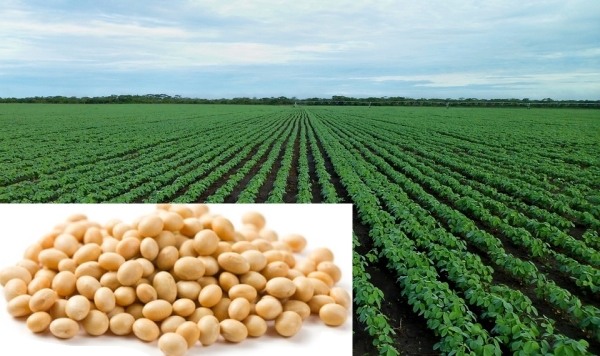
Soil and land preparation:
Well drained loamy and sandy loam soil are most suitable. Low lying areas where water stagnation
During the rainy season the rainy season may occur should be avoided. Two cross ploughing are sufficient to get the soil well pulverized and weed free land.
Loamy soil:

Loam soil is a mixture of sand, silt and clay that are combined to avoid the negative effects of each type.
These soils are fertile, easy to work with and provide good drainage. Depending on their predominant composition they can be either sandy or clay loam.
As the soils are a perfect balance of soil particles, they are considered to be a gardens best friend, but still benefit from topping up with additional organic matter.
Sandy Loam soil:

Sandy Soil is light, warm, dry and tends to be acidic and low in nutrients. Sandy soils are often known as light soils due to their high proportion of sand and little clay (clay weighs more than sand).
These soils have quick water drainage and are easy to work with. They are quicker to warm up in spring than clay soils but tend to dry out in summer and suffer from low nutrients that are washed away by rain.
The addition of organic matter can help give plants an additional boost of nutrients by improving the nutrient and water holding capacity of the soil.
Implements used in soil preparation:
Tractor Drawn Cultivator:

Cultivator is an implement used for finer operations like breaking clods and working the soil to a fine tilth in the preparation of seedbed. Cultivator is also known as tiller or tooth harrow. It is used to further loosen the previously ploughed land before sowing. It is also used to destroy weeds that germinate after ploughing. Cultivator has two rows of tynes attached to its frame in staggered form. The main object of providing two rows and staggering the position of tynes is to provide clearance between tynes so that clods and plant residues can freely pass through without blocking. Provision is also made in the frame by drilling holes so that tynes can be set close or apart as desire. The number of tynes ranges from 7 to 13. The shares of the tynes can be replaced when they are worn out.
Treatment of soil:
Apply lime @ 500kg/ha in furrows and incorporate to the soil at least 1-2 weeks before sowing the crop.

Benefits of soil treatment:
Water benefits:
- Healthy soil acts as a sponge: more rainwater is absorbed and stored in the ground, where it recharges groundwater and aquifers.
- Healthy soil prevents run-off and erosion, and reduces evaporation.
- Healthy soil improves water quality by filtering pollutants.
Nutritious food:
- Healthy soil increases the nutritional value of food and forage.
- Healthy soil provides plants with the nutrition they need and strengthens plants natural resistance to pests and diseases.
Economic security:
- Healthy soil improves farm productivity and provides stability.
- Healthy soil cuts down on inputs, which increases profit.
- Healthy soil helps withstand extreme weather, floods and drought.
Environmental and health benefits:
- Healthy soil helps reverse global warming by absorbing carbon from the atmosphere where it acts as a greenhouse gas.
- Healthy soil provides habitat for soil microbes to flourish.
- Healthy soil supports greater biodiversity and species stability
Varieties:
| S.N. | Name | State | Duration | Resistant | Identification |
| 1 | Ahilya-1(NRC 2) | M.P. | 103-106 | Resistant to Rhizoctonia, pod blight, green mosaic virus, bacterial blight and tolerant to Cercospora leaf spot and Anthracnose | White flowers, tawny pubescence, yellow seed coat, grey to black hilum, good germinability, determinate. |
| 3 | Ahilya-3(NRC 7) | M.P. | 90-99 | Resistant to bacterial blight, green mosaic virus, bacterial pustules, phyllody, soybean mosaic, Myrothecium and Cercospora leaf spots, tolerant to stem fly, girdle beetle, green and grey semilooper, leaf miner and defoliators. | Determinate, grey pubescence, purple flowers, yellow seed coat, brown hilum, high oil content, resistant to pod-shattering. |
| 4 | NRC 37(Ahilya 4) | Madhya Pradesh, Rajasthan, Maharashtra (Vidharbha & Marathwada), Bundhelkhand region of UP | 96-102 | Moderately resistant to collar rot, bacterial pustule, pod blight and bud blight like syndrome. Moderately resistant to stem fly and leaf miner. Non lodging under optimum plant population, non-shattering behaviour upto 10 days after harvest maturity | Erect, determinate plants without anthocyanin colouration in the hypocotyl, white flowers, tawny pubescence, small to medium, and spherical yellow seeds with light to dark brown hilum. |
| 5 | Alankar | Northern plains | 115-120 | Resistant to bacterial pustules, tolerant to yellow mosaic | White flowers, tawny pubescence, yellow seed coat, light brown hilum and determinate |
| 6 | Ankur | Northern plains | 115-120 | Resistant to bacterial pustules and rust | White flowers, tawny pubescence, yellow seed coat and light brown hilum |
| 7 | ADT-1 | Cauvery delta of Tamil Nadu | 85-90 | Tolerance to leaf miner and leaf webber | Determiante, grey pubescence, yellowish white seed coat, brown hilum, suitable as relay crop in rice fallows |
| 8 | Birsa soy 1 | Uplands of Jharkhand state | 110 | Moderately resistant to Bacterial pustule and bacterial blight, resistant to soybean mosaic, yellow mosaic and Cercospora leaf spot | Determinate plants with white flowers, dark green leaves and black seeds with dull white hilum |
| 9 | Bragg | Throughout India | 112-115 | Resistant to bacterial pustules, susceptible to YMV. | White flowers, grey pubescence, yellow seed coat, black hilum, brown pods, determinate. |
| 10 | Co-1 | Tamil Nadu | 85-90 | Resistant to stem fly & pod borer, moderately resistant to YMV. | Purple flowers, creamy yellow seed coat, relatively low hull and linolenic acid content, determinate. |
| 11 | Co Soya-2 | Tamil Nadu | 75-80 | Tolerant to YMV and leaf miner. | Purple flower, determinate, dark green leaves, yellow seed. |
| 12 | Durga(JS 72-280) | Central zone | 102-105 | Tolerant to bacterial pustules. | White flowers, tawny pubescence, yellow seed coat, black hilum, tall and indeterminate, fast growing. |
| 13 | Gaurav(JS 72-44) | Central zone | 104-106 | Susceptible to bud blight, defoliators, girdle beetle and stem fly | Purple flowers, tawny pubescence, yellow seed coat, light black hilum and determinate |
| 14 | Gujarat soybean 1(J-231) | Low rainfall areas of Gujarat | 90-95 | Fairly tolerant to disease and pests in Gujarat | Purple flowers, grey pubescence, yellow seed coat, brown hilum and determinate |
| 15 | Gujarat soybean 2(J-202) | Medium to high rainfall areas of Gujarat | 105-110 | Fairly tolerant to disease and pests in Gujarat | Purple flowers, grey pubescence, yellow seed coat, brown hilum and determinate |
| 16 | Hara soy(Himso 1563) | Himachal Pradesh, Uttaranchal | 108-130 days with a mean of 117 days | Immune to bacterial pustule, highly resistant to brown spot, bacterial blight, and resistant to frog eye leaf spot and pod blight. Highly tolerant to pest complex. Resistant to pod shattering. First ever culinary purpose variety in soybean. | Semi-determinate growth habit, green seed with black hilum, transparent seed coat and green cotyledons. Dark green leaves with smooth surface. The leaves remain green in colour even at senescence. White flower, dark brown pubescence on stem, leaves and pods, pods turn black on maturity. Green seeds, round, bold with black hilum. |
| 17 | Hardee | Southern zone | 105-110 | Fairly tolerant to bacterial pustules, susceptible to yellow mosaic | White flowers, grey pubescence, yellow seed coat, rosy hilum, determinate and suitable for inter cropping |
| 18 | Indira soy 9 | Madhya Pradesh, Assam, West Bengal, Bihar, Jharkhand, Meghalaya, Sikkim, Arunachal Pradesh, Nagaland and Tripura | 106 | Resistant to rust. Moderately resistant to stem tunneling and girdle beetle and leaf folder. Performs well under low to moderate plant densities | Light grey pubescence throughout the plant parts, broad light medium size green leaves, yellow seeds of medium size with black hilum and intermediate lustre. |
| 19 | Improved Pelican | Southern zone | 112-115 | Susceptible to bacterial pustules and yellow mosaic | Purple flowers, tawny pubescence, yellow seed coat, brown hilum, brown pods |
| 20 | JS 2 | Central zone especially Madhya Pradesh | 90-95 | Resistant to bacterial pustule, tolerant to Macrophomina | Purple flowers, tawny pubescence, pods with dense brown pubescene, yellow seed coat, light brown hilum, determinate, highly shattering |
| 21 | JS 71-5 | Malwa Plateau of MP | 90-95 | Purple flowers, yellow seed coat, black hilum, semi-dwarf, plant height 30 to 40 cms, determinate, poor seed longevity. | |
| 22 | JS 75-46 | Central zone | 100-106 | Tolerant to bacterial pustules, tolerant to Macropho-mina | Purple flowers, tawny pubescence, pods with dense brown pubescence, yellow seed coat, light brown hilum, determinate, highly shattering. |
| 23 | JS 76-205 | Madhya Pradesh esp. and adjoining districts | 105-110 | Resistant to bacterial pustules and seed and seed ling rot, tolerant to Anthracnose | Purple flowers, brown pubescen, black seed coat, buff coloured hilum, medium tall plants, suited to low input conditions. |
| 24 | JS 79-81 | Madhya Pradesh | 102-105 | Resistant to bacterial pustle, bacterial blight and tolerant to green mosaic and susceptible to YMV | Purple flowers, detrminate, yellow seed coat, brown hilum and resistant to shattering and lodging |
| 25 | JS 80-21 | Central zone | 105-110 | Tolerant to bacterial pustules, viral diseases and foliar insect-pests. | Purple flowers, tawny pubescence, yellow seed coat, brown/black hilum, determinate, high seed germinability. Perform well in eastern states. |
| 25 | JS 90-41 | M.P. | 87-98 | Moderately resistant to stemfly, semilooper and tolerant to major diseases | Purple flower, tawny pubescence, semi-determinate, lanceolate leaves, 4-seeded pods, greenish yellow seed, blackish hilum. |
| 26 | JS 93-05 | Central zone (Maharashtra, Madhya Pradesh, Rajasthan, Gujarat and Bundhelkhand region of Uttar Pradesh). | 90-95 | Resistant to major diseases and insect pests. | Semi determinate, violet flowers, lanceolate leaves, four seeded pods, glabrous stem & pods, non-shattering, black hilum. |
| 27 | JS 335 | Central zone | 95-100 | Resistant to bacterial pustule, bacterial blight and tolerant to green mosaic. Susceptible to YMV. | Purple flowers, semi-determinate, resistant to shattering, black hilum. Performs well in Eastern and Southern states. |
| 28 | Kalitur | Madhya Pradesh and Bundhelkhand region of M.P. | 120-130 | Susceptible to soybean mosaic, tolerant to bacterial pustules | Purple flowers, tawny pubescen, black seed coat, black hilum, small seeded semi indeterminate |
| 29 | Sneh(KB 79) | Karnataka | 85-93 | Resistant to Alternaria, bacterial pustules, YMV, soybean mosaic. Moderate tolerance to Cercospora and bud blight. | Purple flowers, grey pubescence, determinate yellow seed, brown hilum. |
| 30 | KHSb 2 | Karnataka | 115-120 | Moderately tolerant to bacterial pustules | Purple flowers, tawny pubescence, yellow seed coat, black hilum, semi determinate |
| 31 | Lsb 1 | Andhra Pradesh | 65-71 | — | Determinate, white flowers, light green leaves, cream coloured seed in 4 seeded pods |
| 32 | Lee | Northern hill zone | 105-115 | Susceptible to yellow mosaic, defoliators, bacterial pustules and girdle beetle | Purple flowers, tawny pubescence, yellow seed coat, black hilum, light brown pods and determinate |
| 33 | MACS-13 | Central zone | 90-100 | Resistant to bacterial pustules, tolerant to viral diseases and leaf-miner. | Purple flowers, tawny pubescence, yellow seed coat, brown pod black hilum, indeterminate. |
| 34 | MACS-57 | Maharashtra (Rabi/ Summer) | 85-100 | Resistant to soybean mosaic bacterial pustules and bud blight. | Semi-determinate, purple flowers, tawny pubescence, yellow seed coat, light brown hilum, suitable for Kharif & Rabi. |
| 35 | MACS-58 | Central zone | 90-100 | Resistant to bacterial pustules & leaf spot, tolerant to YMV. | Purple flowers, tawny pubescence, yellow seed coat, light brown hilum, tall semi-determinate, suitable for mechanical harvesting. |
| 36 | MACS-124 | Southern zone | 95-105 | Resistant to bud blight, soybean mosaic and bacterial pustules. | Purple flowers,tawny pubescence, yellow seed coat, dark brown hilum, semi-determinate resistant to lodging. |
| 37 | MACS-450 | Southern zone | 90-95 | Resistant to leaf spot, bud blight, yellow mosaic, soybean mosaic, bacterial pustule. Highly resistant to stemfly and defoliators. | Purple flowers, medium tall, semi-determinate, tawny pubescence, yellow seed, black hilum. |
| 38 | MAUS 1 | Maharashtra | 90-95 | Moderately resistant to YMV, soybean mosaic, bacterial pustules and leaf spots. Moderately resistant to leaf miner, stem fly and girdle beetle | Determinate, white flowers, tawny pubescence, yellow seed coat, brown hilum, tolerant to pod shattering |
| 39 | Pooja(MAUS 2) | Southern zone | 105-110 | Resistant to green mosaic, bacterial pustule, rust and leaf spots. Moderately resistant to leaf miner, stem fly and blue beetle. | Semi-determinate, grey pubescence, yellow seed coat, light brown hilum, resistant to pod-shattering. |
| 40 | MAUS 32 | Maharashtra | 100-105 | Resistant to moderately resistant of common diseases and pests | Semideterminate, violet flowers, yellow seeds, brown hilum |
Selection of seed:
- Make sure seed is not more than 12 months old to ensure good germination.
- Sort out the good seeds for planting to ensure that they are free from insects, disease infestation and weed seeds.
- Do a germination test at least 10 days before planting. Plant 50 seeds. If at least 40 emerge, the seed is good for planting. If 30-40 emerge, plant more seeds than recommended. Get new seeds if less than 30 seeds emerge.
Seed Treatment:


Treat seed with rhizobia:
- Spread 100 kg of soybean seed on a clean plastic sheet or in a large container.
- Mix 100 g of inoculant and 1 litres of water in a clean bucket.
- Add 50 grams of sugar
- into the solution. The sugar acts as an adhesive between the seed and the inoculant.
- Stir the solution for 30 seconds.
- Sprinkle the inoculant mix onto the seed.
- As you sprinkle the inoculant onto the seed, turn the seed gently to ensure that all seeds are coated with the inoculant. The coated seeds should look shiny wet.
- Plant immediately after inoculation and protect the inoculated seed from direct sunlight by covering the container with paper, cloth or gunny bag.
- Sow the seeds in moist soil and cover immediately afterwards to protect the rhizobia from sunlight.
Sowing time:
- June-July in summer and August-September for winter plantation.
- Sowing in mid-June in the higher region is found to be most suitable.
Seed Depth: 3-5cm.
Seed spacing: 40x10cm.
Methods of sowing:
Seed Drilling method:

Seed drilling is a planting method that uses a seed drill to place seeds in the ground. The seed drill opens furrows in the soil and then deposits the seeds into the furrow. The seed drill also covers the seeds with soil to protect them from wind and animals. There are two main drilling methods of sowing seeds: push and pull drills. The push drill is operated by pushing the seed tube into the soil and then pulling it back out, while the pull drill is operated by pulling the seed tube through the soil. The choice of a push or pull drill depends on the type of soil and the amount of power available. In general, the push drill is better for harder soils, while the pull drill is better for softer soils.
During drilling, seeds may be sown continuously or at regular intervals in the rows. These rows may be straight and parallel or staggered and irregular. Rows may be arranged as paired row planting, or bi-directional (cross row planting). Drilling may be adopted for both pure cropping and intercropping situations. Seeds are planted in groups of two to three at a uniform distance between them.
Advantages:
- The seed rate becomes less.
- Drilling facilitates thinning and roughing of weak and diseased plants.
- Weeding can be done profitably within a short time by wheel hoe, Japanese rice weeder etc.
- The intercultural operations such as earthing up, manuring, irrigation, spraying etc. can be done successfully in the drilled crops.
- The drilled crops get light, air, nutrients equally as they are spaced at uniform distance.
- Harvesting of crops is easier and advantageous. So, harvesting cost becomes less.
- Drilling may be adopted for both sole cropping and intercropping situations.
- The cost of cultivation in drilled crop becomes less and the yield of drilled crop increases.
Disadvantages:
- Drilling requires an implement such as a seed-drill which increases the cost of cultivation. ii.
- Drilling requires more time, energy and cost.
- An expert technical person is required for running of a seed-drill.
- Drilling needs more time in comparison to broadcasting.
- Drilling is not feasible in clay and stony soils.
Fertilizer management:
Soybean can use atmospheric nitrogen, but that’s not sufficient. So, crop is supplied with 10-15% of total nitrogen requirement. 12.5 kg of Nitrogen per acre and 32 kg per acre of Phosphorus is sufficient. And Potash is required only if deficiency observed.
Weed management:
The crop should be kept weed free up to 60DAS
Two hand weeding (20DAS and 40DAS) are sufficient for higher yield
Among weed control, pre emergence application of pendimethalin @ 0.75a.i/ha and one hand weeding at 40 DAS and Butachlor @1kg a.i/ha and one hand weeding registered higher seed yield.
| Active ingredient | Use rate | Amount for one sprayer load (20 l knapsack) | For which type ofweeds |
| Metalochlor | 1.1 l/ha | 82 ml | Broad-leaved weeds and grasses |
| Metribuzin (triazine) | 1.1 l/ha | 75 ml | Broad-leaved weeds and some grasses |
| Alachlor | 2.5 l/ha | 75 ml | |
| Fluaziflop-p-butyl | 1.5 l/ha | 75 ml | Grasses and volunteer wheat |
| Chlorimuron ethyl | 45 g/ha | 5 g | Nut-sedge and broad-leaved weeds |
Irrigation management:
Soybean. Irrigate immediately after sowing. Give life irrigation on the 3rd day. Further irrigations at intervals of 7 – 10 and 10 – 15 days during summer and winter season respectively may be given depending on soil and weather conditions.
Soybean Plant Growth Stages:

Leave a Reply