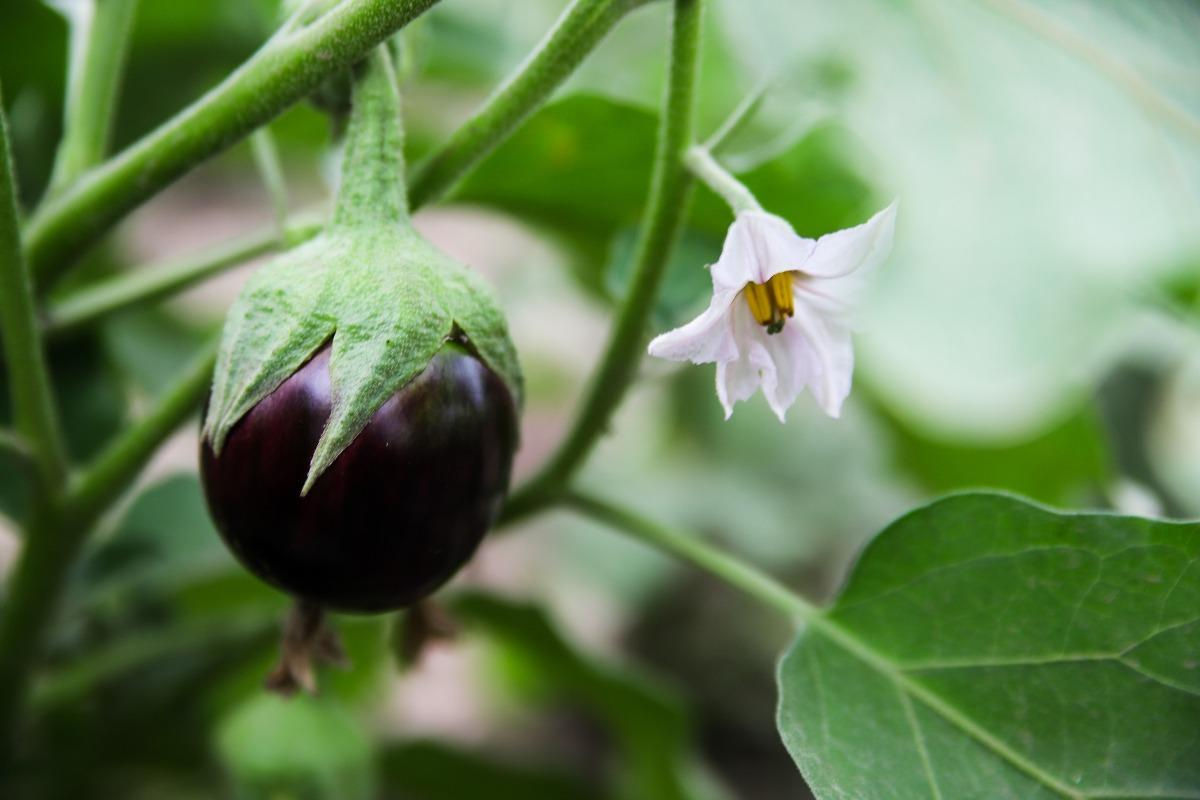
Apply the second split application of nitrogen-

Brinjal is a long duration crop and needs a good amount of fertilizers for high yields. The amount of fertilizers added will depend largely on factors such as type of plants (Varieties or hybrids), the type of soil and weather conditions. Here are some recommendations for your eggplants:
- The second split application is done about 50-65 days after transplanting.
- This includes the addition of ¼ of nitrogen, amounting to about 20-30 kg/acre of urea.
- Apply fertilizer pellets around the base of the plant, avoiding contact with the stem.
- Make sure to hoe and earth-up soil around the base of the plant.
- If no rain is expected, do not forget to irrigate the crop.
Field monitoring should be done to protect crop from disease and insect infestation-
Fruit and Shoot Borer:

It is one of the major and serious insect pests of brinjal. A short pinkish caterpillar bores into the terminal shoot and eats internal tissue in initial stages, later it bores into the young fruit. The large holes can be seen on the infected fruits. The insect affected fruits become unfit for consumption. Scout field every week after transplanting for fruit and shoot borer infestation. Remove and destroy infected fruits. Take a spray of Triazophos@20ml/10Ltr water and Neem extract@50gm/Ltr, one month after transplanting. Repeat spray with an interval of 10-15 days. When the crop is in flowering stage, take a spray of Chlorantraniliprole 18.5%SC (Coragen) @ 5ml+Teepol @ 5ml in 12 Ltr of water, twice within a 20 days interval.
In the initial stage of infestation, take a spray of 5% Neem extract@50gm/Ltr. If infestation is seen in the field, spray 25% Cypermethrin@2.4 ml/10Ltr of water on affected crops. For high population spray Spinosad@1ml/Ltr of water. Avoid spraying Triazophos or any other insecticide after fruit maturation and harvest.
Whiteflies


Description of Insect Stages
Eggs are yellowish white laid singly on the under surface of leaves. They are stalked and sub elliptical in shape. Nymphs are yellowish and brownish, sub elliptical and scale-like. They are found in large numbers on the underside of leaves. Pupae also resemble nymphs in shape and have brownish opercula. Adults are tiny and white in color. They have a yellow body dusted lightly with a white waxy powder. Females are 1.1 –1.2 mm long; males are slightly smaller. Antennae of females are longer than males. Hind legs are larger than the anterior pair of legs. Large numbers of adults are found in the middle region of the plant.
Nature of Damage and Symptoms
Whiteflies cause damage to plants in two ways: firstly by sucking the sap and secondly by excreting honey dew on which sooty mould grows. Damage from direct feeding reduces the photosynthetic activities of the plant and hence the yield. Indirect damage results from lint contamination with honeydew and associated fungi and through transmission of leaf curl virus disease. Late season severity affects the seed development and the lint quality. Leaves curl upwards and the plant vigour reduces. Leaves become shiny with honeydew or darkened by sooty mold growing on honeydew. Lint contamination with honeydew and associated fungi occur during heavy infestations after boll opening.
Life History
The female whitefly lays the eggs singly on the under surface of leaves and mostly on the top and middle crop canopy. Each female is capable of laying about 120 eggs. The incubation period varies from 3-5 days during spring and summer, 5-17 during autumn and >30 days during winter. The nymphs after hatching fix themselves to the underside of the leaves and they moult thrice before pupation. The nymphal period varies from 9-14 days during summer, and 17-19 days during winter. The pupal period is 2-8 days. The total life-cycle ranges from 14 to 107 days depending upon the weather conditions. There are about 12 overlapping generations in a year and the pest also reproduces parthenogenetically at times. Whiteflies have an extremely wide host range.
Management of whiteflies
- Avoid late sowing and excessive use of “N” fertilizers.
- Destroy infected shoots during early stages.
- Release predators like Coccinellids or Chrysoperla carnea.
Any of the following insecticides can be used: 0.05% oxyedemeton methyl 25 EC, 0.02% dimethoate 30 EC, 0.02% acephate, 75 SP or 0.005% 1 of imidachlorpid 17.8 SL.
Phomopsis Blight and Fruit Rot:

Dark brown color spots appear on leaves. The fruit shows watery lesions and becomes black in appearance. Before sowing, do seed treatment with Thiram@3gm per kg of seeds. Use blight disease resistant variety for cultivation. If infestation is observed in the field, take a spray of Zineb@2gm/Ltr of water or Mancozeb@2.5gm per litre of water.
Leave a Reply