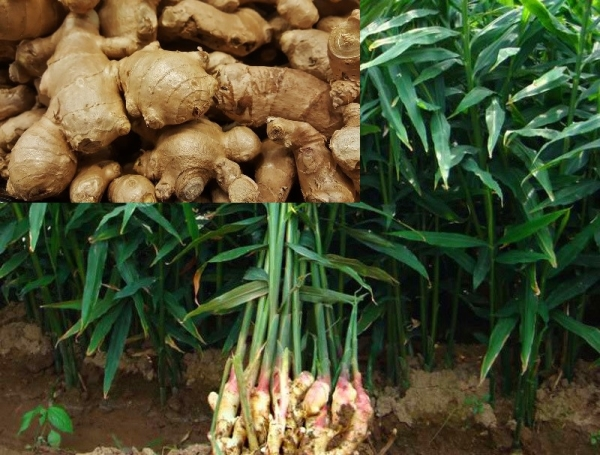
Ginger
The ginger plant has a thick, branched rhizome (underground stem) with a brown outer layer and yellow centre that has a spicy, citrusy aroma. Every year, it grows pseudostems (false stems made of tightly wrapped leaf bases) from the rhizome which bear narrow leaves.
Anatomy of Ginger:

Climate:
Ginger grows well in warm and humid climate and is cultivated from sea level to an altitude of 1500 m above sea level. Ginger can be grown both under rain fed and irrigated conditions. For successful cultivation of the crop, a moderate rain fall at sowing time till the rhizomes sprout, fairly heavy and well distributed showers during the growing period and dry weather for about a month before harvesting are necessary..
Soil:
Ginger thrives best in well drained soils like sandy loam, clay loam, red loam or lateritic loam. A friable loam rich in humus is ideal. However, being an exhausting crop it is not desirable to grow ginger in the same soil year after year.
Loam soil-

Loam soil is a mixture of clay, sand and silt soils. Because of the mixture, it’s considered to be the best for planting. There are enough nutrients in the soil and the soil is able to drain efficiently. Because of these reasons, almost any plant can be grown in this type of soil.
Loamy soil is the best type of soil because it contains all three of these components in equal amounts. Loamy soil retains lots of water, but also drains enough not to drown the plant.
Features of loam soil-
- This soil is made up of a combination of silt, clay, and sand.
- This soil is easy to cultivate and warms up quickly, without becoming too dry during the warmer months. This is an excellent soil for growing plants outside.
- It’s fine-textured, moist soil.
Sowing time:
The best time for planting ginger in the West Coast of India is during the first fortnight of May with the receipt of pre- monsoon showers. Under irrigated conditions, it can be planted well in advance during the middle of February or early March. Early planting with the receipt of summer showers results in higher yield and reduces disease incidence.
The selected varieties:
| Varieties | Green ginger yield t / ha | Maturity (days) |
| IISR | 22.6 | 200 |
| Suprabha | 16.6 | 229 |
| Suruchi | 11.6 | 218 |
| Surabhi | 17.5 | 225 |
| Himagiri | 13.5 | 230 |
| IISR Mahima | 23.2 | 200 |
| IISR Regitha | 22.4 | 200 |
Land preparation:


The land is to be ploughed 4 to 5 times or dug thoroughly with receipt of early summer showers to bring the soil to fine tilth. Beds of about 1 m width, 30 cm height and of convenient length are prepared with an inter-space of 50 cm in between beds. In the case of irrigated crop, ridges are formed 40 cm apart. In areas prone to rhizome rot disease and nematode infestations, solarization of beds for 40 days using transparent polythene sheets is recommended.
Planting:


Ginger is propagated by portions of rhizomes known as seed rhizomes. Carefully preserved seed rhizomes are cut into small pieces of 2.5 – 5.0 cm length weighing 20 – 25 g each having one or two good buds. The seed rate varies from region to region and with the method of cultivation adopted. In Kerala, the seed rate varies from 1500 to 1800 kg /ha. At higher altitudes the seed rate may vary from 2000 to 2500 kg/ha. The seed rhizomes are treated with mancozeb 0.3% (3 g/L of water) for 30 minutes, shade dried for 3 – 4 hours and planted at a spacing of 20 – 25 cm along the rows and 20 – 25 cm between the rows. The seed rhizome bits are placed in shallow pits prepared with a hand hoe and covered with well decomposed farm yard manure and a thin layer of soil and levelled.
Sowing method:
Transplanting:

Though transplanting in ginger is not conventional, it is found profitable. A transplanting technique in ginger by using single bud sprouts (about 5 g) has been standardized to produce good quality planting material with reduced cost. The yield level of ginger transplants is on-par with conventional planting system. The technique involves raising transplants from single sprout seed rhizomes in the pro – tray and planted in the field after 30 – 40 days. The advantages of this technology are production of healthy planting materials and reduction in seed rhizome quantity and eventually reduced cost on seeds.
Technology:
- Select healthy ginger rhizomes for seed purpose
- Treat the selected rhizomes with mancozeb (0.3%) and quinalphos (0.075%) for 30 min and store in well ventilated place.
- One month before planting, the seed rhizomes are cut into single buds with small piece of rhizomes weighing 4-6 g.
- Treat the single bud sprouts (mancozeb 0.3%) for 30 min before planting.
- Fill the pro-trays (98 well) with nursery medium containing partially decomposed coir pith and vermi-compost (75:25), enriched with PGPR/Trichoderma 10g/kg of mixture.
- Plant the ginger bud sprouts in pro-trays.
- Maintain the pro-trays under shade net house.
- Adopt need based irrigation with rose can or by using sprinklers.
- Seedlings will be ready within 30-40 days for transplanting.
Fertilizer:

At the time of planting, well decomposed cattle manure or compost @ 25-30 tonnes/ha has to be applied either by broadcasting over the beds prior to planting or applied in the pits at the time of planting. Application of neem cake @ 2 tonnes/ha at the time of planting helps in reducing the incidence of rhizome rot disease/ nematode and increasing the yield. The recommended blanket nutrient dosage for ginger for different states are given below.
As the soil fertility will be varying with the soil type, agro ecological conditions or management systems, site specific nutrient management based on the soil test results for major nutrient is advocated. The recommended dose of nutrients for varying soil test values of N, P and K is given in the table below. The fertilizers are to be applied in 2 – 3 split doses. Full dose of phosphorus is applied as basal at the time of planting. Equal split doses of N and K is top dressed at 45, 90 (and 120) DAP.
Soil test based fertilizer recommendations for fresh rhizome yield target levels of 25 and 30 tons/ha-
| Soil test value for available nutrients (kg/ha) | Fertilizer recommended for yield targets 25 t/ha | nutrient (kg/ha) 30 t/ha |
| Nitrogen | ||
| < 150 | 250 | 340 |
| 150-250 | 180 | 270 |
| 250-400 | 90 | 175 |
| > 400 | – | 50 |
| Phosphorus(P2O5) | ||
| < 10 | 55 | 75 |
| 10-30 | 35 | 55 |
| 30-50 | 15 | 25 |
| > 50 | – | 5-10 |
| Potassium(K2O) | ||
| < 110 | 100 | 130 |
| 110-300 | 75 | 100 |
| 300-500 | 35 | 50 |
| > 500 | 5 | 15 |
In Zinc deficient soils, basal application of zinc fertilizer up to 6 kg zinc/ha (30 kg of zinc sulphate/ha) gives good yield. Foliar application of micronutrient mixture specific to ginger is also recommended (dosage @ 5 g/L) twice, 60 and 90 DAP, for higher yield.
Mulching:


Mulching the beds with green leaves/organic wastes is essential to prevent soil splashing and erosion of soil due to heavy rain. It also adds organic matter to the soil, checks weed emergence and conserves moisture during the latter part of the cropping season. The first mulching is done at the time of planting with green leaves @ 10-12 tonnes/ha. Application of dried coconut leaves after removing the petiole or paddy straw (2-3 kg/bed) as mulch in ginger is also recommended for effective weed control. Green leaf mulching is to be repeated @ 7.5 tonnes/ha at 45 and 90 days after planting, immediately after weeding, application of fertilizers and earthing up.
Inter cultivation:


Weeding is done just before fertilizer application and mulching; 2-3 hand weeding are required depending on the intensity of weed growth. Proper drainage channels are to be provided when there is stagnation of water. Earthing up is essential to prevent exposure of rhizomes and provide sufficient soil volume for free development of rhizomes. It is done at 45 and 90 days after planting immediately after weeding and application of fertilizers.
Irrigation:


Ginger is cultivated as rain fed crop in high rainfall areas (uniform distribution for 5 to 7 months) and irrigated crop in less rainfall areas where distribution is not uniform. Ginger requires 1300-1500 mm of water during its crop cycle. The critical stages for irrigation are during germination, rhizome initiation (90 DAP) and rhizome development stages (135 DAP). The first irrigation should be done immediately after planting and subsequent irrigations are given at intervals of 7 to 10 days in conventional irrigation (based on prevailing weather and soil type).Sprinklers and drip system can also be employed for better water use efficiency and enhanced yield.
Diseases of Ginger:
Soft rot:

Symptoms:
Soft rot is the most destructive disease of ginger which results in total loss of affected clumps. The disease is soil-borne and is caused by Pythium spp.among which, P. aphanidermatum and P. myriotylum are widely distributed in the country. The fungus multiplies with build-up of soil moisture with the onset of south west monsoon. Younger sprouts are most susceptible to the pathogen. The infection starts at the collar region of the pseudostem and progresses upwards as well as downwards. The collar region of the affected pseudostem becomes water-soaked and the rotting spreads to the rhizome resulting in soft rot with characteristic foul smell. At a later stage root infection is also noticed. Foliar symptoms appear as light yellowing of the leaf margins of lower leaves which gradually spreads to the leaf lamina. In early stages of the disease, the middle portion of the leaves remain green while the margins become yellow. The yellowing spreads to all leaves of the plant from the lower region upwards and is followed by drooping, withering and drying of pseudostems.
Management:
Seed rhizomes are to be selected from disease free gardens, since the disease is also seed borne. Treatment of seed rhizomes with mancozeb 0.3% or metalaxyl mancozeb 0.125% for 30 minutes before storage, and once again before planting and drenching at 30 and 60 days after planting reduces the incidence of the disease. Cultural practices such as selection of well drained soils for planting is important, since stagnation of water predisposes the plant to infection. The soil may be solarized before planting by covering the moist soil with a transparent polythene film for 45-50 days.Application of Trichoderma harzianum along with neem cake @ 1 kg/bed helps in reducing the incidence of the disease. Once the disease is located in the field, removal of affected clumps and drenching the affected and surrounding beds with mancozeb 0.3% or metalaxyl mancozeb 0.125% or copper oxy chloride 0.2% checks the spread of the disease.
Bacterial wilt:

Symptoms:
Bacterial wilt caused by Biovar-3 is a soil and seed-borne disease that occurs during south west Ralst monsoon. Water soaked spots appear at the collar region of the pseudostem and progresses upwards and downwards. The first conspicuous symptom is mild drooping and curling of leaf margins of the lower leaves which spread upwards. In the advanced stage, the plants exhibit severe yellowing and wilting symptoms. The vascular tissues of the affected pseudostems show dark streaks. The affected pseudostem and rhizome when pressed gently extrudes milky ooze from the vascular strands. Ultimately rhizomes rot emitting a foul smell.
Management:
The cultural practices and seed rhizome treatment adopted for managing soft rot are also to be adopted for bacterial wilt. Seed rhizomes must be taken from disease free fields for planting. It is not advisable to plant ginger consecutively in the same field every year. Fields used for growing potato, or other solanaceous crops are to be avoided. Once the disease is noticed in the field the affected clumps may be removed carefully without spilling the soil around and the affected area and surrounding areas drenched with copper oxychloride 0.2%. Care should be taken to dispose the removed plants far from the cultivated area or destroyed by burning.
Leaf spot:


Symptoms:
Leaf spot is caused by Phyllosticta zingiberi. The disease starts as water soaked spot and later turns as a white spot surrounded by dark brown margins and yellow halo. The lesions enlarge and adjacent lesions coalesce to form necrotic areas. The disease spreads through rain splashes during intermittent showers. The incidence of the disease is severe in ginger grown under exposed conditions.
Management:
The disease can be controlled by spraying of Bordeaux mixture 1% or mancozeb 0.2% or carbendazim 0.2%, with the appearance of disease symptoms. Care should be taken to see that the spray solution should reach lower surface of the leaves also.
Nematode pests:

Symptoms:
Root knot (Meloidogyne spp.), burrowing (Radopholus similis) and lesion (Pratylenchus spp.) nematodes are important nematode pests of ginger. Stunting, chlorosis, poor tillering and necrosis of leaves are the common aerial symptoms. Characteristic root galls and lesions that lead to rotting are generally seen in roots. The infested rhizomes have brown, water soaked areas in the outer tissues. Nematode infestation aggravates rhizome rot disease.
Management:
The nematodes can be controlled by treating infested rhizomes with hot water (50°C) for 10 minutes, using nematode free seed rhizomes and solarizing ginger beds for 40 days. In areas where root knot nematode population is high, the resistant variety IISR-Mahima may be cultivated. Pochonia chlamydosporia, a nematode biocontrol agent can be incorporated in ginger beds (20 g/bed with 106 cfu/g) at the time of sowing.
Insects-pest of Ginger:
Shoot borer:

Symptoms:
Stem borer causes the most damage in ginger. If the insect infested plants become yellow color of the leaves, stems drying.
Management:
To control pest, a low-level attack subjecting Peo – de – Janeiro may be used for cultivation. It should be control using prakkonite family of natural enemies or spray the pesticide monocrotophos 0.1% (1 liter of water 1 ml) and infested plants should be removed.
Leaf roller:

Symptoms:
Leaf roller attacks the leaves and leave are rolled, which are found in large numbers in the months of August and September.
Management:
To control it, to spray carbaryl 0.1% (1g per liter of water) or dimethoate 0.05% or phosphamidon 0.05%.
Tuber scales:

Symptoms:
Tuber scales attacks the tuber in the field and also in godowns. It attack the plant severely, so the plant dried. In godown tuber scale buds dried and it reduces the germination capacity.
Management:
To control the tuber scales, thrips and other sucking insects, spray phosphamidon 0.05 per cent (5 ml with 10 liters of water). Spray malathion in the bag which is filled with tuber.
Harvest:  Ginger plant preparing for harvesting within eight months from the date of planting. Brown leaves are ready to be harvested at arrival points to the bottom-up dries. This condition should be harvested in order to extract the ginger oil. The leaves are harvested in the dry state by seed tuber used. Harvested ginger, removed from the dried leaves, roots, and tubers, unearthed by the adhering soil is removed, washed with water and dried in shade. The ginger used as vegetable and cooking, it should be harvested from the fifth month after sowing. This immature harvested ginger has less alkalinity and fibre. Yield: Well maintained crop average yield from 15 to 20 tons/ha of ginger rhizomes. |
| Post-harvest: Ginger – and sell it off as soon as ginger, washed, dried in shade and then stored for 2 days. If we keep the ginger in 55 cm heat and 65% of humidity, stored up to 6 months.Dry ginger – used after drying.Black Sin – the rhizomes are put in boiling water for 10-15 minutes, remove the skin and dried. It is available in black colour is killing tubers. Processed ginger: Processing in sugar solution: Ginger rhizomes should be well washed, cut the roots and then cooked in sugar solution and then dried.Processing in salt water: wash the rhizome, peel skin, and soak it in salt water. Then shall pour the water mixed with a little salt and vinegar and soak in 7 days. Then rinse well, and sterilize with 10 minutes. Drilled the tuber and soak the sugar solution (48 kg sugar and 60 kg of ginger) in the quantities to be sterilized. Boiled it three times and dried it. Ginger Candy: Cook the tuber well and drained it and then kept in the syrup (for syrup 1 kg to 1.5 kg sugar, add ginger) and boil it for two hours and to keep cool. Pour the syrup over the top of the plates and cover it. It could taste the longer lights up. The material is made from ginger is ginger oil and oliyoresin. Seed tuber storage: Increase the seed tuber germination capacity must be stored in pits on the spot in the shade. Choose the tubers for seed without infection. For this choose the plant of six to eight months of age without disease infection. Seed tubers should be treated with Quinalphos 0.075% and Mancozeb 0.3% mixture, soak 30 minutes in the solution. Apply cow dung on the lateral wall of the storage pit. Arrange the seed tuber in several layers in the pit. After every layer broadcast the sawdust for 2cm. Top of the pit with the flow of air give a little gap and close with wood. We should check the seed tubers for three weeks interval and eliminate the shrunken and disease infected tubers. Seed tuber storage: December – January month harvested tubers are sowing in the month of May – June. So we have to store the tubers for 3 to 4 months. Seed tubers traditionally stored in sand or pits in shade. Because of this the tuber dry and rot disease affected before sowing and germination, post-harvest loss is very high. Seed storage as a result of research in technology-ventilated seed rhizome 3 percent to 100 gauge polythene bags, tying it down on dry sand saving, post-harvest losses are decreased viability in seed tubers found. Soak the seed tubers in Quinalphos 0.1% or Dythene M 45 and dry it and store the tubers. |
Leave a Reply