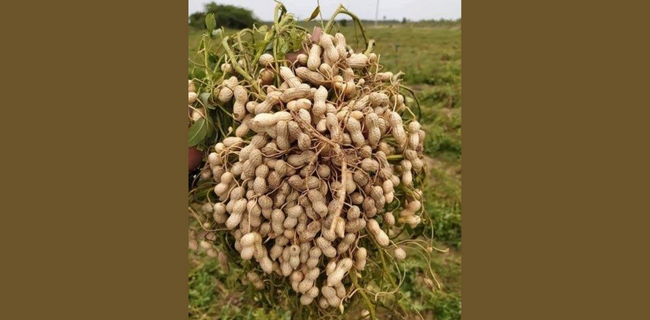
Groundnut is a significant oilseed, ideal for cultivation in tropic regions of the country. Groundnut (Arachis hypogaea), is a species in the legume or “bean” family. It is considered to be local in South America. These are known by many other local names such as earthnuts, ground nuts, goober peas, monkey nuts, pygmy nuts and peanuts. Despite its name and appearance, peanut is not a nut, but rather a legume. Groundnut is the third most important oilseed of world. In India, it is available throughout the year. It is an important source of protein grown mostly under rain-fed conditions. In India, Uttar Pradesh, Madhya Pradesh, Rajasthan, Gujarat, Maharashtra, Karnataka, Andhra Pradesh and Tamil Nadu are major groundnut growing states.
Botanical description of groundnut-

Root

Groundnut is a herbaceous annual with a fairly developed root system and a tap root. Tap root appears on the second day after seed germination and has a massive root cap. It elongates rapidly and grows almost vertically. It may vary from a few millimeters in diameter in annual species to 10 cm in perennial species. The well developed tap root may penetrate to a depth of 130 cm but rarely goes beyond 90 cm. The root system is normally concentrated at a depth of 5 to 35 cm and root spread is confined to a radius of 12 to 14 cm. The root system of spreading types are usually more vigorous than the bunch types. The lateral roots appear on the third day after seed germination. They are basically similar to tap roots but they lack the central pith and they multiply very quickly (as many as 100-120) on the fifth day and grow to a length of 15-20 cm.
Stem-

The young stems are angular, usually pubescent and solid with a large pith. As the plant grows, the stems become hollow and tend to be cylindrical and shed hairs. The thickness of stem is highly variable. Generally the bunch types have thicker stems. Internodes are short and highly condensed at the base but are longer at the higher nodes.
Leaf-

The leaves in the genus are tetrafoliate. Occasionally small and abnormal leaflets may appear. The leaves of cultivated species are paripinnate with two pairs of opposite, sub-sessible, obovate (variable), shortly by mucronate leaflets with entire ciliate margin. The leaflets are borne on a slender, grooved and jointed rachis. Groundnut cultivars differ in leaf characteristics such as leaf colour (foliage colour), shape, hairiness and size. Stomata appear on both sides of the leaf.
Inflorescence and Flower-

The inflorescence of the groundnut appears as a cluster of flowers in the leaf axils and is a reduced monopodium, either simple or compound. It consists of three or more flowers, is spike-like and always occurs in the axils of cataphylls or foliage. Flowers are enclosed in between 2 bracts. One of them is simple, subtending a short peduncle and the other bifid, subtending the pedicel. The flower is sessile but appears stalked after the growth of a tubular hypanthium just before anthesis. The calyx has 5 lobes. The typical papilionoid corolla is inserted on the top of the hypanthium and surrounds the staminal column. The stamens are 10, monadelphous with the staminal column surrounding the ovary. The pistil consists of a single ovary surrounded by the base of the hypanthium. The stigma is club shaped or clavate, usually at anther level or protruding slightly above.
The Peg-

Fertilization is normally completed before midday. After that the flower droops, the corolla closes, the calyx tube bends and the flower withers. During the early development of the young embryo, the ovary at the base of the calyx tube becomes mobilized for growth within a week. By then an intercalary meristem below the ovary is activated. The green ovary turns purplish from the tip downwards. The developing ovary pierces through the floral parts by the activity of the meristem to reveal an elongating peg or carpophore. The peg is a stalk-like structure that bears the fertilized ovules at its tip. Its growth is positively geotropic, until it has penetrated the soil to some depth. The tip then becomes diageotropic. After some initial development, the ovary shows no apparent change until it is diageotropically positioned in the soil. It is then that the ovary starts developing into a fruit.
The Pod

The fruit of groundnut normally referred to as a pod, is a lomentiform carpel, indehiscent and up to 10 cm in length. The mature pod normally contains up to 4 seeds, depending on the cultivar. Single seeded pods may be produced when all the ovules but the proximal abort.
The pod size may range up to 6.0 x 2.7 cm. The fruit consists of 2 valves, structurally dehiscent but functionally indehiscent. When pressed the pods split along the longitudinal suture. The tip of the indehiscent fruit may end in an appendage called the beak.
Seed-

The seeds of groundnut differ in size, shape and colour of the seed coat or testa. The testa is thin and papery. In general, 3 unicellular layers viz., the outer epidermis or sclerenchyma, middle parenchyma and inner parenchyma constitute the testa. These layers are maternal tissue representing the integument of the maturing ovule. Seed size is an important economic character. Seed length ranges from 7 to 21 mm and seed diameter from 5 to 13 mm. Seed weight is also an important distinguishing character, which ranges from 0.17 to 1.24 g.
Colour of seed coat or testa is an important criteria for classifying cultivated groundnuts and this may also influence the marketability of a cultivar. The colour characteristic is highly subjective and the different grades are difficult to describe on a uniform basis. However, this is an important diagnostic genetic character.
Each seed consists of 2 cotyledons, upper stem axis and young leaf primordia (epicotyl) and lower stem axis (hypocotyl) and primary root. The embryo of the seed is straight rather than curved. The embryo contains all the leaves and the above ground parts that appear during the first two weeks of growth.
The epicotyl consists of 3 buds – 1 terminal and 2 cotyledonary laterals. The former has 4 and the later has 1 or 2 leaf primordia. Thus the dormant embryo has 6 to 8 differentiated leaves ready to expand immediately after emergence.
Growth stages of groundnut-
The cultivated groundnut has a distinct main stem and a varying number of lateral branches. The carriage of laterals is an important character which determines the growth habit of the plant.
Two distinct forms of growth habits have been reported in groundnut. They are, Spreading (runner, trailing, procumbent and prostrate) and Erect (upright, erect and bunch).
The spreading form is usually characterized by an erect conspicuous main stem with procumbent or documbent lateral branches. In the erect types the main axis becomes indistinguishable from the laterals. An intermediate semi-spreading form (spreading bunch, bunch runner and runner bunch) is also reported.
Pre- Flowering Phase
The two main botanical sections of Arachis hypogaea differ in the distribution of vegetative branches and inflorescence in the axils of the leaves on the main axis and the branches.
The main branch (axis) of cultivated groundnuts is designated as `n’ and the first, second and third branches are called n+1, n+2 and n+3 respectively. In all forms of the species, primary vegetative branches (n+1) arise on the axis of the cotyledons and at a number of higher nodes on the main axis.
In the sequential type (bunch types) inflorescence are borne at a second and several subsequent nodes of the primary branches. The first node on such a branch may bear secondary branch (n+2) but often it to bears an inflorescence, so that the first flowers are initiated very soon after the development of n+1 branch.
In the alternate branching type (spreading type), the first two nodes of n+1 branch normally bear vegetative branches (n+2), the next two bear inflorescence and the next two again vegetative branches and so son. The same sequence is repeated for n+2 branches.
In the Spanish group of sequential type, the n+1 branches grow upwards from the very beginning whereas in the Valencia group, these branches grow outwards first and then upwards. These two groups are generally referred as bunch type.
In the alternate branched section, the runner forms have prostrate n+1 branches, whereas spreading forms more upright branches, both constituting spreading types.
The sequential and alternate branching types also differ in many other agronomic characters: the duration is 110-120 days in the sequential and 130-150 days in the alternate branched; seeds are dormant in the alternate branched and non-dormant in the sequential branched; and plants are light green in sequential and dark green in alternate branched.
The production of leaves and increase in shoot weight are considered as a measure of vegetative growth. The period of maximum growth is between 56 and 97 days in bunch varieties and 70 and 125 days in spreading ones. Higher rate of growth during early stages and more dry matter accumulation was seen in bunch types in comparison with spreading types.
The total number of leaves per plant showed an exponential increase from about 21 days to 90-100 days after sowing and it ranged from 93 to 112 in bunch varieties and from 206 to 346 in spreading types.
Maximum Leaf Area Index reported was 4.0 and for maximum yield the leaf area index at the 14th leaf stage should be more than 4, the total plant dry matter more than 500 g/m2 and the leaf dry matter more than 175 g/m2.
Flowering-
In bunch types flowering commenced from 26 to 34 days after sowing. First flower opened generally 7 to 10 days later in runner types than bunch types. Onset of flowering was gradual, flower production began to accelerate 3 weeks later in Virginia types and 2 weeks later in the bunch types. During the 5 weeks after the first flower appeared, 66% of the total flowers were produced in bunch types and 79% in Virginia types. The number of flowers produced per plant ranges from 40 to 250 in spreading types and 98 to 137 in bunch types. Fruiting efficiency depends on the pattern of flowering (number of flowers at different period of flowering), which is more important than total number of flowers per plant. The flower production increased rapidly immediately after the commencement and reached the peak in about a week, and later the number of flowers produced per day declined. Maintained a lower rate of flower production for about 10 days. A second spell of increased flower production of lesser intensity than first occurred, and finally, there was a gradual decrease until cessation, 75 days after sowing. The cyclic flowering is inherent in the developmental process of groundnut and is not directly controlled by variation in environmental factors. Flowering gets reduced as pegging and fruiting progress. Daily minimum mean temperature recorded 0-3 days after flowering were positively correlated with flower production. Maximum temperature had a negative effect on production of flowers and high light intensity reduced it. Flowering stopped when the soil moisture dropped to wilting point but continuation of fruiting depended on the length of the drought. Relative humidity had a positive effect on the daily production of flowers.
Post Flowering Phase/ Reproductive Phase-
The reproductive growth in groundnut occurs over a period of at least 2 months. The groundnut flower opens before 6.00 a.m. and fertilization completes before midday. The flower droops, the corolla closes and calyx tube bends down and the flower withers away in 3 days. The peg is visible in about 5-7 days. The peg enters the soil in 2-8 days after initiation of the gynophore development in the bunch types and in about 5-10 days in the semi-spreading and spreading types. Usually 5-6 days after the peg enters the soil, development of pod commences. The peg ceases elongation as soon as the pod begins to develop. The lower ovule develops first. The enlargement of the pod proceeds from the base to the apex. The basal seed develops early and abortion or injury to the apical seed results in one shelled nut. Complete development of pod takes about 60 days from the time of fertilization. Under normal conditions with concurrent flowering, fruiting and vegetative growth, 30-50% of the flowers usually do not develop into fruits. The ovaries of pollinated flowers can remain dormant for several weeks without losing their ability to resume active fruit development. The fertilized flowers range from 49 to 58.9% in spreading types and 21.9 to 67.5% in bunch types. Generally, a large number of early formed flowers develop into fruits. Flowers that appear 70 days after flowering do not form pods and fail to increase the yield due to low yield of mature pods. Pod set percentage (the ratio of the number of mature pods to the total number of flowers) ranges from 8 to 17%.
Soil type for groundnut-
Groundnut is raised in a sandy loam as well as well drained sandy clay loam soil. Deep well- drained soil with pH of 6.5 -7 as well as having great fertility are perfect for groundnut cultivation. Spanish as well as Runner varieties are beneficial for good quality soil compared to the Virginia forms. The lack of pods is often rich in heavier grounds. An excellent climatic condition for better germination of groundnut is 31° C. Heavy and stiff clays are unsuitable for groundnut cultivation as the pod development is hampered in these soils.
Loam soil-

Loam soil is a mixture of sand, silt and clay that are combined to avoid the negative effects of each type.
These soils are fertile, easy to work with and provide good drainage. Depending on their predominant composition they can be either sandy or clay loam.
As the soils are a perfect balance of soil particles, they are considered to be a gardeners best friend, but still benefit from topping up with additional organic matter.
Popular varieties with their yield-
TG37A: The variety is suitable for spring season. The shelling out turn is 65% and the average weight of 100 kernels are 42.5gm. The kernels are spherical in shape and pink in color. It gives an average yield of 12.3qtl/acre of pods.
PG-1: It is a spreading variety recommended for cultivation under rain fed conditions in Punjab and it’s ready to harvest in 130 days. It has a shelling percentage of 69. It yields about 6-8 quintals per acre. Seeds contain 49 per cent oil.
C-501 (Virginia group): It is a semi-spreading variety recommended for cultivation in sandy loam and loamy soils under irrigated conditions were spreading varieties do not grow well. It yields about 10 quintals per acre. It matures in about 125-130 days. It has 68 per cent shelling out turn and 48 percent oil content.
M548: Grown in sandy areas of the place with certainly dispersed rain fall of about 550 mm in July, mid-august as well as september or simply under deterrent irrigation and it is ready to harvest in 123 days. Crude oil content obtained is 52.4%.
M-335: It is a spreading variety recommended for cultivation in Punjab. It matures in 125 days. It has a shelling percentage of 67. It yields about 8-10 quintals per acre. Seeds contain 49 percent oil. It is recommended for sowing under irrigated conditions in Punjab.
M-522: It is a spreading variety for sowing under irrigated conditions in Punjab. It matures in about 115 days. It has a shelling out turn of 68 percent. Seeds contain 50.7 percent oil. Pods are medium bold in size with mostly two kernels. Its yield potential is 9 quintals per acre.
M-37: Crop size is 25cm, a scattering kind variety with trailing divisions, foliage is big in dimensions, densely organized as well as deep greenish in shade. Pods are 1 to 2 seeded hardly ever 3-seeded. Shelling is 69%.
SG 99: This variety is grown in loamy sand to sandy places throughout summer months. Period of maturity is 124 days; principle stalk length is 66-68 cm; mature pods/plant is 22-24 in number; hundred kernel weights is 54; shelling out turn is 66%; oil content produced is 52.3. Average pod yield is about 10qtl/acre. Tolerant to bud necrosis disease.
SG-84: It is a bunch type variety suitable for growing in Punjab. It matures in 120-130 days. Seeds are of light brown color and contain 50 percent oil. It has a shelling out turn of 64 percent. Its yield potential is 10 quintals per acre.
Moongphali No. 13: It is a spreading variety with profuse lateral branches and vigorous growth. It is recommended for cultivation in sandy soils. It matures in 125-135 days. Its yield potential is 10-12 quintals per acre. It has 68 percent, shelling out turn. Seeds are of bold size and contain 49 percent oil.
M-145: A semi growing kind. Ideal for cultivation under irrigated as well as rain fed situations. Foliage is light greenish. Pods 1-4 seeded with purple tinted kernels. Shelling is 77%. Hundred kernels weight about 51gm. Proteins amount contains 29 .4%. It matures within 125 days.
M-197: It is a semi spreading variety recommended for cultivation in Punjab. It matures in 118-120 days. It has a shelling percentage of 68. It yields about 7-9 quintals per acre. Seeds contain 51 percent oil.
ICGS1: High yielding Spanish bunch type variety. Mature in 112 days. It is resistant to bud necrosis disease. 70% shelling turn over and 51% oil content.
AL 882: It is a dwarf and early maturing variety. It gives an average yield of 5.4qtl/acre.
Other state varieties:
GG 21: This variety is has bold kernel size and having attractive tan color. It is having higher pod yield. It is having average kernel yield of 490 kg/acre.
GG 8: It gives an average yield of 690 kg/acre which is 7-15%higher than TAG 24 and JL 24.
Land preparation
After harvesting of previous crop, plough the land twice and pulverised soil to obtained good tilth of soil. Give a third ploughing if necessary for rainfed crop, in the end of June or early July. Use harrow or tillers for cultivation purpose. When land is heavily infested with perennial weeds, very deep ploughing is needed. For irrigated crop, make beds of convenient size depending upon topography. Application of 5-7 ton/acre of chicken manure or 10 ton/acre of farm yard manure or well decomposed cow dung should be done 1 month before sowing. It helps to improve soil structure along with good plant growth.
Disc Plough

The disc plough bears little resemblance to the common mould board plough. A large, revolving, concave steel disc replaces the share and the mould board. The disc turns the furrow slice to one side with a scooping action. The usual size of the disc is 60 cm in diameter and this turns a 35 to 30 cm furrow slice. The disc plough is more suitable for land in which there is much fibrous growth of weeds as the disc cuts and incorporates the weeds. The disc plough works well in soils free from stones. No harrowing is necessary to break the clods of the upturned soil as in a mould board plough.
Tractor Drawn Cultivator:

Cultivator is an implement used for finer operations like breaking clods and working the soil to a fine tilth in the preparation of seedbed. Cultivator is also known as tiller or tooth harrow. It is used to further loosen the previously ploughed land before sowing. It is also used to destroy weeds that germinate after ploughing. Cultivator has two rows of tynes attached to its frame in staggered form. The main object of providing two rows and staggering the position of tynes is to provide clearance between tynes so that clods and plant residues can freely pass through without blocking. Provision is also made in the frame by drilling holes so that tynes can be set close or apart as desirect. The number of tynes ranges from 7 to 13. The shares of the tynes can be replaced when they are worn out.
Advantages of soil preparation-
- It loosens the soil.
- It aerates the soil.
- It prevents soil erosion.
- It allows easy penetration of roots into the soil.
Disadvantages of soil preparation-
The downside of tilling is that it destroys the natural soil structure, which makes soil more prone to compaction. By exposing a greater surface area to air and sunlight, tilling reduces soil’s moisture-retaining ability and causes a hard crust to form on the soil surface.
Sowing
Time of sowing
Groundnut is raised in rabi season on a limited scale in areas where winter is not severe and night temperatures do not go below 15oC. This crop is usually raised in rice fallow situation to utilize the residual moisture after the harvest of rice. Where irrigation facility is available, 2 or 3 irrigations are given in the later stages of the crop. The rabi crops are sown from September to December. The growth and yield of September sown crop is poor even though it may receive 2 or 3 irrigation.
Low temperatures delay the germination of seed and cause setback in the plant growth and reduce flower production. If the crop is sown in November or later with an early maturing cultivar, the growth and yield can be better.
Spacing
Spacing to be adopted is depends upon type of variety. i.e., for semi spreading variety (M 522) use spacing of 30cm between the rows and 22.5 cm between plants and for bunchy type varieties (SG-99, SG84) use spacing of 30 x 15 cm.

Sowing Depth-

Healthy and well developed pods should be hand shelled with a suitable groundnut sheer about fortnight before sowing. Pods are sown with help of seed drill at depth of 8-10 cm at a seed rate of 38-40 kg/acre.
Method of sowing–
Seeds are sown with help of seed drill.
ICRISAT method:

Polythene mulching has been attributed as one of the major improved cultivation practices for enhanced productivity of groundnut in China. When grown under polythene mulch system, groundnut matures about 10 days earlier than under non-mulched condition. Polythene mulching increases the soil temperature by retaining the heat from the sun. The increased accumulated temperature shortens the crop period. During the hot season it also protects the soil from direct sunlight. In this technology, Broad beds and furrows are used for groundnut cultivation. Environment of Broad beds and furrows system is favourable for the development of groundnut pods, by doing little modification in the size, beds are formed along with polyethylene film mulched. Make beds of 60 cm width and leave 15 cm on the either side for the furrows. In a plot size of 4.5 m x 6.0 m, five beds can be made. After the formation of the bed and fertilizer application, spread black polythene sheet (90 cm width) over the soil surface. Polyethylene sheet of Seven micron @20kg/acre is required. Holes can be made at required spacing of 30 x10 cm before spreading of the sheets. The seed requirement is similar to normal groundnut cultivation
SEED-
Seeds Rate-
For sowing, use seed rate of 38-40 kg/acre.
Seed Treatment–

Use healthy and well developed kernels for sowing. Discard very small, shrivelled and diseased kernels. Carry out seed treatment with Thiram @ 5gm or Captan @ 2-3 gm/kg or Mancozeb @ 4g/kg or Carboxin or Carbendazim @ 2gm/kg of the kernels to avoid infestation from ground borne disease. After chemical treatment, treat the seeds with Trichoderma viride @ 4g/kg seed or Pseudomonas fluorescens @10gm/kg seed. Seed treatment will protect the young seedlings from root-rot and collar rot infection.
| Fungicide/Insecticide name | Quantity (Dosage per kg seed) |
| Carbendazim | 2gm |
| Captan | 2-3gm |
| Thiram | 5gm |
| Mancozeb | 4gm |
| Chlorpyriphos 20EC | 12.5ml |
FERTILIZER
Fertilizers Requirement (kg/acre)
| UREA | SSP | MURIATE OF POTASH | GYPSUM |
| 13 | 50 | 17 | 50 |
Apply fertilizer dose depending upon Soil testing. Due to this exact amount of fertilizer needed for soil is given and thus unnecessary loss of fertilizer is avoided. Apply Urea @13kg/acre, SSP @ 50kg/acre and depending upon soil testing if soil show deficiencies of potash then apply 15-17 kg/acre of MoP. Also apply Gypsum @ 50kg/acre. Broadcast gypsum and drill all fertilizers at time of sowing. Application of gypsum encourages pod formation and better filling up of the pods.
The leaves of upper portion of crop get smaller and it gives light yellow appearance, this is due to Zinc deficiency. Crop growth gets stunted and the kernels are shrivelled in severe condition. Apply zinc sulphate heptahydrate@25kg or zinc sulphate monohydrate@16kg per acre. This dose will be sufficient for 2 to 3 years.
Water soluble fertilizer
To improve pod filling spraying of nutrient solution is important. This can be prepared by soaking DAP @ 2.5 kg, Ammonium sulphate@1kg and Borax @ 500 gm in 37 lit of water overnight. The next day morning it can be filtered and about 16 litre of mixture can be obtained and it may be diluted with 234 lit of water so as to made up to 200 litre to spray for one acre. Planofix @ 4ml/15 ltr can also be mixed while spraying. This can be sprayed on 25th and 35th day after sowing.
Weed control


Weed control during first 45 days of growth period is essential for good yield. The most critical period is 3-6 weeks after sowing of crop. The average yield loss due to weed is about 30% whereas under poor management yield loss by weed may be 60%., therefore carryout mechanical or chemical weed control during initial stage of crop growth. Give two hoeing after the first three weeks of sowing and then after second three weeks of sowing. No interculture would be done after the pegs have commmenced going underground. Apply Fluchoralin @ 600 ml per acre or Pendimethalin @ 1 ltr per acre as pre-emergence area followed by hand weeding once 36-40 days after planting. Accomplish earthing up during second hand weeding/late hand weeding (in herbicide application). It is an important operation in groundnut. Earthing up is to be done within 40-45 days after sowing as it helps for the penetration of pegs in the soil and also facilitates for increased pod development.
Irrigation

Irrigation for two or three time depending upon seasonal rainfall is necessary for good crop growth. Apply first irrigation at flowering stage. If the Kharif crop is caught in a long spell of draught, especially at the pod formation stage, supplemental irrigation is given, if water is available (In pod development stage, 2 – 3 irrigations are given depending on the soil type). Another irrigation a few days before the harvest may be given for full recovery for pods from soil.
PLANT PROTECTION
Aphid:

Its infestation is high when rainfall is low. These are black bodied tiny insects suck the sap making the plants stunted and yellow. They secrete a sticky fluid (honeydew) on the plant, which is turned black by a fungus. It can be controlled by spraying of rogor @ 300ml/acre or Imidacloprid 17.8 % SL@ 80 ml/acre or Methyl demeton 25% EC @ 300 ml/acre as soon as the symptoms are seen.
White grub:

The adult beetles emerge from the soil during June-July with the first showers of rain. They congregate on the nearby trees such as ber, guava, rukmanjani, grapevines, almonds etc. and feed on their leaves during night. The eggs are laid in the soil and the larvae (grubs) hatching from them eat away the rootlets or root hairs of the groundnut plants.
For effective management of white grub plough the field twice during May-June. It exposes the beetles resting in the soil. Do not delay crop sowing. Before sowing treat the seed with Chlorpyriphos 20E C@12.5 ml per kg kernels. For beetle control, spray with carbaryl @ 900 gm/100 Ltr of water. The spray should be repeated after every rainfall till the middle of July. Apply Phorate @ 4 kg or carbofuran @ 13 kg per acre in the soil at or before sowing.
Hairy caterpillar:

The caterpillars occur in masses and defoliate the crop, reducing the yield. Larvae are reddish brown with black band and reddish hairs on all over body.
Set up 3-4 light traps immediately after receipts of rains. Collect and destroy egg masses in the cropped area. Avoid migration of larvae by digging a trench 30 cm deep and 25 cm wide with perpendicular sides around the infested fields. Distribute small balls of poison bait in the field during evening hours. To prepare poison bait, mix 10 kg of rice bran, 1 kg jaggery and one litre Quinalphos. To control young larvae, do dusting of Carbaryl or Quinalphos at 300 ml/acre. To control grown up caterpillar, spray with 200 ml of Dichlorvos 100 EC @200 Ltr water/acre.
Groundnut leaf miner:

Young larvae boar into the leaflets and form small purple blotch on the leaf. Later stages larvae web the leaflets together and feed on them, remaining within the folds. Severely attacked field gives “burnt” appearance. Set up light traps @ 5/acre. Apply Dimethoate 30EC@300 ml/acre or Malathion 50 EC @400ml/acre or Methyl demeton 25% EC@ 200 ml/acre.
Termites:

Termites penetrate and hollow out the tap root and stem thus kill the plant. Bore holes into pods and damage the seed. Due to infestation of termite wilting of plant is observed.
Use well decomposed cow dung. Do not delay harvesting of crop. Seed treatment with chlorpyriphos @ 6.5ml /kg of seed may reduce termite damage. Do Dusting of Chlorpyriphos@2 ltr/acre in soil before sowing in endemic areas.
Pod borer:

The holes are observed in young plant that is plugged with excreta. Nymph is of white in early stages and later turns brown.
Apply Malathion 5D@10 kg/acre or Carbofuran 3%CG @13 kg/acre, on soil at 40 days prior to sowing on infected area.
Disease and their control:
Tikka or Cercospora Leaf-spot:

Necrotic circular spot surrounded by a light-yellow ring on the upper side of the leaves.
To control the disease take care from starting, from selection of seeds. Select healthy and unblemished kernels. Before sowing do seed treatment with Thiram (75%)@5 gm or Indofil M-45 (75%)@3 gm/kg of kernels. Spray the crop with Wettable sulphur 50 WP@ 500-750 gm/200-300 Litres of water per acre. Give 3 or 4 sprays at fortnight intervals, starting from the first week of August. Alternatively, spray the irrigated crop with Carbendazim(Bavistin/Derosal/Agrozim 50 WP@500gm/200 Ltr of water per acre. Give three sprays at fortnight intervals, starting when the crop is 40 days old.
Collar-rot and Seed rot:

These diseases are caused by Aspergillus niger. It causes rooting of the hypocotyl region, wilting and death of the seedlings. To control seed treatment is necessary. Treat the seed with Thiram or Captan 3 gm/kg of seed.
Alternaria leaf disease:

Characterized by blighting of apical portions of leaflets which turn light to dark brown color. In the later stages of infection, blighted leaves curl inward and become brittle. Lesions produced by A. alternata are small, chlorotic, water soaked, that spread over the surface of the leaf.
If infestation is observed, do foliar application of Mancozeb@3 gm/ Ltr or Copper-oxychloride@3 gm/acre or Carbendazim @ 3 gm/ Ltr of water.
Rust:

Pustules appear first on the lower surface of leaf. They may be formed on all aerial plant parts apart from flower and pegs. Severely infected leaves turn necrotic and desiccate but are attached to the plant. After infestation is observed, take spray of Mancozeb@400 gm/acre or Chlorothalonil@400 gm/acre or Wettable sulphur@ 1000 gm/acre. If necessary take second spray with interval of 15 days.
Deficiency and their remedy-
Potassium Deficiency:
Leaves are not growing properly or grow in irregular shape. Mature leaves show pale yellow appearance and veins remain green. To overcome this deficiency apply Muriate of Potash @16-20kg/acre.
Calcium Deficiency:
Calcium deficiency mostly observed in light soils or alkaline soils. Plants not grow properly. Leaves show curling up. To overcome this deficiency applies Gypsum @ 200kg/acre at peg formation stage.
Iron deficiency: Entire leaf get white or chlorotic. If deficiency is observed, spray crop with ferrous sulphate @5gm + citric acid@1gm/Ltr of water with one week interval. Continue spraying till deficiency gets disappeared.
Zinc Deficiency:
Affected plant shows leaves in cluster form, leaves growth get stunted and appear small.
Take spray of Zinc sulphate@2gm/Litre of water. Spray for two-three times with 7 days interval. Sulphur Deficiency:
Young Plant growth get stunted and appeared smaller in size. Also leaves are small and give yellowish appearance, maturity of plants get delayed. As a preventive measure apply Gypsum @200kg/acre at planting and pegging stage.
Harvesting
For efficient harvesting of crop, adequate moisture should be present in soil and crop should not be overripe. The tractor- mounted groundnut-digger shaker developed at the Punjab Agricultural University may be used for quick harvesting. Harvested plants are stacked for a few days for drying and stripped afterwards. After curing, collect the crop at one place and give 2-3 shakings and beatings daily for 2 to 3 days with a toothed rake or trangli to separate pods and leaves from the stalk. Collect the pods and leaves into a heap and winnow. Dried pods in sun for 4 or 5 days before storage. On cloudy days removed pods and then immediately place them in an air drier@27-38 degree centigrade for 2 days or until pods dry to constant mass (6-8%).
Post-harvest
After cleaning and grading, store pods in gunny bags and stack them up to 10 bags high in separated stocks so that air freely circulate among them. The bags should be piled on wooden plank to avoid damage due to dampness.
Processed Peanuts: Apart from raw edible peanuts, India is also in a position to supply blanched peanuts, roasted salted peanuts and dry roasted peanuts and a variety of peanut based products.

Leave a Reply