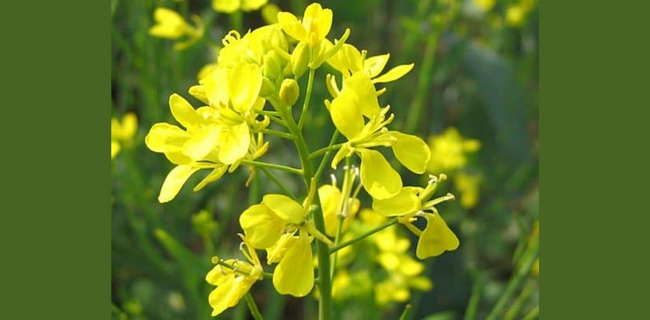
India is the fourth largest contributor of oilseeds and Rapeseed and mustard contributes about 28.6% of total oilseeds production. After soybean and palm oil, it is the third most important oilseed in the world. Mustard seeds and their oil is used for culinary purposes. Young leaves are used for vegetable purposes. Its oil cake is used for feeding cattle.
Mustard-rapeseed groups include Indian mustard, Brown and yellow sarson, raya, and toria crop. Indian mustard is grown in Rajasthan, Madhya Pradesh, UP, Haryana, and Gujarat also in some areas of the south like Andra Pradesh, Karnataka, and Tamil Nadu. Yellow sarson is taken as rabi crop in Assam, Bihar, Orissa, and West Bengal whereas in Punjab, Haryana, UP, and Himachal Pradesh it is taken as catch crop. Earlier brown sarson was cultivated in most of the area now its area under cultivation is decreasing and replaced by Indian mustard. Brown sarson has two ecotypes Lotni and Toria. Toria is a short-duration crop sown under irrigated conditions. Gobhi sarson is new emerging oilseed, it is long duration crop grown in Haryana, Punjab, and Himachal Pradesh.

Roots:
- The mustard plant bears long tapering roots.
- The Torrai roots are surface roots as the roots have a limited working depth and an extensive lateral spread.
Stem:
- In Torrai the stems are 45 cms long.
- In yellow sarson, the stems are 150 cms long.
- The stem are covered with a waxy deposit known as “Bloom”.
- Some mutants of Torrai and sarson are bloomless.
Leaves:
- The leaves of mustard are usually auricled and stem clasping.
- Sarson and Torrai usually poses glabrous and hairy leaves.
Inflorescence and flowers:
- Mustard has a corymbose raceme.
- The size of the flower varies from variety to variety.
- In case of yellow sarson, the four petals are spaced apart.
- In case of brown sarson or Torrai, the four petals may be overlapping.
- The colour of the petal may range from deep yellow to creamy white.
- The petals are shed on the third or fourth day of flowering.
- Due to inbreeding in some varieties of brown sarson and Torrai the petals are held long after they are fully dried.
Fruits:
- The mustard fruit is a siliqua.
- The pods are usually straight with smooth surface having short and stout beaks.
Seeds:
- The seed colour may be brown to yellow depending on the variety.
- The seeds are usually very small and round.
- They weigh from 455-2450seeds per grime.
Climate:
Temperature: 22oC-25oC
Rainfall: 25-40mm
Sowing temperature: 20oC-22oC
Harvesting temperature: 28oC-30oC
The crop prefers low humidity
Soil:
Light to heavy soil is good for mustard and rapeseed cultivation. Raya can be grown in all type of soil whereas loam to heavy soils are suitable for toria crop. Sandy and loamy sand soils are suitable for Taramira crops.
Sandy soil:

Sandy Soil is light, warm, dry and tends to be acidic and low in nutrients. Sandy soils are often known as light soils due to their high proportion of sand and little clay (clay weighs more than sand). These soils have quick water drainage and are easy to work with. They are quicker to warm up in spring than clay soils but tend to dry out in summer and suffer from low nutrients that are washed away by rain. The addition of organic matter can help give plants an additional boost of nutrients by improving the nutrient and water holding capacity of the soil.
Loam soil:

Loam soil is a mixture of sand, silt and clay that are combined to avoid the negative effects of each type. These soils are fertile, easy to work with and provide good drainage. Depending on their predominant composition they can be either sandy or clay loam. As the soils are a perfect balance of soil particles, they are considered to be a gardener best friend, but still benefit from topping up with additional organic matter.
- Pre-sowing irrigation should be done before sowing of seeds.
Preparation of Land:
For good germination of crop it required a fine seed bed. Do ploughing of soil for two to three times followed by two harrowing. Do planking after every ploughing. Prepared firm, moist and uniform seed bed as it will help in uniform germination of seed.
Disc Harrow:

The disc plough bears little resemblance to the common mould board plough. A large, revolving, concave steel disc replaces the share and the mould board. The disc turns the furrow slice to one side with a scooping action. The usual size of the disc is 60 cm in diameter and this turns a 35 to 30 cm furrow slice. The disc plough is more suitable for land in which there is much fibrous growth of weeds as the disc cuts and incorporates the weeds. The disc plough works well in soils free from stones. No harrowing is necessary to break the clods of the upturned soil as in a mould board plough.
Laser Land Leveler:

Laser Land Leveler is a more advanced technique for smoothing the land surface from its average height with a certain degree of the desired slope using a guided laser beam throughout the field. Laser Land Levelling is an important technology for good agronomic, highest possible yield, crop-management, and water-saving.
Advantages of soil preparation-
- It loosens the soil.
- It aerates the soil.
- It prevents soil erosion.
- It allows easy penetration of roots into the soil.
Disadvantages of soil preparation-
The downside of tilling is that it destroys the natural soil structure, which makes soil more prone to compaction. By exposing a greater surface area to air and sunlight, tilling reduces soil’s moisture-retaining ability and causes a hard crust to form on the soil surface.
Selection of variety:
Popular Mustard Varieties
Pioneer 45S46:
- Early maturity variety.
- Matures 90-95 days
- Better oil percentage
- Grains are bold.
ADV414:
- Early maturity variety.
- Matures 90-100 days
- Better oil percentage
- Grains are bold.
PBT 37:
- Early maturity variety.
- Matures in 91 days.
- It is suitable for toria-wheat cultivation.
- Seeds are dark brown and bold in size.
- It gives average yield of 5.4 q/acre and seeds contains 41.7% oil.
TL 15:
- It is early maturity variety.
- It required 88 days to mature.
- It gives average yield of 4.5 q/acre.
TL 17:
- Ready to harvest in 90 days.
- Suitable for multiple cropping.
- It gives average yield of 5.2 q/acre.
RLM 619:
- It is recommended for cultivation in irrigated and rainfed area.
- It is ready to harvest in 143 days.
- Its seed are bold and contain 43% oil.
- It is resistive to white rust, blight and downy mildew.
- Gives average yield of 8 q/acre.
PBR 91:
- It get ready to harvest in 145 days.
- It show resistant to blight, rust and insect pest.
- It gives average yield of 8.1 quintal/acre.
PBR 97:
- Suitable for cultivation under rainfed condition.
- Ready to harvest in 136 days.
- Grains are medium bold and contain 39.8% oil content.
- Gives average yield of 5.2 q/acre.
PBR 210:
- Suitable for timely sown and irrigated condition.
- Ready to harvest in 150 days.
- It gives average yield of 6 q/acre.
RLC 3:
- Tall variety, ready to harvest in 145 days.
- Its average yield is about 7.3 q/acre.
- Its oil content 41.5%.
GSL 1:
- Ready to harvest in 160 days.
- Crop is short and not lodge easily.
- It gives average yield of 6.7 q/acre.
- Seeds contains 44.5% oil content.
GSC 6:
- Recommended for timely sown crop under irrigated condition.
- Seeds are bold and content 39.1% oil content.
- It gives average yield of 6.07 q/acre.
RH 0749:
- Suitable for growing in Haryana, Punjab, Delhi, Jammu and North Rajasthan.
- It is high yielding variety having more number of seeds per silique.
- Ready to harvest in 146-148 days.
- Seeds are bold and having oil percentage of 40%.
- It give average yield of 10.5-11 q/acre.
T 59 (Varuna):
- It is suitable under all climatic conditions.
- Ready to harvest in 145-150 days.
- Gives oil content about 39%.
- It gives average yield of 6-8 q/acre.
Treatment of seed:

To protect seed from soil borne pest and disease, before sowing do seed treatment with Thiram@3gm per kg of seeds.
Seed Rate:
- Line sowing: 1.5 kg/acre
- Broadcasting: 2 kg/acre
Sowing time
- Time for sowing Mustard crop is from September to October month.
- For toria crop, sowing from first fortnight of September to October.
- For African sarson and Taramira can be sown in whole October month.
- For Raya crop complete sowing from mid of October to November End.
Spacing
- For rapeseed :- Row to Row distance of 30 cm and plant to plant distance of 10-15 cm.
- For Gobhi sarson:- Row to Row distance of 45 cm and plant to plant distance of 10 cm.
Depth
- Depth should be kept at 4 to 5 cm.
Sowing Method
Drilling method:

Seed drilling is a planting method that uses a seed drill to place seeds in the ground. The seed drill opens furrows in the soil and then deposits the seeds into the furrow. The seed drill also covers the seeds with soil to protect them from wind and animals.
Advantages of Drilling Method:
- The seed rate becomes less.
- Drilling facilitates thinning and roughing of weak and diseased plants.
- The intercultural operations such as earthing up, manuring, irrigation, spraying etc. can be done successfully in the drilled crops.
- The drilled crops get light, air, nutrients equally as they are spaced at uniform distance.
- Harvesting of crops is easier and advantageous. So, harvesting cost becomes less.
- Drilling may be adopted for both sole cropping and intercropping situations.
- The cost of cultivation in drilled crop becomes less and the yield of drilled crop increases.
Disadvantages of Drilling Method:
- Drilling requires more time, energy and cost.
- An expert technical person is required for running of a seed-drill.
- Drilling needs more time in comparison to broadcasting.
Broadcasting:

This method is as old as agriculture itself but it has several draw backs viz. all seeds do not get better soil moisture contact and do not germinate, a part of the seed is eaten up by birds and ants etc., which results in uneven and poor germination.
Advantages of broadcasting-
- It is an easy, quick, and cheap method of sowing seed.
- More land can be covered within a short time.
- No need for sowing implementation.
- Cost of sowing becomes less.
- Broadcasting is the usual method of sowing seed for mixed cropping.
- Broadcasting needs less labour.
Disadvantages of broadcasting
- The requirement of seed per area is more.
- The cost of weeding and thinning in the broadcast crop is more.
- Intercultural operations such as earthing up, manuring, irrigation, etc., cannot be carried out easily.
- Broadcasting needs planking for covering the seed with soil. On the other hand, drilling needs no planking.
- Broadcast crops do not grow uniformly, and the desired yield is not possible. Moreover, the prediction of the expected outcome becomes erroneous.
Soil and Land preparation:
Apply 70 to 100 quintals of farm yard manure or well-decomposed cow dung in soil.

Benefits of soil treatment:
Water benefits:
- Healthy soil acts as a sponge: more rainwater is absorbed and stored in the ground, where it recharges groundwater and aquifers.
- Healthy soil prevents run-off and erosion, and reduces evaporation.
- Healthy soil improves water quality by filtering pollutants.
Nutritious food:
- Healthy soil increases the nutritional value of food and forage.
- Healthy soil provides plants with the nutrition they need and strengthens plants natural resistance to pests and diseases.
Economic security:
- Healthy soil improves farm productivity and provides stability.
- Healthy soil cuts down on inputs, which increases profit.
- Healthy soil helps withstand extreme weather, floods and drought.
Environmental and health benefits:
- Healthy soil helps reverse global warming by absorbing carbon from the atmosphere where it acts as a greenhouse gas.
- Healthy soil provides habitat for soil microbes to flourish.
- Healthy soil supports greater biodiversity and species stability.
Weed Management:
- Weed control in Toria crop, do pre-plant incorporation of Trifluralin at 400ml/200Ltrs of water per acre.
- For raya crop, give pre-emergence spray of Isoproturon at 400gm/200Ltr within 2 days of sowing.
Mustard saw fly:

Symptoms:
- Initially the larva nibbles leaves, later it feeds from the margins towards the midrib.
- The grubs cause numerous shot holes and even riddled the entire leaves by voracious feeding.
- They devour the epidermis of the shoot, resulting in drying up of seedlings and failure to bear seeds in older plants.
- The yield losses up to 5 to 18 %. In severe case at the seedling stage, the crops have to be re sown.
Management:
- Maintain clean cultivation
- Apply irrigation in seedling stage is very crucial for sawfly management because most of the larvae die due to drowning effect. Severe cold reduces pest load.
- Collection and destruction of grubs of saw fly in morning and evening
- Conserve Perilissus cingulator (parasitoids of the grubs), and the bacterium Serratia marcescens which infect the larvae of sawfly
- Use of bitter gourd seed oil emulsion as on anti- feedant
- Spray the crop with malathion 50 EC @ 1000 ml/ha quinolphos 25 EC @ 625ml/ha. All this should be applied in about 600 to 700 litres of water per ha.
Downy mildew:

Symptoms:
- Grayish white irregular necrotic patches develop on the lower surface of leaves.
- Later under favourable conditions brownish white fungal growth may also be seen on the spots.
- The most conspicuous and pronounced symptom is the infection of inflorescence causing hypertrophy of the peduncle of inflorescence and develop stag head structure.
Management:
- Treat the seed with Apron 35 SD at the rate of 6 g/kg of seed before sowing.
- Spray the crop with 0.2 % Ridomil or 0.1% Karathane as soon as the symptoms are noticed and repeat the spray two to three times at 10 days interval.
Diamondback moth:

Symptoms of damage:
- Whitish patches due to scrapping of epidermal leaf tissues by young larvae
- The leaves give a withered appearance but in later stages larvae bore holes in the leaves
- It also bores into pods and feeds developing seed
Mechanical control:
- Installing pheromone traps @ 4/acre to monitor the adult activity.
- Collection and careful destruction of the larvae.
Chemical control:
- For control of grown up larvae apply 5% malathion dust @37.5 kg/ha
Bihar hairy caterpillar:

Symptoms:
- Young larvae feed gregariously mostly on the under surface of the leaves.
- Caterpillars feed on leaves and in severe infestation the whole crop is defoliated.
Management:
- Apply chlorpyriphos 20 EC @ 1.5 lit/ha or trizophos 40 EC @ 0.8 Lit/ha or quinalphos 25 EC @ 1.5 lit/ha.
- Dust Chlorpyriphos 1.5% DP quinalphos 1.5% @ 25kg/ha when the population is likely to reach 10/m row length (ETL). Repeat it as needed.
Powdery mildew:

Symptoms:
- The disease attacks on the lower leaves as small circular brown necrotic spots which slowly increase in size.
- Many concentric spots coalesce to cover large patches showing blightening and defoliation in severe cases.
- Circular to linear, dark brown lesions also develop on stems and pods, which are elongated at later stage.
- Infected pods produce small, discoloured and shriveled seeds.
Cultural control:
- Follow timely sowing of seeds.
- Adopt proper field sanitation.
- Destruct crop infected crop residues.
- Apply potash in recommended dose
Chemical control:
- Three sprays of aqueous suspensions of Triadimefon 25 WP (0.1%), Tridemorph 80 EC (0.1%), Dinocap 48 EC (0.075%) and Wettable Sulfur 80 WP (0.3%), at 15 day intervals, after disease appearance, controlled the disease effectively and increased seed yields.
Mustard aphid:

Symptoms:
- Both nymph and adults suck the sap from leaves, buds and pods.
- Curling may occur for infested leaves and at advanced stage plants may wither and die.
- Plants remain stunted and sooty molds grow on the honey dew excreted by the insects.
Management:
- Spray the crop with one of the following in the flowering stage: oxydemeton methyl, dimethoate @625-1000 ml per ha
Bacterial blight:

Symptoms
- The leaf tissue turns yellow and chlorosis reach towards the centre of the leaf and form V shaped area with base of V towards the midrib.
- The veins show brown to black discoloration. Dark coloured streaks are formed on the stem from the ground level and gradually these streaks enlarge and girdle the stem.
- Stem become hollow due to internal rotting.
- Midrib cracking of lower leaves, browning of veins and withering is observed.
- In severe cases, the vesicular bundles of the stem also turn brown and the plant collapses.
Chemical control:
- Dimethoate 30% EC @ 264 ml in 200-400 l of water/acre
- Methyl parathion 2% DP @10000 g/acre
- Carbofuran 3% CG @ 26,640 g/acre
Painted bug:

Symptoms:
- Adults and nymphs suck sap from all parts of the plant.
- Young plants wilt and wither as a result of the attack.
- Adult bugs excrete a resinous substance which spoils the pods.
- Quality and quantity (31% losses) of yield is affected when grown up plants are infected.
- Harvested crop in threshing floor is also infested.
Management:
- Spray the crop with malathion 50 EC @1000 ml or dimethoate 30 EC @625 ml in 600-700 litres water.
Club root:

Symptoms:
- Affected plants remain stunted.
- Tiny nodules to large club shaped outgrowths develop in root system.
- Leaves turn pale green or yellow followed by wilting and under severe conditions the plants die
Management:
- Soil fumigation with Methly bromide 1kg/10m2 followed by covering with plastic film.
- Seed treatment with Captan/Thiram 4g/kg, followed by T.viride 4g/kg.
- Application of lime 2.5 t/ha.
- Soil drenching with Copper oxychloride 0.25%.
Sclerotinia stem rot:

Symptoms
- Stems develop water soaked spots near to crown region which later may be covered with cottony white mycelium.
- As disease progresses the affected portions of stem develops a bleached appearance at the internodes and eventually the tissues shreds.
- Premature ripening and shredding of stem, wilting, and drying
- In later stage black sclerotial bodies are also seen on infected plants.
Management
- Use crop rotation; do not plant highly susceptible crops more than once in four years, including dry edible beans, sunflowers, mustard and canola. Use at least a five year rotation for severely infested fields.
- Avoid planting next to a field that had severe Sclerotinia in the past four or five years.
Harvesting-
Harvesting should be carried out as soon as pods begins to turn yellow colour and seed becomes harder. The mustard crop matures in about 110-140 days. Harvesting should be done in early morning hours to avoid any shattering of seed. Use sickle to cut the crop close to the ground.
Post-harvest task-
Harvested mustard plants should be tied into bundles, keep them in sun for 5-6 days to dry. Thrashing can be carried out by beating the mustard plant with stick. Winnowing is done to separate the grain from husk.


Leave a Reply