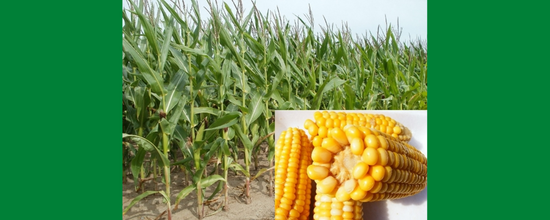
First to second week:
Climate:
- Maize is grown in temperatures between 18°C and 27°C during the day and around 14°C during the night. But the most important factor is the 140 frost-free days. Maize is grown mostly in regions having annual rainfall between 60 cm to 110 cm.
The critical mean temperature range:
Germination and seedling growth : 26° to 30°C
Vegetative Phase : 34°C
Tasselling Phase : 21° to 30°C
Reproductive Phase : 32°C
Suitable Soils with texture ranges : Sandy and clay and clay-loam soil
Suitable pH range : 6 to 6.5

Temperature:
- Maize is grown in temperatures between 18°C and 27°C during the day and around 14°C during the night. But the most important factor is the 140 frost-free days. The crop is very susceptible to frost; therefore, its cultivation in temperate latitudes is limited.
Rainfall:
- Maize is grown mostly in regions having annual rainfall between 60 cm to 110 cm. But it is also grown in areas having rainfall of about 40 cm.
Suitable Soil requirement:
- Fertile well-drained Loamy soil or simply red clay loam free of coarse elements and full off nitrogen are ideal soils for maize cultivation. Maize can be grown on wide range of soils including loamy sand to clay loam. Definitely depleted plains are effective suited to the cultivation, even though it grows up in various hilly zones equally. Soils with fine organic matter containing good water holding capacity with pH ranging from 5.5-7.5 are required to increased yield. Heavy clay soil is not suitable for cultivation.
- Soil test is necessary to know deficiency of any nutrient in the soil.
Loamy sand:

Loamy soil is the mixture of sand, clay and silt. It contains more moisture, nutrients and humus compared to sandy soil and better drainage compared to clay and silt soil. It has the right water holding capacity needed for the growth of plants.
Clay Loam:

Clay loam is a soil mixture that contains more clay than other types of rock or minerals. A loam is a soil mixtures that is named for the type of soil that is present in the greatest amount. The particles of clay are very small, which is one of its most important characteristics. The relative percentages of sand, silt, and clay are what give soil its texture. A clay loam texture soil, for example, has nearly equal parts of sand, slit, and clay. These textural separates result from the weathering process. This is an image comparing the sizes of sand, silt, and clay together.
Soil treatment:
Apply organic manure like FYM/compost/well-decomposed press mud (about 8-10 tonnes/acre). Quantity of organic manure could be adjusted in such a way as to supply 112 kg N/acre through one or more sources depending on their N content. Trichoderma and Pseudomonas (each 1kg/acre) and Decomposing cultures can be mixed with the organic manures. This will improve the soil fertility to realize higher yields.

Benefits of soil treatment:
Water benefits:
- Healthy soil acts as a sponge: more rainwater is absorbed and stored in the ground, where it recharges groundwater and aquifers.
- Healthy soil prevents run-off and erosion, and reduces evaporation.
- Healthy soil improves water quality by filtering pollutants.
Nutritious food:
- Healthy soil increases the nutritional value of food and forage.
- Healthy soil provides plants with the nutrition they need and strengthens plants natural resistance to pests and diseases.
Economic security:
- Healthy soil improves farm productivity and provides stability.
- Healthy soil cuts down on inputs, which increases profit.
- Healthy soil helps withstand extreme weather, floods and drought.
Environmental and health benefits:
- Healthy soil helps reverse global warming by absorbing carbon from the atmosphere where it acts as a greenhouse gas.
- Healthy soil provides habitat for soil microbes to flourish.
Healthy soil supports greater biodiversity and species stability
Land Preparation:
- For cultivation selected land should be free from weeds and remains of previously grown crop. Plough the land to bring the soil to fine tilth. It may take 6 to 7 plough. Apply 4-6 tons/acre of well decomposed cow dung across the field, also apply 10 Azospirillum packets in field. Prepared furrow and ridges with 45 cm to 50cm spacing.
Implements used in Soil and Land preparation:
Disc Plough:

The disc plough bears little resemblance to the common mould-board plough. A large, revolving, concave steel disc replaces the share and the mould-board. The disc turns the furrow slice to one side with a scooping action. The usual size of the disc is 60 cm in diameter and this turns a 35 to 30 cm furrow slice. The disc plough is more suitable for land in which there is much fibrous growth of weeds as the disc cuts and incorporates the weeds. The disc plough works well in soils free from stones. No harrowing is necessary to break the clods of the upturned soil as in a mould board plough.
Tractor Drawn Cultivator:

Cultivator is an implement used for finer operations like breaking clods and working the soil to a fine tilth in the preparation of seedbed. Cultivator is also known as tiller or tooth harrow. It is used to further loosen the previously ploughed land before sowing. It is also used to destroy weeds that germinate after ploughing. Cultivator has two rows of tynes attached to its frame in staggered form. The main object of providing two rows and staggering the position of tynes is to provide clearance between tynes so that clods and plant residues can freely pass through without blocking. Provision is also made in the frame by drilling holes so that tynes can be set close or apart as desire. The number of tynes ranges from 7 to 13. The shares of the tynes can be replaced when they are worn out.
Laser land leveller:

Laser Land Leveller is a more advanced technique for smoothing the land surface from its average height with a certain degree of the desired slope using a guided laser beam throughout the field. Laser Land Levelling is an important technology for good agronomic, highest possible yield, crop-management, and water-saving.
Advantages of soil preparation:
- It loosens the soil.
- It aerates the soil.
- It prevents soil erosion.
- It allows easy penetration of roots into the soil.
Disadvantages of soil preparation:
The downside of tilling is that it destroys the natural soil structure, which makes soil more prone to compaction. By exposing a greater surface area to air and sunlight, tilling reduces soil’s moisture-retaining ability and causes a hard crust to form on the soil surface.
Tillage and crop establishment
Tillage and crop establishment is the key for achieving the optimum plant stand that is the main driver of the crop yield. Though the crop establishment is a series of events (seeding, germination, emergence and final establishment) that depends on interactions of seed, seedling depth, soil moisture, method of sowing, machinery etc. but, the method of planting plays a vital role for better establishment of crop under a set of growing situation. Maize is mainly sown directly through seed by using different methods of tillage & establishment but during winters where fields are not remain vacant in time (till November), transplanting can be done successfully by raising the nursery. However, the sowing method (establishment) mainly depends on several factors viz the complex interaction over time of seeding, soil, climate, biotic, machinery and management season, cropping system, etc. Recently, resource conservation technologies (RCTs) that include several practices viz. zero tillage, minimum tillage, surface seeding etc. Had come in practice in various maize based cropping system and these are cost effective and environment friendly.
Methods of sowing:
Raised bed (ridge) planting:

Generally the raised bed planting is considered as best planting method for maize during monsoon and winter seasons both under excess moisture as well as limited water availability/rain-fed conditions. Sowing/planting should be done on the southern side of the east-west ridges/beds, which helps in good germination. Planting should be done at proper spacing. Preferably, the raised bed planter having inclined plate, cupping or roller type seed metering systems should be used for planting that facilitates in placement of seed and fertilizers at proper place in one operation that helps in getting good crop stand, higher productivity and resource use efficiency. Using raised bed planting technology, 20-30 % irrigation water can be saved with higher productivity. Moreover, under temporary excess soil moisture/water logging due to heavy rains, the furrows will act as drainage channels and crop can be saved from excess soil moisture stress. For realizing the full potential of the bed planting technology, permanent beds are advisable wherein sowing can be done in a single pass without any preparatory tillage. Permanent beds are more beneficial under excess soil moisture situations as the infiltration rate is much higher and crop can be saved from the temporary water logging injury.
Zero-till planting:

Maize can be successfully grown without any primary tillage under no-till situation with less cost of cultivation, higher farm profitability and better resource use efficiency. Under such condition one should ensure good soil moisture at sowing and seed and fertilizers should be placed in band using zero-till seed-cum-fertilizer planter with furrow opener as per the soil texture and field conditions. The technology is in place with large number of farmers particularly under rice-maize and maize-wheat systems in peninsular and eastern India. However, use of appropriate planter having suitable furrow opener and seed metering system is the key of success of the no-till technology.
Conventional till flat planting:
Under heavy weed infestation where chemical/herbicidal weed management is uneconomical in no-till and also for rain-fed areas where survival of crop depends on conserved soil moisture, in such situations flat planting can be done using seed-cum-fertilizer planters.
Furrow planting:

To prevent evaporative losses of water during spring season from the soil under flat as well as raised bed planting is higher and hence crop suffers due to moisture stress. Under such situation/condition, it is always advisable to grow maize in furrows for proper growth, seed setting and higher productivity.
Transplanting:

Under intensive cropping systems where it is not possible to vacate the field on time for planting of winter maize, the chances of delayed planting exists and due to delay planting crop establishment is a problem due to low temperature so under such conditions transplanting is an alternative and well established technique for winter maize. Therefore, for the situation where fields are vacated during December-January, it is advisable to grow nursery and transplant the seedlings in furrows and apply irrigation for optimum crop establishment. Use of this technique helps in maintenance of temporal isolation in corn seed production areas for production of pure and good quality seed as well as quality protein maize grain. For planting of one hectare, 700 m2 nursery area is required and the nursery should be raised during second fortnight of November. The age of seedlings for transplanting should be 30-40 days old (depending on the growth) and transplant in the month of December-January in furrows to obtain higher productivity.
Maize Varieties and their Characters
| Sl. No. | Variety / Hybrids | Suitable for Rainfed / Irrigated conditions | Duration (in days) | Yield q/acre | Characters |
|---|---|---|---|---|---|
| Hybrids | |||||
| 1. | DHM – 103 | Sutable for Irrigated conditions | 105-120 | 22-25 | Tolerant to leaf blight and Stem rot diseases |
| 2. | DHM – 105 | Sutable for Irrigated conditions | 105-120 | 25-30 | Tolerant to leaf blight and wilt |
| 3. | DHM – 1 | Sutable for Irrigated conditions | 85-90 | 18-20 | Short duration hybrid, tolerant to leaf blight disease |
| 4. | Trisulatha | Sutable for Irrigated conditions | 105-120 | 25-30 | Tolerant to leaf blight and wilt diseases |
| 5. | DHM – 107 | Sutable for Irrigated conditions | 88- 95 | 22-25 | Medium duration hybrid. Tolerant to leaf blight and wilt |
| 6. | DHM – 109 | Sutable for Irrigated conditions | 85-90 | 22-25 | Short duration hybrid. Tolerant to leaf blight and wilt |
| Synthetics / composits | |||||
| 7. | Aswani / Harsha / Varun | Sutable for Irrigated conditions | 90-105 | 18-20 | Aswani : Tolerant to StemborerHarsha tolerant to Stemborer, leaf blight and wiltVarun tolerant to drought. |
| Special Varieties | |||||
| 8. | Amber Pop Corn | Sutable for Irrigated conditions | 95-105 | 10-14 | For Pop Corn suitable |
| 9. | Madhuri (Sweet Corn) | Sutable for Irrigated conditions | 65-70 | 30-35 thousand fresh cobs | Sweet Corn. 30-36% sugars. Suitable for table purpose after boiling. |
| 10. | Priya Sweet Corn | Sutable for Irrigated conditions | 70-75 | 30-35 thousand fresh cobs | Sweet Corn. 30-36% sugars. Suitable for table purpose after boiling. Cob size bigger than Madhuri variety |
Sowing and Seed rate:
Time of sowing:
- In kharif season, crop is sown in month of May end to June Corresponding with the onset of monsoon. Rabi crops are sown during mid-october to November. Plantation of baby corn can be done all the year round, except December and January. Kharif and rabi season are best for sweet corn sowing.
Spacing:
To obtain higher yield along with resource-use efficiency, optimum plant spacing is the key factor.
- For kharif maize: use spacing of 60×20 cm.
- For Rabi maize: use spacing of 60×20 cm.
- Sweet corn: use spacing of 60×20 cm spacing.
- Baby corn: Use 60×20 cm or 60×15 cm spacing.
- Popcorn: Use 50×15 cm spacing.
- Fodder: use spacing of 30×10 cm spacing
Sowing Depth:
- Seed should be sown at depth of 3-4 cm.
- For sweet corn cultivation keep depth of sowing to 2.5 cm.
Seed Rate:
Purpose, seed size, season, plant type, sowing method these factor affect seed rate.
1) For kharif/rabi maize: use seed rate of 8-10 kg/acre,
2) Sweet corn: use seed rate of 8 kg/acre
3) Baby corn: 16 kg/acre seed rate.
4) Popcorn: 7 kg/acre seed rate.
5) Fodder: 20 kg/acre seed rate
Seed Treatment
To protect the maize crop from seed and major soil borne diseases and insect-pests, seed treatment with fungicides and insecticides before sowing is advisable/ recommended as per the below given details.

| Disease/insect-pest | Fungicide/Pesticide | Rate of application(g kg-1 seed) |
| Turcicum Leaf Blight,, Banded Leaf andSheath Blight, Maydis Leaf Blight | Bavistin + Captan in 1:1 ratio | 2.0 |
| BSMD | Apran 35 SD | 4.0 |
| Pythium Stalk Rot | Captan | 2.5 |
| Termite and shoot fly | Imidachlorpit | 4.0 |
Intercropping:
- Pea can be taken as intercrop in maize plant. For that take one row of pea between maize crops. In autumn sugarcane and maize can also be intercropped. Sow one row of maize plant after two row of sugarcane.
Fertilizer Requirement:
| Season | Fertilizer (Kg/ha) | Time of application | ||
| Sowing | Vegetative phase | Corn phase | ||
| Kharif | Nitrogen | 50 | 40 | 30 |
| Phosphorus | 60 | – | – | |
| Potassium | 50 | 50 | 50 | |
| Rabi | Nitrogen | 60 | 50 | 40 |
| Phosphorus | 75 | – | – | |
| Potassium | 50 | – | – | |
| Summer | Nitrogen | 50 | 50 | – |
| Phosphorus | 40 | – | – | |
| Potassium | 30 | – | – |
Weed control:
- Weeds are the serious problem in Maize, particularly during kharif/monsoon season they competes with maize for nutrient and causes yield loss upto 35%. Therefore, timely weed management is needed for achieving higher yield. Take atleast one or two hand weeding in maize crop. First 20-25 days after sowing and second when on 40-45 days after sowing. If weed infestation is high, spray with Atrazine @500gm per 200 Ltr. of water. After weeding, apply fertilizer as top dressing and carry out earthing up operation.
- Apply irrigation immediately after sowing. Based upon soil type, on third or fourth day give lifesaving irrigation. In rainy season, if rain is satisfactory then it is not needed.
- Avoid water stagnation in early phase of crop and provide good drainage facility. Crop required less irrigation during early stage, 20 to 30 days after sowing afterwards it required irrigation once in a week.
- Seedling, knee height stage, flowering and grain feeling are the most sensitive stage for irrigation. Water stress at this stage cause huge loss in yield. In case of water scarcity, irrigate alternate furrow. It will save water also.
Maize Shoot Fly:


Symptoms:
- Maggot are legless, tapering towards head, pale yellow, small. Adult Small grey coloured fly.
- Maggots on hatching from the eggs bore into the central shoots of seedlings and kill the growing point, producing “dead hearts”.
Management:
- Cultural Control- Sowing within 10-15 days after onset of monsoon reduces the shoot fly incidence. Synchronisation in sowing also helps in reducing shoofly incidence. Plough after harvest to remove and destroy the stubbles.
- Mechanical Control– Removal of the seedlings with dead hearts and keep the optimum plant stand in the field.
- Physical Control– Use of polythene fish meal trap @4-5/acre.
- Biological Control– Encourage natural enemies like eulophid (Tetrastichus nyemitawus) and chalcid wasp (Callitula bipartius) @1-2 cards/acre which are larval parasites of this fly.
- Chemical Control– Seed soaking with Dimethoate 30% EC @ 1ml/lit. of water, solution for 12 hours and dry it in shade before sowing or seed treatment with Imidacloprid @ 1ml/kg seed for control shoot fly infestation. Apply Quinalphos 5G @ 8 kg mix with 12 Kg send /acre.
Leave a Reply