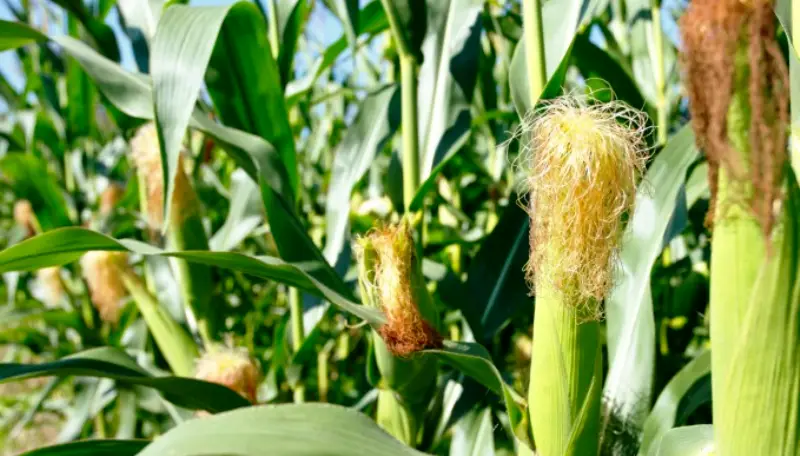
Apply 7 kg of urea per acre. This application is optional. You can either apply side dressing or broadcast the fertilizers.
Example: if you have 3 acres, you will need to apply 21 kg of urea in total.
Monitor your field for some diseases incidence-
Charcoal rot: Macrophomina phaseolina

Symptoms:
- The pathogen affects the plant mostly after flowering and the disease is named as Post Flowering Stalk Rot (PFSR).
- The stalk of the infected plants can be recognized by greyish streak.
- The pith becomes shredded and greyish black minute sclerotia develop on the vascular bundles.
- Shredding of the interior of the stalk often causes stalks to break in the region of the crown.
- The crown region of the infected plant becomes dark in colour.
- Shredding of root bark and disintegration of root system are the common features.
- High temperature and low soil moisture (drought) favours the disease
Management
- Follow crop rotation
- Avoidance of water stress at flowering time reduced disease incidence
- Avoid nutrient stress.
- Apply potash @ 80 kg/ha in endemic areas
- Soil application of P. fluorescens (or) T. viride @ 2.5 kg / ha + 50 kg of well decomposed FYM (mix 10 days before application) or sand at 30 days after sowing
Cob worm/Earworm:


Symptoms:
- Adult is a medium sized, brownish yellow moth, A prominent black spots on the fore wings and Broad black patch on the outer margin of hind wing.
- Caterpillar also feed partially on developing grains and bored holes are plugged with excreta.
- Caterpillars are also feeds on tender leaves for a short time.
Management:
- Cultural Control- Growing intercrops such as cowpea, onion, coriander, urdbean in 1:2 ratio.
- Mechanical Control- Bird perches @ 8-10 in Nos./ acre should be erected for facilitating field visits of predatory birds.
- Physical Control– Pheromone traps @ 4-5 in number/acre can be installed for monitoring borer activity. Replace the lures with fresh lures after every 20-25 day interval.
- Biological Control- Spray HNPV @ 100-120 LE/acre 2-3 times at weekly interval in the evening hours and addition of Teepal 0.1% in the solution gives better results. Inundatively release of T. pretiosum @ 0.4 lakh/acre 4-5 times from flower initiation stage at weekly intervals.
- Chemical Control- Quinalphos 25% EC @ 260 ml or Decamethrin 2.8% EC @ 180 ml or Cypermethrin 10 % EC @ 300 ml or Fenvalerate 20 EC @ 330 ml dissolve in 250-300 lit. of water/acre.
Leave a Reply