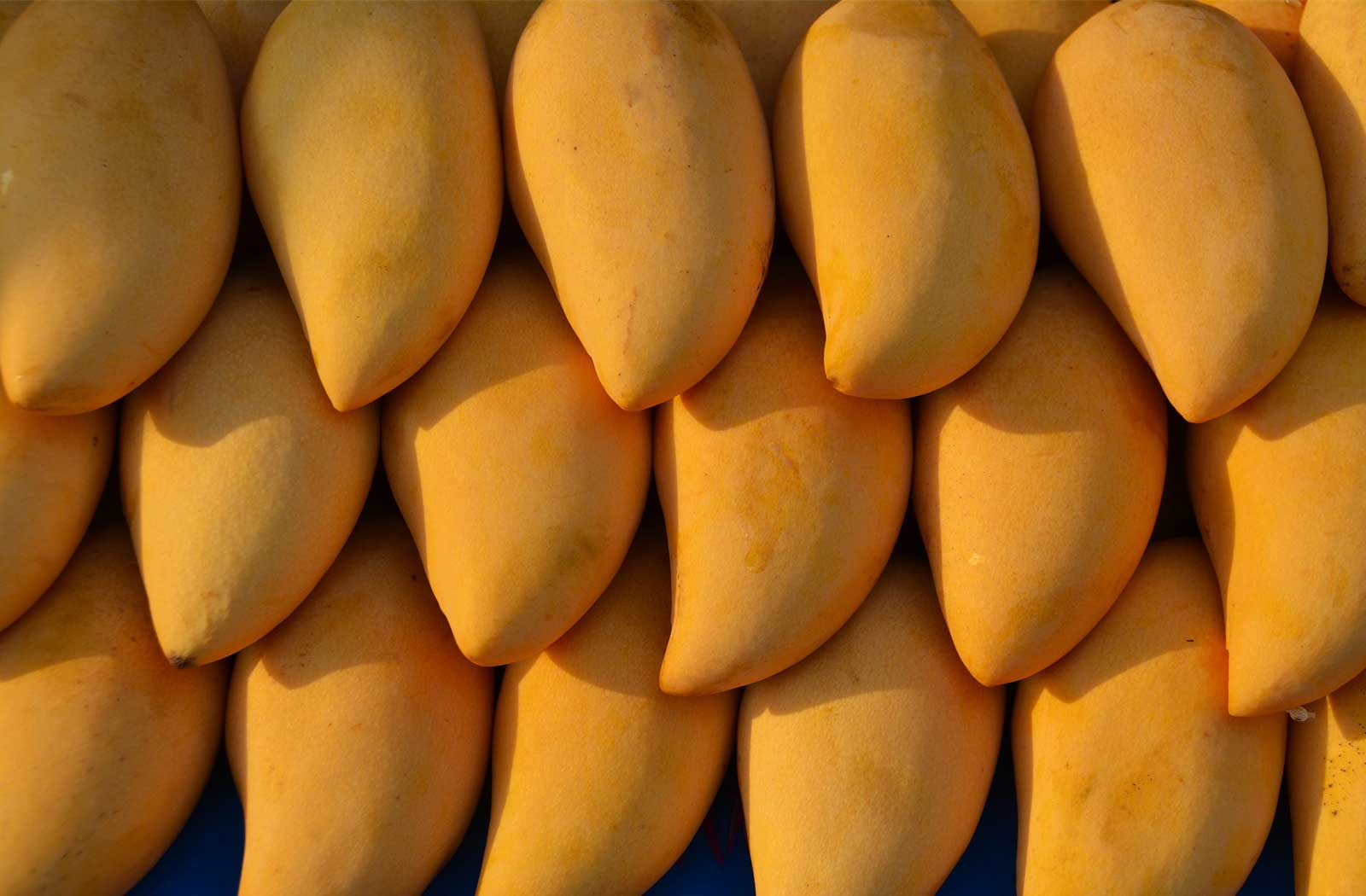
Mango crop
Mango is known as the king of fruits and cultivated in India from old times. Mango is a rich source of Vitamin A and C; its leaves are used as fodder in case of shortage of fodder while wood is used for furniture making. Unriped fruits are used for chutney, pickles and ripe fruits are used for eating purposes as well as for syrups, jam and jelly. It is commercially cultivated in Andhra Pradesh, Karnataka, West Bengal, Kerala, Bihar, UP, Uttarakhand, Punjab, Haryana, Maharashtra, and Gujarat.

Agro-climatic requirements
Mango is well adapted to tropical and sub-tropical climates. It thrives well in almost all the regions of the country but cannot be grown commercially in areas above 600 m. It cannot stand severe frost, especially when the tree is young. High temperature by itself is not so injurious to mango, but in combination with low humidity and high winds, it affects the tree adversely.
Mango varieties usually thrive well in places with rainfall in the range of 75-375 cm. /annum and dry season. The distribution of rainfall is more important than its amount. Dry weather before blossoming is conducive to profuse flowering. Rain during flowering is detrimental to the crop as it interferes with pollination. However, rain during fruit development is good but heavy rains cause damage to ripening fruits. Strong winds and cyclones during fruiting season can play havoc as they cause excessive fruit drop.
Soil-
Loamy, alluvial, well drained, aerated and deep soils rich in organic matter with a pH range of 5.5 to 7.5 are ideal for mango cultivation.
Loamy Soil:

Considered the most fertile of soil type, loamy soils are a combination of sandy, clay and silt particles. The clay and silt particles improve moisture retention while the sand minimizes compaction and improves drainage. Loamy soils don’t get dried out in the summer, but also don’t get water-logged in winter.
Advantages of Loamy Soils
- Drought resistant due to water-holding capacity
- Faster to warm up in the spring, compared to clay
- Can hold nutrients, making soils fertile
- Good infiltration of air and water
Disadvantages of Loamy Soils
- Depending on how your soil was formed, some loamy soils can contain stones that may affect harvesting of some crops.
Managing Your Loamy Soil
While loamy soils are ideal whether you are growing crops, flowers or turfgrass, all soils need to be managed in order to maintain or improve soil health. Adding products rich in soil microbes is key to promoting a robust soil ecosystem. Clay-loam soils having good drainage can also be used. In sandy-loam soils, apple trees are adversely affected by the stem diseases like Canker and Papery Bark and insects like stem and root borers. The soils rich in organic matter and, have a pH of around 6.5 and have good drainage are best for apple growing. The shallow soils with gravels can be made suitable by adding heavy quantities of farm yard manure/ compost or leaf moulds. On the whole, the soils on which natural forests of oak and deodar a flourish are ideal for apple orcharding.
Alluvial soil-

Alluvial soil as a whole is very fertile. Mostly these soils contain adequate proportion of potash, phosphoric acid and lime which are ideal for the growth of sugarcane, paddy, wheat, and other cereal and pulse crops.
Growing and Potential Belts of Mango-

Mango is cultivated in almost all the states of India. The state-wise growing belts are given in the following:
| State | Growing belts |
| Andhra Pradesh | Krishna, East and West Godavari, Vishakhapatnam, Srikakulam, Chittoor, Adilabad, Khamman, Vijaynagar |
| Chhattisgarh | Jabalpur, Raipur, Bastar |
| Gujarat | Bhavnagar, Surat, Valsad, Junagarh, Mehsana, Khera |
| Haryana | Karnal, Kurushetra |
| Jammu & Kashmir | Jammu, Kathwa, Udhampur |
| Jharkhand | Ranchi, Sindega, Gumla, Hazaribagh, Dumka, Sahibganj, Godda. |
| Karnataka | Kolar, Bangalore, Tumkur, Kagu |
| Kerala | Kannur, Palakkad, Trissur, Malappuram |
| Madhya Pradesh | Rewa, Satna, Durg, Bilaspur, Bastar, Ramnandgaon, Rajgari, Jabalpur, Katni, Balagha |
| Maharashtra | Ratnagiri, Sindhudurg, Raigarh |
| Orissa | Sonepur, Bolangir, Gajapati, Koraput, Rayagada, Gunpur, Malkanpuri, Dhenkanal, Ganjam, Puri |
| Punjab | Gurdaspur, Hoshiarpur, Ropar |
| Tamil Nadu | Dharmapuri, Vellore, Tiruvallur, Theni, Madurai |
| Uttaranchal | Almora, Nainital, Dehradun, Bageshwar, UdhamSingh Nagar, Haridwar |
| Uttar Pradesh | Saharanpur, Bulandshahar, Lucknow, Faizabad, Varanasi |
| West Bengal | Malda, Murshidabad, Nadia |

Varieties Cultivated
In India, about 1,500 varieties of mango are grown including 1,000 commercial varieties. Each of the main varieties of mango has a unique taste and flavour.
Based on time of ripening, varieties may be classified as under:
| Early | Bombai, Bombay Green , Himsagar, Kesar, Suvernarekha |
| Mid-season | Alphonso, Mankurad, Bangalora, Vanraj, Banganapalli, Dashehari, Langra, Kishen Bhog, Zardalu, Mankurad |
| Late | Fazli, Fernandin, Mulgoa, Neelum, Chausa |
Hybrids:
Amrapalli (Dashehari x Neelum), Mallika (Neelum x Dashehari), Arka Aruna (Banganapalli x Alphonso), Arka Puneet (Alphonso x Janardhan Pasand), Arka Neelkiran (Alpohonso x Neelum), Ratna (Neelum x Alphonso), Sindhu (Ratna x Alphonso), Au Rumani (Rumani x Mulgoa), Manjeera (Rumani x Neelum), PKM 1 (Chinnasuvernarekha x Neelum), Alfazli, Sunder Langra, Sabri, Jawahar, Neelphonso, Neeleshan, Neeleshwari, PKM 2 (very few of these hybrid varieties are grown commercially in the country).
The important mango varieties cultivated in different states of India are given below:
| State | Varieties grown |
| Andhra Pradesh | Allumpur Baneshan, Banganapalli, Bangalora, Cherukurasam, Himayuddin, Suvernarekha, Neelum, Totapuri |
| Bihar | Bathua, Bombai, Himsagar, Kishen Bhog, Sukul, Gulab Khas, Zardalu, Langra, Chausa, Dashehari, Fazli |
| Goa | Fernandin, Mankurad |
| Gujarat | Alphonso, Kesar, Rajapuri, Vanraj, Jamadar, Totapuri, Neelum, Dashehari, Langra |
| Haryana | Dashehari, Langra, Sarauli, Chausa, Fazli |
| Himachal Pradesh | Chausa, Dashehari, Langra |
| Jharkhand | Jardalu, Amrapalli, Mallika, Bombai, Langra, Himsagar, Chausa, Gulabkhas |
| Karnataka | Alphonso, Bangalora, Mulgoa, Neelum, Pairi, Baganapalli, Totapuri |
| Kerala | Mundappa, Olour, Pairi |
| Madhya Pradesh | Alphonso, Bombay Green, Langra, Sunderja, Dashehari, Fazli, Neelum, Amrapalli, Mallika |
| Maharashtra | Alphonso, Mankurad, Mulgoa, Pairi, Rajapuri, Kesar, Gulabi, Vanraj |
| Orissa | Baneshan, Langra, Neelum, Suvarnarekha, Amrapalli, Mallika |
| Punjab | Dashehari, Langra, Chausa, Malda |
| Rajasthan | Bombay Green, Chausa, Dashehari, Langra |
| Tamil Nadu | Banganapalli, Bangalora, Neelum, Rumani, Mulgoa, Alphonso, Totapuri |
| Uttar Pradesh | Bombay Green, Dashehari, Langra, Safeda Lucknow, Chausa, Fazli |
| West Bengal | Bombai, Himsagar, Kishen Bhog, Langra, Fazli, Gulabkhas, Amrapalli, Mallika |
Planting
Planting Material
![PDF] Mango Propagation | Semantic Scholar](https://lh4.googleusercontent.com/ZtJxQrj7uTwhiNINOxwYefoIJ20y3NVCUuqyzzukZE3np4VeRVLCWEq-31h_Rta_Uxm0H_StsiDy1WojlEy3pu3JZQxIcwPp7nHPHkswxol5TUfhfeWxVXnHp8R4P39ElmpdRiXZeFo5HguVjyNTlA2aEJubmqNFp7hacVE8Oo815FKBc6NzXAwXF2BWtHUYOiGYpiGkCg)

Mango can be propagated from seed or propagated vegetatively. Plants are generally propagated vegetatively by using several techniques like veneer grafting, inarching and epicotyl grafting etc.
Seed Treatment-
Before planting, dip stones in solution of Dimethoate for few minutes. It will protect crop from mango weevils. Seed treatment with Captan fungicide protects seeds from fungal infections.
Planting Season
Planting is usually done in the month of July-August in rainfed areas and during February-March in irrigated areas. In case of heavy rainfall zones, planting is taken up at the end of rainy season.
Spacing

The planting distance is 10m. x 10m and 12m x 12m. In dry and moist zones respectively. In the model scheme, a spacing of 8m x 8m with a population of 63 plants per acre has been considered which was observed to be common in areas covered during a field study.
Sowing Depth-

Dug pits of 1x1x1m size at distance of 9x9m one month earlier before planting. Expose them to sun. Fill with mixture of soil, 30 to 40 kg of FYM or Compost and 1 kg single super phosphate.
Training of Plants

Training of plants in the initial stages of growth is very important to give them a proper shape especially in cases where the graft has branched too low.
Nutrition

Fertilizers may be applied in two split doses , one half immediately after the harvesting of fruits in June/July and the other half in October, in both young and old orchards followed by irrigation if there are no rains. Foliar application of 3 % urea in sandy soils is recommended before flowering.
The following table gives the details of fertilizer applied (depending upon the age of the plants):
| Age of the plant (in years) | Fertilizer applied |
| 1* | 100g. N, 50g. P2O5, 100g. K2O |
| 10 | 1kg. N, 500g. P2O5, 1kg. K2O |
| 11 | -do- |
*The doses applied in the subsequent years should be increased every year up-to 10 years in the multiple of the first year’s dose.
Well decomposed farm-yard manure may be applied every year. For trench application of fertilizers should be 400g each of N and K2O and 200g of P2O5 per plant should be provided. Micro-nutrients may be applied as per the requirement in the form of foliar sprays.
Irrigation:-


The frequency and amount of irrigation to be provided depends on the type of soil, prevailing climatic conditions, rainfall and its distribution and lastly the age of the trees. No irrigation is required during the monsoon months unless there are long spells of drought.
| Age of the plant (in years)/Growth stage | Irrigation schedule |
| 1 | Irrigated at an interval of 2-3 days during dry season. |
| 2-5 | Irrigation interval- 4-5 days. |
| 5-8/ fruit set to maturity | Irrigated after every 10-15 days. |
| Full bearing stage | 2-3 irrigations after fruit set. |
Frequent irrigation during 2-3 months prior to the flowering season is not advisable as it is likely to promote vegetative growth at the expense of flowering. Irrigation should be given at 50% field capacity. Generally inter-crops are grown during the early years of plantation and hence frequency and method of irrigation has to be adjusted accordingly. The method usually followed for irrigating mango plants is basin irrigation. However, use of Drip Irrigation will not only reduce the water requirements but will also help in fertigation in root zones of the plants.
Intercultural Operations
The frequency and the time of inter-culture operations vary with age of the orchards and existence of inter-crops. The weed problem may not exist immediately after planting the mango crop but it is advisable to break the crust with hand hoe each time after 10-15 irrigations are applied. In case of mono-cropping, the area between the basins should be ploughed at least three times in a year i.e. during the pre-monsoon, post-monsoon period and in the last week of November.
Inter-cropping
Intercropping can be taken up till the mango trees attain suitable height and develop canopy (at 5-6 years of age).Leguminous crops like green gram, black gram, gram etc., cereals like wheat, oilseeds like mustard, sesame and groundnut, vegetable crops such as cabbage, cauliflower, tomato, potato, brinjal, cucumber, pumpkin, bitter gourd, tinda, lady’s finger etc. and spices like chillies can be grown as intercrops. The partial shade loving crops like pineapple, ginger, turmeric etc. can be cultivated in fully grown orchards. In addition to field crops, some short duration , less exhaustive and dwarf type inter- fillers like papaya, guava, peach, plum etc. can be grown till these do not interfere with the main mango crop .It is advisable to take vegetable crops as inter crops for better returns.
The average cost of inter cropping would be Rs.10,000/Acre and it would yield on an average of 6 tonnes / Acres.
Crop Management
Regulation of Bearing
Proper cultural practices like addition of fertilizers and control of diseases and insect pests may be adopted to regulate growth and bearing. Regular bearing varieties viz. Dashehari and Amrapalli may be grown. De-blossoming of the panicles with NAA @ 200 ppm. (20 g./100 l. water) during ‘on’ year may help to regulate the bearing.
Regulation of Fruit Drop
Embryo abortion, climatic factors , disturbed water relation, lack of nutrition, attack of disease and pest, hormonal imbalances are the major factors that lead to fruit drop. A spray of Alar (B-Nine) @ 100 ppm. or 20 ppm. 2,4-D (2g. in 100 l. water) in the last week of April or in the last week of May will control to some extent the summer fruit drop in Langra & Dashehari.
Plant Protection Measures
Insect Pests
Mealy Bug:

It causes damage to crop by sucking sap from inflorescences, stem, leaves and shoot. Infestation observed mostly in January to April. Mealy bug affected part dried and sooty mould is seen on infected parts.
To prevent tree from mealy bug infestation, 25cm width Polythene (400gauge) strip fastened around tree trunk to stop ascent of nymphs before hatching of eggs in month of Nov and Dec. If infestation is observed, spray Acephate@2gm/Ltr or Spirotetramat@3ml/Ltr of water to control mealy bug.
Mango Hopper:

Infestation is observed mostly in February-March Month when crop is in flowering stage. They suck sap from inflorescences, leaves. On infection flower get sticky and sooty mould a black color fungus is developed on affected parts.
If infestation is observed take Spray Cypermethrin 25EC @3ml or Deltamethrin 28EC@9ml or Fenvelarate20EC@5ml or Neembicidine 1000ppm@20ml in 10Ltr water on whole tree.
Mango Fruit Fly:

It is a serious pest of mango. Females lay eggs below epidermis of young fruits. Later on maggots feed on pulp afterward fruits starts rotting and get drop.
Destroy infected fruits away from field. During fruit developed stage, hang traps of 100ml emulsion of methyl Engenol 0.1%. In May month start spraying of Chlorpyrifos 20EC@2ml/Ltr of water for three times with interval of 20days.
Disease and their control:
Powdery Mildew:

Whitish powdery growth observed on inflorescence and the floral parts. In severe condition, they get drop. Also fruits, branches and floral part show dieback symptoms.
Before flowering, during flowering and after fruit set, take spray of 1.25kg wet able sulphur in 200litre of water. If needed, take second spray with interval of 10-15days. If infestation is observed in field, take spray of 178% Imidacloprid@3ml along with Hexaconzole@5ml/10Ltr water or Tridemorph@5ml or Carbendazim @10gm/10Ltr of water.
Stem Borer:


It is a serious pest of mango crop. It create tunnel under bark and destroyed tree by feeding on internal tissue. Larva of stem borer excreta is observed outside of tunnel.
If infestation is observed, clean tunnel with hard wire and insert cotton swab dip in mixture of Kerosene and Chlorpyriphos in ratio of 50:50 and then closed it with mud.
Anthracnose or Dieback:

Dark brown or black spots are observed on shoots. On fruits also small, raise, dark spots are observed.
To control dieback and other diseases, cut infested, dead portion and apply Bordo Paste on it. Spray Bordeaux mixture @ 10gm/Ltr of water. If infestation observed in field take spray of Copper oxychloride @ 30gm/10Ltr on infected trees. If Anthracnose observed on new flush. Spray with Thiophanate methyl @ 10gm or Carbendazim@10gm/10Ltr of water.
Black Tip:

Fruits get abnormally elongated at tips along with pre-mature ripening of fruits.
During flowering take spray of Borax @ 6gm/ltr of water + Copper Oxychloride @ 3gm/Ltr of water for three times with 10-15days interval.
Harvesting and Yield


Changing of fruit color is sign of fruit maturity. It usually required 15-16week after fruits set to get mature. Pick individual fruits with help of ladder or bamboo having sharp knife and having net to collect harvested fruits. Avoid falling of fruits on ground as it will damage fruits during storage. After harvesting, do sorting and grading of fruits according to size, color and then packed in boxes. Place harvested fruits on polynet upside down.
POST HARVEST MANAGEMENT
Grading
Grading is mainly based on the size, colour and maturity of the fruits. While grading, smaller fruits are separated from the larger ones in order to achieve uniform ripening. Immature, overripe, damaged and diseased fruits are discarded in the process of grading.
The fruits are generally harvested early in the season at a pre-mature stage to capture early market. Such fruits are ripened by uniformly dipping in 750 ppm. ethrel (1.8ml./l.) in hot water at 52±20 C for 5 minutes. within 4-8 days under ambient conditions. Mature fruits are ripened with lower doses of ethrel for uniform colour development.
Storage
The mature green fruits can be stored at room temperature for about 4-10 days depending upon the variety. The harvested fruits are pre-cooled to 10-120 C and then stored at an appropriate temperature. The fruits of Dashehari, Mallika and Amrapalli should be stored at 120 C, Langra at 140 C and Chausa at 80 C with 85-90 % relative humidity.
Packing
Wooden or cardboard boxes, rectangular in shape and bamboo baskets having capacity to accommodate 5 to 8kg of fruit is used for packaging and transportation of mango fruits. The most commonly used containers are ventilated card board boxes of corrugated fibre board (CFB) cartons. Size of the box varies to accommodate 5 to 10 kg of fruit.
Leave a Reply