INTRODUCTION
Mints belong to the genus Mentha, in the family Labiatae (Lamiaceae) which includes other commonly grown essential oil-yielding plants such as basil, sage, rosemary, marjoram, lavender, pennyroyal and thyme. Within the genus Mentha there are several commercially grown species, varying in their major chemical content, aroma and end use. Their oils and derived aroma compounds are traded world-wide.
The four most commonly cultivated species are:
- Japanese Mint/Menthol Mint (M.arvensis)
- Peppermint (M.piperita)
- Spearmint (M. spicata)
- Bergamot mint (M. citrata)
All are herbaceous plants, readily sending out runners (rainy season) and stolons (winter), which develop new roots and shoots at the nodes and form plants. The entire aerial shoots together with foliage is a source of essential oil rich in menthol, carvone, linalool and linanyl acetate having use in pharmaceutical preparations and flavour industry.
For the past four decades, mints are commercially cultivated in India. Of these, the Japanese Mint, yielding menthol is grown extensively in northern India. Other major producing countries are China and Brazil and to a smaller extent Thailand and Vietnam.
Origin
The cultivation of Japanese or corn mint originated from Brazil and China. Subsequently, China and India overtook Brazil and more recently India has taken the leading position in cultivation of this essential oil yielding plant.
Botanical Description

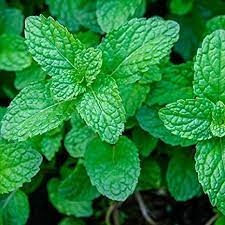
Japanese mint is a perennial ascending herb growing about 60-80 cm. in height and under favourable conditions may attain a height upto 100 cm. It is propagated mainly by its stolons . Leaves are lanceolate-oblong, sharply toothed; petiole is small about 5mm. in length. The leaf lamina varies from 5 to 15 cm. The leaf surfaces mainly lower side is covered with dense hairy growth of glandular trichomes. Flowers are borne in axillary and terminal verticillaster , abundant in number , purplish in colour. The flowers are small with corolla measuring 4-5mm., calyx 2-3mm., narrowly deltoid and acuminate. It does not produce seed and propagation is through vegetative means only.
Economic Importance
Japanese Mint (Mentha arvensis var piperascense) is an aromatic perennial herb, grown as an annual in sub-tropical parts of north India. The over-ground herb (foliage) on distillation yields an essential oil, containing high (75 – 80%) menthol content. The oil has a bitter cooling taste, harsh odour and is the principal source of menthol. It is used in combating cold, used as an ingredient in cough drops and related pharmaceuticals, dentifrices, cosmetics, mouth washes, scenting of tobacco products and flavouring of beverages. Synthetic menthol has also come in market but its volumes are meagre due to high cost of production. Besides, natural menthol is preferred in food and flavour industry.
Agro-climatic Requirements
Japanese mint can be cultivated both in tropical and sub-tropical areas. The mean temperature between 20-400 C during major part of the growing period and rainfall between 100-110 cm. (light showers at planting stage and ample sunshine at the time of harvesting) is ideal for its cultivation.
Well drained loam or sandy loam soils rich in organic matter having pH between 6 and 8.2 are ideally suited for its cultivation. It can also be cultivated on both red and black soil. In case of acidic soil having pH less than 5.5, liming is recommended.
Sandy Soil-

It consists of small particles of weathered rock. Sandy soils are one of the poorest types of soil for growing plants because it has very low nutrients and poor water holding capacity, which makes it hard for the plant’s roots to absorb water. This type of soil is very good for the drainage system. Sandy soil is usually formed by the breakdown or fragmentation of rocks like granite, limestone and quartz.
Loam soil-

Loam soil is a mixture of sand, silt and clay that are combined to avoid the negative effects of each type.
These soils are fertile, easy to work with and provide good drainage. Depending on their predominant composition they can be either sandy or clay loam.
As the soils are a perfect balance of soil particles, they are considered to be a gardeners best friend, but still benefit from topping up with additional organic matter.
Growing and Potential Belts
India grows Japanese mint in around 60,000 ha in tarai districts (Rudrapur, Bilaspur etc.) of Uttaranchal and central U.P. (Barabanki, Moradabad, Bareily, Badaun and Lucknow) besides smaller area in parts of Punjab (Ludhiana and Jallandhar).
Varieties
The new varieties developed on Japanese mint in the country together with their traits as given in release note or extension literature are presented below:
| Sr. No. | Variety | Characteristics given in literature |
| 1. | MAS-1 | § It is a dwarf variety 30-45 cm. in height and early maturing variety.§ Less prone to insects due to short height.§ Menthol content-70-80%.§ Yield: About 200 q/ha. of herbage & 125-150 kg. of oil /ha. |
| 2. | Hybrid-77 | § Early maturing variety.§ It is 50-60 cm. in height.§ Less prone to diseases viz. leaf spot & rust diseases.§ Menthol content-80-85%.§ Yield: About 250 q/ha. of herbage & 120-150 kg. of oil /ha.§ It is especially well adapted to sandy loam soils and drier climate than that of the tarai region. |
| 3. | Shivalik(selection from Chinese cultivar) | § The recovery of oil from the herb is 0.4 -0.5 %.§ Menthol content: 65-70%.§ This variety is highly suitable for obtaining second cut through ratooning.§ It is particularly grown in tarai region of U.P. & Uttaranchal.§ The herbage yield is 300q/ha while the essential oil yield amounts to about 180 kg/ha.§ Highly sensitive to the fungal diseases and pests prevailing in the tarai area. |
| 4. | EC-41911(selection from Russian germplasm) | § This is an erect type variety, which is less affected by rains.§ It produces 236.5 q/ha of herbage and 125.2 kg/ha of oil with 70% menthol.§ Oil is preferred in flavouring food items. |
| 5. | Gomti | § It is sturdy, light red in colour.§ Menthol content-78-80%.§ Yield is less compared to other varieties. It is less adopted by farmers. |
| 6. | Himalaya | § Resistant to rust, blight, mildew and leaf spot diseases.§ Crop is good; size of leaves is larger than other varieties.§ Menthol content-78-80%.§ The yield of herbage is 400q/ha and essential oil is 200-250 kg/ ha. |
| 7. | Kosi | § Matures early in 90 days.§ Resistant to rust, blight, mildew and leaf spot diseases.§ Essential oil content 75-80 % menthol.§ Yield: 200-250 kg. of oil /ha. |
| 8. | Saksham | § Developed through tissue culture from cv. Himalaya.§ Yield: 225-250 kg. of oil/ha. having menthol content more than 80%. |
| 9. | Kushal | § New variety developed through tissue culture. § Matures within 90-100 days.§ The crop remains free from pests and diseases (particularly rust and leaf blight).§ The variety is most suitable for transplanting after wheat in semi-arid –sub- tropical condition of UP and Punjab. § It can withstand waterlogging for few days. § Yield: 300-330 q. /ha. having oil yield upto 175-200 kg./ha. |
Propagation

Mint can be propagated vegetatively through stolons and runners. By and large, most area under the crop is propagated by planting live juicy 8 to 10 cm. long stolons (underground stems) during early spring season. The seed rate used is 400-450 kg. of stolons per ha. and the spacing varies from 40 to 60 cm., depending upon soil fertility and the kind of the intercultural implements used. In northern India, planting of Japanese mint is suitable from first week of February to second week of March.
Production of Stolons

The plot should preferably be the best piece of land. It should be given high level of FYM during land preparation. Around 200 sq.m. plot is required to produce stolons for 1 hectare. Mature plants of chosen variety brought from a reliable nursery should be planted at 30 X 30cm. The nursery for the stolons is planted in August. The nursery is given frequent irrigation avoiding stagnation of water. Stolons are produced in autumn and are ready for use during the months of January to March. To obtain the stolons , the soil is opened manually or mechanically. These stolons can be used immediately or within a fortnight or so.
Planting from Stolons

The field should be ploughed and harrowed thoroughly and divided into beds of suitable size to facilitate irrigation and make it free from weeds and stubbles. In each bed, lines are opened at a distance of 40 to 60 cm depending upon the variety and inter-culture implement used. The furrows are opened about 5 to 6 cm deep manually or through tractor driven harrow. Within a furrow, stolons are placed in rows at 10 cm. distance and furrows are closed with top soil. The bed is irrigated immediately after placing the stolons. On an average, 4 quintals of stolons are required for planting in one hectare of land. The stolons sprout in about 2 to 3 weeks when planted in February. Generally the planting should be done early depending upon ground temperature.
Irrigation

Ten irrigations are given during summer season at intervals of 10-12 days whereas another 4-6 for autumn crop harvested in late October. In order to obtain luxuriant growth, sufficient fertilizers and water must be applied to mint crop. A minimum water of about 100 mm is required to obtain good crop yield. Water logging during rainy season should be avoided by providing adequate drainage. In case of heavy soils and the soils prone to water logging, it is preferable to cultivate mint on ridges. The frequency of irrigation can also be reduced by 25% through the application of leaf mulches @ 5 t/ha.
Nutrition
The recommended dose for chemical fertilizers is Nitrogen 120 kg, phosphorus 60 kg and potassium 40 kg per ha. The entire quantity of P and K along with one-fifth of N is mixed with the soil at the time of planting, the remaining four-fifth of N is given as top-dressing twice for each harvest in available split doses. About 20 tonnes of well-rotten FYM, 150 kg DAP and 100 kg MOP per hectare are applied at the time of planting. Subsequently, half of N in the form of calcium ammonium nitrate or urea is applied in 2 split doses at 30 and 60 days after planting and similar quantities for ratoon crop at 25 days and 45 days of the harvest.
Weed management-

By and large, 4 to 14 weeks after planting is crucial period for weed control. The crop requires intensive weeding and this is the most expensive cultural operation which contributes to a higher yield of the crop. Weeding with hand or mechanical hoes within the first six weeks of planting does control weeds. This process can be repeated once and rarely twice at an interval of about two to three weeks, after the first weeding. Since weeding and hoeing accounts for 30% of the cost of cultivation, use of wheel hoes either driven by hand or bullock drawn helps in reducing cost on interculture. Several pre-and post application of weedicides are recommended but these weedicides cannot control monocot weeds after the rainy season. Therefore best method is to combine manual, mechanical and chemical methods. Some of the effective herbicides includes Oxyflurofen (0.5 kg a.i. / ha), Pendimethalin (0.75 a.i. / ha), Simazine and Atrazine (1 kg a.i. / ha). The best procedure is to first apply a weedicide followed by manual or mechanical weeding at 8 to 10 weeks when mulching should also be applied.
Plant Protection Measures
Insect Pests
Hairy Caterpillar- Diacrisia oblique

The caterpillar starts eating the under-surface of the leaves.
Management-
Application of Thiodan or Malathion @1.7ml/ litre of water.
Cutworms- Agrotis flammatra

Young plants are damaged at the collar region during spring season.
Management-
Soil treatment with Phorate 10g before planting.
Red Pumpkin Beetle- Aulocophora foevicollis

The pest feeds on the growing leaves and buds.
Management-
Spray Malathion @1ml/litre of water.
Mint Leaf Roller- Syngamia abrupatalis

The caterpillar folds the leaf in the form of a roll and feed inside the leaf tissue during August-September. The edges of the leaves are held together with silk-like filaments.
Management-
Two to three sprays of Thiodan @1.5ml/litre of water at weekly intervals.
Diseases
Stolon Rot-

Caused by- Macrophomina phaseoli
During rainy season, stolon rot occurs on the underground parts; the infected stolons show brown lesions which enlarge and turn black, resulting in a soft decay.
Management-
Crop rotation.It is better to follow 3-year-crop rotation with rice, wheat and mint.
Treatment of the stolons with 0.25% solution of Captan or 0.1% Benlate, 0.3 % Agallol solution for 2 to 3 minutes before planting is a preventive measure.
Fusarium Wilt-
Caused by- Fusarium oxysporum

Affected leaves turn yellow, curled and finally dry.
Management- Application of Benlate, Bavistin and Topsin.
Leaf blight-
Caused by- Alternaria sp.

Cause loss of foliage during summer season.
Management- Application of copper fungicide.
Harvesting and Yield

The crop planted through stolons in January and February is harvested twice i.e. in June and October months. The first crop is harvested after 100-120 days of growth and the second harvest in about 80-90 days following the first harvest. The fresh herbage at harvesting stage contains 0.5 to 0.68% of oil and is ready for distillation after wilting for 6-10 hrs. The wilted crop is cut 10cm. above the ground by means of a sickle on bright sunny days, since harvesting on cloudy or rainy days decrease the menthol content in the oil.
The average yield is 20 tonnes of fresh herbage per ha. in two harvests , which, in turn, yields around 250 kg of oil in a year.
POST HARVEST MANAGEMENT
Storage of Herbage
Mint herbage should be shade dried for about a day before it is distilled. Care should be taken so that decomposition of the herbage does not initiate during the drying process. There would be some reduction in oil yield if wilted herbage crop is stored for a longer period of 2-3 days. As such, storage of herbage for a longer period is not recommended.
Distillation
The recovery of oil from the herb is 0.5-0.8%. Oil is obtained through steam distillation. The oil is of golden yellow colour, containing not less than 75% menthol. The duration of steam distillation is 2-2.5 hours for complete recovery of the oil. About 80% of the oil is received in the receiver in about one hour’s time. The oil that is received later is richer in menthol.
The fresh or semi dried herbage is placed in a tank and treated with passing steam under pressure. The steam that comes out of the tank is then passed through a condenser. The condenser receiving the steam, carrying the oil extracted from the herbage in the tank is kept constantly cool by circulating cold-water over/around it. The condensed oil and water mixture is collected in a receiver. Since the water and oil have different densities, oil floats on the surface of the water in the receiver. The oil is skimmed off and collected.
Purification of Oil
The oil that is skimmed off must be cleaned of traces of water that it may carry. For this purpose, a separator funnel is used. Treating with anhydrous sodium sulphate and decanting removes any remnant moisture in the oil. The whole process is highly critical. Steam rectification process may be applied in case the colour of the oil changes due to rusting.
Storage & Packing of Oil
PVC drums of good quality (20-200l capacity) and galvanized iron (GI) drums or aluminium containers are suitable for short and long term storage respectively. The containers should be kept in cool and dark place.
Leave a Reply