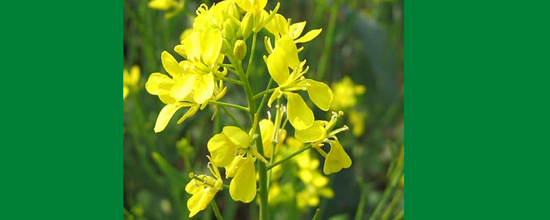
Bihar hairy caterpillar:

Symptoms:
- Young larvae feed gregariously mostly on the under surface of the leaves.
- Caterpillars feed on leaves and in severe infestation the whole crop is defoliated.
Management:
- Apply chlorpyriphos 20 EC @ 1.5 lit/ha or triazophos 40 EC @ 0.8 Lit/ha or quinalphos 25 EC @ 1.5 lit/ha.
- Dust Chlorpyriphos 1.5% DP quinalphos 1.5% @ 25 kg/ha when the population is likely to reach 10/m row length (ETL). Repeat it as needed.
Powdery mildew:

Symptoms:
- The disease attacks on the lower leaves as small circular brown necrotic spots which slowly increase in size.
- Many concentric spots coalesce to cover large patches showing blightening and defoliation in severe cases.
- Circular to linear, dark brown lesions also develop on stems and pods, which are elongated at later stages.
- Infected pods produce small, discoloured and shriveled seeds.
Cultural control:
- Follow timely sowing of seeds.
- Adopt proper field sanitation.
- Destruct crop infected crop residues.
- Apply potash in recommended dose
Chemical control:
- Three sprays of aqueous suspensions of Triadimefon 25 WP (0.1%), Tridemorph 80 EC (0.1%), Dinocap 48 EC (0.075%) and Wettable Sulfur 80 WP (0.3%), at 15 day intervals, after disease appearance, controlled the disease effectively and increased seed yields.
Leave a Reply