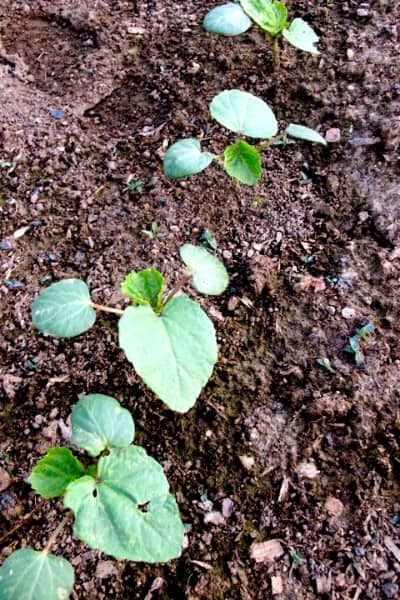
3 Weeks before seedling-
Growing conditions for Okra crop-
Climate:
During the growing period, it requires long warm season. In humid condition, it gives good yield. It grows well within a temperature range of 22-35°c. It grows the best in rainy season and in heavy rainfall areas. It is highly receptive to frost injury. Below 20°c seeds will fail to germinate.
Soil Requirement:
It grows well in all kind of soils. For its cultivation, Sandy loam and clay-loam soils are the best.
The optimum pH range is 6-6.8. The soil should have good internal drainage. Soil with high organic matter is preferred so that cartful of FYM or compost should be assimilated during land preparation.
Loam soil-

Loam soil is a mixture of sand, silt and clay that are combined to avoid the negative effects of each type.
These soils are fertile, easy to work with and provide good drainage. Depending on their predominant composition they can be either sandy or clay loam.
As the soils are a perfect balance of soil particles, they are considered to be a gardeners best friend, but still benefit from topping up with additional organic matter.
Sandy soil-

Sandy Soil is light, warm, dry and tends to be acidic and low in nutrients. Sandy soils are often known as light soils due to their high proportion of sand and little clay (clay weighs more than sand).
These soils have quick water drainage and are easy to work with. They are quicker to warm up in spring than clay soils but tend to dry out in summer and suffer from low nutrients that are washed away by rain.
The addition of organic matter can help give plants an additional boost of nutrients by improving the nutrient and water holding capacity of the soil.
Varieties selection-
Punjab no.13: Developed by PAU. Suitable for cultivating in spring-summer season and fruits are light green and 5ridged and of medium length. It is susceptible to mosaic.
Parbhani Kranti: Developed by MKV. Fruits are medium long with tender smooth surface at marketable stage. Average yield is 8.5-11.5 t/ha in 120 days.
Arka Anamika: Developed by IIHR. Fruits are borne in two flushes and they are borne on the first stem 45-50 days after sowing during second flush. Fruits are spineless with 5-6 ridges.
Punjab Padmini: Developed by Punjab Agricultural University, Ludhiana. Fruits are quick growing, hairy and of dark green color. It’s ready to harvest within 55-60days after sowing. It is tolerant to yellow vein mosaic virus. Gives average yield of 40-48qtl/acre.
Punjab 7: It is resistant to yellow vein mosaic virus, jassid and boll worm. Fruits are dark green, medium in size. Gives average yield of 40qtl/acre.
Punjab 8: Developed from Pusa Sawani. Fruits are of dark green color and 15-16 cm long at time of harvesting. It is tolerant to yellow vein mosaic virus and resistant to fruit borer.
Punjab Suhavani: It gives an average yield of 49qtl/acre. It has dark green color fruits and is tolerant to yellow mosaic virus.
Parbhani Kranti: Fruits are medium long with good keeping quality. It is tolerant to yellow vein mosaic virus. It’s ready to harvest in 120 days. Gives average yield of 40 to 48qtl/acre.
Pusa Sawani: It is developed by IARI, New Delhi. It is suitable for cultivation in summer and rainy season. It’s ready to harvest within 50 days. Fruits are dark, green and 10-12cm long at time of harvesting. It is susceptible to yellow vein mosaic virus. Gives average yield of 48-60qtl/acre.
2 Weeks before seedling-
Fertilizer plan for okra
Balanced fertilization includes the addition of farmyard manure and mineral fertilizers containing Nitrogen (N), Phosphorus (P) and Potassium (K). fertilizer requirements are different for variety and hybrid okra. Here are some recommendations:
- Hybrids require three times more nutrients than varieties.
- For varieties, all mineral fertilizers are applied at sowing.
- For hybrids, one-third of total nitrogen and total amount of phosphorus and potassium are applied at sowing.
- Then, one-third of total nitrogen is applied 4 weeks after sowing and the last third is applied at the start of flowering.
- An optional application of nitrogen in the soil at every third picking is advantageous for yield and to maintain the size of fruits until the end of harvest.
Land Preparation:
2-3 plowing is needed for well prepared land. At the time of land preparation, well decomposed FYM 25t/ha is integrated into the soil. It is sown on flat soil or on ridges. Sowing should be done on ridges if the soil is heavy. Neem cake and poultry manures helps in improving the growth of plant and the yield in this crop. By using neem cake and poultry manures or other compost it is possible to reduce the use of fertilizer.
Disc Plough

The disc plough bears little resemblance to the common mould board plough. A large, revolving, concave steel disc replaces the share and the mould board. The disc turns the furrow slice to one side with a scooping action. The usual size of the disc is 60 cm in diameter and this turns a 35 to 30 cm furrow slice. The disc plough is more suitable for land in which there is much fibrous growth of weeds as the disc cuts and incorporates the weeds. The disc plough works well in soils free from stones. No harrowing is necessary to break the clods of the upturned soil as in a mould board plough.
Tractor Drawn Cultivator:

Cultivator is an implement used for finer operations like breaking clods and working the soil to a fine tilth in the preparation of seedbed. Cultivator is also known as tiller or tooth harrow. It is used to further loosen the previously ploughed land before sowing. It is also used to destroy weeds that germinate after ploughing. Cultivator has two rows of tynes attached to its frame in staggered form. The main object of providing two rows and staggering the position of tynes is to provide clearance between tynes so that clods and plant residues can freely pass through without blocking. Provision is also made in the frame by drilling holes so that tynes can be set close or apart as desirect. The number of tynes ranges from 7 to 13. The shares of the tynes can be replaced when they are worn out.
Advantages of soil preparation-
- It loosens the soil.
- It aerates the soil.
- It prevents soil erosion.
- It allows easy penetration of roots into the soil.
Disadvantages of soil preparation-
The downside of tilling is that it destroys the natural soil structure, which makes soil more prone to compaction. By exposing a greater surface area to air and sunlight, tilling reduces soil’s moisture-retaining ability and causes a hard crust to form on the soil surface.
1 Weeks before seedling-
Soil Treatment-
- Soil treatment with organic fungicides prior to planting can help to ensure seedlings survival by preventing a series of diseases.
- Add well-decomposed FYM (8-10 t/acre) or vermicompost (5t/acre) treated with Trichoderma species and/ or Pseudomonas species (2kg/acre).
- Incorporate at the time of field preparation at 1 week (vermicompost) or 2 to 3 weeks (FYM) before sowing.
- Alternatively, seeds can be treated 24 hours before sowing with the same organic fungicides powders or solutions, for example with Trichoderma spp (4-10 g/kg seed), pseudomonas sp (10 g/kg seeds).
- The treated seeds are then dried overnight in a protected place, to be sown the next day.
- There is no need to treat seeds if the soil has already been treated.
Seed Treatment-

Seed germination can be enhanced by soaking the seeds in water for 24hours. Seed treatment with Carbendazim will protect seeds from attack of soil born fungus. For that soak seeds in Carbendazim solution@2gm/Ltr of water for 6 hours and dry them in shades. Then immediately complete sowing. For better germination and also to protect crop from soil born disease, treat seed with Imidacloprid@5ml per 1Kg seed followed by treatment with Trichoderma viride@4gm/kg seeds.
| Fungicide name | Quantity (Dosage per kg seed) |
| Carbendazim | 2gm |
| Imidacloprid | 5gm |
Seedling stage
Planting okra crop-
The right amount of seeds should be used to get the optimum plant population and to increase yield. A higher than recommended seed rate is a waste of money and also reduces the crop growth due to competition for nutrients and solar radiation.
- Plant okra at rate of 1 kg/acre for hybrids varieties and 2-3 kg/acre for regular varieties.
- Alternatively, use 1.5-2.5 kg seeds/acre during the summer season and 3.5-4 kg seeds/acre during the rainy season.
- During rainy season, the recommended planting distance is 60cm between rows and 30cm between plants.

- During summer season, the recommended planting distance is 45cm between rows and 30cm between plants.
- Sow the seeds at a depth of 2.5 cm using the dibbling method.

- Enhance the germination of the seeds by soaking them in water for 24 hrs before planting.
Bio-fertilizers for okra-
- Bio-fertilizers are microbial preparations containing beneficial micro-organisms. When mixed with seed or applied to the soil, they multiply and fix nitrogen or solubilize phosphates in the root region of the crop. This treatment results in a yield increase and reduces the required quantity of inorganic fertilizers to be applied. Bio-fertilizers are an economical, eco-friendly and effective renewable energy source. They do not alter the soil properties, as inorganic fertilizers do.
- Treat yoyur seeds with bio-fertilizers such as Azotobacter and phosphorous solubilizing bacteris (PSB) cultures at a rate of 10gm/kg seed each.
Important tips to remember-
- Apply bio-fertilizers during morning hours.
- Store bio-fertilizers in cool, dry places.
- Bio-fertilizers should not be applied along with insecticides, fungicides and chemical fertilizers.
- Bio-fertilizers are to be used after treatment with fungicides.
Irrigating okra crop-
- Irrigate field immediately after sowing.
- Subsequent irrigation should be done at fixed intervals depending on the texture of soil and climate.
- In black soils, irrigation should be done at an interval of every 5-6 days.
- Water stress at flowering and fruiting stages will drastically influences the growth of plants, the size of fruits and yield.
Weed management-
- Closely control weeds with frequent hoeing, weeding and earthing up, until the crop canopy is fully grown.
- Approximately 3-4 weeding will be required.
- The first weeding can be done when seedlings are two weeks old and following weeding can be done at an interval of 25 days.
- After 40-45 days of sowing. Application of Fluchoralin 48%@1 liter per acre or Pendimethalin@1ltr/acre or Alachlor@1.6Ltr/acre is used as post-emergence herbicide for controlling weeds in Bhindi is found an effective method.
Root rot:

Infested roots become dark brown in color and plant die in case of severe infestation.
Management-
Avoid monocropping and follow crop rotation. Before sowing do seed treatment with Carbendazim@2.5gram per kg of seed. Drench the soil with Carbendazim solution@1gm/Ltr of water.
Leave a Reply