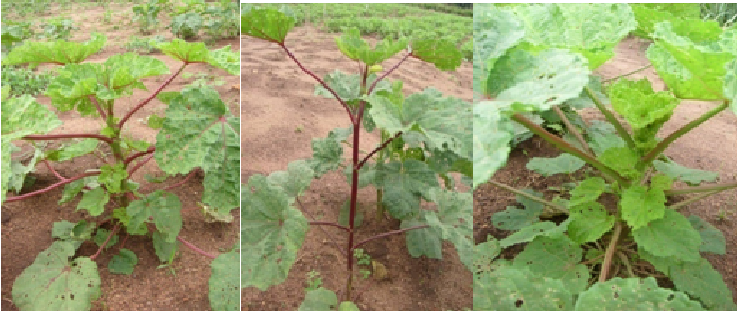
First split application of hybrid okra-
Hybrid okra requires more nitrogen for healthy growth. Apply the first split of urea at a rate of 44 kg/acre, 4-5 weeks after sowing.
Monitoring of field-
Monitor the growth of your crop often. Walk through your field in a random manner or zigzag and check for signs of diseases, pests and deficiencies. Deficiencies are characterized by the discoloration of leaves and poor vigor of the plants. Diseases are often visible as discoloration and spots or streaks on leaves. Finally, remember that most of the insects present in the field are beneficial for your crop. Those that attack your crop will leave behind damage on leaves and buds in the form of holes.
These diseases may appear during this week-
Whitefly (Bemisia tabaci):

Identification: Adults are winged, they are 1.0-1.5 mm long and their yellowish bodies are slightly dusted with white waxy powder. They have two pairs of pure white wings and have prominent long hindwings.
Life history: The females lay stalked eggs singly on the underside of the leaves, averaging 80-110 eggs per female. The eggs hatch in 3-5 days during summer, 5-33 days in winter. The nymphs feed on cell sap and grow into three stages to form the pupae within 9-14 days in summer and 17-81 days in winter. In 2-8 days, the pupae change into whiteflies. The total lifecycle completed in 14-100 days depending on weather conditions.
Damage: The milky white minute whiteflies and nymphs suck the cell sap from the leaves. The affected leaves curl and dry. The affected plants show a stunted growth. Whiteflies are also responsible for transmitting yellow vein mosaic virus (YVMV). Interwoven network of yellow veins encompassing with islands of green tissues on leaves. Later, entire leaves turn yellow. This disease, spread by whitefly, is economically most important disease.
Management: 4-5 foliar sprays of imidacloprid 17.5SL (0.002%) or dimethoate (0.05%) or metasystox (0.02%) at an interval of 10 days effectively controls the whitefly population.
Aphid:

Colony of aphids on young leaves and fruits can be seen. Adult and nymphs, both suck the sap thus weaken the plant. In severe infestation, they cause curling and deformation of young leaves. They secrete honey dew like substance and sooty, black mould is developed on affected parts. Destroy affected parts as soon as infestation is noticed. Apply Dimethoate 300 ml/150Ltr of water, 20 to 35 days after sowing. Repeat again if necessary. If infestation is observed, take spray of Thiamethoxam 25WG@5gm/15Ltr of water.
Yellow Vein Mosaic Virus (YVMV):


This is the most important and destructive viral disease in bhendi. The disease infects at all the stages of crop growth and severely reduces growth and yield. The disease is transmitted by white fly. The characteristic symptoms of the disease are a homogenous interwoven network of yellow veins enclosing islands of green tissues. Initially infected leaves exhibit only yellow coloured veins but in the later stages, the entire leaf turns completely yellow. In extreme cases, the infected leaf become totally light yellow or cream coloured and there is no trace of green colour. At times, enations (raised structures) are observed on the under surface of infected leaf. Plants infected in the early stages remain stunted. The fruits of the infected plants exhibit pale yellow colour, deformed, small and tough in texture.
Control:
Removal and destruction of virus affected plants and planting of disease resistance varieties reduces the disease incidence. Controlling the whitefly population minimizes the incidence of YVMV. Soil application of Carbofuran (1kg a.i./ha) at the time of sowing and 4-5 foliar sprays of Dimethoate (0.05%) or Metasystox ( 0.02%) or Nuvacron (0.05%) at an interval of 10 days effectively controls the whitefly population.
Powdery mildew:

White powdery growth is observed on young leaves and also on fruits. In severe condition premature defoliation and fruit drop is observed. Fruit quality deteriorates and they remain small in size.
If infestation is observed in field, take spray of Wettable Sulphur 25gm/10Ltr of water or Dinocap@5ml/10Ltr of water, 4times at 10days interval or Tridemorph@5ml or Penconazol@10ml/10Ltr of water for 4 times with 10days interval.
Leave a Reply