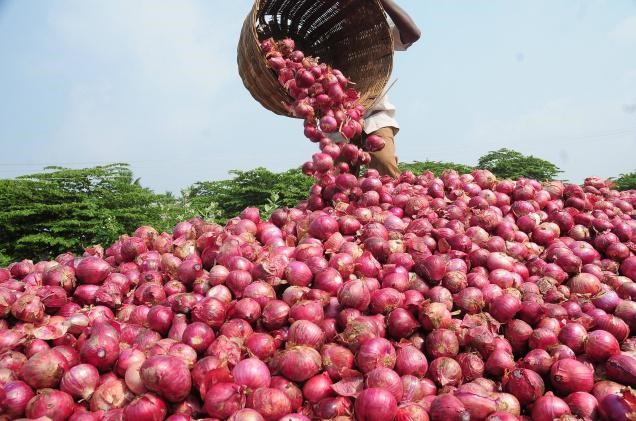
Harvesting and yield:
Onions are ready for harvest in 3-5 months after transplanting depending on variety. Harvesting is done by pulling out plants when tops are drooping but still green. During hot days when soil is hard, bulbs are pulled out with a hand-hoe. Yield varies with season and variety. 15-25 tonnes of bulbs are expected from one hectare of transplanted crop. Yield of the kharif crop is comparatively low.
Rainy season onion cultivation:
Onion was grown during rabi season only. Development of varieties suitable for the rainy season is a significant achievement in onion breeding and it resulted in cultivation of onion in the kharif season also. Varieties like N-53, Agrifound Dark Red, Baswant 780 and Arka Kalyan are suitable for growing in the rainy season. For a successful crop, seeds are sown by the end of May or June, transplanted in August and harvested in December-January. In the kharif season, yield will be less and range from 15-20 t/ha.
Green onion or Spring onion:
Consumption of green onion is almost equal to that of dry onion in the world. Both bulb forming and non-bulb forming types are used as green onions. For green onion production, seeds are sown in August, transplanted in October and harvested after 75-80 days at tender stage. Varieties like early Grano, Pusa White Flat and Pusa White Round are suitable for green onion purposes. Yield ranges from 40-45 t/ha.
Post-harvest handling:
It is estimated that 60-65% of onion produced in India is consumed internally, 5% exported and 30-40% lost by post-harvest damage.
Curing:
Sprouting and rooting are common problems in storage since bulbs contain high moisture. The bulbs should be adequately cured for proper development of skin colour and to remove field heat before storage of bulbs. It is done till the neck is tight and outer scales are dried. This will prevent infection of diseases and minimize shrinkage loss. Bulbs are cured either in the field or in open shade or by artificial means before storage. During kharif season, bulbs are cured for 2-3 weeks along with top. In rabi, bulbs are cured in the field for 3-5 days; tops are cut leaving 2.0-2.5 cm above the bulb and again cured for 7-10 days to remove field heat.
Storage:
After curing, bulbs are stored in well ventilated rooms by spreading them on dry and damp proof floorings or on racks. Periodical turning of bulbs and removal of rotten and sprouted bulbs is highly essential. A pre-harvest spray of maleic hydrazide (2000-2500 ppm) prevents rotting and sprouting of bulbs stored at room temperature. At BARC, Trombay irradiation of bulbs with very low doses (4000-9000 krads) of gamma rays is effective for preventing sprouting and enhancing storage life of onion bulbs.
Bulbs harvested from kharif crops do not store well for a long period. At 0-2-2.2oC under cold storage, bulbs can be stored for a long period. NHRDF and NAFED erected storage structures in Nasik for helping farmers. Three types of storage structures, viz., Panipat type 2tiered, 3-tier onion store and 2-tier model were established by Government itself investing heavily.
Grading:
These necked, bolted and decayed bulbs are removed. Cured bulbs are graded based on size, and depending on the market to which it is sent. Big sized onions are in demand in New Delhi, medium sized in Kolkata, Patna and small sized onions in North Eastern regions of the country.
Dehydrated onion:
Popularity of dehydrated onions is increasing now-a-days. Advantages of dehydrated onions are storage stability and ease of preparation. Commercial processing plants prescribe a shrinkage ratio of 7:1 to 17:1 with a moisture content of 4% in the final product. Dehydrated onions are sold in many forms as slices, chopped, minced, granulated and powdered.
Leave a Reply