Potato (Solanum tuberosum) is the most important food crop of the world. Potato is a temperate crop grown under subtropical conditions in India. The potato is a crop which has always been the ‘poor man’s friend’. Potato is being cultivated in the country for the last more than 300 years. For vegetable purposes it has become one of the most popular crops in this country. Potatoes are an economical food; they provide a source of low cost energy to the human diet. Potatoes are a rich source of starch, vitamins especially C and B1 and minerals.
Potatoes are used for several industrial purposes such as for the production of starch and alcohol. Potato starch (farina) is used in laundries and for sizing yarn in textile mills. Potatoes are also used for the production of dextrin and glucose. As a food product itself, potatoes are converted into dried products such as ‘potato chips’, ‘sliced’ or ‘shredded potatoes’.
Potatoes are grown in almost all states of India. However, the major potato rowing states are Himachal Pradesh, Punjab, Uttar Pradesh, Madhya Pradesh, Gujarat, Maharashtra, Karnataka, West Bengal, Bihar and Assam.
Roots of potato-

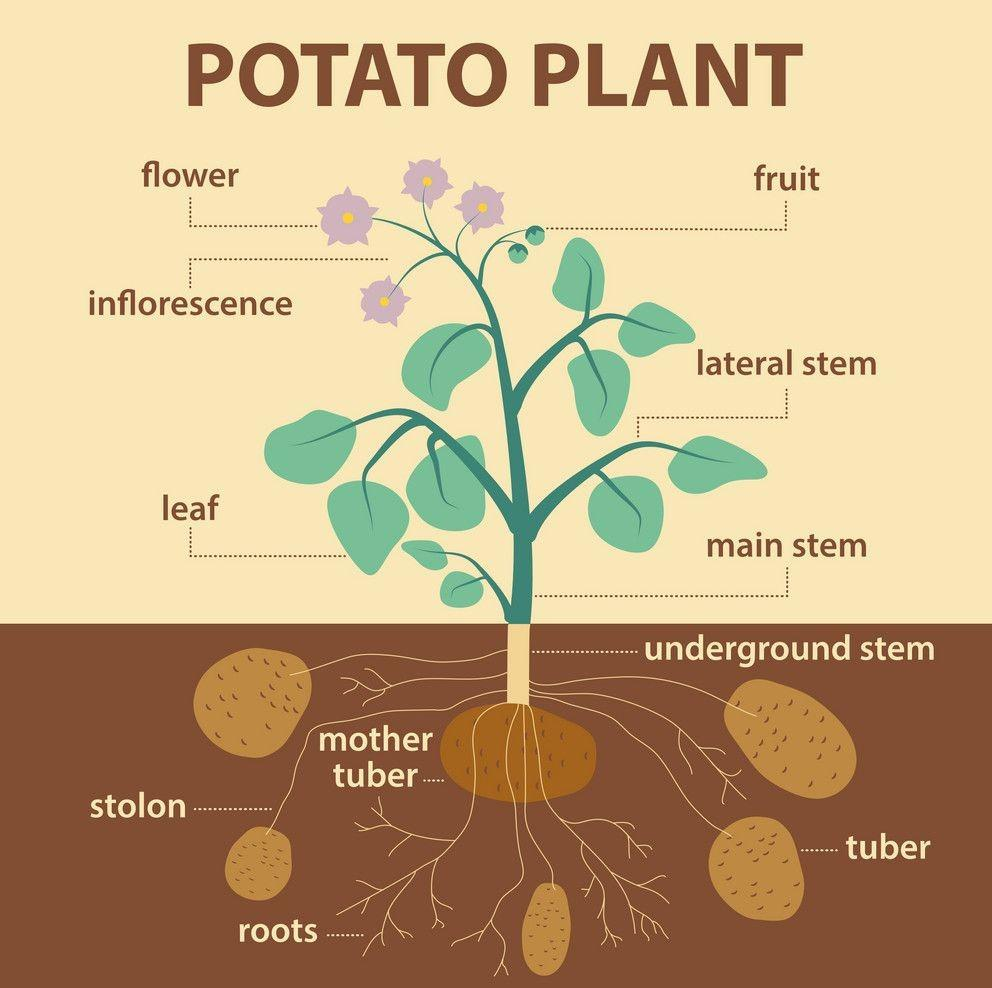
Potato plants may develop from seed or from tubers. Plants grown from seed form a slender tap root with lateral branches. Plants grown from tubers form adventitious roots at the base of each stem. Occasionally, roots may also grow on stolons. In comparison with other crops, the potato root system is weak. Therefore, good soil condition is necessary for potato growing. The type of root system varies from light and superficial to fibrous and deep.
Stems-

The potato stem system consists of stem, stolons and tubers. Plants grown from true seed have one main stem; while from a tuber a number of main stems may be produced. Lateral stems are branches of main stems.
Stems are round to angular in cross section. Margin wings or ribs are often formed. Wings could be straight, undulate or dentate. Stem colour is generally green; sometimes it may be red-brown or purple.
Stem may be solid or partly hollow duw to disintegration of the pith cells. Buds in the axils of leaves may grow out to form lateral stems, stolons, inflorescences, or sometimes even aerial tubers.
Stolons-

Morphologically, potato stolons are lateral stems which grow horizontally below ground from buds of the underground part of stems. The length of stolons is an important varietal character. Long stolons are common in wild potatoes; potato breeding aims at short stolons.
Stolons may eventually form tubers by enlargement of their terminal end, however, not all stolons may form tubers. A stolon not covered by soil may develop into a vertical stem with normal foliage.
Tubers-

Morphologically, tubers are modified stem and constitute the main storage organs of the potato plant. A tuber has two ends: the heel end is attached to the stolons; the opposite end is called either the apical, rose or distal end.
The eyes are spirally arranged on the tuber surface and concentrated towards the apical end. They are located in the axis of scale-like leaves, or the eyebrows. Depending on the variety, eyebrows may be elevated, superficial or deep. Each eye contains several buds.
The eye of a potatao tuber morphologically corresponds to the nodes of stems. Eyebrows represent scale leaves, and eye buds represent axillary buds. The eyebuds eventually grow out to form sprouts and a new system of main stem, lateral stems, and stolons. Generally, at tuber maturity, eyebuds are dormant in that they are unable to develop. After a period of time, depending on the variety, the apical eyebuds break dormancy first. This characteristic is called apical dominance. Later, the other eyebuds develop into sprouts.
The skin is a thin protective layer on the outside of the tuber. Its colour may vary between white-cream, yellow, orange, red, or purple. Some have two colours. When exposed to the light for some days, tubers normally turn greenish. The skin is usually smooth and in some varieties russet or rough. It can be easily peeled off by rubbing when the tuber is immature. Thus skin damage is frequent when tubers are harvested immaturely.
The cortex is immediately below the skin. It is a narrow band of storage tissue that contains mainly protein and starch.
The vascular system connects the tuber and the tuber eyes with other parts of the plant.
Sprouts-

Sprouts grow from the buds in the eyes of a tuber. The colour of the sprout is an important varietal characteristic. Sprouts can be white partially coloured at the base or the apex or almost totally coloured. White sprouts when exposed to indirect light turns green.
The basal part of the sprouts normally forms the underground portion of the stem and is characterized by the presence of lenticels. After planting, this part rapidly produces roots and later stolons, or lateral stems. The tip of the sprout is leafy and represents the growing part of the stem.
Leaves-

Leaves are arranged spirally on the stem. Normally leaves are compounds that consist of mid rib and several leaflets. Each rachis may carry several pairs of lateral primary leaflets plus a terminal leaflet. The part of the rachis below the lowest pair of primary leaflets is called a petiole. Leaflets may be attached directly on the rachis or by means of small stalks. The regular sequence of these primary leaflets may be interrupted by small interjected secondary leaflets.
At the base of the petiole, the size and form of the two small lateral leaves, as well as the angle of insertion of the petiole on the stem, are useful in distinguishing varietal characteristics. From the point of insertion, wings or ribs may extend downward on the stem.
Inflorescence, flower-

The main stalk of the inflorescence is normally divided into two branches. Each branch is usually further divided into two other branches. In this way, they form a so-called cymose inflorescence.
Form the branches of the inflorescence arise the flower stalks, whose tips merge into the calyx. The pedicles bear a joint where flowers or fruit may drop off. In some cultivars this articulation is pigmented. The position of the articulation is a useful taxonomic character.
Potato flowers are bisexual. They possess all four essential parts of a flower: calyx, corolla, male elements and female elements.
The calyx consists of five sepals that are partly joined at their base, forming a bell-shaped structure below the corolla. The shape and size of the lobes or free ends of the sepals vary according to cultivar. The calyx colour may be green, or partially or totally pigmented.
The corolla consists of five petals. These are also joined at their base and form a short tube and a flat five-lobed surface. Each lobe ends in a triangular point. The outline of the corolla is generally round. Some primitive cultivars have pentagonal or star-like corollas. The corolla colour may be white, light blue, blue, red and purple with different tonnes and intensities.
The androecium consists of five stamens that alternate with the petals. The stamen is composed of anther and filament that are joined to the corolla tube. Anthers are generally fused in a conical column enclosing the pistil. In some cultivars they may be spread apart loosely. The colour of anthers varies from light yellow to deep orange. Pollen grains are shed through pores at other tips.
The gynoecium of the flower consists of a single pistil which is composed of the ovary, style and stigma. The ovary is superior, that is, the sepals, petals and stamens are attached to the receptacle just below the ovary. In the transverse section, the ovary shows two cavities where, generally, numerous ovules are arranged along the periphery of the placenta.
The style is an elongated portion of the pistol connecting the stigma and ovary. The style length may be longer, equal or shorter than that of stamens. The stigma is the receptive portion of the pistil where pollen grains germinate to grow down the style.
Fruit, seed-

Upon fertilization the ovary develops into a fruit (berry) containing numerous seeds. The fruit is generally spherical, but some cultivars produce ovoid or conical fruit. The fruit colour is generally green. In some cultivars they have white or pigment spots or pigmented stripes or areas.
The shape of the embryo is generally curved like an U and oriented towards the point of attachment to the placenta. The embryo has two opposite poles, one pole is the primordial root and the other contains two cotyledons.
Seeds are also known as true or botanical seed (as opposed to tubers, called seed tubers, when used to produce a potato crop).
Climatic requirement
- The thermal optimum is 20 to 45° C but at 30 to 35° C, respiration rate increases.
- Frost free days and clear sky is essential for growth and development.
- Highest average yields are usually obtained where day length is 13 to 17 hours during the growing season.
- Soils are of special significance for tuber crops like potato, since loose friable soil is a pre-requisite for developing stolen and tubers.
- Tubers grown in darkness, and when exposed to light, turn green due to the excessive formation of solanin-an alkaloid.
- Hence, cracking black cotton soils are not suitable. Alluvial soil, red and laterites with friable porous texture are ideally suited for potato culture.
- In India, majority area is under alluvial soils (77%) followed by acidic hill soils (13%) and black and red soils (7.9%).
- It is a short duration crop and grows in large amounts in Hassan, chikmangalore, Dharwar and Belgaum districts under rainfed conditions.
- It is also grown in Kolar and Bangalore districts under irrigated conditions.
Suitable Soil pH range: 5.3 to 6.5
The pH can control the availability of nutrients, biological functions, microbial activity, and the behavior of chemicals. Because of this, monitoring or controlling the pH of soil, water, and food or beverage products is important for a wide variety of applications.
In the pH scale, pH 7.0 is neutral. Below 7.0 is acidic and above 7.0 is basic or alkaline. Soil pH affects nutrients available for plant growth. In highly acidic soil, aluminum and manganese can become more available and more toxic to plant while calcium, phosphorus, and magnesium are less available to the plant.

Soil requirements
- Potato prefers sandy or medium loam soils rich in organic matter content.
- The soil of the seed bed should be loose, friable, well aerated with good drainage.
- Light textured soils having friable soil structure and high humus content tend to promote more uniform soil temperature and better aeration which favour tuber development and harvesting becomes easier.
- Most favourable soil pH should be between5-7 as the crop does not grow well in alkaline soils and under highly acidic conditions it suffers from scab disease.
Sandy soil-

- Sandy Soil is light, warm, dry and tends to be acidic and low in nutrients. Sandy soils are often known as light soils due to their high proportion of sand and little clay (clay weighs more than sand).
- These soils have quick water drainage and are easy to work with. They are quicker to warm up in spring than clay soils but tend to dry out in summer and suffer from low nutrients that are washed away by rain.
- The addition of organic matter can help give plants an additional boost of nutrients by improving the nutrient and water holding capacity of the soil.
Loam soil-

- Loam soil is a mixture of sand, silt and clay that are combined to avoid the negative effects of each type.
- These soils are fertile, easy to work with and provide good drainage. Depending on their predominant composition they can be either sandy or clay loam.
- As the soils are a perfect balance of soil particles, they are considered to be a gardeners best friend, but still benefit from topping up with additional organic matter.
Preparation of Land
- Tuberisation prefers to have well pulverized tilt which may be obtained by giving two ploughings with mould board plough followed by two harrowing, plankings and picking up the weeds and plant residues or stables.
- In lighter soils, farmers do not always have to plough prior to planting, but if the potato crop is following paddy rice or jute (more typical of the West Bengal area), more preparation may be necessary.
- Before planting the tubers ensure that the soil has sufficient moisture required for germination of the crop.
- In ant infested soils 50 kg per ha of Heptachlor or Aldrin should be mixed well.
- FYM should be mixed well.
Mould–board Plough-
The parts of mouldboard plough are frog or body, mouldboard or wing, share, landside, connecting, rod, bracket and handle. This type of plough leaves no unploughed land as the furrow slices are cut clean and inverted to one side resulting in better pulverisation. The animal drawn mouldboard plough is small, ploughs to a depth of 15 cm, while two mouldboard ploughs which are bigger in size are attached to the tractor and ploughed to a depth of 25 to 30 cm. Mouldboard ploughs are used where soil inversion is necessary. Victory plough is an animal drawn mouldboard plough with a short shaft.

Disc Plough

The disc plough bears little resemblance to the common mould board plough. A large, revolving, concave steel disc replaces the share and the mould board. The disc turns the furrow slice to one side with a scooping action. The usual size of the disc is 60 cm in diameter and this turns a 35 to 30 cm furrow slice. The disc plough is more suitable for land in which there is much fibrous growth of weeds as the disc cuts and incorporates the weeds. The disc plough works well in soils free from stones. No harrowing is necessary to break the clods of the upturned soil as in a mould board plough.
Advantages of soil preparation-
- It loosens the soil.
- It aerates the soil.
- It prevents soil erosion.
- It allows easy penetration of roots into the soil.
Disadvantages of soil preparation-
The downside of tilling is that it destroys the natural soil structure, which makes soil more prone to compaction. By exposing a greater surface area to air and sunlight, tilling reduces soil’s moisture-retaining ability and causes a hard crust to form on the soil surface.
Varieties
Salient features of the variety bred by the Central Potato Research Institute
| Cultivar | Yea of Release | Tuber characters and reaction to biotic and abiotic stress | Region of adaptability |
|---|---|---|---|
| Kufri Kisan | 1958 | Large, round, white, deep eyes with prominent eye brows | North Indian Plains |
| Kufri Kuber | 1958 | Medium, oval, tapering towards crown end, white, medium deep eyes. Resistant to PLRV & immune to PVY | North Indian plains and Plateau region |
| Kufri Kumar | 1958 | Medium, oval, tapering towards heel end, white, fleet eyes. Moderately resistant to late blight | North Indian hills |
| Kufri Kundan | 1958 | Medium, round-oval, flattened, white, medium deep eyes. Moderately resistant to late blight | North Indian hills |
| Kufri Red | 1958 | Medium, round, red colour in cortex, medium deep eyes. | North eastern plains |
| Kufri Saved | 1958 | Medium, round, white, deep and picked red-purple eyes. | North Indian plains |
| Kufri Neela | 1963 | Medium, round, white, medium deep eyes. Moderately resistant to blight. | South Indian hills |
| Kufri Sindhuri | 1967 | Medium, round, red, deep eyes. Moderately resistant to early blight and tolerant to PLRV. Slow rate of degeneration. Can tolerate temperature and water stress to some extent. | North Indian plains |
| Kufri Alankar | 1968 | Large, oblong, white, fleet eyes, tubers turn purple on exposure to light. Field immune to race “O” of late blight. | North Indian plains |
| Kufri Chamatkar | 1968 | Large, oval, slightly flattened, white fleet eyes. | North Indian plains & Plateau region |
| Kufri Jeevan | 1968 | Medium, oval, white, fleet eyes. Moderately resistant to early blight, field resistant to late blight and resistant to wart. | North Indian hills |
| Kufri Jyoti | 1968 | Large, oval, white, fleet eyes. Moderately resistant to early and late blight, resistant to wart. Slow rate of degeneration | North and South Indian hills and North Indian plains. |
| Kufri Khasigaro | 1968 | Medium, round oval, white, deep eyes. Resistant to late blight and moderately resistant to early blight. | North eastern hills. |
| Kufri Naveen | 1968 | Medium, oval, white, fleet eyes. Field resistant to late blight and immune to wart. | North eastern hills |
| Kufri Neelamani | 1968 | Medium, oval, flattened, white, fleet eyes, tubers turn purple on exposure to light. Moderately resistant to late blight. | South Indian hills |
| Kufri Sheetman | 1968 | Medium, oval, white, fleet eyes. Resistant to frost | North western plains |
Important Varieties Recommended for Uttar Pradesh A. Early Varieties (Duration: 60-75 days): K. Chandrmukhi, K. Pukhraj, K. Surya, K. Khyati, K. Bahar, K. Ashoka B. Main Crop(Duration: 90-110 days): K. Bahar, K. Anand, K. Badshah, K. Sinduri, K. Satlaj, K. Lalima, K.Arun, K. Sadabahar, K. Pukhraj C. Late Varieties(Duration: 110-120 days): K. Satlaj, K. Badshah, K. Anand D. Varieties Suitable for Processing ( For Chips /wafers): K. Surya, K. Chipsona-1, K. Chipsona-2, K. Chipsona-3, K. Frysona, K. Jyoti, K. Lavkar Some Special Varieties of India i. Better Storage Quality: K. Deva, k. Kundan,K. Lal,K. Dewa, K. Safed ii. Early Blight Resistant: K. Lalima, K. Jeewan, K. Kundan, K. Jyoti, K. Badshah, K. Satlaj. K. Pukhraj, K. Sinduri iii. Late Blight Resistant: K. Jyoti, K. Badshah, K. Sherpa, K. Swarna, K. Megha, K. Jawahar, K. Salaj, K. Pukhraj, Chipsona-1 and 2, K. Giriraj, k. Kumar, K. Neela, K. Chamatkar, K. Neelmani. iv. Wart Disease Resistant: K. Naveen, K. Jeewan, K. Jyoti, K. Sherpa, K. Khasi Garo v. Frost Resistant : K. Sheetman, K. Dewa, Chipsona-2, K. Anand, K. Chamatkar vi. Suitable for Intercropping : K. Jawahar (JH 222) vii. Suitable for Multiple Cropping : K. Alankar viii. Photo insensitive Variety : K. Alankar ix. Nematode Resistant : K. Swarna x. Mosaic Tolerant : K. Jyoti, K. Sinduri, K. Kuber Hybrid Varieties of Potato : B-420(2), Ex/A-680-16, HT/92-621, HT/93-707, J/92-13, J/92-164, J/92-167, J/93-4, J/93-77, J/93-81, J/93-86, J/93-87, J/93-139 etc. (All these Hybrids are late blight resistant varieties).
Crop Establishment
Seed and Sowing
Selection of the seed stock
- Potato is vgetatively propagated, hence the disease pathogens are carried from the mother plants and the crop gets spoiled.
- Therefore, pure and healthy seed is the basic necessity for successful cultivation of the crop.
Following points must be taken into account at the time of seed selection:
- Seed tuber must be uniform in shape and size.
- The tubers showing surface diseases like wart, scab, brown rot and nematode infection must be separated out.
- The tubers should not be shriveled.
- The tubers should be in their right stage of sprouting.
- The sprouts should be about 1 cm long at the time of sowing.
- The tuber size should be preferably 3.5 to 5 cm in diameter.
- The seed tubers should be purchased from a trusted agency like State Department of Agriculture, etc.
Selection of seed tubers-

- Use of certified and disease free tubers is important.
- Tubers produced in rainy season should not be used for sowing in winter season.
- Each tuber should have 2-3 eye buds and large sized tubers should be cut into pieces that weighs around 40 to 50 g.
- Small sized tubers weighing 25 g can be used without cutting.
- Knife for cutting should be dipped in alcohol or spirit or formalin 10 per cent solution after every cutting so as to avoid spread of seed borne diseases.
- The cut tubers are then dipped in 1 litre solution of mancozeb (4 g) or mercuric compound (2.5 g) or kaptafol (2 g) for five minutes, dried in shade and then can be used for sowing.
- By this we can avoid seed tuber rotting.
- Tubers should not be used for sowing just after taking out from cold store but they must be spread in cool, shady and ventilated place having diffused light for accelerating the sprouting of tubers as sprouted tubers give higher yield than unsprouted ones.
Sowing time
- The optimum time of planting potato synchronizes with the period when maximum temperature is about 30°- 32°C and minimum around 18°- 20° C.
Seed size, spacing and seed rate
- The ideal tuber size for planting should be 2.5 to 3 cm in diameter and approximately 50 g in weight.
- It is an established fact that potato yield increases with increase in seed size and decrease in spacing.
- However, the seed size and spacing depend upon the variety and the purpose for which the potato is grown.
- Higher seed rates are used for raising a good crop but lower (preferably cut pieces) for ware potatoes.
- A correlation of all these factors is given below:
| seed size (Diameter) | Spacing | Seed Rate |
|---|---|---|
| 2.5 cm x 3.0 cm | 45 cm x 15 cm | 10 qt/ha |
| 4.0 cm x 5.0 cm | 50 cm x 20 cm | 25 qt/ha |
| 2.5 cm x 4.0 cm | 60 cm x 25 cm | 20 qt/ha |
Seed Treatment Before planting, the seed potatoes after removing from the cold storage be kept in cool and shady place for one to two weeks to allow the emergence of sprouts. The sprouted tubers should be used as seed. A. Treatment Against Diseases Both the whole and cut tubers should be treated with 0.25% Aretan or Tafasan (6% mercury) solution for at least 5 minutes against black surf disease and rotting of seed potatoes. Dipping of cut seed tubers in 0.5% Dithane M – 45 solution for 10 minutes is also effective in avoiding rotting in early planting. B. Breaking Dormancy If seed is required for planting before completion of tuber’s dormancy period, there is need to artificial breaking of tuber dormancy for better germination. The dormancy can be broken by treating the tubers with 1% Thiourea (1 kg Thiourea in 100 litres water) + 1ppm Gibberellic Acid (1 mg in 1 litre water) for one hour followed by treatment with3% Ethylin Chlorohydrin solution and keeping the tubers in an airtight place for 72 hours.
Method of planting potato
There are three methods of planting in India:
- Planting potatoes on ridges:

After preparation of field, ridges are made at a distance of 45-60 cm with the help of spade. Planting of potato is done on the ridges with the help of khurpi.
- Flat method:

Planting of potato is done on the flat surface in shallow furrows. Ridges are made after germination when plants attain 10-12 cm height. This method is suitable for light soils. Later on two to three earthings are done to make the ridges thick.
- Planting potatoes on flat surface followed by ridges:

In this method field is prepared and then shallow furrows are opened on the flat surface. Potatoes are planted in furrows and immediately after planting tubers, small ridges are made. Later on these ridges are made thick by earthing up of the side soil.
- Furrows of 40-50 cm should be opened. Apply 50 per cent of recommended dose of nitrogen, full dose of recommended phosphorus and potassic fertilizers 10 cm away from both furrow and tubers.
- Then place the tubers at an interval of 20 cm.
- Provide light irrigation immediately after sowing.
Intercultivation and Earthing up-

- Potato tubers are modified underground stems which use to synthesize anthocyanin and chlorophyll if exposed to sunlight, therefore, it is essential to cover the tubers fully with soil because with chlorophyll formation the tubers stop accumulation of starch and remain smaller and the solanin formation in green tubers results into bitter taste of tubers which is harmful, if consumed.
- Number of earthling and height of ridges after earthling depends upon method of planting and soil type
- In case of flat-bed planting two earthings – one at 25-35 days and second 45-50 days after sowing are given.
- In case of furrow planting method light ridging is done up to the height of 10-15 cm soon after sowing and second earthing is done about 30-35 days after sowing.
- While earthing it is essential to loosen the soil around the plants, then fertilizer, needed for top dressing is mixed with the soil after which the ridges are made.
- Since the roots are disturbed and partly damaged it is required to provide one very light irrigation.
Nutrient Management
Inputs required (for hectare)
| Irrigated | Rainfed | |
| Seed Tuber | 1500-2000kg | 1500-2000kg |
| Organic Manure | 25t | 25t |
| Fertilizers | ||
| Nitrogen | 125kg | 75kg |
| Phosphorous | 100kg | 75kg |
| Potassium | 125kg | 100kg |
Fertilizer management

- Potato is a heavy feeder and needs high doses of fertilizers for best yield of tubers.
- Role of organic manure is well established and according to organic matter content of the soil a dose of 10-15 tonnes/ha of well decomposed farm yard manure, leaf mould or compost gives better results.
- An application of 3 to 5qt/ha of well powdered neem cake helps to control the insect/pest and it also supplies plant nutrients.
- These doses of manures should be supplemented with required quantities of fertilizer.
- Apart from major nutrients the crop needs micronutrients also which must be applied as the soil is losing them very fast.
- Potatoes are shallow and sparse rooted and 30 t crop removes 150 kg N, 50 kg P2O5, 350 kg K2O, 90 kg CaO and 30 kg MgO. Tuberization and early bulking phase (65 to 85 DAP) are most critical for nutrient absorption.
- This crop responds well to Farm yard manure (FYM) and green manuring.
- This improves N use efficiency (1.82 to 1.92 q tuber per kg N) and yield potential.
- Application of FYM at 25 t/ha nearly meets P and K requirement and the yield potential is raised to – 2t/ha.
- Green manure crops like Dhancha has improved the potato tuber quality as evidenced from high dry matter, starch and ascorbic acid contents.
- However, sugar and protein contents remained unaffected.
- Nitrogen is the most limiting nutrient in all soils and stimulates crop emergence, leaf area, LAI, LAD, top growth and tuber growth by increasing their number, size and bulking period.
- Excessive N delays tuber initiation.
- Response to N is highest in alluvial soils and lowest in red soil and is highest in alluvial soils and lowest in red soil and rates range from 120 to 240 kg/ha (or over 300 kg in highly N deficient soil), depending on the variety and soil type. N produces larger grade tubers and longer duration cultivars are more responsive than shorter ones.
- The critical soil test for NO3-N is 100 to 125 ppm, and alluvial soils are most deficient. Hence, the recommended N dose for Karnataka soils is 125 kg/ha.
- Application of P improves tuber number, size, help in rapid bulking, hastens maturity and counteracts the ill effects of excessive N.
- High response to applied P is observed in acid hill soils and lowest in black soils.
- Hence the application rate is 100 kg/ha in alluvial soils.
- This is applied in single dose at planting.
- The critical soils P (Olsen’s or Bray’s) is 10 to 20 PPM.
- Among the P sources water soluble SSP, DAP and pyrophosphates are better than rockphosphates or bone meal.
- Banding or point placement is better than broadcasting.
- It has been observed that Rockphosphate or SSP in the ratio of 1 : 3 is more effective than rockphosphate even in acid soils. Similarly, soaking mother tubers for 4 hrs in 1.5 per cent solution of SSP and 0.5 per cent urea before planting and dried under shade will greatly economize the fertilizers.
- By and large, hybrids are more responsive than Kufri Chandramukhi or K. Alankar. Potassium is a quality element and increases dry matter, starch content and better cooking quality.
- It improves tuber yield by increasing their size and helps in efficient utilization of N, Potassium offers resistance to water stress and disease.
- But the most important function it imparts resistance to frost damage.
- The critical soil test value is 100 to 120 PPM of NH4OAC extractable K.
- Application rate varies from 100 to 125 kg K2O/ha.
- K sources such as MOP, KCl and potassium scheonite are equally effective.
- Varietal differences exist and hybrids are more responsive to K dressing.
- The needs of secondary elements like Ca, Mg and S are met by the use of SSP, K2SO4 and ammonium sulphate.
- Liming may be useful in highly acidic soils.
- Nonetheless, application of Mg improves ascorbic acid content of tubers.
- In most soils, Zn deficiency was common.
- In black soils, Fe deficiency and in hill soils, Boron deficiency is frequently observed. Soil application of 25 kg ZnSO4 or 25 kg FeSO4 and 1 kg sodium borate would ameliorate this malady.
- But due to high seed rate (3 t/ha), seed treatment (soaking micronutrient solution of 0.05% for 3 hrs) seems most effective.
- Dipping seed tubers in 2 per cent ZnO suspension is equally effective.
- In highly acidic soils, toxicity of Zn and Cu was noticed which tend to accumulate in tubers.
- Sulphur is another nutrient being recognised as fourth major plant nutrient after nitrogen, phosphorus and potassium.
- A good response to sulphur application has been reported with respect to potato yields.
- But these responses have been found to vary widely due to differences in location, soil types, available sulphur status, source of sulphur, genotypes, growth conditions and crop management levels.
- Micro-nutrients play a specific role in the growth and development of a plant.
- The deficiency of Zn is most wide spread and ranges from 18-83 per cent of samples tested in seven stages of India followed by deficiency of Fe, Cu and Mn.
- Zinc deficiency occurs mainly in calcareous and high phosphorus containing soils, alkaline soils, heavy and peaky soils.
- Many a time, no foliar symptoms are seen in potato plant with the result that Zn deficiency often remains undetected.
- This results in reduced yields.
- Application of zinc sulphate by different methods (seed tuber treatment, soil application and foliar application) has shown a mean increase in tuber yield by 5.08 and 4.46 t ha-1 which accounted for an increase in tuber yield by 32.19 and 25.62 per cent over control.
- Application of sulphur in the form of sulphate of potash, gypsum and elemental sulphur at three levels 16, 32 and 48 kg sulphur ha-1 was found to influence the tuber yield significantly.
- Under the transitional tract of Dharwar under rainfed condition.
- Higher tuber yields (about 25% more) can be obtained by application of sulphur at 32 kg ha-1 in the form of gypsum (200 kg gypsum ha-1) and zinc sulphate either through seed tuber treatment (0.05%) or soil application (25 kg ha-1) or foliar application (0.2% at 45 DAP) on Typic chromosturt (black-clayey soils) of Northern transitional zone under rained conditions.
- In addition to the nutrient management, yield potential of any crop can be realised only when it is grown under optimum population level.
- The plant populations ranging from 56,000 to 1,48,000ha-1 have been tried under different agro-climatic conditions.
- Under transitional tract of Dharwar a plant density of 98,766 (45 x 22.5 cm spacing) has been reported to give maximum yield in black soil under rainfed conditions.
- The paired row system of planting (with plant density of 1,01,010 plants ha-1) which facilitates for mechanical cultivation with bullocks can be adopted in place of recommended spacing of 45 x 22 cm (single row system of planting). Ammonium sulphate which gave 15-18 per cent high yield, may be preferred to urea as a source of nitrogen.
Integrated Nutrient Management in potato
- The optimum doses of nitrogen, phosphorus and potassium vary greatly with the length of growing season, fertility status of the soil, soil type, cultivar, geographical location and the environmental factors.
- The use of chemical fertilizers involves non-renewable sources of energy.
- This calls for utilization of nutrients from renewable energy sources like farm yard manure (FYM).
- However, very little information is available for Karnataka state on effect of organic, inorganic and combination of both on the yield and yield parameters of potato and its economics.
- The research conducted in this respect in Karnataka have produced following results:
- Amongst the different fertility levels tested in the study, the economic optimum dosage was found to be 60 kg N + 50 kg P2O5 + 60 kg K2O + 50 t FYM/ha by considering the cost benefit ratio with yield compared to the earlier recommended practices.
Water management

- Water requirement of potato is supposed to be very high (500-600 mm) but scheduling irrigation at optimum moisture level during critical stages and sub-optimum level during rest of the period may result into about 30 per cent saving in water requirement of the crop.
- The critical stages have been regarded to be (i) germination, (ii) tuber initiation (iii) early tuber enlargement and (iv) late tuber enlargement.
- It is recommended to irrigate the crop at a soil moisture of about 0.2 to 0.3 atmospheric tension at 15 cm soil depth which comes to nearly 63 per cent available water and has found to be optimum for better crop yields.
- The depth of irrigation must be limited to about 25 mm which is equal to value CPE (Cumulative Pan Evaporation) for scheduling irrigation but such a shallow irrigation can be done through drip and sprinkler irrigation systems only.
- The farmers practice is to irrigate the furrows by 5.0 to 7.5 cm deep water which results into hardly 46 per cent water use efficiency or even low.
- A saving of 38 per cent water could be obtained by irrigating alternate furrows.
- Potato crop requires frequent and light irrigation at low moisture tension, irrespective of the varieties.
- This is particularly important with new varieties which produce large tubers.
- It is, therefore, important to keep the ridges moist but not wet which may be attained by giving irrigation at regular intervals.
- Accordingly the first irrigation should be light and given 7-10 days after planting or even earlier depending upon soil moisture content.
- The subsequent irrigation should be moderate to heavy which should cover 2/3rd to 3/4th height of ridge.
- The intervals in subsequent irrigations could be about 15 days in heavy soils and 10 days in light soils.
- Over flooding results in soil compaction of the ridges which results into poor aeration and poor tuber development.
- The crop should be given light irrigation if frost is expected.
Weed Management

- Weeds compete with the potato crop for nutrients, moisture, light and space and also serve as an alternate host of several insect pests and diseases.
- Wider spacing, frequent irrigations in the plains and frequent rainfall in the hills, liberal use of manures and fertilizers in potato culture provide favourable conditions for the luxuriant weed growth.
- The potato crop develops canopy in about 4 weeks after crop emergence and weeds must be controlled by this time to gain a competitive advantage for the crop.
- The most critical period for crop-weed competition was found to be 4-6 weeks after planting in the plains and 5-7 weeks after planting in the hills.
- A large number of techniques and herbicides have been developed and evaluated to tackle the weed problem.
- Hot weather cultivation in summer is particularly helpful in the destruction of weeds in soil and elimination of some of perennial weeds like Cynodon dactylon and Cyperus rotundus L. Inclusion of legume crops like cow pea and green manure crops in potato-based crop sequences reduces the population and growth of weeds in potato.
- Planting of well sprouted seed tubers in thoroughly prepared seed beds with the application of manures and fertilizers in bands near the root zone, helps in stimulating vigorous growth of potato plants which smothers the weeds and minimises the crop weed competition.
- An animal drawn three time cultivator popularly known as triphali is a useful implement development for weeding and tilling in potato. It can cover one ha area in a day.
- Single bottom animal drawn ridger is used for earthing up of the crop.
- Tractor mounted spring tine cultivator cultivates three rows at a time and tractor mounted 3-4 bottom ridger is later used for earthing up of the crop.
- Manual and mechanical weeding removes early flush of weeds during the emergence phase of the crop.
- Moreover, labour shortage and its high cost necessitates weed management with herbicides (table).
- It is quicker and much less labour-intensive, and large areas can be covered with a short time with a limited amount of labour.
Herbicides for weed management in potato
| Name of herbicide | Dose (kg a.i./ha) | Time of application | Type of weed flora controlled |
|---|---|---|---|
| Fluchloralin | 0.70-1.00 | Pre-planting | Annual grasses and broad leaf weeds |
| Pendimethalin | 0.5 | Pre-planting | Annual grasses and broad leaf weeds |
| Alachlor | 1.00-1.50 | Pre-emergence | Annual weeds, grasses and nutsedge |
| Atrazine | 0.5 | Pre-emergence | Annual weeds, grasses and nutsedge |
| Isoproturon | 0.75-1.00 | Pre-emergence | Broad leaf weeds. |
| Linuron | 0.50-0.75 | Pre-emergence | Annual grasses and broad leaf weeds |
| Methabenz-thiazuron | 1.00 | Pre-emergence | Annual grasses and broad weeds |
| Metribuzin | 0.75-1.00 | Pre-emergence | Annual grasses and broad weeds |
| Oxyfluorfen | 0.10-0.20 | Pre-emergence | Annual grasses and broad weeds |
| Simazine | 0.50 | Pre-emergence | Annual grasses and broad weeds |
| 2, 4-D | 0.5 | Pre-emergence | Broad leaf weeds |
| Paraquat | 0.40-0.60 | Post-emergence | Annual grasses and broad leaf weeds |
| Propanil | 1.00 | Post-emergence | Annual grasses |
- Spray on soil before planting and incorporate in soil to reduce volatilization at 5% plant emergence.
- The integrated weed management programme has been recommended by adopting appropriate agronomic practices for the rapid growth of potato plants along with the combination of cultural and chemical methods of weed control to reduce the weed infestation in potato crop below the threshold level.
- Herbicide also provide timely weed control which is not possible by hand weeding over large areas.
- A weed free environment during the early stages of crop growth can be provided only by use of herbicides.
- During rainy season, whenever weeding is not feasible, the use of herbicides can be highly advantageous.
- The research work conducted in this respect in Eastern dry zone of Karnataka have yielded following results.
- The tuber yield of potato is increased by pre-emergence application of pendimethalin at 0.75 kg a.i./ha, alachlor at 1.0 kg a.i./ha or matribuzin at 0.50 kg a.i./ha.
- These herbicides were most efficient in controlling the weed growth in potato throughout the crop growth.
- The above herbicides were equally effective with cultural practice of hand weeding twice at 20and 35 DAS + earthing up at 35 DAS in respect of tuber yield per hectare.
- However, the benefit cost ratio was little higher in this cultural practice of weed control.
- Hence, weed control by pre-emergence application of pendimethalin at 0.75 kg a.i./ha, alachlor at 1.0 kg a.i./ha and metribuzin at 0.50 kg a.i./ha is most effective and cheaper than the cultural method of weed control.
- Thus, the investigation indicated that, the pre-emergence application pf pendimethalin at 0.75 kg a.i./ha, alachlor at 1.0 kg a.i./ha and metribuzin at 0.50 kg a.i./ha increases the growth and development of the crop by their higher weed control efficiency, which suppressed the weed growth.
- Besides they are not phytotoxic to potato crop and also do not exhibit residual toxicity.
- Further, they are economically cheaper.
- Based on the results of the another investigation carried out in Eastern dry zone of Karnataka on the weed management practices in potato, two hoeing + two hand weeding at 30 and 45 DAP can be advocated for satisfactory weed control, higher tuber yield and net returns in potato.
- The next best option for effective weed control in potato was with pendimethalin at 1.0 kg a.i./ha supplemented with hoeing at 30 DAP.
- Wherever manual weeding is not possible second option was found to be satisfactory for effective weed control, higher tuber yield and net income from potato in kharif under rainfed condition.
Disease management
Black Heart
- The black-heart of potato is a non-parasitic disease commonly found in storage godowns.
- This is due to high storage temperature and low oxygen supply.
- Due to high temperature the tissues break down, resulting in high respiration and failure of gas-exchange.
- The net result is that the tubers are spoiled.
- If the affected tubers are cut to examine the cut surface turns pink, then dark brown to black.
- No microbial agent is associated with the disease.
- Providing sufficient aeration and storing the tubers in thin layers on racks help to avoid the damage.
Brown rot
- There are two major bacterial diseases of potato which are destructive, causing vascular infections.
- They are (i) ring rot caused by Corynebacterium sepedonicum (Spick & Kotth.) Skapt. And Bink. And (ii) brown rot caused by Pseudomonas solanacearum IE.F. Sm.
- Only the brown rot has been reported from different parts of India, whereas the ring rot is absent.
- The latter causes extensive damage to the potato crop in the United States of America and the former is most serious in many parts of Europe and tropical and sub-tropical regions of the world.
- The bacterium infects many hosts other than potato, important among which are tomato, brinjal and other solanaceous hosts.
- In India the disease is believed to have been prevalent since 1892 in Bombay, Poona and other places.
- At present it is widespread, occurring in most of the potato growing areas of the country and in some States it is endemic, causing heavy losses to the crop year after year.
Symptoms
- The first symptom of the disease in the field is dwarfing of the shoots accompanied by bronze discolouration of the leaves, followed soon by plant wilt. If the diseased plant is cut open a whitish bacterial ooze comes out of the cut ends of the stem.
- If the stem is split open and examined the vascular bundles will be seen discoloured black.
- Often such streaks are apparent through the skin on stem.
- If the tubers in the affected plants are examined, the eye-bud can be seen dark brown coloured and when cut open and examined, cream-like exudation may be seen coming from the cut surface of the tuber.
- The tubers may also rot in the soil, which is often associated with the attack of secondary soft rot bacteria.
- The bacterium is a topic rod with bipolar flagella.
- In culture media the colonies are yellowish green and produce soluble fluorescent pigment.
- Some workers have reported on the prevalence of several strains in India and a few varieties of the bacterial species.
Disease cycle
- The organism persists in soil for more than 12 months.
- It may live saprophytically on plant residues or in the tubers left over in the field.
- It can also perpetuate through diseased tubers when used as seed material.
- When diseased tubers in a lot of seed material are cut with a knife before planting, the cutting knife spreads the bacteria to healthy tubers.
- In the field the infection may take place through incidental wounds caused to the plants at the time of various cultural operations.
- The bacteria may spread in the field through irrigation and rainwaters, implements and tools, and by various other means.
- The disease is favoured by high temperature and high soil moisture.
Control
- The disease can be checked by selecting disease-free seed tubers and by adopting various field sanitation measures.
- A crop rotation to avoid potato, tomato and egg plant in the field for not less than two and preferably three years would help in starving out the pathogen.
- Varieties which are known to be resistant or tolerant to the disease should be grown.
Early Blight
- This is one of the common diseases of potato and is world-wide in its distribution.
- In India it is found on potato crops grown in the hills as well as in the plains.
- Since the disease appears early in the season it is known as early blight, in contrast to Phytophthera infestans which appears late in the season, to cause blighting of the foliage.
- The early blight disease is also common on tomato in many parts of India and the causal organism is the same on both hosts.
Symptoms

- On the leaves, spots of varying size appear.
- The spots are irregular, brown to dark brown in colour, and with concentric lines inside the spots.
- Often several spots coalesce to form large patches, resulting in the leaf blight.
- In severe cases the entire foliage is blighted.
- Though the fungus is mostly confined to the leaves, sometimes it may affect the tubers near the soil surface, causing brown discolouration and dry rot and at times affecting the stem and leaf petiole to cause slightly sunken, dark coloured, linear lesions.
- The tuber infection is carried to the storage godowns where it may spread to cause storage-rot, resulting in considerable damage.
- The fungus produces a freely branching, light brown coloured septet mycelium.
- It spreads both inter- and intra-cellularly in the host tissue.
- The conidiophores are light brown, separate and measure 50-90 x 8-0 unit (. The conidia are borne in chains at the tip of the conidiophore. They are club-shaped, marinate with 5 to 10 cross septa and 1 to 5 longitudinal septa and with long beaks.
- They measure 120-296 x 12-20 unit. (In culture media containing organic nitrogen the fungus produces a pinkish to yellowish-brown coloured pigment)
Disease cycle
- The pathogen is mostly air-borne and the primary source of infection may be through tubers, though not much evidence has been obtained to substantiate this.
- Collateral hosts such as tomato may also play a significant role in the perpetuation and dissemination of the fungus.
Control
- Fungicidal sprays, preferably with copper fungicides or Zineb given at 15 day intervals effectively control the disease.
- Since the same spray schedule controls late blight also, it has become a regular practice among potato growers in many tracts to spray the crop with copper fungicides at least three or four times, starting from about six weeks after planting.
Late Blight
- This is one of the worst diseases of potato, which takes a heavy toll year after year in many countries.
- It created history in Europe by causing the widespread famine during 1845 and resulting in subsequent migration of people from Europe, especially from Ireland.
- In India it was mostly confined to the northern hills until a decade agro, since then it has been reported from the Gangetic plains of Uttar Pradesh, in parts of West Bengal, and in some parts of South India, including the Nilgiris, the Pulneys and southern Karnataka State.
Symptoms
- The disease first appears as water-soaked, light brown lesions on the leaf blade.
- If the climatic conditions are favourable with humid and cloudy weather these lesions spread fast over the entire leaflet and petiole.
- Characteristic lesions are roundish with concentric markings on the margin, and generally involve the leaf margin.
- The lesions which are dirty brown in the beginning soon turn black.
- If the infected leaves are examined closely, whitish growth of the fungus can be seen on the lower surface.
- The fungus tuber formed inside the soil causing dry rot and brown discolouration of the tissues.
- In wet soils the tuber may rot quickly, with soft rot bacteria associating with the fungus, at which time a watery ooze may be seen.
- The severely diseased plants wilt within a few days after the first symptoms are seen on the leaves and in the field the disease spreads like wild fire, causing severe damage to the crop yield.
- The fungus is present both inter- and intra-cellularly in the host and spreads by freely branching, hyaline, coenocytic hyphae.
- It produces many branched sporangiophores which emerge in clusters through the stomata and bear the hyaline, thin-walled, lemon-shaped, papillae sporangia.
- These sporangia are spread through wind and germinate through germ tubes and cause further infections.
- As the disease advances the fungus produces the oospores.
- The oospores are thick walled and germinate to form sporangia inside of which the biciliate sporangiospores are formed.
- At least 18 races of the fungus have been differentiated in India.
- Besides P.infestans, P.parasitica Dustur, and P.himalayensis Duster are reported to be associated with this disease in the Himalayan ranges.


Disease cycle
- The primary infection of the plants is through infected tubers.
- The numerous conidia produced on the host foliage spread by wind and irrigation water and cause secondary infections, sometimes resulting in epiphytotic outbreaks of the disease.
- Later on, with the advancement of the disease, the sexual stage is formed resulting in the oospores, which can survive adverse climatic conditions.
- When the fungus is present in soil it attacks the tubers and hibernates therein.
- When the infection tuber is stored during the off-season and used as seed material during the following season, the fungus is returned to the soil and causes further infections.
- Thus the disease cycle is maintained.
- There is, however, no evidence to show that the fungus is capable of remaining saprophytically in soil for long periods.
- On the other hand, the pathogen can infect several other species of Solanum and tomato and such collateral hosts may also play a role in perpetuation of the organism
Control
- The disease can be controlled by adopting certain prophylactic measures.
- Firstly, the seed material should be obtained from a disease-free area.
- They should be examined carefully before planting and also should be pre-treated by dipping in 1 per cent Bordeaux mixture or other fungicides.
- The plants must be sprayed with copper fungicides, zineb or phenyl compound at 15 day intervals, starting from about a month after planting until the crop matures.
- Ridomil at 7 kg/ha in combination with Dithane M-45 has given encouraging results.
- Considerable work has been done in Europe and America to evolve late blight-resistant varieties, utilising Solanum demissum, a hexaploid wild species as one of the parents, newer varieties have been obtained which show high resistance to the disease.
- The Central Potato Research Station, Simla, has released three varieties, ie., Kufri Kishan, Kufri Sindhuri and Kufri Kuber, which are resistant to late blight
Potato Eel Worm or Golden Nematode of Potato
- This is one of the worst diseases of potato in the world.
- It was first discovered in Germany in 1881 and in Scotland in 1913.
- Since then it has been reported from most parts of Europe, USA, USSR, Peru and other countries.
- In India its presence in some areas of the Nilgiri hills was reported during the 1960s.
- The causal agent, Globodera rostoechinensis is a cyst-forming nematode of the Family Heteroderidae and Order Tylenchoidea.
- The chief symptoms of nematode infection are stunted growth and unthrifty appearance of the plant.
- The foliage may become chlorotic, followed by premature yellowing and death of the outer leaves.
- The disease may appear in patches in a field, and several such patches may be seen.
- When the infected plants are pulled out and examined the roots are formed in bunches and in larger numbers than in healthy plants, and the root tips may appear blunt.
- The tubers formed on the diseased plants are smaller in size and lesser in number.
- The cysts which emerge on the roots of mature plants are conspicuous by the yellow to brown colour.
- The larval emergence of the nematode is stimulated by the potato roots.
- On hatching, the second-stage larva penetrates the root, just behind the root tip or where the lateral roots emerge.
- After migrating to some distance with its head in the cells of the pericycle the larva molts, and during the development of the third-stage larva the sexes are differentiated.
- Then the fourth-stage larva emerges after molting, during which stage the reproductive system gains access to the exterior by the formation of the vulva A gelatinous matrix is extorted around the posterior end of the female and inside this matrix an egg-sac, containing the eggs is formed.
- These eggs hatch when stimulated by the presence of suitable host roots.
- The nematode cysts may drop off into the soil where they may remain dormant for several years.
- They may also be carried on the tuber, and when such tubers are used as seed material the nematode becomes active.
- The population in soil can increase upto ten times when a potato or tomato crop is grown during one season.
- If these crops are grown repeatedly the eel worm builds up in large numbers and causes severe reduction in the yield.
- Soil temperature and seasonal conditions, however, exert a great influence on its activity.
- At present six pathotypes of the nematodes are recognized.
- The disease is avoided by selecting healthy tubers for planting.
- Since the nematode population in soil has a direct correlation with tuber yield, opportunities for the nematode to build up its population should not be provided.
- For this purpose a crop rotation to avoid potato and tomato in the soil for atleast two years should be adopted.
- Also when potato is grown, harvesting should be done carefully and efficiently so that the tubers are not left over in the soil in large numbers, since these would help the nematode to multiply.
- Certain potato varieties are reported to be highly resistant to the nematode infection and these should be grown wherever possible.
- Soil fumigants such as ‘D-D’ have been successfully used in England and USA to check the nematode population.
- In India strict quarantine measures to prevent spread of the nematode from the localized areas on the Nilgiris to the other potato growing tracts of the country are required.
- In the affected areas on the Nilgiris systematic rogueing and regular eradication work are required.
- Work on testing the cultivars of potato in India for resistance to the nematode is necessary.
Potato Tuber Moth (Phthorimea opercullata)
Nature of damage
- The damage is caused by the caterpillar, which bore into tuber feeding inner substances and rendering them unfair for seed and human consumption.
- In addition, they make them susceptible for bacterial attack, which leads them to rotting.
- The attacked tubers can be distinguished by black excreta near eyes.
- Losses to tuber may occur from 30-70 per cent.
- In fields, the caterpillar mines the leaves and bores into the stem and sometimes also expose tubers, but this type of damage is, however, negligible as compared to the stores.
- The pest is carried over through infested tubers from place to place.
- This pest is world-wide in distribution.
- In Australia it severely attacks potato plants in fields as well as tubers.
- It was probably introduced in India from Italy in about 1900.
- One life cycle is completed in 17-25 days and there may be 8-9 generations during, one storage season.
- The pest remains active throughout the year and found on plants from November-March as leaf miners or bores the terminal shoots, petioles, tubers, etc., in fields and from March to October in storage.
Control
- Seed tubers should be planted at proper time i.e., during first fortnight of November or even earlier at a depth of about 100 mm instead of 60 mm and through ridging of hills 30-50 days after transplanting.
- Affected tubers, from the field with black spots in or around eyes, should be picked up and rejected before storage.
- Store the potato in dry, well ventilated space where temperature does not exceed 21oC and should be covered with 5-25 mm of dry cool sand and sand should be changed fortnightly to remove pupating caterpillars.
- Produce should not be left over in fields after harvest but should be immediately bagged to avoid egg lying.
- Dusting the tubers with 1 per cent malathion dusts at an interval of one month @ 200 gm/quintal.
- Spraying the infested crop with Bacillus thuringiensis B. @ 2.5 litres/ha is found effective.
- Spraying the infested crop with 0.07 per cent endosulfan 35 EC or 0.05 per cent chlorfenvinphos (birlane) 24 EC or 0.05 per cent bidrin EC @ 700 litre water/ha proves effective in controlling the pest. After the harvest tubers may be fumigated with carbon bi-sulphide @ 2-3 kg/100 cubic meters of air space in container for 12-14 hours.
Harvesting
- Harvesting can be done when plants turn to yellow mixed brown colour and starts drying.
- Rainfed crop comes to harvest during August-September and irrigated crop during February-April months and this also depends on varietal characters.
- While digging land for harvesting tubers, care should be taken not to injure tubers.
- Irrigation should not be given one week prior to harvest.
- After harvesting, tubers should be airs dried for 10-15 days for the purpose of curing.

Leave a Reply