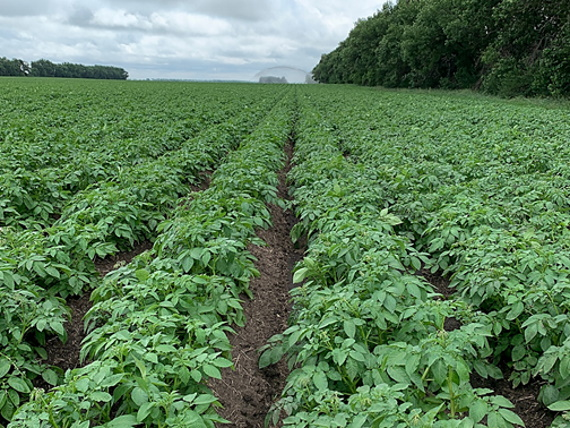
Apply a second dose of urea (1 bag)/acre after that to give irrigation in the potato field.
Monitor your field for checking some insect and disease infestation-
Cut Worms (Agrotis spp, Euxoa spp)

They cut the sprouts at ground level. They feed only at night. They also attack tubers and make holes, thereby reducing market prices.
Control Measures-
- Spray the crop with dursban 20 EC at 2.5 ml per litre of water or drench the plants, where the damage is noticed.
- Apply phorate 10 G granules at 10 kg I per hectare on soil around the plants and rake the soil thereafter.
- Use only well rotted farmyard manure.
Jassids-

They are slender wedge shaped green hopping insects. They are diagonally. They suck sap from under the surface of leaves causing yellowing, curling and later burning of leaves called ‘hopper bums’.
Control Measures-
1. Spray the crop with metasystox at 0.1 per cent.
2. Apply thimet 10 g granules at 10 kg per hectare in furrows at the time of planting.
Manage weeds for potato crop better establishment-
For best growth, control weeds within the first 4 weeks after planting. Weeding can be done by hand if labour is available, mechanically by a bullock-drawn three-tine cultivator and alternatively by spraying herbicides. To manage weeds around your potato crop, 2-3 hand weedings should be done along with the earthing-up operations.
OR
Spray post emergence application of metribuzin 70% WP @100-200g/acre and earthing up is to be done.
Monitor the potato field for early blight disease and Aphids infestation-
Early Blight of potato (Alternaria solani)-

Symptoms-
The infection appears on lower leaves with necrotic spots having concentric rings. The fungus survives in the soil in diseased plant debris. The collateral host is tomato. High moisture and low temperature are favourable for disease.
Control Measures-
1. Follow crop rotation
2. Collect and bum plant debris after harvesting
3. Start sprays the crop Dithane M-45 at 0.2 per cent 30 to 35 days after planting and repeat at 10 to 15 days interval
4. Grow early blight tolerant varieties such as Kufri Naveen, Kufri Sindhuri and Kufri Jeevan.
Apply irrigation to crops at this time.
Nutrient deficiency symptoms:
Nitrogen:

The yellowing in nitrogen deficiency is uniform over the entire leaf including the veins. Recovery of deficient plants to applied nitrogen is immediate (days) and spectacular. Younger leaves turn darker green, older leaves remain yellow. Upward cupping of deficient when severs.
Correction measure:
foliar application of 2% urea thrice at 15 days interval or soil application of nitrogen based on soil test recommendation.
Phosphorus-

The symptoms first develop on older leaves showing some necrotic spots and plants are dwarfed or stunted. Phosphorus deficient plants develop very slowly. Plants develop a distinct purpling of the stem, petiole and the undersides of the leaves. Plant remains stunted, darker than normal color. Lower leaf surface is grey-green. Leaflets roll upward, severely if deficiency is severe.
Correction measure:
Soil application of recommended dose of phosphorous should be applied at the time of sowing or planting.
Potassium–

Since potassium is very mobile within the plant, symptoms only develop on young and full sized leaves in the case of extreme deficiency. Leaflets become rugose (crinkled). Some of the leaves show marginal necrosis (tip burn) and at a more advanced deficiency status show interveinal necrosis. As the deficiency progresses, most of the interveinal area becomes necrotic, the veins remain green and the leaves tend to curl and crinkle. Leaves take on a scorched appearance with black pigmentation and necrtic (dead tissue) edges. In contrast to nitrogen deficiency, chlorosis is irreversible in potassium deficiency, even if potassium is given to the plants.
Correction measure:
Foliar application of K2SO4 @ 1%.
Sulphur-

This leaves show a general overall chlorosis. The veins and petioles show a very distinct reddish color. The yellowing is much more uniform over the entire plant including young leaves. The reddish color often found on the underside of the leaves. With advanced sulfur deficiency the leaves tend to become more erect and often twisted and brittle. Leaflet yellowing is uniform and general.
Correction measure:
Apply gypsum@ 100 Kg /acre in soil and use sulphur containing fertilizers e.g. SSP. Foliar spray of K2SO4 or CaSO4 @1% twice at fortnightly interval.
Magnesium-

The Mg-deficient leaves show advanced inter veinal chlorosis. Interveinal necrosis causes scorched look. In its advanced form, magnesium deficiency may superficially resemble potassium deficiency. The symptoms generally start with mottled chlorotic areas developing in the interveinal tissue. Symptoms appear first on young mature leaves.
Correction measure:
Foliar application of 0.2% MgSO4.
Manganese-

The leaves show a light interveinal chlorosis developed under a limited supply of Mn. The early stages of the chlorosis induced by manganese deficiency are somewhat similar to iron deficiency. As the stress increases, the leaves develop dark necrotic areas along the veins. Leave cup upward. Browing spotting ocurs on leaflets, especially along larger veins and mid-ribs.
Correction measure:
Spray 0.2 % manganese sulphate 2-3 times at weekly intervals.
Molybdenum-

The leaves show some mottled spotting along with some inter veinal chlorosis. An early symptom for molybdenum deficiency is a general overall chlorosis, similar to the symptom for nitrogen deficiency but generally without the reddish coloration on the undersides of the leaves. Correction measure:
Foliar spray of NaMO4 0.05% twice at weekly interval.
Zinc-

The leaves show interveinal necrosis. In the early stages of zinc deficiency the younger leaves become yellow and pitting develops in the interveinal upper surfaces of the mature leaves. As the deficiency progress these symptoms develop into an intense interveinal necrosis but the main veins remain green, as in the symptoms of recovering iron deficiency.
Correction measure:
Foliar spray of ZnSO4 @ 0.5%.
Boron-

These boron-deficient leaves show a light general chlorosis. Boron deficiency results in necrosis of meristematic tissues in the growing region, leading to loss of apical dominance and the development of a rosette condition. These deficiency symptoms are similar to those caused by calcium deficiency. The leaves are unusually brittle and tend to break easily. Also, there is often a wilting of the younger leaves even under an adequate water supply, pointing to a disruption of water transport caused by boron deficiency.
Correction measure:
Foliar spray of borax @ 0.2%.
Calcium

The calcium-deficient leaves show necrosis around the base of the leaves. The very low mobility of calcium is a major factor determining the expression of calcium deficiency symptoms in plants. Symptoms show soft dead necrotic tissue at rapidly growing areas, which is generally related to poor translocation of calcium to the tissue rather than a low external supply of calcium. This ultimately results in the margins of the leaves growing more slowly than the rest of the leaf, causing the leaf to cup downward. Plants under chronic calcium deficiency have a much greater tendency to wilt than non-stressed plants.
Correction measure:
Foliar spray of 2% Calcium sulphate twice at weekly intervals.
Copper–

The copper-deficient leaves are curled, and their petioles bend downward. Copper deficiency may be expressed as a light overall chlorosis along with the permanent loss of turgor in the young leaves. Recently matured leaves show netted, green veining with areas bleaching to a whitish gray. Some leaves develop sunken necrotic spots and have a tendency to bend downward.
Correction measure:
Foliar spray of 0.5% CuSO4 twice at fortnightly interval.
Iron-

The iron-deficient leaves show strong chlorosis at the base of the leaves with some green netting. The most common symptom for iron deficiency starts out as an interveinal chlorosis of the youngest leaves, evolves into an overall chlorosis, and ends as a totally bleached leaf. Because iron has a low mobility, iron deficiency symptoms appear first on the youngest leaves. Iron deficiency is strongly associated with calcareous soils, anaerobic conditions, and it is often induced by an excess of heavy metals. Growing point and young leaves become yellow or in extreme cases white. Usually not accompanied by necrosis. Veins and leaflet ends remain green. Correction measure:
Soil application of 10 Kg/ acre FeSO4 or spray 0.5% ferrous sulphate solution 2-3 times at weekly intervals.
Aphids (Myzus persicae)

Aphids suck the sap from leaves. Affected plants become weak; leaves become yellow and curl downwards. Aphid secretes honeydew, which gives rise to sooty mould and other fungal diseases.
Control Measures-
1. Spray the crop with rogor or metasystox or nuvacron or monocil at 1 ml per liter of water, and repeat the spray 10 to 12 days interval
2. Apply thimate 10 G granules at 10 kg per hectare in furrows at the time of planting.
3. Cut the haulms in the first week of January to check the transmission of virus through seed potatoes.
Leave a Reply