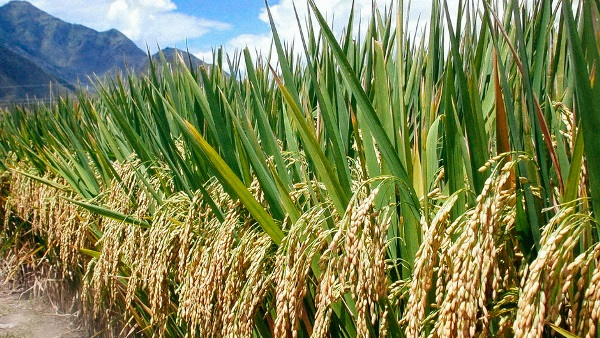
Rice is the most important food crop of India covering about one-fourth of the total cropped area and providing food to about half of the Indian population. Punjab has made tremendous progress in rice productivity and production during the past 45 years. Due to use of high yielding varieties and new technology Punjab has been given the title of “Rice Bowl of India”.

Climate-
Soil and pH-
It can be grown on a variety of soils with low permeability and pH varying from 5.0 to 9.5.
The pH can control the availability of nutrients, biological functions, microbial activity, and the behavior of chemicals. Because of this, monitoring or controlling the pH of soil, water, and food or beverage products is important for a wide variety of applications.
In the pH scale, pH 7.0 is neutral. Below 7.0 is acidic and above 7.0 is basic or alkaline. Soil pH affects nutrients available for plant growth. In highly acidic soil, aluminum and manganese can become more available and more toxic to plants while calcium, phosphorus, and magnesium are less available to the plant.

| Soil pH | Plant growth |
| >8.3 | Too alkaline for most plants. |
| 7.5 | Iron availability becomes a problem on alkaline soils |
| 7.2 | 6.0 to 7.5- acceptable for most plants6.8 to 7.2- near neutral |
| 7.0 | |
| 6.8 | |
| 6.0 | |
| 5.5 | Reduced soil microbial activity |
| <4.6 | Too acid for most plants |
Application of liming or acidifying materials will ensure that soil pH is near the agronomic target pH. Yet, it is also important to consider the critical pH before making soil pH management decisions. The critical pH is defined as “the maximum soil pH value at which liming increases crop yield”. The critical pH reflects the practical and economic considerations of changing soil pH to the value most suited for plant growth.
Sandy loam to loamy sand to silty loam to clay loams, silty to clayey loam soils with low permeability, free of water logging and sodicity are considered best for paddy cultivation.
Loam soil-

Loam soil is a mixture of sand, silt and clay that are combined to avoid the negative effects of each type.
These soils are fertile, easy to work with and provide good drainage. Depending on their predominant composition they can be either sandy or clay loam.
As the soils are a perfect balance of soil particles, they are considered to be a gardener’s best friend, but still benefit from topping up with additional organic matter.
Popular varieties with their yield
PR 128: PR 128 of rice is an improved version of PAU 201. It possesses long slender clear translucent grains. Its average plant height is 110 cm and matures in about 111 days after transplanting. It is resistant to all the 10 presently prevalent pathotypes of bacterial blight pathogen in the Punjab state. Its average paddy yield is 30.5 quintals per acre.
PR 129: PR 129 of rice is an improved version of PAU 201. It possesses long slender clear translucent grains. Its average plant height is 105 cm and matures in about 108 days after transplanting. It is resistant to all the 10 presently prevalent pathotypes of bacterial blight pathogen in the Punjab state. Its average paddy yield is 30.0 quintals per acre.
HKR 47: HKR 47 is a mid-early maturity variety of rice. It takes 104 days to mature after transplanting and its average plant height is 117 cm. It is susceptible to all the 10 presently prevalent pathotypes of bacterial blight pathogen in Punjab and is prone to lodging. Its average yield is 29.5 quintals per acre. It is suitable for parboiling.
PR 111: It is short-statured, stiff strewed variety and it leave are erect and dark green in color. It matures in 135 days. Its grains are long, slender and clear. It is resistant bacterial leaf blight disease and gives average yield of 27 qtl/acre.
PR 113: It is short-statured, stiff strewed variety and its leave is erect and dark green in color. It matures in 142 days. Grain is bold and heavy. It is resistant bacterial leaf blight disease and gives average yield of 28 qtl/acre.
PR 114: It is semi-dwarf, stiff strewed variety having narrow, dark green erect leaves. It matures in 145 days. Its grains are extra-long, clear translucent grains with very good cooking quality. It gives average yield of 27.5 qtl/acre”
PR 115: It is semi-dwarf, stiff strewed variety having narrow, dark green erect leaves. It matures in 125 days. Its grains are long slender, translucent with good cooking quality. It gives average yield of 25 qtl/acre.
PR 116: It is semi-dwarf, stiff strewed variety. It show resistant to lodging. Its leaves are light green and erect. It matures in 144 days. Its grains are long, slender and translucent. Its average yield is 28 quintals/acre.
PR 118: It is a semi-dwarf, stiff strewed and lodging tolerant variety. Its leaves are dark green and leaves are erected. It matures in 158 days. Its grains are medium slender with good cooking quality. Its average yield is 29 qtl/acre.
PR 120: It is semi dwarf variety with long slender and translucent grains with high cooking quality. It matures in 132 days. It gives average yield of 28.5 qtl/acre.
PR 121: It is short, stiff strewed variety. It show resistant to lodging. Its leaves are dark green and erect. It matures in 140 days. Its grains are long, slender and translucent. It is resistive to bacterial blight pathogen. It gives average yield of 30.5 qtl/acre.
PR 122: It is semi-dwarf, stiff strewed variety having dark green erect leaves. It matures in 147 days. It possesses long slender translucent grains with good cooking quality. It gives average yield of 31.5 qtl/acre.
PR 123: It is semi dwarf, stiff strewed variety with dark green and erect leaves. Its grains are long, slender and translucent. It is moderately resistant to bacterial blight pathogen. It gives average yield of 29 qtl/acre.
PR 126: This variety is released by PAU for general cultivation in Punjab. It is an early maturing which gets mature in 123 days after transplanting. The variety is resistant to bacterial blight disease. It gives an average yield of 30qtl/acre.
PR 127: It is a medium maturing variety which matures in 137 days after seeding. The plant attains the average height of 104cm. The variety is not suitable for growing in alkali and brackish soils. It gives an average yield of 30qtl/acre.
CSR 30: The variety has extra-long slender shaped grains which are known for its excellent cooking and good eating qualities. The variety gets mature within 142 days after transplanting. It gives an average yield of 13.5qtl/acre.
Punjab Basmati 3: Developed by PAU Ludhiana. It has excellent cooking and eating quality. It is improved version of basmati 386. It is resistant to lodging and Bacterial Blight. Its grains are extra-long and having excellent aroma. It give average yield of 16qtl/acre.
Punjab Basmati 4: It is a high yielding variety and semi dwarf variety which is 96cm tall. It is a lodging tolerant variety and is resistant to bacterial blight. The variety gets mature within 146 days after transplanting. It gives an average yield of 17qtls/acre.
Punjab Basmati 5: It is also a high yielding variety which gives an average yield of 15qtls/acre. The variety gets mature within 137 days after transplanting.
PB 1509: Early maturing variety i.e ready to harvest in 120 days. It is susceptible to bacterial blight. Its grains extra long, slender and possess excellent cooking quality. It is suitable for multiple cropping pattern. It gives average yield of 15.7 qtl/acre.
Pusa Basmati 1121: Tall variety and ready to harvest in 137 days. Aromatic variety with longest cooking length and having great cooking quality. It gives average yield of 13.7 qtl/acre.
Pusa 44: Long duration variety and it is susceptible to bacterial blight.
Pusa Basmati 1637: Released in 2018. The variety is moderately resistant to blast diseases. The plant attains the height of 109cm. The variety matures in 138 days and it gives an average yield of 17.5qtl/acre.
Hybrid 6201: Suitable for irrigated areas. It give resistance to blast. It gives average yield of 25 qtl/acre.
Vivek Dhan 62: Suitable for hilly and irrigated areas. Its grains are short bold. It gives resistant to blast. Neck blast and it can survive in low temperature areas. It give average yield of 19 qtl/acre.
Karnataka Rice Hybrid 2: Suitable for irrigated and timely sown areas. It is tolerant to leaf blight and other disease. It gives average yield of 35 qtl/acre.
Land preparation
RICE (Oryza sativa L.)
Transplanted Puddled Lowland Rice
Wet nursery

Forming Seedbeds
- Mark plots of 2.5m breadth with channels 30cm wide all around the seedbeds.
- Length of the seed bed may vary from 8 to 10m according to soil and slope of the land.
- Collect the puddled soil from the channel and spread on the seedbeds or drag a heavy stone along the channel to lower it, so that the seed bed is at a higher level.
- Level the surface of the seedbed, so that the water drains into the channel.
Dry nursery

- Dry ploughed field with fine tilth is required.
- Nursery area with sand and loamy soil status is more suitable for this type of nursery.
- Area 20cents.
- Plots of 1 to 1.5 m width of beds and channels may be formed. Length may be according to the slope and soil. Raised beds are more ideal if the soil is clayey in nature.
Main Field Management
Land preparation


- Plough the land during summer to economize the water requirement for initial preparation of land.
- Flood the field 1 or 2days before ploughing and allow water to soak in. Keep the surface of the field covered with water.
- Keep water to a depth of 2.5cm at the time of puddling.
- Special technologies for problem soils:
- For fluffy paddy soils: compact the soil by passing 400kg stone roller or oil-drum with stones inside, eight times at proper moisture level (moisture level at friable condition of soil which is approximately 13 to18%) once in three years, to prevent the sinking of draught animals and workers during puddling.
- Keep water to a depth of 2.5cm at the time of puddling
SYSTEM OF RICE INTENSIFICATION (SRI)

Mat nursery preparation
Preparation of nursery area: Prepare 100 m2 nurseries to plant 1 ha. Select a level area near the water source. Spread a plastic sheet or used polythene gunny bags on the shallow raised bed to prevent roots growing deep into soil.
Main field preparation-

- Puddled lowland prepared as described in transplanted section.
- Perfect leveling is a pre-requisite for the water management proposed here under-
Wet seeded puddled lowland rice
Wet Seeded Rice
- On receipt of showers during the months of May – July repeated ploughing should be carried out so as to conserve the moisture, destroy the weeds and break the clods.
- After inundation puddling is to be done as per transplanting. More care should be taken to level the field to zero level.
- Stagnation of water in patches during germination and early establishment of the crop leads to uneven crop stand.
- Land leveling has say over efficient weed and water management practices.
- Provision of shallow trenches (15cm width) at an interval of 3m all along the field will facilitate the draining of excess water at the early growth stage.
Land leveling

Dry seeded rainfed un-puddled lowland rice
- Dry plough to get fine tilth taking advantage of rains and soil moisture availability.
- Apply gypsum at 1 t/ha basally wherever soil crusting and soil hardening problem exist.
- Perfect land leveling for efficient weed and water management.
- Provide shallow trenches (15 cm width) at an interval of 3m all along the field to facilitate draining excess water at the early growth stage.
Dry seeded rainfed un-puddled lowland rice with supplemental irrigation
- Dry plough to get fine tilth taking advantage of rains and soil moisture availability.
- Apply gypsum at 1 t/ha basally wherever soil crusting and soil hardening problem exist.
- Perfect land leveling for efficient weed and water management.
- Provide shallow trenches (15 cm width) at an interval of 3m all along the field to facilitate draining excess water at the early growth stage.
- Pre-monsoon sowing is advocated for uniform germination.
Dry seeded irrigated un-puddled lowland rice
- Dry plough to get fine tilth taking advantage of rains and soil moisture availability.
- Apply gypsum at 1 t/ha basally wherever soil crusting and soil hardening problem exist.
- Perfect land leveling for efficient weed and water management.
- Provide shallow trenches (15 cm width) at an interval of 3m all along the field to facilitate draining excess water at the early growth stage.
SEED
Seed Rate:
Use 20-25kg seed per hectare of fine, 30-35kg seed for medium and 35- 40kg seed for coarse paddy in nursery to transplant it in one hectare land.
Seed treatment:


Before sowing, soak them in 10 ltr water containing, Carbendazim@20gm+ Streptocycline @ 1gm for 8 to 10 hour before sowing. After then dry seeds in shade. And then use for sowing. Also you can use below mention fungicides to protect crop from root rot disease. Use chemical fungicides first then treat seed with Trichoderma.
| Fungicide/Insecticide name | Quantity (Dosage per kg of seeds) |
| Trichoderma | 5-10 gm |
| Chlorpyriphos | 5 ml |
SOWING
Time of sowing:
20 may to 5 june is the optimum time for sowing
Spacing:

For normal sown crop a spacing of 20 – 22.5 cm between rows is recommended. When sowing is delayed a closer spacing of 15-18 cm should be adopted.
Method of sowing:


In traditional rice cultivation, rice is sprouted in a nursery; sprouted seedlings are then transplanted into standing water. With direct seeding, rice seed is sown and sprouted directly into the field, eliminating the laborious process of planting seedlings by hand and greatly reducing the crop’s water requirements.
Sowing depth:

The seedlings should be transplanted at 2 to 3 cm depth. Shallow planting gives better yields.
Nursery Preparation:
15th to 30th May is the optimum time for nursery preparation.
Before sowing, soak them in 10 Ltr water containing, Carbendazim@20gm+ Streptocycline@1gm for 8 to 10 hour before sowing. After then dry seeds in shade. And then use for sowing.
Wet bed nursery:

It is done in region having adequate water availability. Nursery area is about 1/10 of the area to be transplanted. Broadcast Pre-germinated seeds on puddled and levelled soil. Keep the beds moist for the first few days. Do not flood the beds. When the seedlings are about 2 cm high, keep the beds submerged in a shallow layer of water. Apply dose of 26 kg/acre Urea about a fortnight after sowing. For transplantation use seedlings of 15-21 days or when seedlings are 25-30 cm long. Regularly irrigate the nursery.
Dry Bed:
It is prepared in dry soil condition. Total seed bed area is about 1/10 of the area to be transplanted. Make seed bed of convenient dimensions with the soil raised at height of 6-10 cm. Spread half burned rice husk on these beds for easy uprooting. Irrigation should be done properly because less moisture can damage seedling. Incorporate basal fertilizer for proper nutrients.
Modified Mat nursery:
This is the modified method of nursery making which require less space and less quantity of seeds. It can be cultivated at any place having flat surface and assured water supply. The area needed is about 1% of the transplantable land. Establishing seedlings in 4 cm layer of soil mix, arranged on a firm surface. Make 1 meter wide and 20-30 meter long plot and spread plastic sheet or banana leaves on it. Place a wooden frame with 4 cm deep and then fill the frame with soil mixture. Sow the pre-germinated seed in it and cover them with dry soil. Immediately sprinkle water on it. Irrigate frame as and when needed and keep it moist. Seedlings are ready for transplanting within 11 to 14 days of sowing. Transport seedling mat to field and separate them and transplant 1-2 seedlings at 20×20 cm or 25×25 cm spacing.
Depth of planting:
The seedlings should be transplanted at 2 to 3 cm depth. Shallow planting gives better yields.
Method of Transplanting-
Flat puddled transplanting:

Transplant seedlings in line at 20×15 cm for normal and 15×15 cm for late transplanting. Put 2 seedlings per hill and the seedlings should be transplanted upright and about 2-3 cm deep.
Bed Transplanting:

Transplant seedlings on middle of slopes of bed. These beds are prepared by wheat bed planter in heavy soil. Before transplanting irrigate the furrows, and then transplant seedlings by maintaining a plant to plant distance of 9 cm.
Mechanical transplanting:

For transplanting Mat type nursery, mechanical transplanter are used. It transplants seedlings at spacing of 30×12 cm.
Fertilizer

For paddy apply N:P:K@50:12:12 kg/acre in form of Urea @110 kg/acre, SSP@75 kg/acre and MOP@20 kg/acre. Before fertilizer application, carried out soil test and apply fertilizer on the basis of soil test result. Apply P and K dose if soil test show deficiency of it. If DAP is to be used, apply Urea@100 kg/acre, DAP@27 kg/acre and MOP@20 kg/acre. Apply 1/3rd dose of Nitrogen and whole dose of P and K before last puddling.
Apply second dose three week after transplanting and three weeks after 2nd dose, apply remaining dose of Nitrogen. Use neem coated Urea as it will increased uptake of N. Apply Zinc sulphate heptahydrate@25 kg or zinc sulphate monohydrate@16 kg/acre at puddling to overcome zinc deficiency. Due to water scarcity, young leaves give yellow or yellow white appearance about three week after transplanting. Apply irrigation immediately also spray with ferrous sulphate@1 kg/100 ltr water per acre, two-three time with weekly intervals.
Weed control


Use Butachlor 50 EC @ 1200 ml/acre or Thiobencarb 50 EC @ 1200 ml or Pendimethalin 30 EC @ 1000 ml or Pretilachlor 50 EC @ 600 ml per acre as pre-emergence herbicides, 2 to 3 days after transplanting. Mix any one of these herbicides in 60 kg of sand per acre and broadcast uniformly in 4-5 cm deep standing water.
For broadleaf weed control, apply Metsulfuron 20 WP @ 30 gm/acre in 150 Ltr water as post emergence, 20-25 days after transplanting. Before spray, drained out the standing water from the field and apply irrigation one day after spray.
Irrigation


Keep field flooded up to two weeks after transplanting. When all water gets infiltrated two day after apply irrigation in field. Depth of standing water should not exceed 10 cm. While doing intercultural and weeding operation, drain out excess water from field and irrigate field after completion of this operations. Stop irrigation about a fortnight before maturity to facilitate easy harvesting.
Plant protection
Pest and their control:
Root Weevil:

The presence of root weevil can be detected by the root and leave damage of yield. These are white legless grub feeds mainly on root. Plant gives yellow appearance, growth gets stunted and few tillers are form.
If incidence is observed apply Carbaryl (4G)@10 kg either Phorate (10 G)@4 kg or Carbofuran (3 G) @10 kg per acre.
Plant Hoppers:

These mainly occur in the irrigated wetland conditions or in rainfed areas. The presence of pest shows the browning of the yield, sooty moulds and honeydew present in bases where infected.
If incidence is observed to control, spray with Dichlorvos @ 126 ml or 400 gm Carbaryl in 250 Ltr of water per acre or Imidacloprid @ 40 ml or Quinalphos 25 EC @ 400 ml or Chlorpyriphos @1 Ltr in 100 ltrs of water per acre.
Leaf folder:

This pest develops in high humidity and specifically found where rice is fertilized heavily. Larva fold the leaves and eat the plant tissue and produces white streaks.
Control:
If infestation is observed spray crop with cartap hydrochloride @ 170 gm or Triazophos @ 350ml or Chlorpyriphos @1 Ltr in 100 ltr of water per acre.
Rice Hispa:

It is serious pest in some districts. Larva create tunnel into leaves and thus destroyed leaves by producing white streaks on leaves.
If Infestation is observed in field, spray crop with Methyl Parathion@120 ml or Quinalphos 25 EC@400 ml or Chlorpyriphos @1 Ltr in 100 ltr of water per acre.
Disease and their control:
Blast:

Due to blast disease, spindle shaped spots with greyish centre and brown margin observed on the leaves. Also give neck rot symptoms and panicles get fall over. Observed in areas having excessive use of nitrogen.
If infestation is observed, spray with Zineb@500 gm/acre in 200 Ltr of water.
Brown leaf spot:

It produces oval, eye-shaped spots with a conspicuous dark-brown dot in the centre and light brown margin. Spots are developed on grains also. In low nutrient soil, this attacked more.
To keep check on this disease, give balance amount of nutrient. When crop is at boot stage take spray of Tebuconazole @ 200 ml or Propiconazole @200 ml in 200 Ltr of water. After 15 days repeat the spray.
False smut:

This fungus developed large greenish velvety spore-balls on individual grains. In humid, high rainfall and cloudy conditions, chances of spread of disease are high. Excessive use of Nitrogen also increases intensity of attack.
To control this disease spray with 500 gm Copper Oxychloride per acre in 200 Ltr of water at boot stage in crop. With interval of 10 days, take spray with Tilt 25 EC @ 200 ml/200 liters of water.
Sheath blight:

On leaf sheath, greyish lesion with purple margin is developed. Later these lesions get developed and enlarge. In severe condition, poor grain filling is observed. Avoid excess use of Nitrogen. Keep field clean. If incidence of disease is observed, spray crop with Tebuconazole or Tilt 25 EC@200 ml or Carbendazim 25% @200 gm in 200 Ltrs of water per acre. Repeat the spray after 15 days interval.
Harvesting

Reap the yield once the panicles are developing fully as well as the crops get changed significantly yellow. The yield is generally harvested manually by sickles or by blend harvester. The harvested crops, tied up into compact bundles, strike it against really hard surface to split the grains from straw, accompanied by winnowing.
Post-harvest
The post-harvest method includes some procedures which include the interval from harvest to utilization 1) harvesting 2) threshing 3) cleaning 4) drying 5) warehouse 6) milling then transport to the trade.
Before the storage of grains to protect harvested stuff from pest and disease attack, mix 500 gm Neem seed dust with 10 Kg of seed. To protect stored grains from pests attacked Mix Malathion 50 EC@30 ml/3 Ltr of water. Spray for 1002meter storage area at every 15 days.
Leave a Reply