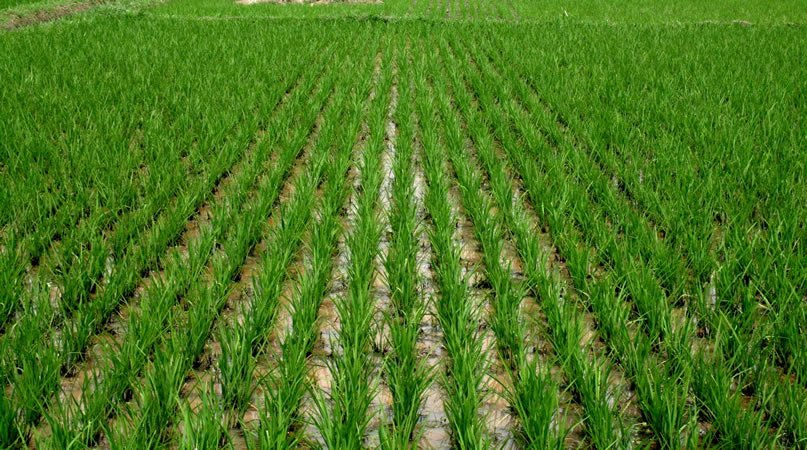
Manual and mechanical weed control-
It is recommended to remove weeds the first 20-50 days after transplanting the crop in the main field. Repeat the weeding twice more during the crop cycle. Manual weeding is a part of integrated weed management that involves the use of cultural, manual and mechanica control methods.
Weeds need to be controlled from planting until the ripening stage. Start hand weeding within two weeks of planting (or when weeds are large enough to grasp). You can also use a rotary weeder. Do not allow flowers and set seeds in a crop field. Ensure that there is enough soil moisture for easy pull up of weeds.
Weeds may survive if pulled and thrown in water. Remove the weeds from the field.
Monitor your field for some disease and insect-pest incidences-
Yellow stem borer-

Paddy stem-borer: Scirpophaga incertulas
Symptom of damage:
- Presence of brown coloured egg mass near leaf tip
- Caterpillar bore into central shoot of paddy seedling and tiller, causes drying of the central shoot known as “dead heart”
- Grown up plant whole panicle becomes dried “white ear”
- Plants could be easily pulled by hand
Identification of insect pest:
- Egg: are creamy white, flattened, oval and scale like and laid in mass and covered with buff coloured hairs
- Larva: pale yellow with dark brown head
- Pupa: White silken cocoon are found inside the stem
- Adult:
Female moth: bright yellowish brown fore-wings with a black spot possess a tuft of yellow hairs
Male moth: Smaller with pale yellow forewings without black spot
Management:
ETL: 25% Dead heart symptoms.
ATL (Action Threshold Level): 2 egg masses/m2
- At ATL release egg parasitoid, Trichogramma japonicum for the management of the rice yellow stem borer
- Spraying Neem seed kernel extract controls stem borer
- Clip the seedling tips before transplanting to eliminate egg masses and collect and destroy the egg masses in main field
- Spray any one of the following insecticides
- Phosalone 35 EC 1500 ml/ha
- Acephate 75 % SP 666-1000 g/ha
- Azadirachtin 0.03% 1000 ml/ha
- Carbofuran 3% CG 25 kg/ha
- Carbosulfan 6% G 16.7 kg/ha
- Carbosulfan 25% EC 800-1000 ml/ha
- CartapHydrochloride 50 % SP 1 kg/ha
- Chlorantraniliprole 18.5% SC 150 ml/ha
- Chlorantraniliprole 0.4% G 10 kg/ha
- Chlorpyriphos 20% EC 1.25 l/ha
- Fipronil 5% SC 1000-1500 g/ha
- Fipronil 80%WG 50- 62.5 kg/ha
- Flubendiamide 20% WG 125 g/ha
- Flubendiamide 39.35% M/M SC 50 g/ha
- Phosphamidon 40% SL 1250 ml/ha
- Thiacloprid 21.7% SC 500 g/ha
- Thiamethoxam 25% WG 100 g/ha
- Triazophos 40% EC 625-1250 ml/ha.
Leave a Reply