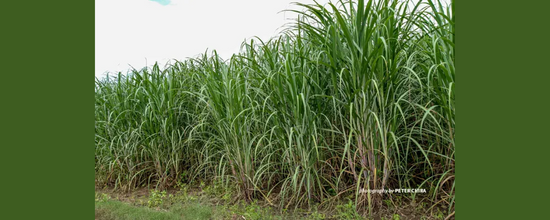
Soil for sugarcane cultivation:
Well-drained, loamy deep soil with a groundwater 1.5-2 m below the soil surface with ample water holding capacity is the best for sugarcane cultivation. Sugarcane does not require any specific type of soil as it can be successfully raised on diverse soil types ranging from sandy soils to clay loams & heavy clays.
Suitable Soils with texture ranges:
Loam, sandy, Red and yellow soil.
Loam soil:

Loam soil is a mixture of sand, silt and clay that are combined to avoid the negative effects of each type.
These soils are fertile, easy to work with and provide good drainage. Depending on their predominant composition they can be either sandy or clay loam.
As the soils are a perfect balance of soil particles, they are considered to be a gardenes best friend, but still benefit from topping up with additional organic matter.
Sandy soil:

Sandy Soil is light, warm, dry and tends to be acidic and low in nutrients. Sandy soils are often known as light soils due to their high proportion of sand and little clay (clay weighs more than sand).
These soils have quick water drainage and are easy to work with. They are quicker to warm up in spring than clay soils but tend to dry out in summer and suffer from low nutrients that are washed away by rain.
The addition of organic matter can help give plants an additional boost of nutrients by improving the nutrient and water holding capacity of the soil.
Red and yellow soil:

Found in Deccan plateau, Western Ghat, Orissa, and Chhattisgarh.
Characteristics:
The soils are red due to iron oxide in them. The soils form when metamorphic rocks weather away. Rich in potash. Somewhat acidic. Poor in nitrogen, magnesium, lime, phosphorus, and organic matter. The Soil is sandy.
Soil treatment:
Apply organic manure like FYM/compost/well-decomposed press mud (about 8-10 tonnes/acre). Quantity of organic manure could be adjusted in such a way as to supply 112 kg N/acre through one or more sources depending on their N content. Trichoderma and Pseudomonas (each 1kg/acre) and Decomposing cultures can be mixed with the organic manures. This will improve the soil fertility to realize higher yields.

Benefits of soil treatment:
Water benefits:
- Healthy soil acts as a sponge: more rainwater is absorbed and stored in the ground, where it recharges groundwater and aquifers.
- Healthy soil prevents run-off and erosion, and reduces evaporation.
- Healthy soil improves water quality by filtering pollutants.
Nutritious food:
- Healthy soil increases the nutritional value of food and forage.
- Healthy soil provides plants with the nutrition they need and strengthens plants’ natural resistance to pests and diseases.
Economic security:
- Healthy soil improves farm productivity and provides stability.
- Healthy soil cuts down on inputs, which increases profit.
- Healthy soil helps withstand extreme weather, floods and drought.
Environmental and health benefits:
- Healthy soil helps reverse global warming by absorbing carbon from the atmosphere where it acts as a greenhouse gas.
- Healthy soil provides habitat for soil microbes to flourish.
- Healthy soil supports greater biodiversity and species stability.
Soil and land preparation:
Sugarcane crops stand in the field for more than a year, it is necessary to deep plow by a moldboard plow drawn by tractor. The proper time for plowing is immediately after the preceding, as crop is harvested or just after a good shower of rain received, the land is then exposed to the atmosphere for a month. The harrowing is done 3 to 4 times to break clouds and to make the land smooth and even to facilitate uniform irrigation. Four to six plowing to produce good tilth is recommended.Well drained, deep, loamy soil with ground water table 1.5-2 m from the soil surface with adequate water holding capacity is ideal for sugarcane cultivation. It can tolerate a considerable degree of acidity and alkalinity so it can be grown on soil, ranging pH from 6.5 to 7.5. If soil is low in pH (less than 5) add lime in soil and for high pH (more than 9.5) do gypsum application. Give two plowing to land. First plowing should be given at a depth of 20-25 cm. Crush clouds with suitable implements or machines.
Implements used in Soil and Land preparation:
Disc Plow:

The disc plow bears little resemblance to the common moldboard plow. A large, revolving, concave steel disc replaces the share and the mouldboard. The disc turns the furrow slice to one side with a scooping action. The usual size of the disc is 60 cm in diameter and this turns a 35 to 30 cm furrow slice. The disc plough is more suitable for land in which there is much fibrous growth of weeds as the disc cuts and incorporates the weeds. The disc plough works well in soils free from stones. No harrowing is necessary to break the clods of the upturned soil as in a moldboard plow.
Tractor Drawn Cultivator:

Cultivator is an implement used for finer operations like breaking clods and working the soil to a fine tilth in the preparation of seedbed. Cultivator is also known as tiller or tooth harrow. It is used to further loosen the previously plowed land before sowing. It is also used to destroy weeds that germinate after plowing. Cultivator has two rows of tynes attached to its frame in staggered form. The main object of providing two rows and staggering the position of tynes is to provide clearance between tynes so that clods and plant residues can freely pass through without blocking. Provision is also made in the frame by drilling holes so that tynes can be set close or apart as desirect. The number of tynes ranges from 7 to 13. The shares of the tynes can be replaced when they are worn out.
Laser land leveler:

Laser Land Leveler is a more advanced technique for smoothing the land surface from its average height with a certain degree of the desired slope using a guided laser beam throughout the field. Laser Land Leveling is an important technology for good agronomic, highest possible yield, crop-management, and water-saving.
Advantages of soil preparation:
- It loosens the soil.
- It aerates the soil.
- It prevents soil erosion.
- It allows easy penetration of roots into the soil.
Disadvantages of soil preparation:
The downside of tilling is that it destroys the natural soil structure, which makes soil more prone to compaction. By exposing a greater surface area to air and sunlight, tilling reduces soil’s moisture-retaining ability and causes a hard crust to form on the soil surface.
Sugarcane varieties released and notified for different zones:
Peninsular Zone
| Co 06022: This variety has been developed by ICAR-SBI, Coimbatore in early group for Peninsular Zone and identified in 2012. The variety has exhibited cane yield by 105.23 t/ha, CCS yield 13.76 t/ha and sucrose 18.88% in juice. This variety is high yielding and quality with tolerance to salinity. This variety has been released & notified by the CVRC during 2018. |  |
| Co 09004 (Amritha): This variety has been developed by ICAR-SBI, Coimbatore in early group for Peninsular Zone and identified in 2017. The variety has exhibited cane yield by 109.85 t/ha, CCS yield 14.56 t/ha and sucrose 18.94% in juice. This variety is tolerant to drought and salinity. This variety has been released & notified by the CVRC during 2018. |  |
| Co 10026 (Upahar): This variety has been developed by ICAR-SBI, Coimbatore in early group for Peninsular region and identified in 2018. The variety exhibited cane yield by 109.06 t/ha, CCS yield 13.86 t/ha and sucrose 17.98% in juice. It is tolerant to drought and salinity conditions. It is resistant to red rot and YLD. This variety has been released & notified by the CVRC during 2019. |  |
| Co 12009 (Sankalp): This sugarcane variety has been developed by ICAR-SBI, Coimbatore in midlate group for Peninsular Zone and identified in 2019. The variety has exhibited cane yield by 119.65 t/ha, CCS yield 17.31 t/ha and sucrose 19.91% in juice. Reaction to red rot, MS-MR (plug) and R (nodal), resistant to smut & YLD. |  |
North West Zone
| CoLk 09204 (Ikshu-3): This variety has been developed by ICAR-IISR, Lucknow under mid-late group for North-West zone and identified in 2017. The variety recorded cane yield by 82.80 t/ha, CCS yield 9.30 t/ha and sucrose 17.0% in juice. It is lodging tolerant and suitable for multiple ratooning with a lush green top at maturity. This provides additional benefit in the form of green fodder to the farmers. This variety has been released & notified by the CVRC during 2018. |  |
| Co 09022 (Karan-12): This variety has been developed by ICAR-SBI, Coimbatore under mid-late group for North-West zone and identified in 2017. The variety recorded cane yield by 83.56 t/ha, CCS yield 10.06 t/ha and sucrose 17.49% in juice. This variety is suitable for water logging conditions. It is a good substitute for CoS 767 which has deteriorated due to increased incidence of GSD and red rot. This variety has been released & notified by the CVRC during 2018. |  |
| CoLk 11206 (Ikshu-4): This variety has been developed by ICAR-IISR, Lucknow in mid-late group for North West Zone and identified in 2017. The variety recorded cane yield by 91.50 t/ha, CCS yield 11.20 t/ha and sucrose 17.65% in juice. This variety is non-loading, non-flowering, better rationing and nutrient responsive and a good performer under moisture stress conditions. This variety has been released & notified by the CVRC during 2018. |  |
| CoLk 11203 (Ikshu-5): This variety has been developed by ICAR-IISR, Lucknow in early group for North-West Zone and identified in 2017. The variety recorded cane yield by 81.97 t/ha, CCS yield 10.52 t/ha and sucrose 18.41% in juice. The variety CoLk 11203 is a good ratooner. This variety has been released & notified by the CVRC during 2018. |  |
| Co 12029 (Karan-13): This variety has been developed by ICAR-SBIRC, Karnal under mid-late group for North-West zone and identified in 2018. The variety recorded cane yield by 95.57 t/ha, CCS yield 12.07 t/ha and sucrose 18.10% in juice. It is suitable for planting in autumn and spring seasons. It is a least susceptible to shoot borer, top borer and stalk borer. This variety has been released & notified by the CVRC during 2019. |  |
| CoS 12232 (Sahaj-3) : This sugarcane variety has been developed by UPCSR, Shahjahanpur in mid-late group for North West zone and identified in 2019 The variety has exhibited cane yield by 88.86 t/ha, CCS yield 11.21 t/ha and sucrose 18.18% in juice. This variety is Non lodging, Non flowering, better ratooning and nutrient responsive. Reaction to red rot was R to MR. |  |
| Co 13035 (Karan-14) : This sugarcane variety has been developed by ICAR-SBI Regional Center, Karnal in mid-late group for North West zone and identified in 2019. The variety has exhibited cane yield by 86.76 t/ha, CCS yield 11.00 t/ha and sucrose 18.25% in juice. Reaction to red rot was R to MR. The variety is least susceptible to shoot borer, top borer and stalk borer. |  |
North Central & North Eastern Zones
| UP 09453: This variety has been developed by SRS, Gorakhpur (UPCSR, Shahjahanpur) in an early group for North Central & North Eastern Zones and identified in 2017. The variety has exhibited cane yield by 74.74 t/ha, CCS yield 8.76 t/ha and sucrose 17.90% in juice. It is better suited for waterlogged conditions. This variety has been released & notified by the CVRC during 2018. | |
| CoLk 12207 (Ikshu-6): This variety has been developed by ICAR-IISR, Lucknow in early group for North Central & North East Zones and identified in 2018. The variety has exhibited cane yield by 75.42 t/ha, CCS yield 8.74 t/ha and sucrose 16.90% in juice. It is non-lodging, non-flowering, better ratooning and nutrient responsive. It is resistant to red rot and water logged condition. This variety has been released & notified by the CVRC during 2019. |  |
| CoLk 12209 (Ikshu-7): This variety has been developed by ICAR-IISR, Lucknow in mid-late group for North Central & North East zones and identified in 2018. The variety has exhibited cane yield by 77.5 t/ha, CCS yield 9.38 t/ha and sucrose 17.65 % in juice. It is non-lodging, non-flowering, better ratooning and nutrient responsive. This variety has been released & notified by the CVRC during 2019. |  |
East Coast Zone
| CoA 11321 (Sri Mukhi): This variety has been developed by RARS, Anakapalle in early group for East-Coast Zone and identified in 2017. The variety has exhibited cane yield by 111.31 t/ha, CCS yield 13.59 t/ha and sucrose 17.16% in juice. It is a thick yellowish green cane with black encrustation, cylindrical internodes with straight alignment. Medium size bud, round in shape, bud cushion and bud groove absent. This variety has been released & notified by the CVRC during 2018. |  |
| CoA 08323 (Buddhi): This variety has been developed by RARS, Anakapalle in early group for East-Coast Zone and identified in 2013. The variety has exhibited cane yield by 106.30 t/ha, CCS yield 11.76 t/ha and sucrose 16.41% in juice. It is suitable for irrigated conditions, limited irrigated and rainfed situations and it is a good ratooner. This variety has been released & notified by the CVRC during 2017. |  |
| CoA 05323 (Revathi): This variety has been developed by RARS, Anakapalle in mid-late group for East-Coast Zone and identified in 2011. The variety has exhibited cane yield by 103.18 t/ha, CCS yield 11.18 t/ha and sucrose 16.74% in juice. It is tolerant to moisture stress, suitable for normal irrigation and a very good ratooner. This variety has been released & notified by the CVRC during 2017. |  |
| CoC 13339: This sugarcane variety has been developed by SRS, Cuddalore in mid-late group for East Coast Zone and identified in 2019. The variety has exhibited cane yield by 117.97 t/ha, CCS yield 15.16 t/ha and sucrose 18.21% in juice. This variety is moderately resistant to red rot and YLD. It is also moderately resistant to smut. |  |
Zone-wise prominent sugarcane varieties
Peninsular zone
| Co 86032 (Nayana): The wonder variety, Co 86032 of the decade was developed at the Sugarcane Breeding Institute, Coimbatore from the progenies of Co 62198 x CoC 671 and identified in 1994 for the peninsular zone (Gujarat, Madhya Pradesh, Chattisgarh, Maharashtra, Karnataka, interior plains of Andhra Pradesh, interior plains of Tamil Nadu and Kerala). It was released and notified in the year 2000. In Tamil Nadu it occupies nearly 80% of the area and in Andhra Pradesh, Karnataka, Gujarat and Maharashtra around 40% in each state. This is a high yielding, high sucrose midlate variety with good ratooning ability. This is cultivated in a wide range of soils except water logging. It yields 120 t/ha and 15.09 t/ha of cane and sugar, respectively. The average sucrose content is 19.19%. |  |
| This is resistant to smut, moderately resistant to wilt and field tolerant to red rot. This is amenable for multiple ratooning and suitable for mechanization as it performs well under wide row spacing. This can be cultivated in drought and saline affected areas. Co 86032 substituted CoC 671, a predominant variety in the early 1990s when it gradually succumbed to red rot and subsequently withdrawn from cultivation. This wonder variety of the decade is still preferred as a major variety in all the states of the peninsular zone. | |
| CoM 0265 (Phule 265): is a mid-late maturing variety. It is a selection from the progeny of Co 87044 GC. It was identified in 2009 for release in the peninsular zone (Gujarat, Madhya Pradesh, Chattisgarh, Maharashtra, Karnataka, interior plains of Andhra Pradesh, interior plains of Tamil Nadu and Kerala). This variety is high yielding (111. 45 t/ha) with good ratooning ability. It is suitable for cultivation in spring, autumn and as adsali (18-month duration) crop. It is moderately resistant to red rot and tolerant to drought and salinity. The adsali crop of this variety yielded about 200 t/ha with an increase of 16.9% over existing varieties like Co 86032. In pre-season and suru planting also, the cane yield was higher than existing varieties. It has recorded 21.8 t/ha sugar which was 18.75% higher than existing variety Co 86032. It is most suitable for cultivation in salinity affected soils and is fast spreading in Maharashtra and other states in the peninsular zone. It is now most preferred by the farmers. |  |
| Co 99004 (Damodar): This variety has early vigorous growth, shy flowering, tall, erect canes and without spines on leaf sheath. Resistant to red rot and tolerant to wilt and internode borer, tolerant to drought and salinity, mid-late maturing variety with high cane yield. Recommended for cultivation in the Peninsular Zone- Gujarat, Maharashtra, Madhya Pradesh, Karnataka, Interior Andhra Pradesh, Tamil Nadu and Kerala. |  |
| Co 2001-13: This variety was notified for release in Peninsular zone during 2009. This mid-late maturing variety has 14.73 t/ha CCS, 108.6 t/ha cane yield and 19.03% sucrose. The canes are medium thick, semi erect with cylindrical zigzag internodes and dark purple and wax coated canes. The variety is high tillering with good ratooning potential and is well suited for drought and saline conditions. It is resistant to red rot and smut diseases, internode borer and free from all pests under natural conditions. The variety gives A1 quality jaggery with moderate fiber (13.43%). Medium thick canes with purple color. Leaf sheath has sparse hairs and is tightly clasping. Internode is cylindrical, zigzag and growth cracks absent, rind surface is smooth and with heavy wax. Bud cushion absent. Number of millable canes per stool is high. |  |
| Co 2001-15: This variety was notified for release in 2009 and showed superiority for cane yield, sugar yield and CCS % in AICRP trials of Peninsular zone (2006-08). This variety is suitable under normal and drought conditions at different centers. Canes are tall and medium thick with a light canopy and more partitioning towards canes. The average cane yield is 108.18 t/ha, CCS yield 14.57 and sucrose % juice is 18.90. The variety also combines resistance to red rot and smut diseases, internode borer and tolerance to drought and salinity. Jaggery quality of this variety is A1. The fiber content in cane is 14.70%. Tall, erect, greenish purple cane with medium thickness. Cylindrical and zigzag internodes with corky patches on the rind and light wax. Bud is ovate, medium, bud groove absent, bud cushion present and bud tip below the growth ring. Leaf sheath is semi clasping with sparse hairs, deltoid ligule, calcariform auricle and yellow green dewlap. Leaf blade is arched with medium width. Green canopy with tip drooping leaves. |  |
| Co 0403: Co 0403 (Samriddhi) has recently been notified by Central Varietal Release Committee, and is recommended for cultivation in Peninsular zone. First identified by the varietal identification committee of the 28th AICRP(S) Workshop held at NAU, Navsari during October 2010. Performance of Co 0403 in Peninsular zone at 300 days (Mean of two plant and one ratoon crops). Distinct Morphological features: Cane is tall, erect and rind color is greenish purple. Leaf sheath has no hairs and is with deltoid ligule, dentoid inner auricle and light green dewlap. Leaf is medium wide, arched and the leaf sheath is semi clasping. Internode is medium thick, cylindrical, without zigzag alignment, without growth cracks, ivory marks present and with heavy waxiness. Bud is ovate with shallow bud groove and bud is cushion absent with bud tip touching the growth ring. Number of millable canes is very high. |  |
North West Zone
| Co 0238 (Karan 4): This variety Co 0238 was developed at the ICAR-Sugarcane Breeding Institute Research Centre, Karnal. Co 0238 (early maturing) is a selection from the progeny of the cross CoLk 8102 x Co 775. It was identified in 2008 and released & notified in 2009 for cultivation in the North West Zone (Punjab, Haryana, Rajasthan, Uttar Pradesh (western & central) and Uttarakhand). In the zonal varietal trials conducted across 8 centers of North West Zone, it recorded 81.08 t/ha of cane yield, 9.95 % of CCS t/ha and 17.99 % of sucrose. There was 19.96, 15.83 and 0.50 per cent improvement over the best check CoJ 64. The fiber (%) is around 13.05 %. Experiments conducted in Uttar Pradesh at DSCL Sugar, Ajbapur and Simbhaoli Sugar Mills Ltd., Simbhaoli indicated an improvement in cane yield under water stress and water logging conditions by more than 20 t/ha over respective standards. Co 0238 is a good ratooner as the reduction in cane yield when harvested during winter was 4.66% compared to CoJ 64 which recorded 41.29 % reduction. This variety also performed well in UP, Bihar and Haryana. Sugar recovery was found to be improved by an average of 1.14 units over mill recovery of 10.83% across crushing during the months of March and April, 2008 at Shahabad Cooperative Sugar Mills Ltd., where it is a major variety occupying 45% (18,505 ha) of the total area. Due to its wider adaptability, the variety is fast spreading in Haryana (19,517 ha), Punjab (26,683 ha), Uttarakhand (2,950 ha), UP (72,628 ha) and Bihar (91,795) which was 14.83, 27.78, 2.68, 3.08 and 0.66 % of the total sugarcane areas of the respective states. |  |
| Co 0118 (Karan-2): It is non-flowering early maturing variety for subtropical region. Co 0118 is a selection from the progeny of the cross Co 8347 x Co 86011. This variety was identified from seedling ratoon nursery raised at Sugarcane Breeding Institute, Regional Centre, Karnal and was tested under the Pre Zonal Varietals Trial. Co 0118 is a medium thick, green yellow canes with obconical internodes, rectangular buds, lanceolate auricles on both sides (generally long on one side), shallow bud groove and weak spines on leaf sheath. The variety is free from splits, pith and bud cushion. The fiber % is about 12.78 %. The jaggery is of A1 quality with light yellow color. This variety is moderately resistant (MR) to the prevalent races of red rot pathogen by plug method of inoculation. This variety has been evaluated under All India Coordinated Research Project in the North Western Zone. Co 0118 ranked 3rd in the zone for cane yield (78.20 t/ha), sugar yield (9.88 t/ha) and sucrose in juice (18.45%) based on average of 2 plant and 1 ratoon crops at 7 research stations in the zone. Co 0118 was released by the Central Sub Committee on Crop Standards, Notification and Release of Varieties for Agricultural Crops in 2009. This variety proved as high quality early maturing varieties under assured irrigation, water stress or water logging areas. |  |
| CoH 128: CoH 128 has been developed from a cross of CoH 70 x CoS 510 at CCSHAU Regional Research Station, Uchani (Karnal). This variety was evaluated in different selection stages for cane yield, juice quality and insect-pests / disease tolerance against standards in plant and ratoon crops. It has an excellent ratooning capability. The variety has the potential of high tonnage for cane yield with experimental mean as 76.23 t/ha. The variety recorded 21.08, 6.30 and 09.32 per cent more cane yield as compared to the checks CoS 8436, Co 1148 and CoS 767, respectively. Similarly the variety recorded high commercial cane sugar (9.28 t/ha) which was 21.62, 9.31 and 9.82 per cent higher as compared to the checks CoS 8436, Co 1148 and CoS 767, respectively. It recorded good sucrose percent (17.70) at 360 days which is numerically superior to the standards CoS 8436 (17.68), Co 1148 (17.22) and CoS 767 (17.64). |  |
North Central & North Eastern Zones
| CoLk 94184 (Birendra): This variety was developed at the ICAR-Indian Institute of Sugarcane Research, Lucknow. CoLk 94184 is a selection from the progeny of selfed CoLk 8001. It was identified in 2007 and released & notified in 2008 for North Central Zone (eastern U.P., Bihar and West Bengal). This is an early maturing high yielding variety with a rare combination of two attributes: early maturity and good ratoonability. It gives a cane yield of 75-80 t/ha in plant crops and more than 70 t/ha in ratoon crop. The variety withstands both moisture stress and water logging and therefore, is replacing the existing varieties that do not perform well under waterlogged conditions in eastern U. P. and Bihar. The average sugar recovery is about 10-11% which is 1.13 to 1.23 units higher with existing varieties. In a varietal trial at Balrampur Chini Mills, Balrampur (U.P.), the sugar recovery ranged from 10.23 to 11.13% showing an increase up to 1.23 units. The variety is moderately resistant to red rot and tolerant to top borer. It is fast spreading in U.P. and Bihar and covers more than 2.5 lakh ha area. |  |
| Co 0232 (Kamal): The variety is early maturing, water logging tolerant and red rot resistant. This variety is suitable for cultivation in the North Central and North East zones comprising of Eastern Uttar Pradesh, Bihar, West Bengal and North Eastern states. This variety was identified from Sugarcane Breeding Institute, Research Centre, Motipur (presently under IISR, Lucknow) during 2002. Under water logging conditions Co 0232 performed better over the best standard CoSe 95422 with 7.63 % higher cane yield, 11.55 % higher CCS t/ha and 0.77 % higher sucrose content. It is also tolerant to early drought and top borer. Erect canes with medium height and reddish orange rind color. Sparse leaf sheath hairiness, incipient inner auricle, green dewlap, conoidal internode shape, heavy internode waxiness, ovate bud and bud tip not touching growth ring. |  |
| Co 0233 (Kosi): A mid-late maturing variety for North Eastern and North central Zone. This variety was identified from Sugarcane Breeding Institute, Research Centre, Motipur (presently under IISR, Lucknow). It is a selection from the cross CoLk 8102 x Co 775 and is suitable for cultivation in the North Central and North East zones. The cane and sugar yield of Co 0233 was 21.11 % and 24.62% higher over the best standard CoSe 92423. This variety is high yielding, tolerant to early drought, water logging and top borer and resistant to red rot. Plant is erect. Leaf sheath has sparse hairs, crescent ligule, dentoid auricle, dark green dewlap, arched, medium wide leaf blade and leaf sheath is weak. The internode color is purplish green. Internode thickness is medium, cylindrical, with smooth rind and medium waxiness. Bud is round of medium size, bud groove and bud cushion absent and bud tip touching the growth ring. |  |
| CoP 06436: The Variety is of cardinal importance in sugarcane cultivation. It should fulfill not only the requirements of cane in the early and mid-late seasons but should also ensure high cane and sugar yield under varied climatic situations, free from diseases with low insect incidences of various kinds which affect yield or recovery. The trial network of AICRP on Sugarcane is being conducted to enhance the productivity and sugar yield of the country. Presently in Bihar sugarcane is being grown on 2.98 lakh hectares with total production of 149 lakh tons of cane (2013-14) at an average cane yield of 50 tons per hectare. Cane and sugar yield of North Central and North Eastern Zone are lower in comparison to other Zones of India due to many factors which adversely affect yield. Among them, cultivation of low yielding sugarcane varieties is a major factor while another important factor is spreading of sugarcane varieties which are not recommended or released for this zone, which restricts optimum cane yield and sugar recovery in this zone. CoP 2061 showed consistent performance for cane and sugar yield in plant and ratoon crops across the all zonal Centre over the years and trials. This variety recorded 9.18 t/ha commercial cane sugar yield which was 24.1%, 28.3% and 24.4% higher than the checks BO 91(7.40 t/ha), CoP 9301 (7.12 t/ha) and CoSe 92423 (7.38 t/ha), respectively. |  |
East Coast Zone
| CoOr 03151 (Sabita): This early maturing variety, CoOr 03151 is a selection from the progeny of CoC 671 x Co 1148. It was identified in 2009 and released & notified in 2011 for cultivation in East Coast Zone (Odisha, coastal Andhra Pradesh and coastal Tamil Nadu). This variety, on an average, yields 105.28 t/ha of cane and 11.13 t/ha of sugar. It is moderately resistant to red rot and well suited to irrigated upland and could be grown in rice land with standing water of about 1-2 ft during the rainy season. It is tolerant to waterlogging and drought. This variety has good ratooning ability and is non-flowering. In front line demonstrations, the variety has given more than 60% higher cane yield over the existing varieties. There is growing demand for this variety and is fast spreading in Odisha. |  |
| Co 06030: The variety was notified by the Central Sub-Committee on Crop Standards, Notification and Release of Varieties for Agriculture Crops, New Delhi for cultivation in the East Coast zone comprising the coastal regions of Tamil Nadu, Andhra Pradesh and Odisha vide notification no. S.O. 2817(E) dtd 19.9.2013. It recorded a cane yield of 104.0 t/ha compared to the best standard CoV 92102 (95.11 t/ha) with an improvement in yield of 10.59 % over Co 86249. In ratoon trials it recorded an improvement of 15.31% over Co 86249 and 12.47% over CoV 92102.The variety Co 06030 was ranked first in the zone with a CCS yield of 11.21 t/ha as against 10.53 t/ha of the best standard CoV 92102. It recorded an improvement of 19.12% over Co 86249, 7.92% over Co 7219 and 6.52% over CoV 92102 for CCS yield. In ratoon trials, it performed well at Anakapalle and Nellikuppam recording 25.53%, 11.73% and 9.32% improvement over the zonal checks Co 86249. The variety recorded sucrose at 12 months -16.6%, and fibre-13.6% and has A-1 Jaggery quality with golden yellow color. |  |
| Co 86249 (Bhavani): High yielding, mid-late variety in tropical India. Resistant to red rot, smut and rust. Tolerant to major pests. Tolerant to drought. Erect cane, medium thick, good ratooner. Suitable for planting in October and January/February. East Coast Zone comprising Coastal Tamil Nadu, Andhra Pradesh, Odisha and all Zones with the problem of red rot. |  |
Treatment of selected variety:
- Select healthy sets for planting.
- The sets should be soaked in 100 liters of water dissolved with 50g Carbendazim, 200 ml malathion and 1 kg urea for 15 minutes.
- Treat sets with Aerated steam at 50°C for one hour to control primary infection of grassy shoot disease.

Methods of sowing:
Furrow method:

One step further, the double row method is better than the sugarcane planting method but not an ideal method. In this method, the line-to-line distance design is in the ratio of 90:30:90 or 90:50:90. It means line to line gap is 90 cm and sowing in 30 to 50 cm area. This method does not work properly for heavy production and has some shortcomings. Two-eyed cuttings are generally used in the double row method. Production rate in the double row method, just better than the flat method, 10-15cm deep furrows made in North India and about 20cm in South India in heavy soils. End to end planting. Mostly followed method in Eastern UP and Peninsular India in heavy soil.
Trench method:

The Trench method is one of the best modern methods of sugarcane plantation. In this method, fewer sugarcane cuttings (two-eyed) are used per acre and all cuttings get almost 80% sprout and growth. Despite a modern scientific method of sugarcane plantation, it is less costly and gives a longer sugarcane yield. Plants consume less water in this method through hedges. In the method, there is no disturbance of spontaneous plants to sugarcanes. It is easy to grid sugarcanes without any problem of space gap. Followed in very long cane growing areas such as coastal areas to save crops from lodging. 20-25 cm deep and 30 cm wide trench at 75-90 cm distance are made. End to end planting.
STP technique (Spaced transplanting):

One of the most scientific methods of sugarcane plantations is the vertical nursery method of STP. In this method, one-eyed cuttings are prepared in nursery cups. These basic nursery cups help to get almost 90% sprout from the cuttings. After caring for them in nursery cups for 20 to 25 days, they become ready for fields. These sprouts get quick and better growth in fields. The only method which gives better results for the STP method is the trench method. The STP method helps to get almost 80% of sugarcane from cuttings, which is a great result in comparison to others.
Partha method:

Suggested for water logged or excess soil moisture conditions. Three eye budded sets are planted in a slanting position, 60° to the vertical, in the wet furrow or half-way on the ridges.
Ring-pit method:

The Ring pit method is a modern method of sugarcane planting. In the method, a cylindrical 45 cm deep, 22.5 cm radius rig shape. From ground level to 20 cm, organic compost covers the dig. On this compost, two-eyed (sometimes one-eyed) cuttings (20 to 30) are set in wheel shape like spokes of cycle tyre and then covered with soil. Per hectare, the same 4000 digs can possibly be prepared. This method is costlier than other planting methods but works better than flat and double row methods. Sprouting and the growth rate is better with less demand for irrigation and composting. Ultimately, it is a costlier method of sugarcane plantation but gives results. In the ‘ring pit’ method, sugarcane Setts are planted and raised in round ‘pits’ at the spacing of 180 cm between rows and 150 cm between individual pits in a row. The pits are dug using specially designed tractor drawn power tillers.
Bud chip technique:

In this technique, the shoot along with a portion of the nodal region is cut using a shoot cutting machine. Sprout shavings are treated with fungicide and planted in the raised bed nursery or in polyethylene bags filled with FYM / mud, soil, and sand press in a 1: 1: 1 ratio. The seedlings are transplanted as in the case of the STP technique. The advantages are that the amount of seed material (chip sprouts) required is only around 1 to 1.5 tons.
Fertilizer Management:
- Soil testing after every three year is necessary to know the actual need of fertilizer. Before sowing at time of last plowing, add well decomposed cow dung@8ton or Vermicompost Ralligold@8-10kg or PSB@5-10kg per Acre. At time of sowing apply Urea@66kg per acre.
Weed Management:
- To control weeds, carry out pre-emergence weedicide application with Simazine or Atrazine@600-800 g/acre or Metribuzine@ 800 g/acre or Diuron@1- 1.2 kg/acre. Apply pre-emergence herbicides immediately after planting. Apply 2,4-D@250-300 g/acre as post-emergence herbicide for broad-spectrum weed control in sugarcane.
Irrigation Management:
- Apply first irrigation when 20-25% crops have germinated.
Leave a Reply