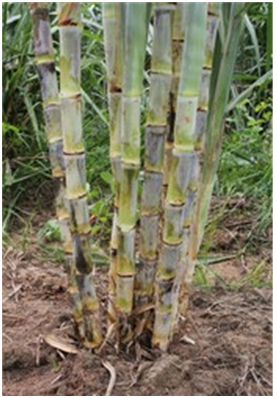
It is a physiological process of continuous underground branching of compact node joints of the primary shoot. Tillering gives crop, the necessary number of stalks required for a good production. Several factors, such as variety, light, temperature, soil humidity (irrigation), spacing and fertilization practices influence tillering. Light is the most important factor. Adequate lighting at the base of the plant during this period results in active basal vegetative buds. Temperature around 30°C is considered ideal for tillering. Temperatures below 20°C slow it down. Tillers formed earlier help to produce thicker and heavier stalks, while those formed later die or remain short or immature. Maximum tiller population is reached between 90 and 120 days after planting. At 150–180 days, at least 50% of the shoots die and a stable population is established. While six to eight tillers are produced from a bud, it has been observed that only 1.5–2.0 tillers per bud remain to form sugarcane plants.
Second split application of fertilizer-

The second split application should be applied at this time, in bands on either side of the cane row. Urea should be applied at a rate of 35 kg/acre. SSP and Potash do not need to be applied in this split.
Irrigation Management:


Apply irrigation in your cane crop at an interval of 10-12 days during this phase/stage, for better tillering and growth of crop.
Post-emergence weed management-

- Post-emergence herbicides can be effective for the control of weed growth.
- You can apply 2,4-D sodium salt 80 WSP at 0.5 kg/acre can be used for controlling weeds.
- Always mix clean water with the herbicides before application.
- Remember to wear proper protective equipment (i.e., gloves, breathing mask, goggles and protective clothing) when spraying.
- Refrain from using muddy water, as this reduces herbicides efficacy.
- Ensure that all equipments, such as spray tanks, booms and nozzles are well-cleaned after every use.
- Do not mix different herbicides together unless recommended.
- Apply herbicides at the recommended dose.
Root Borer:

Symptoms:
- Fully grown caterpillars are white in color, relatively active and measure 2-5 cm in length. The full grown larvae are white color.
- In grownup canes the damage symptom is visible in the form of yellowing of leaves. The canes need to be uprooted to detect the damage and the presence of larva. While attack by the first brood affects tiller production, second to fourth broods reduce cane length and weight in the decreasing order of magnitude with the brood number. Yield loss and sucrose reduction have been observed due to borer attack.
Management:
Cultural control:
- Deep summer plowing.
- Inter culture and hand weeding.
- Timely irrigation.
- Light earthing up of crops three months after planting.
- Grow onion/garlic/coriander as intercrop.
Mechanical Control:
- Destruction of affected shoots along with borer larvae in the pre-monsoon period reduces pest inoculum.
- Use of pheromone traps @ 2 in Nos/acre for monitoring.
- Installation of light trap @ 1 in Nos per acre.
Biological Control:
- Release of 125 gravid females of Sturmiopsis inferens a tachinid parasitoid per acre.
- Release Trichogramma chilonis @ 20,000/acre @ 10 days interval at the time of incidence.
Chemical Control:
- Spray of Fipronil 5% SC @ 600-800 ml OR Chlorpyrifos 20% EC @ 500-600 ml OR Quinalphos 5% granule @ 2 kg/acre. OR Monocrotophos 36% SL @ 600-900 ml dissolve in 250-300 lit of water/acre.
Tying of sugarcane crop is done during this stage-


To prevent lodging, use the dead leaves to tie the crop together. The leaves are removed and used to tie up all the canes from one stand into a bundle. This helps air circulate between the rows. Tie up your crop when it reaches about 2 meters in height. Do not use the green healthy leaves for this operation.
Monitoring of field-
Monitor the growth of your crop often. Walk through your field in a random manner or zigzag and check for signs of diseases, pests and deficiencies. Deficiencies are characterized by the discoloration of leaves and poor vigor of the plants. Diseases are often visible as discoloration and spots or streaks on leaves. Finally, remember that most of the insects present in the field are beneficial for your crop. Those that attack your crop will leave behind damage on leaves and buds in the form of holes.
Some diseases may appear during this stage, so farmer need to be careful about these diseases, so that they cannot attack the sugarcane crop and farmer can get higher yield of crop-
Smut:

Symptoms:
- The affected plants are stunted and the central shoot is converted into a long whip-like, dusty black structure. The length of the whip varies from a few inches to several feet. In early stages, this structure is covered by a thin, white papery membrane. The whip may be straight or slightly curved.
Management:
Cultural Control:
- Grow resistant varieties like Co 6806 and Co 62175.
- Grow red gram as a companion crop between 2 rows of sugarcane.
- Follow crop rotation with green manure crops or dry fallowing.
Mechanical Control:
- Remove the whip with thick cloth without allowing the spore to shed and destroy.
Physical Control:
- Treat the sets in hot water at 52oC for 2 hours.
Chemical Control:
- Seed treatment with Thiram 75% WP or Captan 75%WP @3g/kg seed.
- Sett’s treatment with fungicides vizTriadimefon 25% WP @ 200g dissolve in 250-300 liter of water or Carbendazim 50% WP @ 2.5 g/lit. of water for 10 minutes.
Grassy Shoot Disease:


Symptoms:
- The disease is characterized by the production of numerous lanky tillers from the base of the affected shoots. Leaves become pale yellow to completely chlorotic, thin and narrow. The plants appear bushy and ‘grass-like’ due to reduction in the length of internodes, premature and continuous tillering.
Management:
Cultural Control:
- Fresh sowing is done after 3-4 years with seed-setts from resistant varieties.
- Uproot and destroy the affected clumps.
- Growing resistant varieties viz., Co 86249, Co G 93076 and Co C 22.
Physical Control:
- Treat sets with hot air 54°C for 8 hours to inactivate the casual Virus.
- Hot Water Treatment (HWT) of sets at 520C for 30 min OR Aerated Steam Therapy (AST) at 500C for 1 hr.
Chemical Control:
- Control vector by spraying Dimethoate 30% EC @2ml/lit. of water OR Methyl -Demeton 25% EC @ 2 ml/lit. of water for controlling aphids/leaf hopper.
Rust:


Symptoms:
- Minute, elongated, yellow spots (uredia), usually 2-10 x 1-3 mm appear on both the surfaces of young leaves. The pustules turn to brown on maturity. Late in the season, dark brown to black telia appear on the lower surface of leaves.
Management:
Cultural Control:
- Use resistant varieties like Co 91010 (Dhanush), Co 87025 (Kalyani).
Mechanical Control:
- Remove and destroy the alternate host Oxalis corniculata.
Chemical Control:
- Spray the crop with Mancozeb 75% WP @ 500-600 g/acre dissolved in 250-300 lit of water twice or thrice OR Dusting of sulfur@10 kg/acre.
Yellow Leaf Spot:


Symptoms:
Symptoms are a yellowing of the leaf midrib on the underside of the leaf. The yellowing first appears on leaves 3 to 6 counting down from the top expanding spindle leaf. Yellowing is most prevalent and noticeable in mature cane from October until the end of harvest in March.
Management:
Cultural Control:
- Selection of disease free setts for planting. Application and proper management of nutrition and use resistant varieties.
Chemical Control:
- Control of insect vectors that secondary transmission of the disease. Soil application of Carbofuran 3% CG @8kg/acre.
Red Striped Disease:


Symptoms:
- The disease first makes its appearance on the basal part of the young leaves. The stripes appear as water soaked, long, narrow chlorotic streaks and become reddish brown in a few days. The core is discolored to reddish brown and shriveled and forms a cavity in the center. In badly affected fields, a foul and nauseating smell appears.
Management:
Cultural Control:
- Rogue out and burn affected plants.
- Fresh sowing is done with resistance varieties in well drained soils.
- Apply nitrogen based on actual crop requirements.
- Ensure optimum seeding rate and wider plant spacing also appear to reduce the disease.
Chemical Control:
- Spraying with Carbendazim 50% WP @ 1.0g per liter of water immediately after noticing the disease in the field.
Some insects may appear during this stage, so farmer need to be careful about these insect/pests, so that they cannot attack the sugarcane crop and farmer can get higher yield of crop-
Mealy Bug:


Symptoms:
- Newly emerged nymphs are quite active with a pinkish transparent body. Adults are white with mealy coating, sessile.
- Pinkish oval insects beneath leaf sheath on the nodes, with whitish mealy coating, main cane stunned also attack roots. Sooty mold develops on the honey dew giving a blackish appearance on canes.
Management:
Cultural control:
- Grow resistant varieties like- CO 439, CO 443, CO 720, CO 730 and CO 7704.
- Avoidance of overdose of nitrogen and repeated ratoons in areas prone to the pest should be ensured.
- Drain excess water from the field and avoid water stress conditions.
Mechanical Control:
- Detrashing is the single most effective practice that can easily disturb and dislodge fully developed females.
Biological Control:
- Release of natural enemies such as Chilocorus, Hyperaspis, Chrysoperla, Aphytis, Coccophagus and Encarsia etc. @30000 to 40000 thousand grubs/acre.
Chemical Control:
- Spray of any one of insecticides such as Acephate 75% SP @ 300-400g or Dimethoate 30% EC @ 200-250 ml or Monocrotophos 36% SL @ 600 ml/acre dissolve in 250-300 lit. of water/acre.
Root Grub:

Symptoms:
- Grubs are fleshy “C” shaped, whitish yellow in color found close to the base of the clump. Adult beetles are a rusty-red color just after emerging from the pupal stage, but turn nearly black.
- Yellowing and wilting of leaves. Drying of the entire crown. Affected canes come off easily when pulled. Cause extensive damage to roots and base of shoot.
Management:
Cultural control:
- Grow resistant varieties like- Co 6304, Co 1158, Co 5510.
Mechanical Control:
- At the onset of monsoon, they collect and destroy the adult beetles by shaking the branches of trees on which they settle during night. Set up light trap @1 in Nos/acre for trapping of white grubs adults and kill them in kerosene oil.
Biological Control:
- Entomopathogenic nematodes (EPNs) can be sprayed at the rate of 100 million nematodes per acre, in root grub infested sugarcane fields. Apply Beauveria brongniartii @ 1 kg/acre formulation mix with FYM@30kg at time of planting.
Chemical Control:
- Fipronil 5% SC @ 300- 400ml or Imidacloprid 17.8% SL @ 150 ml/acre dissolve in 250-300 lit of water.
Third split application of fertilizer in sugarcane crop should be applied at this time, in bands on either side of the cane row.
Recommended dosages for better growth are as given below-
- Urea- 141 kg/acre
- SSP- 215 kg/acre
- Potash- 57 kg/acre
Root Borer:
Symptoms:
- Fully grown caterpillars are white in color, relatively active and measure 2-5 cm in length. The full grown larvae are white color.
- In grownup canes the damage symptom is visible in the form of yellowing of leaves. The canes need to be uprooted to detect the damage and the presence of larva. While attack by the first brood affects tiller production, second to fourth broods reduce cane length and weight in the decreasing order of magnitude with the brood number. Yield loss and sucrose reduction have been observed due to borer attack.
Management:
Cultural control:
- Deep summer plowing.
- Inter culture and hand weeding.
- Timely irrigation.
- Light earthing up of crops three months after planting.
- Grow onion/garlic/coriander as intercrop.
Mechanical Control:
- Destruction of affected shoots along with borer larvae in the pre-monsoon period reduces pest inoculum.
- Use of pheromone traps @ 2 in Nos/acre for monitoring.
- Installation of light trap @ 1 in Nos. per acre.
Biological Control:
- Release of 125 gravid females of Sturmiopsis inferens a tachinid parasitoid per acre.
- Release Trichogramma chilonis @ 20,000/acre @ 10 days interval at the time of incidence.
Chemical Control:
- Spray of Fipronil 5% SC @ 600-800 ml OR Chlorpyrifos 20% EC @ 500-600 ml OR Quinalphos 5% granule @ 2 kg/acre. OR Monocrotophos 36% SL @ 600-900 ml dissolve in 250-300 lit of water/acre.
Formative/Tillering Stage-

It is a physiological process of continuous underground branching of compact node joints of the primary shoot. Tillering gives crop, the necessary number of stalks required for a good production. Several factors, such as variety, light, temperature, soil humidity (irrigation), spacing and fertilization practices influence tillering. Light is the most important factor. Adequate lighting at the base of the plant during this period results in active basal vegetative buds. Temperature around 30°C is considered ideal for tillering. Temperatures below 20°C slow it down. Tillers formed earlier help to produce thicker and heavier stalks, while those formed later die or remain short or immature. Maximum tiller population is reached between 90 and 120 days after planting. At 150–180 days, at least 50% of the shoots die and a stable population is established. While six to eight tillers are produced from a bud, it has been observed that only 1.5–2.0 tillers per bud remain to form sugarcane plants.
Second split application of fertilizer-
The second split application should be applied at this time, in bands on either side of the cane row. Urea should be applied at a rate of 35 kg/acre. SSP and Potash do not need to be applied in this split.
Irrigation Management:
Apply irrigation in your cane crop at an interval of 10-12 days during this phase/stage, for better tillering and growth of crop.
Post-emergence weed management-
- Post-emergence herbicides can be effective for the control of weed growth.
- You can apply 2,4-D sodium salt 80 WSP at 0.5 kg/acre can be used for controlling weeds.
- Always mix clean water with the herbicides before application.
- Remember to wear proper protective equipment (i.e., gloves, breathing mask, goggles and protective clothing) when spraying.
- Refrain from using muddy water, as this reduces herbicides efficacy.
- Ensure that all equipments, such as spray tanks, booms and nozzles are well-cleaned after every use.
- Do not mix different herbicides together unless recommended.
- Apply herbicides at the recommended dose.
Root Borer:
Symptoms:
- Fully grown caterpillars are white in color, relatively active and measure 2-5 cm in length. The full grown larvae are white color.
- In grownup canes the damage symptom is visible in the form of yellowing of leaves. The canes need to be uprooted to detect the damage and the presence of larva. While attack by the first brood affects tiller production, second to fourth broods reduce cane length and weight in the decreasing order of magnitude with the brood number. Yield loss and sucrose reduction have been observed due to borer attack.
Management:
Cultural control:
- Deep summer plowing.
- Inter culture and hand weeding.
- Timely irrigation.
- Light earthing up of crops three months after planting.
- Grow onion/garlic/coriander as intercrop.
Mechanical Control:
- Destruction of affected shoots along with borer larvae in the pre-monsoon period reduces pest inoculum.
- Use of pheromone traps @ 2 in Nos/acre for monitoring.
- Installation of light trap @ 1 in Nos per acre.
Biological Control:
- Release of 125 gravid females of Sturmiopsis inferens a tachinid parasitoid per acre.
- Release Trichogramma chilonis @ 20,000/acre @ 10 days interval at the time of incidence.
Chemical Control:
- Spray of Fipronil 5% SC @ 600-800 ml OR Chlorpyrifos 20% EC @ 500-600 ml OR Quinalphos 5% granule @ 2 kg/acre. OR Monocrotophos 36% SL @ 600-900 ml dissolve in 250-300 lit of water/acre.
Tying of sugarcane crop is done during this stage-
To prevent lodging, use the dead leaves to tie the crop together. The leaves are removed and used to tie up all the canes from one stand into a bundle. This helps air circulate between the rows. Tie up your crop when it reaches about 2 meters in height. Do not use the green healthy leaves for this operation.
Monitoring of field-
Monitor the growth of your crop often. Walk through your field in a random manner or zigzag and check for signs of diseases, pests and deficiencies. Deficiencies are characterized by the discoloration of leaves and poor vigor of the plants. Diseases are often visible as discoloration and spots or streaks on leaves. Finally, remember that most of the insects present in the field are beneficial for your crop. Those that attack your crop will leave behind damage on leaves and buds in the form of holes.
Some diseases may appear during this stage, so farmer need to be careful about these diseases, so that they cannot attack the sugarcane crop and farmer can get higher yield of crop-
Smut:
Symptoms:
- The affected plants are stunted and the central shoot is converted into a long whip-like, dusty black structure. The length of the whip varies from a few inches to several feet. In early stages, this structure is covered by a thin, white papery membrane. The whip may be straight or slightly curved.
Management:
Cultural Control:
- Grow resistant varieties like Co 6806 and Co 62175.
- Grow red gram as a companion crop between 2 rows of sugarcane.
- Follow crop rotation with green manure crops or dry fallowing.
Mechanical Control:
- Remove the whip with thick cloth without allowing the spore to shed and destroy.
Physical Control:
- Treat the sets in hot water at 52oC for 2 hours.
Chemical Control:
- Seed treatment with Thiram 75% WP or Captan 75%WP @3g/kg seed.
- Sett’s treatment with fungicides vizTriadimefon 25% WP @ 200g dissolve in 250-300 liter of water or Carbendazim 50% WP @ 2.5 g/lit. of water for 10 minutes.
Grassy Shoot Disease:
Symptoms:
- The disease is characterized by the production of numerous lanky tillers from the base of the affected shoots. Leaves become pale yellow to completely chlorotic, thin and narrow. The plants appear bushy and ‘grass-like’ due to reduction in the length of internodes, premature and continuous tillering.
Management:
Cultural Control:
- Fresh sowing is done after 3-4 years with seed-setts from resistant varieties.
- Uproot and destroy the affected clumps.
- Growing resistant varieties viz., Co 86249, Co G 93076 and Co C 22.
Physical Control:
- Treat sets with hot air 54°C for 8 hours to inactivate the casual Virus.
- Hot Water Treatment (HWT) of sets at 520C for 30 min OR Aerated Steam Therapy (AST) at 500C for 1 hr.
Chemical Control:
- Control vector by spraying Dimethoate 30% EC @2ml/lit. of water OR Methyl -Demeton 25% EC @ 2 ml/lit. of water for controlling aphids/leaf hopper.
Rust:
Symptoms:
- Minute, elongated, yellow spots (uredia), usually 2-10 x 1-3 mm appear on both the surfaces of young leaves. The pustules turn to brown on maturity. Late in the season, dark brown to black telia appear on the lower surface of leaves.
Management:
Cultural Control:
- Use resistant varieties like Co 91010 (Dhanush), Co 87025 (Kalyani).
Mechanical Control:
- Remove and destroy the alternate host Oxalis corniculata.
Chemical Control:
- Spray the crop with Mancozeb 75% WP @ 500-600 g/acre dissolved in 250-300 lit of water twice or thrice OR Dusting of sulfur@10 kg/acre.
Yellow Leaf Spot:
Symptoms:
Symptoms are a yellowing of the leaf midrib on the underside of the leaf. The yellowing first appears on leaves 3 to 6 counting down from the top expanding spindle leaf. Yellowing is most prevalent and noticeable in mature cane from October until the end of harvest in March.
Management:
Cultural Control:
- Selection of disease free setts for planting. Application and proper management of nutrition and use resistant varieties.
Chemical Control:
- Control of insect vectors that secondary transmission of the disease. Soil application of Carbofuran 3% CG @8kg/acre.
Red Striped Disease:
Symptoms:
- The disease first makes its appearance on the basal part of the young leaves. The stripes appear as water soaked, long, narrow chlorotic streaks and become reddish brown in a few days. The core is discolored to reddish brown and shriveled and forms a cavity in the center. In badly affected fields, a foul and nauseating smell appears.
Management:
Cultural Control:
- Rogue out and burn affected plants.
- Fresh sowing is done with resistance varieties in well drained soils.
- Apply nitrogen based on actual crop requirements.
- Ensure optimum seeding rate and wider plant spacing also appear to reduce the disease.
Chemical Control:
- Spraying with Carbendazim 50% WP @ 1.0g per liter of water immediately after noticing the disease in the field.
Some insects may appear during this stage, so farmer need to be careful about these insect/pests, so that they cannot attack the sugarcane crop and farmer can get higher yield of crop-
Mealy Bug:
Symptoms:
- Newly emerged nymphs are quite active with a pinkish transparent body. Adults are white with mealy coating, sessile.
- Pinkish oval insects beneath leaf sheath on the nodes, with whitish mealy coating, main cane stunned also attack roots. Sooty mold develops on the honey dew giving a blackish appearance on canes.
Management:
Cultural control:
- Grow resistant varieties like- CO 439, CO 443, CO 720, CO 730 and CO 7704.
- Avoidance of overdose of nitrogen and repeated ratoons in areas prone to the pest should be ensured.
- Drain excess water from the field and avoid water stress conditions.
Mechanical Control:
- Detrashing is the single most effective practice that can easily disturb and dislodge fully developed females.
Biological Control:
- Release of natural enemies such as Chilocorus, Hyperaspis, Chrysoperla, Aphytis, Coccophagus and Encarsia etc. @30000 to 40000 thousand grubs/acre.
Chemical Control:
- Spray of any one of insecticides such as Acephate 75% SP @ 300-400g or Dimethoate 30% EC @ 200-250 ml or Monocrotophos 36% SL @ 600 ml/acre dissolve in 250-300 lit. of water/acre.
Root Grub:
Symptoms:
- Grubs are fleshy “C” shaped, whitish yellow in color found close to the base of the clump. Adult beetles are a rusty-red color just after emerging from the pupal stage, but turn nearly black.
- Yellowing and wilting of leaves. Drying of the entire crown. Affected canes come off easily when pulled. Cause extensive damage to roots and base of shoot.
Management:
Cultural control:
- Grow resistant varieties like- Co 6304, Co 1158, Co 5510.
Mechanical Control:
- At the onset of monsoon, they collect and destroy the adult beetles by shaking the branches of trees on which they settle during night. Set up light trap @1 in Nos/acre for trapping of white grubs adults and kill them in kerosene oil.
Biological Control:
- Entomopathogenic nematodes (EPNs) can be sprayed at the rate of 100 million nematodes per acre, in root grub infested sugarcane fields. Apply Beauveria brongniartii @ 1 kg/acre formulation mix with FYM@30kg at time of planting.
Chemical Control:
- Fipronil 5% SC @ 300- 400ml or Imidacloprid 17.8% SL @ 150 ml/acre dissolve in 250-300 lit of water.
Third split application of fertilizer in sugarcane crop should be applied at this time, in bands on either side of the cane row.
Recommended dosages for better growth are as given below-
- Urea- 141 kg/acre
- SSP- 215 kg/acre
- Potash- 57 kg/acre
Root Borer:
Symptoms:
- Fully grown caterpillars are white in color, relatively active and measure 2-5 cm in length. The full grown larvae are white color.
- In grownup canes the damage symptom is visible in the form of yellowing of leaves. The canes need to be uprooted to detect the damage and the presence of larva. While attack by the first brood affects tiller production, second to fourth broods reduce cane length and weight in the decreasing order of magnitude with the brood number. Yield loss and sucrose reduction have been observed due to borer attack.
Management:
Cultural control:
- Deep summer plowing.
- Inter culture and hand weeding.
- Timely irrigation.
- Light earthing up of crops three months after planting.
- Grow onion/garlic/coriander as intercrop.
Mechanical Control:
- Destruction of affected shoots along with borer larvae in the pre-monsoon period reduces pest inoculum.
- Use of pheromone traps @ 2 in Nos/acre for monitoring.
- Installation of light trap @ 1 in Nos. per acre.
Biological Control:
- Release of 125 gravid females of Sturmiopsis inferens a tachinid parasitoid per acre.
- Release Trichogramma chilonis @ 20,000/acre @ 10 days interval at the time of incidence.
Chemical Control:
- Spray of Fipronil 5% SC @ 600-800 ml OR Chlorpyrifos 20% EC @ 500-600 ml OR Quinalphos 5% granule @ 2 kg/acre. OR Monocrotophos 36% SL @ 600-900 ml dissolve in 250-300 lit of water/acre.
Leave a Reply