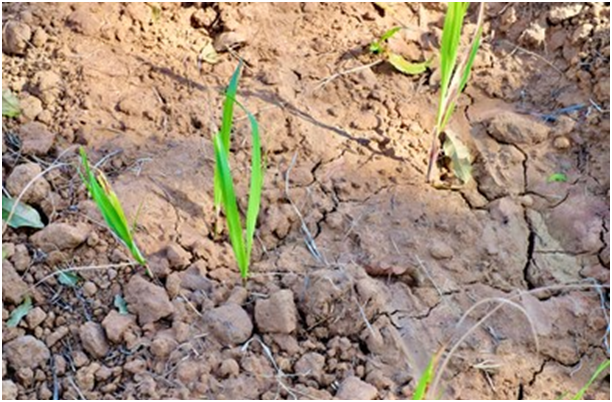
The germination phase is from planting to the completion of the germination of buds. In Sugarcane, seed germination denotes activation and subsequent sprouting of the vegetative bud. The germination of bud is influenced by external factors as well as internal factors. Some of the external factors are soil moisture, soil temperature and aeration. The internal factors are bud health, sett moisture, sett reducing sugar content and sett nutrient status. The optimum temperature for sprouting is around 28-300C. The base temperature for seed germination is about 120C. Warm, moist soil ensures rapid seed germination.
Germination results in increased respiration and good soil aeration are important. So, open structured porous soils facilitate better germination.
Some important practices that are to be followed during this phase for better germination of crop are given below-
Fertilizer Management:

Soil testing after every three year is necessary to know the actual need of fertilizer. Before sowing at time of last plowing, add well decomposed cow dung @ 8ton/acre.
- Use biofertilizers such as Acetobactor, Azotobactor, Azospirillium, Bacillus or Pseudomonas. Either of these biofertilizers or in combination should be used at the time of sowing @ 5 Kg / acre for sett treatment or in soil along with FYM.
- Basal application of NPK is done on soil test basis.
- In sugarcane, fertilizer should be applied as per the table mentioned below.
- Apply zinc sulphate @10 Kg/acre in soil at the time of planting.
- In soils deficient with micro nutrients like iron, zinc, manganese, copper, molybdenum and boron, 10 Kg ferrous sulphate, 8 Kg zinc sulphate, 4 Kg manganese sulphate, 4 Kg copper sulphate,1 Kg, sodium molybdate and 2 Kg borax per hectare should be applied.
- Micro nutrient fertilizers should be mixed with well decomposed dung manure or compost and applied as basal dose.
Irrigation Management:


- Apply first irrigation when 20-25% crops have germinated.
- If we are sowing crop in an un-irrigated field then apply irrigation just after sowing.
- Apply irrigation in sugarcane crop at interval of 7-8 days during this stage/phase.
Irrigation methods-
Flood irrigation-

- In this method, free flow of irrigation water is allowed in the fields in all the directions.
- It is practiced in the flat planted cane, but water loss is high.
Furrow irrigation-

- It is most commonly used and is particularly effective for early plant crop.
- In later crop growth periods and during ratoon crops, the water distribution may become increasingly problematic because of deterioration of the furrows.
- Reduced furrow length is sometimes used to allow better distribution of water over the field in a later stage.
Alternate skip furrow method:

- In skip-furrow method, sugarcane is planted in flat beds as usual and after germination, 45 cm wide and 15 cm deep furrows were made in alternate inter row spaces.
- There is considerable saving of water in this method of irrigation.
- In Autumn planting, there are 7 irrigations in plains (5 before rain and 2 after rain)
- In spring planting, there are 6 irrigations (4 before rain and 2 after rain) – one irrigation at tillering is must.
Sprinkler irrigation:

- For sprinkler irrigation, increasing use is made of spray guns, hand and automatically moved, replacing the cumbersome boom and labour-intensive hand-moved sprinkler laterals Prevailing winds of more than 4 or 5 m/sec will limit their usefulness.
Drip irrigation:

- Drip irrigation is defined as the precise, slow and frequent application of water through point or line source emitters on or below the soil surface at a small operating pressure (20-200 kPa) and at a low discharge rate (0.6 to 20 LPH), resulting in partial wetting of the soil surface.
Poor irrigation leads to-
- Decrease length of internodes.
- Decrease amount of juice and increase percent of fiber.
- Decrease rate of germination.
- Decrease of sugar yield.
Heavy irrigation leads to-
- Death of buds.
- Damage to roots.
- Sugar content decreases.
- Cane yield decreases.
- Plant cannot adsorb elements from soil and becomes yellowish.
Weed Management:
Cultural control:
- Adopt proper crop rotation and intercropping.
- Avoid mono cropping.
- Follow recommended agronomic practices.
- If intercropping has been adopted no chemical herbicide should be use in the field.
Chemical Control-


To control weeds, carry out pre-emergence weedicide application with Simazine or Atrazine@600-800 g/acre or Metribuzine@ 800 g/acre or Diuron@1- 1.2 kg/acre. Apply pre-emergence herbicides immediately after planting. Apply 2,4-D@250-300 g/acre as post-emergence herbicide for broad-spectrum weed control in sugarcane.
Soil and seed borne diseases, insect pests-
Cultural control:
- Select tolerant / resistant varieties.
- Select the seed cane from aerated steam treated nurseries
- Crop like potato, mustard, lentil, pulses and winter vegetables can be grown as inter crop during autumn planted sugarcane i.e. Oct-Nov &, sunflower, soybean, green gram, groundnut etc, during Feb-March planted sugarcane to reduce the pests population and to conserve bio-agents of white woolly aphid and other pests
- Adopt paired row method of planting.
Nematodes-
Cultural control:
- Deep ploughing, solarisation, flooding, crop rotation and apply organic manure.
- Under wetland conditions, intercropping with sun hemp or marigold or daincha
- Apply pressmud at 6 t/acre or poultry manure @ 0.8 t/acre or neem cake 0.8 t/acre or poultry manure @ 0.4 t/acre before last ploughing.
Biological control:
Application of biocontrol agents like Pochonia chlamydosporia, Paecilomyces lilacinus or Trichoderma viride or Pseudomonas fl uorescens @ 4 Kg/acre at the time of planting mixed with moist FYM or cured pressmud and distributed uniformly helps in suppressing the plant parasitic nematodes.
Termites and white grubs-


Cultural control:
- Remove stubble and debris of previous crops
- Dig the termatoria and destroy the queen.
Physical control:
- Locate and destroy the termite colony and affected setts.
- Set up light trap for trapping of white grubs adults and kill them in kerosene oil water.
- At onset of monsoon collect and destroy the adult beetles by shaking the branches of trees on which they settle during night.
Biological control:
- Entomopathogenic nematodes (EPNs) can be sprayed at the rate of 100 million nematodes per acre, in root grub and termite infested sugarcane fields OR
- EPN infected cadavers of Galleria/Corcyra larvae containing live infective juveniles (IJs) are implanted in soil at plant bases at the rate of four cadavers per plant during May/ June and/or September for sugarcane root grub control.
Chemical control:
For termite-

Symptoms of termites include wilting of young or older plants and often lodging and presence of termites and tunnels around and in the roots. Roots and the base of the stem are also hollowed out. To prevent crop from termites be sure to follow these recommendations-
- Inspect plants regularly, early in the morning or late in the afternoon.
- Remove and destroy affected plants or plant parts.
- Avoid water stress and unnecessary injury to the plants.
- Remove plant residues and other debris after harvest.
- Chlorantraniliprole 18.5% SC @ 200-250 ml in 400 l of water/acre or clothianidin 50%WDG @100 g in 400 l of water/acre or imidacloprid 70% WS @28-42 g in 40-60 l of water/acre or imidacloprid 17.8% SL @ 140 ml in 750 l of water/acre or chlorpyrifos 20% EC @ 2.5 l/acre
For white grubs:

Fipronil 40% + imidacloprid 40% WG @175-200 g in 400-500 l of water/acre or phorate 10% CG @ 10,000 g/acre.
Earting-up operations-


Earthing-up is also known as “hilling-up”. There are multiple benefits to this practice which should be done two to three times.
- It improves overall root conditions and prevents lodging.
- It prevents further tillering and water shoots (late-formed tillers or side shoots) formation.
- It helps to control weeds.
Timing and methods of earthing-up:
The first earthing-up is a partial operation done 45 days after planting. The partial earthing is done by removing a small amount of soil from either side of the furrow and placing around the base of the shoots.
Early Shoot Borer:


Symptoms:
- Larva is dirty white with five dark violet longitudinal stripes and dark brown head. Pale grayish brown moth with black dots near the coastal margin of the forewings and with white hind wings.
- Dead heart in 1-3 month old crop, which can be easily pulled out, rotten portion of the straw coloured dead – heart emits an offensive odor. A number of bore holes at the base of the shoot just above the ground level.
Management:
Cultural Control:
- Deep summer plowing.
- Inter culture and hand weeding.
- Timely irrigation.
- Light earthing up of crops three months after planting. In ratoon crop mulching with trash reduces shoot borer attack.
- Grow resistant varieties like CO 312, CO 421, CO 661, CO 917 and CO 853.
- Inter crop: Onion or Garlic or Coriander for early shoot borer.
Mechanical Control:
- Collection and destruction of adult moths, egg masses and dead hearts.
- Remove the first leaf sheath to kill the larvae.
- Use of pheromone traps@4 in Nos/acre two weeks after planting.
- Trash mulching minimizes the pest incidence.
Biological Control:
- Release egg parasitoid Trichogramma chilonis @20,000/acre.
- Parasitized eggs of Corcyra cephalonica @ 20,000/acre at 10 days interval beginning 30 days after planting during April-June would be useful.
Chemical Control:
- Spray of Fipronil 5% SC @ 600-800 ml dissolved in 250-300 lit of water/acre OR Chlorantraniliprole 0.4% GR @ 7.5 kg/acre. OR Chlorpyrifos 20% EC @ 500-600ml /acre OR Quinalphos 25 % EC @ 800 ml dissolve in 250-300 lit. of water/acre .
Leave a Reply