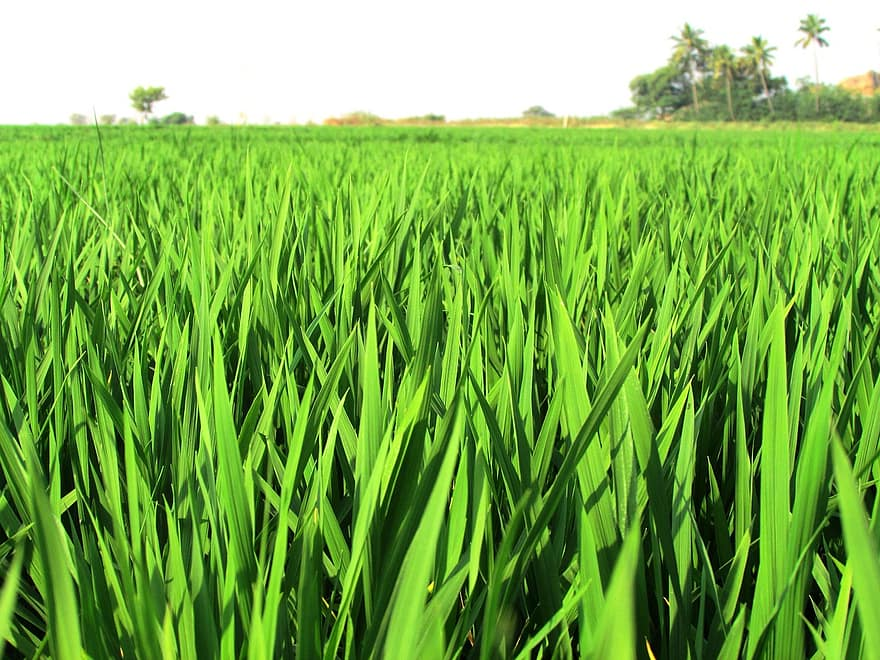
Panicle initiation stage starts, farmers need to be very careful during this week.
Weed control-
For grassy weeds, you can apply within 15-20 days:
- Cyhalofop-butyl 250-300 ml/acre.
- Fenoxaprop-P-ethyl 200-250 ml/acre.
For broadleaf weeds, you can apply within 25-30 days:
- 2,4-D sodium salt 500-600 gr/acre.
- 2,4 D ethyl ester (2,4 DEE) 1-1.25 lt/acre.
Blast-


Leaf Blast-
- Severe cases of infection – entire crop give a blasted or burnt appearance- hence the name “BLAST”
- Severe cases – lodging of crop (after ear emergence).
Neck Blast-

- Neck region of the panicle develops a black color and shrivels completely / partially grain set inhibited, the panicle breaks at the neck and hangs.
Nodal Blast-

Nodes become black and break up.
Management-
Cultural method-
- Remove collateral weed hosts from bunds and channels
- Use only disease free seedlings
- Avoid excess nitrogen
- Apply N in three split doses (50% basal, 25% in tillering phase and 25% N in panicle initiation stage)
- Use resistant variety CO 47.
Chemical Method-
- Spray after observing initial infection of the disease,
- Carbendazim 50WP @ 500g/ha (or)
- Tricyclozole 75 WP @ 500g/ha (or)
- Metominostrobin 20 SC @ 500ml/ha (or) 47
- Azoxystrobin 25 SC @ 500 ml/ha
Pre-tillering to Mid-tillering-
- Light at 2 to 5 % disease severities – Apply Carbendazim @ 0.1 %. Delay top dressing of N, fertilizers when infection is seen. Panicle initiation to booting.
- At 2 to 5% leaf area damage spray Carbendazim or Tricyclazole @ 0.1 %.
Flowering and after flowering-
At 5 % leaf area damage or 1 to 2 % neck infection spray Carbendazim or Tricyclazole @ 1 g /lit of water.
Leave a Reply