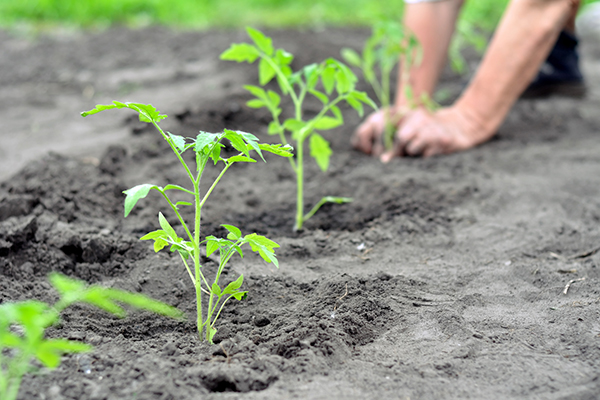
Sowing of seeds in nursery-
- Soak good quality seeds in warm water overnight to soften them and speed up germination.
- While the seeds are drying, use a wooden teeth bar to mark the seedbed soil at the place where you want to sow them (usually, 5 cm apart and 0.5 cm deep). Alternatively create a continuous narrow and shallow drill with a hoe.
- Dry the seeds thoroughly and put 2-3 seeds per hole in the seedbed soil. If using the continuous drill on the soil, sow the seeds evenly at about the recommended distance.
- Cove the seeds lightly with soil from the bed or finely sieved compost that you have prepared separately.
- Water reasonably, add organic mulch if at hand to keep soil moist and the temperature constant. Once the seeds have emerged, remove the mulch cautiously.
Irrigate the seedbeds for good seed germination-
The first irrigation takes place immediately after sowing the seeds in the seedbeds and must be substantial to secure a good seed-soil contact for germination. After that, you can irrigate more superficially during the next 3-5 days in the morning and the evening. Wet soil will help boost the germination and establish the crop well. If you irrigate well, the seeds will germinate 5-7 days after sowing.
Hardening of seedlings to increase their survival-
Hardening refers to the gradual exposure of the seedlings on seedbeds to a harsher environment. This increases their resilience and chances of survival after transplanting. Hardening can be done in different ways, using light, higher temperatures, or withholding irrigation.
- Gradually expose seedlings to higher light intensities and/or higher temperatures over a period of 7-10 days prior to transplantation.
- Reduce or withhold irrigation 4-5 days before transplanting.
Thinning seedlings for healthy plant stands-
Thinning is usually carried out within 2-3 days after the first true leaf has appeared, or about 5-7 days after sowing. Some recommendations for doing thinning:-
- Remove the mulch that you have laid onto the seedbed after sowing.
- Pull out weak and diseased seedlings from the soil.
- Make sure that the remaining seedlings are about 5 cm apart within the row.
- Transplant the seedlings that you have removed into containers with the soil. These can be used for gap-filling in the field later in the season.
- This is particularly significant when expensive seeds, such as hybrids, are used.
Monitor your field during this week for some disease and insect-pest incidence-
Damping Off:

Moist and poorly drained soil causes damping off disease. It is a soil borne disease. Water soaking and shriveling of the stem occurs. Seedlings killed before emergence. If it appears in a nursery the entire lot of seedling may get destroyed. It is a serious disease of brinjal.
Before sowing, do seed treatment with Thiram@3gm per Kg of seeds. Do soil solarisation of nursery soil. If damping off is observed in the nursery. Drained out water and drenched soil of the nursery with Copper Oxychloride@3gm/Ltr of water.
Root Knot Nematodes:

It is common in brinjal crop. These are more harmful at the initial stage of seedlings. They cause root galls. Due to infestation of root knot nematodes, plants get stunted, give yellow appearance and thus affect yield. Avoid mono-cropping and follow crop rotation. Incorporate Carbofuran or Phorate@5-8kg/acre in the soil.
Irrigate regularly for a good establishment of seedlings-
Wet soil will help boost the formation of roots and favor a good establishment of the seedlings. Here are some recommendations-
- Irrigate crop substantially to secure a good establishment of the seedlings.
- Irrigate in the mornings so that crops have direct access to water and can dry during the day.
- Plan to irrigate at 10-15 and 25 days after sowing to strengthen plants.
- If you choose to harden your seedlings by reducing water, stop irrigating at this stage. Hardening your seedlings helps them get accustomed to the harsher weather conditions found in the open field.
- Make sure to irrigate again the day before transplanting to soften the soil around the roots.
Right time of transplanting seedlings-
- In cool climates or at high altitudes, only transplant after the last spring frost is behind you to avoid losses.
- Day and night temperatures should be above 120C for a number of days.
- Seedlings must be of the right age and development. Seedlings that are too old may not grow well.
- Transplant in the evening hours or on a cloudy day to minimize shock.
- Transplant in small, flat beds or shallow furrow, depending upon the availability of the irrigation.
Weeding your crop for good growth-
Do frequent weeding, hoeing and earthing up and keep field weed free till 45 days. If weed is left uncontrolled then it will reduce crop yield upto 70-90%. Two to three days after transplantation, take spray of Fluchloralin (Basalin) @ 800 ml/200 Ltr water as pre-emergence weedicide. If weed intensity is high, take post emergence spray of Sencor @ 300g/acre. Mulching is also an effective way to reduce soil temperature along with weed control.
Transplanting tomato seedlings-
Spacing–
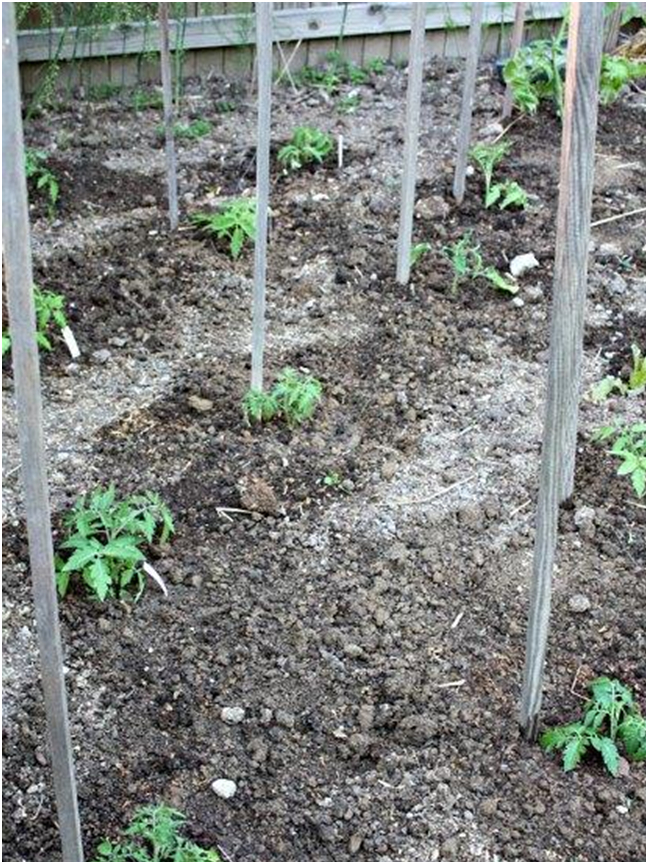
Depending upon the variety and its growth habits use spacing of 60 x 30cm or 75 x 60cm or 75 x 75cm. In Punjab, for dwarf variety use spacing of 75cm x 30cm and for rainy season use spacing of 120-150 x 30cm.
- Irrigate the furrows in larger quantities of water 3-4 days prior to transplanting.
- Pull out seedlings from the seedbed soil carefully and collect them in a container.
- Make sure that the young plants have enough soil around the roots to start developing roots.
- If necessary, remove a few of the lower branches on transplants to clear the canopy.
- Plant deep enough so that the remaining leaves are just above the surface of the soil.
- Press the soil firmly around the roots to eliminate air pockets.
Irrigating the field-
Irrigation after the transplanting is important to soften the seedlings in the soil and reduces the shock to the roots. Some recommendations are given below-
- Irrigate the seedlings before transplanting to soften the soil around the roots.
- Irrigate again immediately after transplanting to fasten the soil around the plant and limit the osmotic shock.
- Two more irrigation events should be planned 5 and 10 days after transplanting.
- During summer, do not forget to irrigate with a greater frequency (5-6) days, or depending on the moisture.
- Avoid over-watering as excess moisture may favor fungal diseases and cause stress.
Use extra seedlings to carry out gap filling in the field-
- Carry out gap filling within 10 days of the first transplanting.
- Do it during the evening hours or on cloudy days to minimize shock to the plants.
- Use the seedlings you kept after thinning your nursery. They will come in handy.
- Do not forget to irrigate the newly transplanted plants.
Post-emergence weeding-
Post-emergence herbicides are used against weeds that have already grown in the field. They are sprayed onto the plants and are less effective if washed off the leaf surface by rainfall or irrigation.
Some recommendations are there-
- There are two types of post-emergence herbicides: contact and systemic.
- Contact herbicides affect only sprayed plant parts, i.e. spraying onto the weed must be thorough.
- Systemic herbicides affect the whole plant and are particularly effective against grass weeds or plants that grew from underground plant parts.
- Post-emergence herbicides can also be classified as selective (against a specific crop) or non-selective (broad weed control).
- Metribuzin (0.11-0.2 kg/acre), can be applied when the crop has 4-6 leaves to control certain broadleaf weeds and grassy weed species.
Leave a Reply