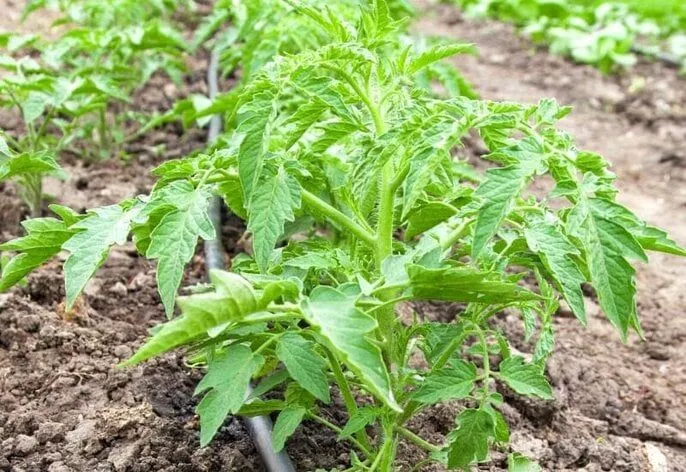
Apply first split application of mineral fertilizers-
- At this stage, plants are growing very rapidly, and they need more food in the form of nutrients to support this growth. The fertilizers added to the soil before planting have been used. If you are using flood irrigation, side dressing is recommended:
- Apply the fertilizers pellets on the furrows and work them into the soil. This is side dressing.
- At this stage, a quarter of the total need of nitrogen is added, amounting to 20 kg of urea per acre.
- If no rain is expected, do not forget to irrigate the crops so that the nutrients can reach the plant roots.
- If using drip irrigation, the fertilizers can be mixed with the irrigation water at the recommended doses.
Irrigation schedule for vigorous growth of the crop-
- Timely irrigation is essential for good vegetative growth, flowering, fruit set and fruit development.
- Water requirement will off-course depends on rainfall, but also on the type of soil and the season. Thus, higher yield may be obtained at optimum moisture level and soil fertility conditions.
- Water stress, especially during fruit growth and ripening, can cause reduced yield. Symptoms of water stress include shedding of the flowers, sun scalding and dry rot of fruit. The most critical stages for watering are at transplanting, flowering and fruiting stages. Irrigation at flowering and fruiting stage will help to improve fruit soluble solids and fruit color.
Recommendations for healthy and productive plants:
- During hot and dry weather, irrigation should be applied every 4-5 days.
- During cool, humid weather, irrigation may be planned every 7-12 days.
- Do not forget that sandy soils require more frequent irrigation than clay soils.
- Never irrigate extra after a long spell of drought; this may cause fruit deformation.
- Do not overwater, as vegetable crops are usually very sensitive to flooding.
Use plant support for health and fruit- bearing capacity-
Stakes lift the plants off the ground and allow for air circulation in the canopy. Before doing anything, make sure that your plants are of the non-spreading type, that they are growing upright. The staking can be done any time after transplanting and, at latest one month after that.
Some recommendations on how and when to use stakes in your field:
- You can use wooden, plastic or bamboo stakes, which you can reuse in the following seasons.
- Stakes need to be about 200 cm and stuck about 30 cm into the ground before the plant develops its roots.
- As the plant grows, tie the stem to the stake with a gardening string or brackets without damaging the plant.
- This will avoid the cracking of the branches and contact with the soil, thus preventing diseases.
- Hill up soil around the base of the stems gradually to give the stems added support when bearing the fruit.
Remove unwanted plant growth for good fruits-
Training of tomato plants consists of the removal of unwanted plant growth in order to decrease the canopy’s density, increasing the amount of light exposure to the plant, and thus improving the likelihood of fruit-bearing. Leaves at the foot of plants up to 30-60 cm should also be cleared to avoid diseases. Early and total yield and quality are increased by doing so. Pruning of diseased and damaged branches and leaves from the plant also improves the general health of the plant.
Monitor your field for the diseases and insect/pest incidence-
Leaf Miner:


Maggots of leaf miner feed on leaf and make serpentine mines into leaf. It affects the photosynthesis and fruit formation.
Identification of pest:
- Larva: Minute orange yellowish apodous maggots
- Pupa: Yellowish brown pupates within mines
- Adult: Pale yellow in colour
Management:
- Collect and destroy mined leaves
- Spray (NSKE) Neem Seed Kernel Extract@5%, 50gm/Ltr of water.
- Spray Neem Seed Kernel Extract 5 %.
- Cyantraniliprole 10.26 OD 1.8ml/lit.
White flies:

The nymphs and adults of white fly suck the cell sap from the leaves and weaken the plants. They secrete honey dew on which black sooty mould develops on leaves. They also transmit leaf curl diseases.
After sowing of seeds in nursery, cover bed with 400mesh nylon net or thin white cloth. It helps to protect seedlings from pest-disease attack. To check infestation use yellow sticky traps coated with grease and sticky oils. To control spread of whiteflies, uproot and destroy affected plants. In case of severe infestation, take spray of Acetamiprid 20SP@80gm/200Ltr of water or Triazophos@250ml/200litre or Profenophos@200ml/200litre of water. Repeat the spray after 15 days.
Thrips:
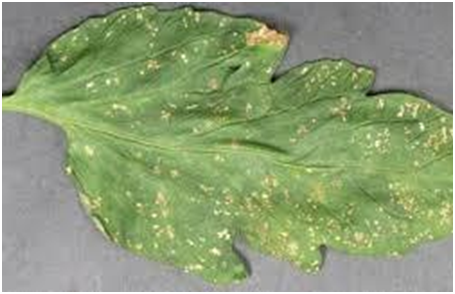
Thrips are commonly observed in tomato field. They are mostly observed in dry weather. They suck sap from the foliage and results in curling of leaves, leaves become cup shaped or curved upward. Also causes flower drop. To check severity of thrips incidence, keep blue sticky traps @6-8 per acre. Also to reduce the incidence of this disease, spray Verticillium lecani@5gm/Ltr water. If incidence of thrips is more, then take spray of Imidacloprid 17.8SL @60ml or Fipronil@200ml/200Ltr of water or Acephate 75% WP@600 gm/200Ltr or Spinosad@80ml/acre in 200Ltr water.
Early Blight:

It is an common and major disease of tomato. Initially small, brown isolated spots are observed on leaf. Later spots are seen on stem and also on fruits. Fully developed spots become irregular, dark brown color with concentric ring inside spots. In severe condition, defoliation occurred. If infestation of early blight is observed, take spray of Mancozeb@400gm or Tabuconazol@200ml/200Ltr. Repeat spray 10-15 days after first spray. In cloudy weather, chances of incidence of early and late blight increases. As a preventive measure, spray with Chlorothalonil @ 250 gm / 100 Ltr of water. Also sudden rain pattern aggravate blight and other diseases take spray of Copper based fungicides@300gm/Ltr+Streptocycline@6gm/200Ltr water to control blight disease.
Wilt and Damping off:

Moist and poorly drain soil causes damping off disease. It is soil borne disease. Water soaking and shriveling of stem occurs. Seedlings killed before emergence. If it appears in nursery the entire lot of seedling may get destroyed.
To prevent root rot, drench soil with 1% Urea@100gm/10Ltr and Copper oxychloride @250gm/200Ltr water. To control wilt, drench nearby soil with Copper oxychloride@250gm or Carbendazim@400gm/200Ltr of water. Increased temperature and humidity due to watering facilitate fungal growth at roots, to overcome it, apply Trichoderma 2 kg/acre along with cow dung near roots of plants. To control soil born disease, drench soil with Carbendazim@1gm/Ltr or Bordo mix@10gm/ltr, 1 month after that apply 2 kg Trichoderma /acre, mixed with 100kg cow dung.
Leave a Reply