LAND PREPARATION

Before transplanting the soil should be well prepared by deep ploughing 4-5 times and levelled. When the field is well prepared and levelled, the beds of suitable size are made in the field before transplanting.
Advantages –
- It loosens the soil.
- It aerates the soil.
- It prevents soil erosion.
- It allows easy penetration of roots into the soil.
Disadvantages –
The downside of tilling is that it destroys the natural soil structure, which makes soil more prone to compaction. By exposing a greater surface area to air and sunlight, tilling reduces soil’s moisture-retaining ability and causes a hard crust to form on the soil surface.
At last plowing apply well decomposed cow dung@10ton/acre in soil.
Spacing

The spacing generally depends on the variety (size and spread and bearing period) soil fertility. Use row to row spacing of 60 cm and plant to plant spacing of 35-40 cm.
Sowing Depth

In the nursery sow seeds at a depth of 1 cm and then covered with soil.
Method of Sowing-

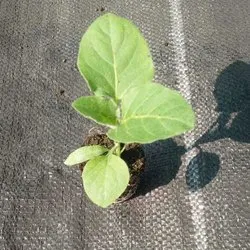
Transplanting seedlings in the main field. Transplanting should be done in the evening because in the morning direct sunlight affects the growth of newly transplanted plants.
Mulch the furrow with plastic to keep fields free from weeds-

Mulch can be added to furrows during field preparation before transplanting, often together with drip irrigation. Seedlings are transplanted in slits or holes in the thin plastic sheeting at a regular distance. Mulch is usually used to retain soil moisture and prevent weed growth. Plastic mulch is more efficient than organic mulch at keeping fields free of weeds. Sometimes, a combination of organic and plastic mulch can be used during the hot season.
Transplanting the eggplant in the main field-


- Eggplant seedlings will be ready for transplanting in about 30-40 days, or when they are about 15 cm with 3-4 leaves and a well developed root system.
- Irrigate the nursery lightly the day prior to transplanting.
- Pull out seedlings from seedbed soil carefully and collect them in a container.
- Make sure that the young plants have enough soil around the roots.
- Press the soil firmly around the roots to eliminate air pockets.
Use extra seedlings to carry out gap filling in the field-
- Carry out gap filling within 10 days of the first transplanting.
- Do it during the evening hours or on cloudy days to minimize shock to the plants.
- Use the seedlings you kept after thinning your nursery. They will come in handy.
- Do not forget to irrigate the newly transplanted plants.
Remove unwanted growth to give vigor to plants-
Keeping three branches per plant will enhance their vitality and the future fruit set. Usually, it is recommended to maintain two branches from the primary division of the main stalk and one branch below this division. Remember that you can also remove leaves at the foot of plants up to 30-60 cm to avoid diseases. Pruning of diseased and damaged branches also improves the general health of the plant.
Fertilize the field for a good growth and development of brinjal crop-
Manuring
Apply 2 kg each of Azospirillum and Phosphobacteria in the main field at planting.
Varieties-
Basal dose: FYM 25 t/ha, NPK 50:50:30 kg/ ha. Top dressing: 50 kg N/ha on 30th day of planting or during earthing up.
Hybrids-
Basal dose: FYM 25 t/ha, NPK 100:150:100 kg/ha. Top dressing: 100 kg N/ha on 30th day of planting or during earthing up.
Monitor your field-
These diseases may appear during this time-
Root Knot Nematodes:

It is common in brinjal crops. These are more harmful at the initial stage of seedlings. They cause root galls. Due to infestation of root knot nematodes, plants get stunted, give yellow appearance and thus affect yield. Avoid monocropping and follow crop rotation. Incorporate Carbofuran or Phorate@5-8kg/acre in the soil.
Mite:

If infestation of Mite is observed in field, to control take spray of Abamectin@1-2ml/Ltr or Fenazaquin@2ml/Ltr of water.
Thrips


Description of Insect
- Eggs are minute, kidney shaped laid in slits in leaf tissues. Incubation period is 5 days.
- Nymphs are creamy to pale yellow in color, resemble adults but wingless.
- Nymphal Period: 5 days.
- Pupal period: 4-6 days.
- Adults are straw colored, yellowish brown and elongated
Nature of Damage and Symptoms
- Shrivelling of leaves due to scrapping of epidermis and desapping.
- Attacked terminal buds –have ragged edges.
- Silvery shine on the under surface of leaves.
Life History
Thrips thrive on the weeds during the off-season and migrate to cotton as soon as the seedlings emerge above ground. Males are rare and the reproduction is parthenogenetic. Eggs hatch in 5 days time, nymphal and pupal period lasts for 5 and 4-6 days, respectively. The preimaginal stage is spent in soil without feeding. The adults survive for 2-4 weeks. Life cycle of T. tabaci from egg to adult lasts for 13-19 days and they have about 15 overlapping generations per year including their development on wild plants. Thrips inhabit on leaves of cotton up to mid season and colonise on bolls during the late season.
Management-
- ETL: 50 nymphs or adults/50 leaves
- Seed treatment with imidacloprid 70 WS 7g/kg protect the crop from aphids, leafhoppers and thripsupto 8 weeks
- Spray any one of the following insecticides (500 l spray fluid/ha)
- Imidacloprid 200 SL @100 ml
- Methyl demeton 25 EC 500ml/ha
- Dimethoate 30 EC 500ml/ha
- NSKE 5% @ 2 kg/ha
Leaf eating caterpillar:

Some time Incidence of caterpillars is seen mostly at the initial stage of crop.
To control spray with neem based pesticides. If those are not that effective and infestation becomes high then only take spray of chemicals pesticides like Emamectin benzoate@4gm or Lambda Cyhalothrin@2ml/1Ltr of water.
Leave a Reply