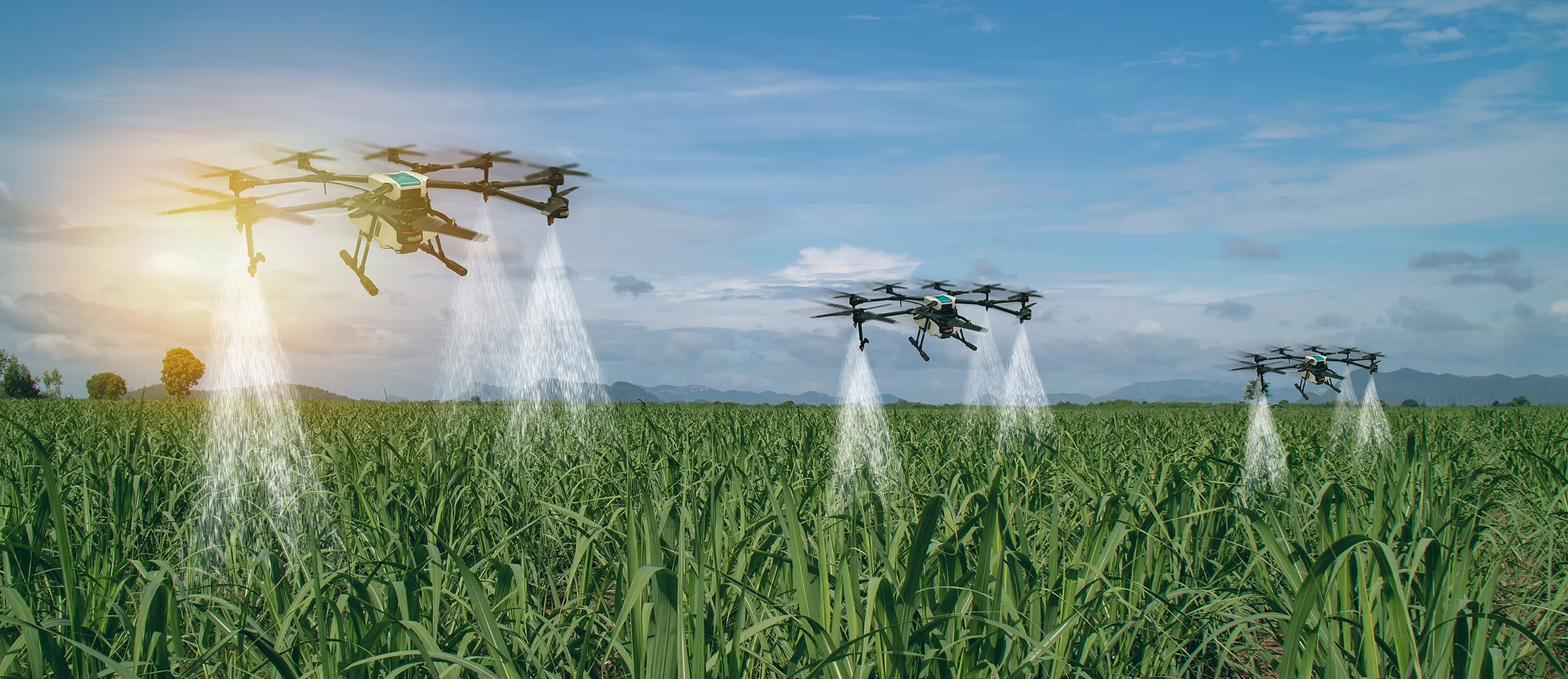
Listing drone technology as one of the “sunrise opportunities” in the previous year’s Budget, the government had said that ‘kisan drones’ (‘kisan’ is farmer in Hindi) would be promoted for “crop assessment, digitisation of land records, and spraying of insecticides and nutrients”.
It launched ‘Drone Shakti’, an initiative to promote and facilitate ‘drone-as-a-service’ (DaaS) that would enable the fragmented drone industry to come together and enable collaboration between manufacturers and service providers.
Agnishwar Jayaprakash, Founder and CEO of Garuda Aerospace, believes that the government should introduce a service-linked incentive, especially for the drone industry.
In September 2021, the government introduced a product-linked incentive scheme for drones and drone components. Garuda Aerospace, founded in 2015, manufactures and sells drones apart from providing DaaS.
“The industry is huge, and its main aim is to receive a major nitro boost propulsion for Service Linked Incentives schemes as for every one indigenous drone manufacturer in the country, there are more than 450 drone service providers,” Agnishwar says.
He suggests that the Budget include more subsidies for drone pilots, for training and skilling programmes, with government partnerships. He adds that this should be used for drone applications in fields like defence, mining, logistics, and transportation.
“There should be more subsidies so that farmers’ problems are solved, enabling better income generation for them,” he adds.
Deepak Bhardwaj and Anoop Upadhay, both Directors and Co-founders of IoTechWorld Avigation Pvt. Ltd, a manufacturer of agricultural drones, speak about issues they feel do not match with what’s on paper.
These include the harmonised system of nomenclature code (HSN), which is used to classify goods under the Goods and Services Tax (GST). He says the HSN for a complete drone is 8806 and for drone parts is 8807. For the latter, the customs duty was declared to be 3% with 5% GST.
“Recently, we got a shipment of motors, and the customs (people) said that they do not consider it to be a drone part. They considered it under a different category where the basic customs duty was 10% and GST 18%. So that way, we had to almost pay thrice the duty as compared to what we were allotted,” says Deepak, adding that the government policies are failing to be implemented on the ground.
Anoop of IoTechWorld gives another example where ground realities don’t match government announcements.
“The government says that up to 90% of the money in the AIF scheme can be given as loans to customers through banks, but in reality, it’s 75%. The moratorium period is two years but banks are giving only three months. Some banks may be considering one year but as of now, the ground reality is only three months,” Anoop says.
“We request the government to pass on the message to all banks to allow maximum limits. This is a new technology, and people can get some breathing time when they’re establishing a new business,” he adds.
Deepak and Anoop also suggest that GST on the purchase of drones be waived off for at least the next five years to enable farmers to buy and adopt the technology and that subsidies be given on drone operations per acre.
The duo great that subsidies for the drone industry be front-ended (similar to the electric vehicle industry). Farmers should be able to purchase the subsidised drone and the amount should go directly to the accounts of manufacturers or distributors.
SOURCE: YourStory.com

Leave a Reply