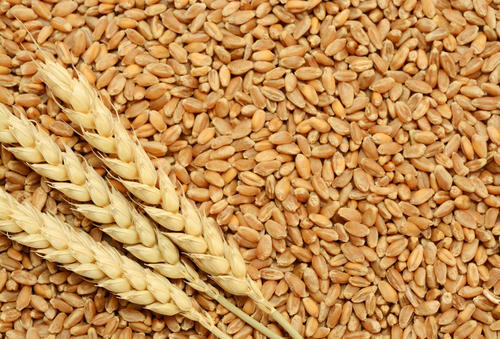
Wheat is a grass widely cultivated for its seed, a cereal grain that is a worldwide staple food. The many species of wheat together make up the genus Triticum; the most widely grown is common wheat (T. aestivum). Wheat is an important source of carbohydrates, having a protein content of about 13%, which is relatively high compared to other major cereals. When eaten as the whole grain, wheat is a source of multiple nutrients and dietary fiber.
| Kingdom | Plantae |
| Family | Poaceae |
| Subfamily | Pooideae |
| Tribe | Triticeae |
| Genus | Triticum |
Wheat plant anatomy-

Major cultivated species of wheat-
- Common Wheat or Bread wheat – (T. aestivum) A hexaploid species that is the most widely cultivated in the world.
- Durum – (T. durum) The only tetraploid form of wheat widely used today, and the second most widely cultivated wheat today.
- Einkorn – (T. monococcum) A diploid species with wild and cultivated variants. One of the earliest cultivated, but rarely planted today.
- Emmer – (T. dicoccon) A tetraploid species, cultivated in ancient times but no longer in widespread use.
Plant height- Wheat is typically 0.7 to 1.2 m tall.
Roots-

Wheat produces both seminal and nodal (or crown or adventitious) roots. The seminal roots form from the seed. The nodal roots form from the lower nodes, are associated with tillers and become increasingly important as the plant grows.
Stem and tillers-

Wheat has a single main stem plus typically 2-3 tillers per plant. The number of tillers tends to increase with better growing conditions and with a lower crop density. Tillering starts at the 3-4 leaf stage approximately when the first nodal roots can be seen.
Leaves-

Wheat leaves form at each node and includes a leaf sheath that wraps around the stem and a leaf blade. Wheat has small auricles. These wrap around the stem at the point where the leaf sheath meets the leaf blade.
Spike-

The spike (also called the ear or head) forms at the top of the plant. A spike usually has 35-50 grains (or kernels).
Grains-

Wheat grain typically weighs 30-60 mg (i.e., 30-60 g/1000 grains) depending on variety and growing conditions. Reduced grain size often indicates moisture stress during grain filling.
Suitable Climate-
It grows well in cool, moist climate and ripens in a warm, dry climate. The cool winters and the hot summers are conducive to a good crop.
Annual Normal Rainfall : 50 to 100 cm

The critical mean temperature range:
- Period of sowing :10°C and 15°C
- Germination :20 to 25°C mean daily
- Accelerated growth :20 to 23°C mean daily
- Proper grain filling :23 to 25°C mean daily
- Ripening period :21°C and 26°C
Suitable Soil pH range: 5.5 to 7.0
The pH can control the availability of nutrients, biological functions, microbial activity, and the behavior of chemicals. Because of this, monitoring or controlling the pH of soil, water, and food or beverage products is important for a wide variety of applications.
In the pH scale, pH 7.0 is neutral. Below 7.0 is acidic and above 7.0 is basic or alkaline. Soil pH affects nutrients available for plant growth. In highly acidic soil, aluminum and manganese can become more available and more toxic to plant while calcium, phosphorus, and magnesium are less available to the plant.

Application of liming or acidifying materials will ensure that soil pH is near the agronomic target pH. Yet, it is also important to consider the critical pH before making soil pH management decisions. The critical pH is defined as “the maximum soil pH value at which liming increases crop yield” (Adams, 1984). The critical pH reflects the practical and economic considerations of changing soil pH to the value most suited for plant growth.
Soil biological health kit-
Soil healths largely rely on soil biodiversity and soil biological processes. A kit was developed under All India Network Project on Soil Biodiversity— Biofertilizers to evaluate soil biological health based on substrate induced respiration. The kit contains assemblies to incubate soil with a defined substrate along with an indicator “Gel probe” which changes its colour based on the amount of CO2 evolved from soil. The colourchange of the gel exhibits positive correlation with actual measure of CO2 and soil biological quality index. The gel probe’s colour change discriminates the soils based on their health status. The kit is a simple, quick and cost-effective method without any instrumentation. The kit will allow the farmer to monitor soil health without much scientific skill and equipment.
Soil for wheat cultivation-
Soils with a clay loam or loam texture, good structure with moderate water holding capacity are ideal for wheat cultivation.
Heavy soil with good drainage is suitable for wheat cultivation under dry conditions.
Soil treatment
Phosphetica culture 2.5 kg + azatobacter 2.5 kg + trycoderma powder 2.5 kg mix with 100-120 kg F.Y.M. and broadcast at the time of last ploughing.

Benefits of soil treatment- Some benefits of soil treatment are given below-
Water benefits-
- Healthy soil acts as a sponge: more rainwater is absorbed and stored in the ground, where it recharges groundwater and aquifers.
- Healthy soil prevents run-off and erosion, and reduces evaporation.
- Healthy soil improves water quality by filtering pollutants.
Nutritious food-
- Healthy soil increases the nutritional value of food and forage.
- Healthy soil provides plants with the nutrition they need and strengthens plants natural resistance to pests and diseases.
Economic security-
- Healthy soil improves farm productivity and provides stability.
- Healthy soil cuts down on inputs, which increases profit.
- Healthy soil helps withstand extreme weather, floods and drought.
Environmental and health benefits-
- Healthy soil helps reverse global warming by absorbing carbon from the atmosphere where it acts as a greenhouse gas.
- Healthy soil provides habitat for soil microbes to flourish.
- Healthy soil supports greater biodiversity and species stability.
Suitable Soils with texture ranges- Clay, Loam and sandy
Clay soil-

Clay Soil is a heavy soil type that benefits from high nutrients. Clay soils remain wet and cold in winter and dry out in summer.
These soils are made of over 25 percent clay, and because of the spaces found between clay particles, clay soils hold a high amount of water.
Because these soils drain slowly and take longer to warm up in summer, combined with drying out and cracking in summer, they can often test gardeners.
Loam soil-

Loam soil is a mixture of sand, silt and clay that are combined to avoid the negative effects of each type.
These soils are fertile, easy to work with and provide good drainage. Depending on their predominant composition they can be either sandy or clay loam.
As the soils are a perfect balance of soil particles, they are considered to be a gardeners best friend, but still benefit from topping up with additional organic matter.
Sandy soil-

Sandy Soil is light, warm, dry and tends to be acidic and low in nutrients. Sandy soils are often known as light soils due to their high proportion of sand and little clay (clay weighs more than sand).
These soils have quick water drainage and are easy to work with. They are quicker to warm up in spring than clay soils but tend to dry out in summer and suffer from low nutrients that are washed away by rain.
The addition of organic matter can help give plants an additional boost of nutrients by improving the nutrient and water holding capacity of the soil.
Soil and land preparation-
After harvest of previous crop, the field should be ploughed with disc or mould board plough. Level the field using laser leveller for uniform water distribution in entire field. Field is usually prepared by giving two deep ploughing with mould board plough followed by two or three times deep ploughing and planking. Carry out ploughing in evening time and kept furrow open whole night to absorb some moisture from dew. Planking should be done after each ploughing early in the morning.

Mould–board Plough

The parts of mouldboard plough are frog or body, mouldboard or wing, share, landside, connecting, rod, bracket and handle. This type of plough leaves no unploughed land as the furrow slices are cut clean and inverted to one side resulting in better pulverisation. The animal drawn mouldboard plough is small, ploughs to a depth of 15 cm, while two mouldboard ploughs which are bigger in size are attached to the tractor and ploughed to a depth of 25 to 30 cm. Mouldboard ploughs are used where soil inversion is necessary. Victory plough is an animal drawn mouldboard plough with a short shaft.
Disc Plough

The disc plough bears little resemblance to the common mouldboardplough. A large, revolving, concave steel disc replaces the share and the mouldboard. The disc turns the furrow slice to one side with a scooping action. The usual size of the disc is 60 cm in diameter and this turns a 35 to 30 cm furrow slice. The disc plough is more suitable for land in which there is much fibrous growth of weeds as the disc cuts and incorporates the weeds. The disc plough works well in soils free from stones. No harrowing is necessary to break the clods of the upturned soil as in a mouldboard plough.
Tractor Drawn Cultivator:

Cultivator is an implement used for finer operations like breaking clods and working the soil to a fine tilth in the preparation of seedbed. Cultivator is also known as tiller or tooth harrow. It is used to further loosen the previously ploughed land before sowing. It is also used to destroy weeds that germinate after ploughing. Cultivator has two rows of tynes attached to its frame in staggered form. The main object of providing two rows and staggering the position of tynes is to provide clearance between tynes so that clods and plant residues can freely pass through without blocking. Provision is also made in the frame by drilling holes so that tynes can be set close or apart as desirect. The number of tynes ranges from 7 to 13. The shares of the tynes can be replaced when they are worn out.
Laser land leveller-

Laser Land Leveler is a more advanced technique for smoothing the land surface from its average height with a certain degree of the desired slope using a guided laser beam throughout the field. Laser Land Levelling is an important technology for good agronomic, highest possible yield, crop-management, and water-saving.
Advantages of soil preparation-
- It loosens the soil.
- It aerates the soil.
- It prevents soil erosion.
- It allows easy penetration of roots into the soil.
Disadvantages of soil preparation-
The downside of tilling is that it destroys the natural soil structure, which makes soil more prone to compaction. By exposing a greater surface area to air and sunlight, tilling reduces soil’s moisture-retaining ability and causes a hard crust to form on the soil surface.
Improve varieties with Different Conditions-
Northern Hills Zone (NHZ)
- VL-832,VL-804, HS-365, HS-240 – Irrigated/Rainfed, Medium Fertility, Timely Sown
- VL-829,HS-277 — Rainfed, Medium Fertility, Early Sown
- HS-375 (Himgiri), HS-207, HS-295, HS-420 (Shivalik) – Irrigated/Rainfed, Medium Fertility, Late Sown
- HS375 (Himgiri), HPW42 — Very High Altitude
North Western Plains Zone (NWPZ)
- HD2687,WH-147, WH-542, PBW-343, WH-896(d), PDW-233(d), UP-2338, PBW-502, Shresth (HD 2687), Aditya (HD 2781) — Irrigated, High Fertility, Timely Sown
- PBW-435, UP-2425, PBW-373, Raj-3765 — Irrigated, Medium Fertility, Late Sown
North Eastern Plain Zone (NEPZ)
- PBW-443, PBW-502, HD-2733, K-9107, HD-2824 (Poorva), HUW-468, NW-1012, HUW-468, HP-1731, Poorva (HD 2824) — Irrigated, High fertility, timely Sown
- Raj-3765, HD-2643, NW-1014, NW-2036, HUW-234, HW-2045, HP-1744, DBW-14 — Irrigated, Medium Fertility, Late Sown
- HDR77, K8027, K8962 — Rainfed, Low Fertility, Late Sown
- HD-2888 — Rainfed, Timely Sown
Central Zone (CZ)
- DL-803-3, GW-273, GW-190, Lok-1, Raj-1555, HI-8498(d), HI-8381(d) — Irrigated, High Fertility, Timely Sown
- DL-788-2, GW-173, NI-5439, MP-4010, GW-322, Urja (HD 2864) — Irrigated, Medium Fertility, Late Sown
- C-306, Sujata, HW-2004, HI-1500, HD-4672(d), JWS-17 — Rainfed, Low Fertility, Timely Sown
Peninsular Zone (PZ)
- DWR-195, HD-2189,DWR-1006(d), MACS-2846(d), DWR-2001(di), Raj-4037, DDK-1009(di) — Irrigated, High Fertility, Timely Sown
- HUW-510, NIAW-34, HD-2501, HI-1977, Pusa Tripti (HD-2833) — Irrigated, Medium Fertility, Late Sown
- A9-30-1, K-9644,NIAW-15(d), HD-2380 — Rainfed, Low Fertility, Timely Sown
Southern Hills Zone (SHZ)
- HW-2044, HW-1085, NP-200(di), HW-741– Rainfed, Low Fertility, Timely Sown
- HUW-318, HW-741, HW-517, NP-200(di), HW-1085 — Irrigated, High Fertility, Timely Sown
National Capital Region Delhi (NCR)
- HD-2851(Pusa Visesh), HD-4713(i)(d) — Irrigated, Timely Sown
- Pusa Gold (WR-544) — Irrigated, Late Sown
Latest Release of wheat varieties
HD 3293- Eastern Uttar Pradesh, Bihar, Jharkhand, West Bengal, Odisha, Assam, Plains of North Eastern states-
Suitable for restricted irrigation, timely sown condition, average grain yield 3.93 tonnes/ha, maturity 129 days, highly resistant to wheat blast, tolerant to heat stress.
DDW 48 (Durum) – Maharashtra and Karnataka-
Suitable for irrigated timely sown condition, average grain yield 4.74 tonnes/ha, maturity 111 days, biofortified variety with high grain protein (12.1%) and yellow pigment content (5.6 ppm), resistant to brown rust, high pasta acceptability.
Wheat 1270- Punjab, Haryana, Delhi, Rajasthan (except Kota and Udaipur divisions), Western Uttar Pradesh, (except Jhansi division), Parts of Jammu & Kashmir (Jammu and Kathua Distt), Parts of Himachal Pradesh (Una Distt. and Paonta Valley), Uttarakhand Tarai region) –
Suitable for irrigated early sown, high fertility condition, average grain yield 7.58 tonnes/ha, maturity 156 days, resistant to yellow and brown rusts, good chapatti quality (7.66/10).
DBW 303 (Karan Vaishnavi)- Punjab, Haryana, Delhi, Rajasthan (except Kota and Udaipur divisions), Western Uttar Pradesh (Except Jhansi division), Parts of Jammu and Kashmir (Jammu & Kathua Distt.), Parts of Himachal Pradesh (Una Distt. and Paonta Valley), Uttarakhand Tarai region)-
Suitable for irrigated, early sown, high fertility condition, average grain yield 8.12 tonnes/ha, maturity 156 days, high grain protein content (12.1%), resistant to yellow and brown rust, good chapatti quality.
HD 3298- Punjab, Haryana, Delhi, Rajasthan (except Kota and Udaipur divisions), Western Uttar Pradesh (except Jhansi division), Parts of Jammu and Kashmir (Jammu & Kathua Distt.), Parts of Himachal Pradesh (Una Distt. and Paonta Valley), Uttarakhand (Tarai region) –
Suitable for irrigated very late sown condition, average grain yield 3.90 tonnes/ha, maturity 103 days, high grain protein (12.12%), iron (43.1 ppm), good chapatti quality and bread quality.
HI 1633 (Pusa Vani) – Maharashtra, Karnataka, Plains of Tamil Nadu-
Suitable for irrigated late sown condition, average grain yield 4.17 tonnes/ha, maturity 100 days, biofortified wheat variety with high grain protein (12.4%), iron (41.66 ppm) and zinc (41.1 ppm), highly resistant to black rust.
HI 1634 (Pusa Ahilya) – Madhya Pradesh, Chhattisgarh, Gujarat, Rajasthan (Kota and Udaipur divisions), Western Uttar Pradesh (Jhansi division)-
Suitable for irrigated late sown condition, average grain yield 5.16 tonnes/ha, maturity 108 days, highly resistant to brown and black rusts, good chapatti quality.
CG 1029 (Kanishika) – Madhya Pradesh, Gujarat, Chhattisgarh, Rajasthan (Kota and Udaipur divisions), Uttar Pradesh (Jhansi division)-
Suitable for irrigated late sown condition, average grain yield 5.21 tonnes/ha, maturity 110 days, resistant to black and brown rusts, tolerant to heat stress, good chapatti quality.
NIDW 1149 (D) – Maharashtra, Karnataka-
Suitable for restricted irrigation, timely sown, average grain yield 2.97 tonnes/ha, maturity 105 days, resistant to brown and yellow rusts.
GW 499- Gujarat-
Suitable for irrigated late sown condition, average grain yield 4.60 tonnes/ha, maturity 95 days, resistant to brown and black rusts.
GW1339 (BANAS) (VD 2014-24) – Gujarat-
Suitable for irrigated timely sown condition, average grain yield 4.96 tonnes/ha, maturity 102 days, resistant to brown and black rusts, good amount of yellow pigment (5.5 ppm).
VL 2015 (VL Gehun 2015) – Uttarakhand hills-
Suitable for rainfed timely sown organic cultivation, average grain yield 1.99 tonnes/ha, maturity 168 days, resistant to yellow and brown rust, good sedimentation value.
MP 3465 (JW 3465) – Madhya Pradesh-
Suitable for irrigated timely sown condition, average grain yield 5.94 tonnes/ha, maturity 117 days, high protein content (>14%), resistant to brown and black rusts.
Chhattisgarh Hanse Wheat (CG 1023) – Chhattisgarh-
Suitable for restricted irrigation, timely sown condition, average grain yield 3.21 tonnes/ha, maturity 126 days, high zinc content (40.4 ppm), resistant to brown rust, good chapatti quality.
DBWH 221 (DBW 221) – Haryana-
Suitable for timely sown irrigated conditions, average grain yield 6.28 tonnes/ha, maturity 135–149 days, highly tolerant to heat stress and resistant to yellow rust.
AAI-W 15 (SHUATS-W 15) – Uttar Pradesh-
Suitable for timely sown rainfed conditions, average grain yield 1.99 tonnes/ha, maturity 105–110 days, tolerant to terminal heat tolerant at grain filling stage and resistant to brown and black rust.
UP 2944- Uttarakhand plains-
Suitable for late-sown irrigated conditions, average grain yield 5.07 tonnes/ha, maturity 119–127 days, high protein content (14.5%), resistant to brown rust.
UP 2938- Uttarakhand plains-
Suitable for timely sown irrigated conditions, average grain yield 5.38 tonnes/ha, maturity 136–139 days, resistant to brown rust
UP 2903- Uttarakhand plains-
Suitable for timely sown irrigated conditions, average grain yield 5.06 tonnes/ha, maturity 129–139 days, high protein content (12.68%) and resistant to brown rust.
Seed Treatment-
- Take 10 litres of hot water (600 C) in an earthen pot.
- Dip 5 kg of improved graded seeds in it.
- Removed the seeds which float on the top of water.
- Mix 2 kg of well decomposed compost, 3 litres cow urine and 2 kg of jaggery.
- After mixing it properly, keep the mixed materials as such for 6-8 hours.
- After this, filter it so that solid materials along with seeds and liquids get separated.
- Mix 10 gm of fungicide (Raxil/Vitavax/Bavistin) properly and keep in shade for 10-12 hours in a wet jute bag for germination & for further sowing.
- To control Bunt/False smut/loose smut/covered smut-
Treat the seed before sowing with any one of the following insecticides:
- Chlorpyriphos @ 4 ml/kg seed OR
- Endosulfan @ 7ml / kg seeds OR
- Thiram 75 WP OR Carboxin 75 WP OR Tebuconazole 2 DS @ 1.5 to 1.87 gm a.i. per kg seed.
Trichoderma viride 1.15 % WP @ 4 gm/kg seed after drying the seed.
Sun Heating:
The sun in the months of May and June is very hot. The suspected grains are soaked in water in flat, shallow bottomed basins with water level about two inches above the level of grain. The basins are placed in the direct rays of the summer sun for about 4 to 6 hours, say from 8 a.m. to 12 noon. During this period the dormant fungus mycelium becomes active. The water is then drained off. The softened grains are spread in thin layers on the brick floor in the midday sun to dry.
Time of Sowing-
Wheat must be sown at the optimum time. Delayed sowing causes a gradual decline in the yield of wheat. The ideal time of wheat sowing is 25th October to 15th November.
Spacing

For irrigated, timely sown wheat, a row spacing of 15 to 22.5 cm is followed, but 22.5 cm between the rows is considered to be the optimum spacing. Under irrigated late-sown conditions, a row spacing of 15-18 cm is the optimum. For dwarf wheats, the planting depth should be between 5 and 6 cm.
Importance of spacing- Spacing is important as it determines plant population hence the final desired yields. Appropriate row spacing makes more efficient use of light leading to faster canopy establishment, thus reducing soil moisture evaporation and weed growth.
Sowing Depth

The sowing depth should be kept between 4-6 cm. To obtain uniform and better germination and to ensure adequate and healthy tillering, it is necessary that the seeds should be placed at optimum depth. Seeds too close to the surface absorb moisture but are at risk of dying because roots cannot reach moisture quickly enough to sustain the germination and seedling growth. Deeper seeding can reduce stand density and plant vigor because the inability of the coleoptile to reach the surface.
Methods of sowing
Recommended methods of sowing that are to be followed-
Drilling method:

The sowing is done through seed drills/seed cum fertilizer drill and it has gained popularity. In this way the seeds droped at uniform depth and results in uniform germination and regular stand.
Advantages of Drilling Method
- The seed rate becomes less.
- Drilling facilitates thinning and roughing of weak and diseased plants.
- The intercultural operations such as earthing up, manuring, irrigation, spraying etc. can be done successfully in the drilled crops.
- The drilled crops get light, air, nutrients equally as they are spaced at uniform distance.
- Harvesting of crops is easier and advantageous. So, harvesting cost becomes less.
- Drilling may be adopted for both sole cropping and intercropping situations.
- The cost of cultivation in drilled crop becomes less and the yield of drilled crop increases.
Disadvantages of Drilling Method
- Drilling requires more time, energy and cost.
- An expert technical person is required for running of a seed-drill.
- Drilling needs more time in comparison to broadcasting.
Zero-Till Seed Drill (ZTSD):

The ZTSD was developed by G.B. Pant University of Agriculture and Technology for rice-wheat cropping system zones, which is used for sowing of wheat seed and in rice stubbles immediately after harvest of rice, to utilized the residual soil moisture and reduce the period, otherwise required for seed bed preparation. It is now gaining popularity as it results in nearly equal productivity as obtained by conventional method of sowing done about a fortnight earlier. For greater advantage the established weeds must be removed and bunds prepared in the field should be broken.
Advantages of zero tillage-
- Reduction in the crop duration and thereby early cropping can be obtained to get higher yields.
- Reduction in the cost of inputs for land preparation and therefore a saving of around 80%.
- Residual moisture can be effectively utilized and number of irrigations can be reduced.
- Dry matter and organic matter get added to the soil.
- Environmentally safe – Greenhouse effect will get reduced due to carbon sequestration.
- No tillage reduces the compaction of the soil and reduces the water loss by runoff and prevents soil erosion.
- As the soil is intact and no disturbance is done, No Till lands have more useful flora and fauna.
Disadvantages of zero tillage-
- Initial cost of zero tillage equipment.
- Gullies can form in the fields.
- Increased use of herbicides.
- Learning curve for zero tillage farming.
Furrow Irrigated Raised Bed (FIRB):

This method has been evolved to economize irrigation water in which raised beds of prepared to accommodate 2 or 3 rows of wheat between two furrows. The irrigation is done only in furrows. Thus about half of the irrigation required may be saved by this method without any loss to the productivity of wheat grain. The wheat yield has been found to be higher than conventional method at Directorate of Wheat Research (DWR), Karnal. A machine has been developed to make raised bed and sowing of wheat simultaneously has been developed for this purpose. This method helps in economizing water required by the crop besides giving better germination.
Advantages of Furrow Irrigation
The followings are the major advantages of furrow irrigation.
- Quick mass area irrigation is possible.
- This is a cost-efficient method as it minimizes water loss of gravity irrigation system.
- The unit cost of pumped water is lower which saves money.
- Re-circulating irrigation runoff water is possible.
- It is possible to reduce chemical leaching in furrow irrigation.
- Higher crop yields can be ensured through proper furrow irrigation practices.
Disadvantages of Furrow Irrigation
The followings are the disadvantages of furrow irrigation.
- Not Suitable for sandy soil.
- Salts are accumulated in ridges of soil between the furrows.
- The movement of farm equipment is difficult in the furrow fields.
- Initial filed preparation labor cost is high.
- Not suitable for some crops.
Broadcasting:

This method is as old as agriculture itself but it has several draw backs viz. all seeds do not get better soil moisture contact and do not germinate, a part of the seed is eaten up by birds and ants etc., which results in uneven and poor germination.
Advantages of broadcasting-
- It is an easy, quick, and cheap method of sowing seed.
- More land can be covered within a short time.
- No need for sowing implementation.
- Cost of sowing becomes less.
- Broadcasting is the usual method of sowing seed for mixed cropping.
- Broadcasting needs less labor.
Disadvantages of broadcasting
- The requirement of seed per area is more.
- The cost of weeding and thinning in the broadcast crop is more.
- The intercultural operations such as earthing up, manuring, irrigation, etc., cannot be carried out with ease.
- Broadcasting needs planking for covering the seed with soil. On the other hand, drilling needs no planking.
- Broadcast crops do not grow uniformly, and the desired yield is not possible. Moreover, the prediction of the expected outcome becomes erroneous.
Wheat Crop Growth Stages-

Weed Control-
Chemical Weed Control is preferred because of less labour requirement and no mechanical damage during manual weeding. As pre-emergence weedicide, apply Pendimethalin (Stomp 30 EC) @ 4ml/ litre of water at 0-3 days before sowing in the upper layer of the soil. Sow the seed below treated soil zone.


As post emergence weedicide, use 2, 4-D @ 1 ml per ltr of water for controlling broad leaf weeds in standing crop. Timing of application of 2, 4-D is critical to avoid injury to wheat. The critical period for 2,4-D applications is after wheat is Fully tillered but before Jointing Stage. Application before full tillering stage and after jointing stage may cause harm to the crop.

Irrigation Management
| ONE IRRIGATION AVAILABLE | TWO IRRIGATION AVAILABLE | THREE IRRIGATION AVAILABLE | FIVE IRRIGATION AVAILABLE | NUMBER OF IRRIGATIONS | INTERVAL AFTER SOWING (IN DAYS) |
| Irrigation apply at crown root initiation stage. | 1st at Crown Root Initiation2nd at Flowering Stage. | 1st at CRI Stage2nd at Late Jointing (boot) Stage3rd at Milking Stage. | 1st Crown Root Initiation, 2nd at Tillering Stage,3rd at Late Jointing (boot) Stage ,4th at Flowering Stage5th at Dough Stage | 1st irrigation | 20-25 days |
| 2nd irrigation | 40-45 days | ||||
| 3rd irrigation | 60-65 days | ||||
| 4th irrigation | 80-85 days | ||||
| 5th irrigation | 100-105 days |
Irrigation Tips-
- CRI stage is most important stage for irrigation. It has been found that each week delay in 1st irrigation from CRI stage result in yield reduction of 83-125 kg per acre.
- Heading stage is the 2nd most venerable stages to moisture stress.
- For dwarf high yielding varieties, give pre sowing irrigation and plough the field at optimum moisture level.
- For heavy soils, four to six irrigations are required whereas for light soils 6-8 irrigations are necessary. Under limited water, irrigate the crop only at critical stage.
Fertilizer management in wheat-
It is desirable that 2 to 3 tonnes of farmyard manure per hectare or some other organic matter is applied 5 or 6 weeks before sowing. The fertilizer requirement for the irrigated wheat crop are-
With assured fertilizer supply:
Nitrogen (N) @ 80-120 kg/ha
Phosphorus (P2O5) @ 40- 60 kg/ha
Potash (K2O) @ 40 kg/ha.
Under fertilizer constraints:
Nitrogen (N) @ 60-80 kg/ha
Phosphorus (P2O5) @ 30-40 kg/ha
Potash (K2O) @ 20-25 kg/ha.
Total quantity of Phosphorus and potash and half the quantity of nitrogen should be applied at the time of sowing. Remaining quantity of Nitrogen should be applied at the time of crown root initiation.For the late sown irrigated wheat crop, the NPK fertilizer dose recommended is:
N – 60-80 kg/ha
P2O5 – 30-40 kg/ha
K2O – 20-25 kg/ha.
Insect-Pests of Wheat-
| S.No. | Name of Insects | Infected Crop Stage |
| 1 | Gujhia Weevil (Tanymecus indicus) | Seedling Stage |
| 2 | Termite (Macrotermes spp) | Soon after Sowing & near Maturity |
| 3 | Pink Stem Borer (Sesamea inference) | Seedling Stage |
| 4 | Aphid (Opalsiphum maidis) | Growth Stages |
| 5 | Army Worm (Mythimna separata) | Milking Stage |
| 6 | Shoot Fly (Atherigona naqvii) | Seedling Stage |
Gujhia Weevil (Tanymecus indicus)
Identification: Weevils are earthen grey about 6.8 mm in length and 2.4 mm in width and Larvae are fleshy and creamy white. The pest is active from June to December and undergoes larval or pupal diapause during rest of the year in the soil.

Nature of Damage
Only adults feed on leaves and tender shoots of the host plants. They cut the germinating seedlings at the ground level. Often the crop is re-sown. The damage is particularly serious during October-November when the rabi crops are germinating.


Management of Gujhia Weevil
Cultural Control:
- Plough the fields in summer to expose and kill the pupae of Gujhia Weevil by Sun light and heat.
Chemical Control:
- Seed treatment with Chlorpyriphos 20 EC @ 4.5 ml per kg of seed.
- Mixing of dust like Lindane 1.3 D @ 25-30 kg/ha in soil before sowing.
- Foliar spray with Chlorpyriphos 20 EC @ 2-3 ml/litre of water as and when infestation is noticed in the field.
Termite (Macrotermes spp)
Identification: Adults are creamy coloured tiny insects resembling ants with dark coloured head. Newly hatched nymphs are yellowish white and about 1 mm long.

Nature of Damage
Termites damage the crop soon after sowing and sometimes near maturity. They feed on roots, stem of growing plants, even dead tissues of plant and feed on cellulose. The damaged plants dry up completely and are easily pulled out. The plants damaged at later stages give rise to white ears.


Management of Termites-
Cultural Control:
- Deep ploughing of fields during summer.
- Three summer ploughings at 10 days interval reduce juvenile population of termite.
- Apply well rotten FYM only to discourage termite infestation. Avoid late sowing of crops. Destroy the crop residues which form the sources of infestation.
- Use of crude oil emulsion to destroy the termite colony in the termitarium.
Mechanical Control:
- Dismantle termitarium (termite mounds) around field and kill the termite queen.
Biological Control:
- Apply Neem Cake @ 80 kg/acre.
- Spray Entomopathogenic nematodes (EPNs) @ 100 million nematodes per acre in termite infested fields.
Chemical Control:
- Seed treatment with Dursban/Durmet 20 EC @ 4 ml per kg of seed is suitable for controlling termites.
- Dissolve 400 ml Chlorpyriphos 20 EC in 5 liters of water and spray it on one quintal seed and dry in shadow before sowing.
- Apply Chlorpyriphos 20 EC @ 2-3 litres/ha along with irrigation water into the field.
Aphid (Opalsiphum maidis)
Identification: Aphids are small, soft-bodied, pearl-shaped insects that have a pair of cornicles (wax-secreting tubes) projecting out from the fifth or sixth abdominal segment. Aphids are yellowish green, grey green or olive green with a white waxy bloom covering the body.


Nature of Damage
The nymphs and adults suck the sap from plants, particularly from their ears. They appear on young leaves or ears in large numbers during the cold and cloudy weather.


Management of Aphid
Cultural Control:
- The crop sown before 20th october escape the damage. Apply recommended dose of fertilizers.
Mechanical Control:
- Destroy the affected parts along with aphid population in the initial stage.
Biological Control:
- Releases of bio agent Chrysoperla carnea @ 50,000/ha two times at weekly interval when aphid infestation is noticed.
Chemical Control:
- Foliar spray with Imidacloprid 17.8% @ 0.25 ml/lit of water OR Dimethoate 30 EC @ 1 ml/lit of water.
Major Diseases of Wheat
| S.No. | Name of Disease | Infected Crop Stage |
| 1 | Stem rust (Black) (Puccinia graminis tritici) | Vegetative Stage |
| 2 | Leaf rust (Brown) (Puccinia recondita triticina) | Vegetative Stage |
| 3 | Stripe rust (Yellow) (Puccinia striiformis) | Vegetative Stage |
| 4 | Loose smut (Ustilago nuda tritici) | Reproductive (Flowering Stage) |
| 5 | Karnal bunt (Tilletia indica) | Reproductive Stage (Booting Stage) |
| 6 | Leaf blight (spot blotch) (Bipolaris sorokiniana) | Dough Stage |
| 7 | Powdery mildew – (Erysiphe graminis var. tritici) | Flowering, Fruiting, Seedling and Vegetative Stages |
Black or Stem Rust
Symptoms:
Symptoms are produced on almost all aerial parts of the wheat plant but are most common on stem, leaf sheaths and upper and lower leaf surfaces. Uredial pustules (or sori) are oval to spindle shaped and dark reddish brown (rust) in color. The pustules are dusty in appearance due to the vast number of spores produced. Spores are readily released when touched.


Management of Black Rust
Cultural Control:
Avoid late sowing as late sown crop is more exposed to rust damage. Balance application of nitrogenous fertilizers lesser the occurrence.
Chemical Control:
- Spray with Plantvax 20 EC @ 2 ml/lit of water followed by two sprays with the Zineb or Mencozeb 75 WP @ 2 g/lit of water adding 0.1 % Sandovit (spreader-sticker) for better results.
- Give first spray when rust pustules are seen in last week of January or first week of February.
- Give second spray 10 days after the first spray. Give third and fourth sprays at an interval of 14 days if required.
Leaf Rust (Brown)
Symptoms:
The first symptom of the disease is the appearance of minute, round, orange sori, irregularly distributed on the leaves, rarely on the leaf sheath and stem. The sori turn brown with maturity.


Management of Leaf Rust (Brown)
Chemical Control:
- Seed dressing with Plantvax @2.5 g/kg of seed.
- Foliar Spray with Plantvax 20 EC @ 2 ml/lit of water OR
- Propiconazole 25 EC @ 1 ml/lit of water OR
- Zineb 75 WP OR Mancozeb 75 WP @ 2 g/lit of water to control the leaf rust of wheat.
Stripe Rust (Yellow)
Symptoms:
Mainly occur on leaves then the leaf sheaths and stem. Bright yellow pustules (Uredia) appear on leaves at early stage of crop and pustules are arranged in linear rows as stripes. The stripes are yellow to orange yellow.


Management of Stripe Rust (Yellow)
Chemical Control:
- Foliar spray with Mancozeb 75 WP OR Zineb 75 WP @ 2 g/lit of water OR Thiophanate Methyl 70 WP @ 1 g/lit of water OR
- Propiconazole 25 EC @ 1 ml/lit of water OR
- Tebuconazole 25 EC @ 1 ml/lit of water
Loose Smut of Wheat
Symptoms:
It is very difficult to detect infected plants in the field until heading. At this time, infected heads emerge earlier than normal heads. The entire inflorescence is commonly affected and appears as a mass of olive-black spores, initially covered by a thin grey membrane. Once the membrane ruptures, the head appears powdery. The disease is internally seed borne, where pathogen infects the embryo in the seed.


Management of Loose Smut of Wheat
Physical Control:
Sun Heating:
The sun in the months of May and June is very hot. The suspected grains are soaked in water in flat, shallow bottomed basins with water level about two inches above the level of grain. The basins are placed in the direct rays of the summer sun for about 4 to 6 hours, say from 8 a.m. to 12 noon. During this period the dormant fungus mycelium becomes active. The water is then drained off. The softened grains are spread in thin layers on the brick floor in the midday sun to dry.
Chemical Control-
- Seed treatment with fungicides like Vitavax 75 WP or Benlate 50 WP @ 2 g/kg seed reduce the pathogen infection.
- Foliar Spray with Propiconazole 25 EC OR Tebuconazole 25 EC @ 1 ml/lit of water if infection is seen in crop
Karnal Bunt of Wheat
Symptoms:
The infection is usually confined to a few grains in the spike with irregular arrangement. In severe cases, the grain is reduced to black shiny sac of teliospores. The bunt affected plants emits a foul smell which is mainly due to the presence of Trimethyl amine.


Management of Karnal Bunt of Wheat
Cultural Control:
Use disease free seed for sowing. Intercropping with Gram or Lentil. Judicious application of nitrogenous fertilizers. Avoid excessive irrigation at the time of flowering.
Biological Control-
Seed treatment with (Trichoderma harzianum and T. viride) @ 6-10g/kg seed and foliar spray of neem (Azadirachta indica) and amaltas (Cassia fistula) extracts @5ml/lit of water.
Chemical Control:
- Seed treatment with Thiram @ 3 g/kg of seed.
- Foliar spray with Propiconazole 25 EC @ 1 ml/lit of water OR Bitertanol 25 WP @ 1 g/lit of water
Leaf Blight (Spot Blotch)
Symptoms:
Reddish brown oval spots appear on young seedlings with bright yellow margin. In severe cases, several spots coalesce to cause drying of leaves. Primary spread is by externally seed-borne and soil borne conidia. Secondary spread of this disease is by air-borne conidia.


Management of Leaf Blight (Spot Blotch)
Physical Control:
Sun Heating: The sun in the months of May and June is very hot. The suspected grains are soaked in water in flat, shallow bottomed basins with water level about two inches above the level of grain. The basins are placed in the direct rays of the summer sun for about 4 to 6 hours, say from 8 a.m. to 12 noon. During this period the dormant fungus mycelium becomes active. The water is then drained off. The softened grains are spread in thin layers on the brick floor in the midday sun to dry.
Chemical Control:
- Seed treatment with Carboxin 37.5 WP + Thiram 37.5 WP @ 1.5 g/kg of seed
- Foliar spray with Mancozeb 75 WP OR Zineb 75 WP @ 2 g/lit of water OR
- Propiconazole 25 EC @ 1 ml/lit of water at Boot Leaf Stage
Powdery Mildew of Wheat
Symptoms:
Greyish white powdery growth appears on the leaf, sheath, stem and floral parts. Powdery growth later become black lesion and cause drying of leaves and other parts.


Management of Powdery Mildew
Chemical Control:
- Foliar spray with Karathane 80 WP OR Triadimefon 25 WP @ 1 g/lit of water OR
- Bayleton 50 WP @ 0.5 g/lit of water at the appearance of first symptom.
Harvesting & Threshing
Harvesting of high yielding dwarf variety is carried out when leaves and stem turn yellow and become fairly dry. To avoid loss in yield crop should be harvested before it is dead ripe. Timely harvesting is needed for optimum quality and consumer acceptance.
The right stage for harvesting is when moisture in grain reaches to 25-30%. For manual harvesting use serrate edge sickles. Combines harvester are also available which can do harvesting, threshing and winnowing of wheat crop in single operation.
Mineral and environmental stress
Poor plant growth often can be attributed to inadequate levels of essential plant nutrients.
N,P and K are used by the plant in relatively large amounts and therefore are the nutrients that are most commonly deficient. However, micronutrient deficiencies can occurs as well. Many minerals in the soil, including those essential to the plant, can be toxic if the amount freely available in the soil is too high. The buildup of salts in the soil, insufficient water, extreme temperature and poor application of pesticides also can affect the growth and yield of a crop.
Nitrogen-
Nitrogen deficient wheat appears pale green and lower leaves become yellow, usually from the tip to the sheath, followed by necrosis if the deficiency persists. Nitrogen deficiency is the most common and widespread nutrient deficiency in small grains.
Phosphorus
Deficiency usually results in the stunted plants with fewer shoots, if the deficiency is mild. Severe deficiency often causes pale to yellowish red leaves, starting with the lower leaves and moving from the leaf tips inward. Affected tissues may turn brown and, with severe deficiency, eventually dies. Green portions of the leaves may be bluish-green and the base of the culms purple. The development of small heads is also a common symptom.
Potassium-
Deficiency can be difficult to detect, and yield losses can occur long before visual symptoms appear. A severe deficiency will cause the shortening of internodes, and he tips and margins of the lower leaves will become dry and scorched.
Manganese-
Deficiency causes grayish necrotic spots or streaks to appear on the basal portion of newest leaves. The necrotic spots may extend across the blade causing the upper portion of the leaf to kink or twist. Deficiency of manganese occurs most commonly in soils that are calcareous, extremely sandy, or high in organic matter. Oats are more sensitive than other small grain species. Foliar applications of manganese sulfate can alleviate this deficiency.
Copper-
Deficiency symptoms include the discoloration of young leaf tips, followed by breaking and curling of the leaves. The plant may also produce bleached and sterile spikes. Often the spike does not emerge properly from the culm.
Aluminum toxicity
High concentrations of aluminium will first reduce development of the root, giving them a stubby appearance. They will often have a brownish colour. Typical symptoms in the above ground portion of the plant are small leaves, and short and and thickened internodes. It also is common for leaf tips to die and for old leaves to become yellow and brittle.
Development-
This toxicity is associated with low soil pH and it can be reduced by liming.
Hosts/Distribution–
Though many minerals can be toxic to plants, the most common toxicity affecting wheat is caused by an excess of free aluminium. Genetic variability exists for aluminium tolerance within bread wheat and triticales.
Importance-
Large areas of potentially productive land with acid soils having low pH have toxic levels of free aluminium.
Salt stress-
Salt concentrations within a field are rarely uniform; therefore one of the first symptoms indicating a salt problem is variability in the crop growth within the field (barren spots are not uncommon). Plants suffering from salt stress are stunted and dark blue-green in colour, with tip burn and firing on the leaf margins. A soil test can rapidly confirm whether levels of salt in the soil are excessive.
Hosts/Distribution-
All small grains are affected but, barley is more tolerant to high levels of salt than other small grains species.
Importance-
In some areas, salt levels in the soil have limited yields for a long time; some poorly drained irrigated wheat areas are experiencing a build-up of salt that will eventually limit yields.
Moisture stress-
Moisture stress early in the crop cycle will stunt plants and reduced tillering and root development. Curling and rolling of leaves during mid-day also are symptoms of moisture stress. Moisture stress during the development of the spike can reduce the number of spikelets and florets, and severe stress may result in grain shrivelling. Other critical periods during late booting and during seed set. Severe water stress during these periods can cause complete or partial sterility.
Distribution-
Moisture stress occurs to some extent each year in most rainfed environments.
Importance-
Yield is often reduced without the appearance of obvious visual symptoms.
Heat stress-
The effects of high temperatures often are associated with the effects of moisture stress, and the symptoms are difficult to separate. Moderately high temperatures increase the rate of plant development and reduce its rate of growth. Then number and formation of spikelets and florets, as well as grain filling, are reduced, resulting in lower yields. The late-boot and seed-set stages are especially vulnerable and, in many areas, high temperatures are more likely to occur during these later stages of plant development. Very high temperatures will kill plants by denaturing proteins.
Importance-
In many areas, the flowering to maturity period in wheat coincides with the beginning of hot, dry weather. If desiccating winds occur along with high temperatures, major deductions in yield may be experienced.
Herbicide damage–
Phytotoxicity can result from the poor application of most pesticides. The application of such hormonal herbicides as 2, 4-D too early in the crop cycle can cause leaf curling and deformed spikes, application near anthesis can cause sterility. Residues from the application of triazines (such as atrazine) to the crop preceeding wheat can adversely affect wheat growth; symptoms are bleaching of the leaves followed by necrosis.
Development-
Damage results when Chemicals are applied in excessive amounts, at the wrong growth stage, or to the wrong species.
Importance-
In small grain cereals, damage is generally limited; deformations seldom cause significant losses.
Frost damage-
Chlorosis of affected tissues is the common symptom. A light frost may only affect new tissues, resulting in a banding or stripping on the leaves or spikes. A severe frost will kill affected tissues, which takes on a bleached white appearance. Sterility can result from the frost occurring at flowering. The epidermis of the peduncle often becomes separated from underlying tissue.
Development-
The freezing of plant tissue can occur at any stage of the crop cycle. Young or newly emerged tissue is the most susceptible to damage. Flowering parts are particularly sensitive.
Hosts/Distribution-
All plants can suffer frost damage, and frosts can occur in most temperate wheat-growing regions.
Importance-
Frost can be a serious problem if it occurs late in the crop cycle.

Leave a Reply