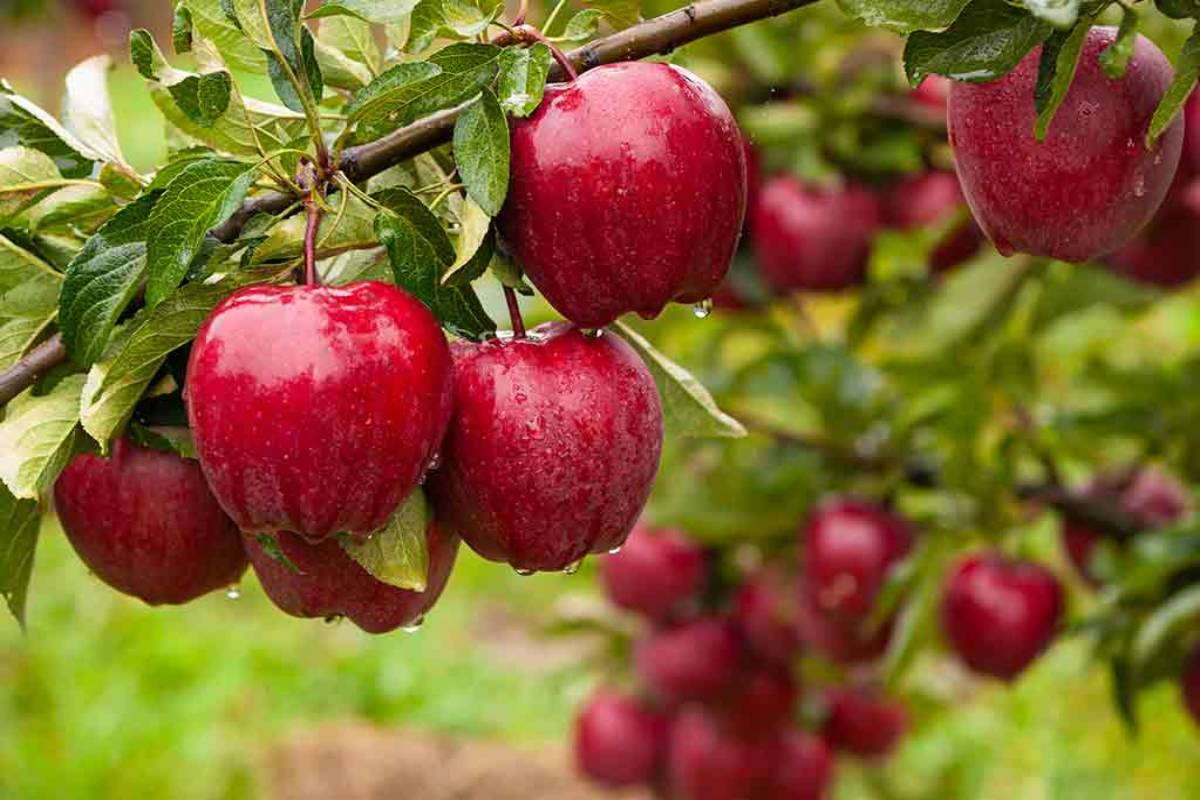
Apple Crop
Apple (Malus pumila) is an important temperate fruit. Apples are mostly consumed fresh but a small part of the production is processed into juices, jellies, canned slices and other items.
In India, Apple is primarily cultivated in Jammu & Kashmir; Himachal Pradesh; hills of Uttar Pradesh and Uttaranchal. It is also cultivated to a small extent in Arunachal Pradesh; Nagaland; Punjab and Sikkim.

Agro-climatic requirements
Apple can be grown at altitudes 1,500-2,700 m. above m.s.l. in the Himalayan range which experience 1,000-1,500 hours of chilling (the no. of hours during which temperature remains at or below 70 C during the winter season). The temperature during the growing season is around 21-240 C. For optimum growth and fruiting, apple trees need 100-125 cm. of annual rainfall, evenly distributed during the growing season. Excessive rains and fog near the fruit maturity period result in poor fruit quality with improper colour development and fungal spots on its surface. Areas exposed to high velocity of winds are not desirable for apple cultivation.
Soil-
Deep loam soil is best for apples.
Loamy Soil:

Considered the most fertile of soil type, loamy soils are a combination of sandy, clay and silt particles. The clay and silt particles improve moisture retention while the sand minimizes compaction and improves drainage. Loamy soils don’t get dried out in the summer, but also don’t get water-logged in winter.
Advantages of Loamy Soils
- Drought resistant due to water-holding capacity
- Faster to warm up in the spring, compared to clay
- Can hold nutrients, making soils fertile
- Good infiltration of air and water
Disadvantages of Loamy Soils
- Depending on how your soil was formed, some loamy soils can contain stones that may affect harvesting of some crops.
Managing Your Loamy Soil
While loamy soils are ideal whether you are growing crops, flowers or turfgrass, all soils need to be managed in order to maintain or improve soil health. Adding products rich in soil microbes is key to promoting a robust soil ecosystem. Clay-loam soils having good drainage can also be used. In sandy-loam soils, apple trees are adversely affected by the stem diseases like Canker and Papery Bark and insects like stem and root borers. The soils rich in organic matter and, have a pH of around 6.5 and have good drainage are best for apple growing. The shallow soils with gravels can be made suitable by adding heavy quantities of farm yard manure/ compost or leaf moulds. On the whole, the soils on which natural forests of oak and deodar a flourish are ideal for apple orcharding.
SOIL MANAGEMENT-
In standard planting where the trees are widely open, during early age when plants are young, there is plenty of vacant space available. This space can be used for growing of short duration crops particularly legumes and other vegetables. Hence there is regular cultivation of the orchard land initially for 5-6 years till the trees become large and the area is occupied by them. This regular cultivation facilitates the nitrification process hence better vegetative growth of trees is expected. In apple, fruits are borne on spurs which are formed on two year or older wood, therefore, once the trees have started fruiting, less vegetative growth is required which can be manipulated under semi-sod system of orchard soil management. In semi-sod system, the basin area of each tree is hoed and kept clean. Over rest of the area, natural grasses are allowed to grow but their growth is kept under control by mowing or cutting. Instead of natural grasses, cover crops can also be sown.
In high density planting, the trees are closely planted hence the area allotted is occupied within 3-4 year period and there is no scope for growing of short duration crops as intercrops. Cultivating to loosen soil around the base of the trees will promote growth. This cultivation should be at regular intervals before weed and grass competition gets well established. It should be shallow in depth so tree roots are not disturbed. It should be discontinued in July to avoid stimulating late tree growth that may be susceptible to winter injury. Weak weed growth under the trees by late summer can help trees harden off, and reduce soil erosion.
Soil fumigation & mulching-

In many cases, tree growth of new orchards planted on old orchard land can be improved significantly with soil fumigation. Ideally, growers should conduct a bioassay before replanting an orchard site to assess the severity of replant problem and determine the value of soil fumigation. Growing a biofumigant crop such as Brassicas or mustard and ploughing in the soil to release the active isothiocyanate compounds to fumigate the soil. Another method is to keep the site fallow for few years, adding organic matter either as composts or green manure crops or adding DAP fertilizers. Although these will improve the soil, they have not been proven to be as effective as fumigants or biofumigants in controlling replant disease pests and pathogens. Preferably apple orchard should not be established again on the same site from where the old apple orchard has been uprooted. It would be proper if other temperate fruits like plum or walnut be planted in cycles.
Placing a thick layer of dry grass or forest leaves on the soil basin of a tree is called mulching. For apple tree, the best time of putting mulch is from second fortnight of March to first fortnight of April after the snow has fully melted and the soil has become workable. After mixing of nitrogenous and potassic fertilizers into the soil, the area upto the tree spread is mulched with grasses/ leaves with 10-15 cm thick layer. It will help in conserving moisture significantly and also function as buffer for keeping the temperature of soil at normal levels. On rotting , it will add humus to the soil.
Growing and Potential Belts
Dry temperate areas are suitable for apple cultivation. The fruits produced in these areas are of high quality with high sugar content and long shelf life.
The state-wise growing belts are given in the following:
| State | Growing belts |
| Jammu & Kashmir | Srinagar, Budgam, Pulwama, Anatnag, Baramullah, Kupwara |
| Himachal Pradesh | Shimla, Kullu, Sirmour, Mandi, Chamba, Kinnaur |
| Uttaranchal | Almora, Pithoragarh, Tehri Garhwal, Uttarkashi, Chamoli, Dehradun, Nainital |
| Arunachal Pradesh | Tawang, West Kanneng, Lower Subansiri |

Varieties Cultivated-

Important varieties cultivated in different states of India are given below:
| Category | Varieties |
| Clonal rootstocks | M 9, M 26, M7, MM 106, MM 11 |
| Scab resistant | Prima, Priscilla, Sir Prize, Jonafree, Florina, Macfree, Nova Easy Grow, Coop 12, Coop 13 (Redfree), Nova Mac, Liberty, Freedom, Firdous, Shireen |
| Hybrids | Lal Ambri (Red Delicious x Ambri), Sunehari (Ambri x Golden Delicious), Chaubattia Princess, Chaubattia Anupam (Early Shanburry x Red Delicious), Ambred (Red Delicious x Ambri), Ambrich (Richared x Ambri), Ambroyal (Starking Delicious x Ambri) |
| Low Chilling | Michal, Schlomit, Anna, Tamma, Vered, Neomi, Tropical Beauty, Parlin’s Beauty |
| Pollinizing | Tydeman’s Early, Red Gold, Golden Delicious, Mc Intosh, Lord Lambourne, Winter Banana, Granny Smith, Starkspur Golden, Golden Spur |
Nursery management

The seedlings of crab apple or of commercial cultivars and stooled plants of clonal varieties of year old are used as rootstock. Several types of clonal rootstocks are available which can be used for tree size control. The clonal rootstocks of Malling–Merton series are resistant to woolly aphid. Similarly, resistant rootstocks are also available for Collar Rot disease. In India, at present, the seedlings of crab apples or of commercial cultivars are used as rootstock for standard planting. Among the clonal rootstocks the M-106, M-111 and Merten-793 are recommended. The whip grafting is done in Feb-March about one month prior to bud break. These grafted plants are ready to be planted in the orchard during the next winter season. Budding is done in May-June and also in September-October.
In the high density planting, the role of clonal rootstocks is immense. The dwarfing rootstocks that are commercially available to fit this niche are M.9, Bud.9 and M.26.No perfect rootstock exists, and the limitations and strengths of each rootstock must be evaluated to select the rootstock that performs best in a specific situation. These rootstocks develop dwarf statured stions and also make the scion precocious. Malling 9 produces stions 1/3rd to 1/4th of the size of standard stions. It is very precocious and very productive rootstock. It has, however, brittle roots which break easily, hence anchorage is poor. This rootstock is tolerant to collar rot and does well on heavier soils where drainage is adequate. Many virus free M.9 sub-clones have been developed by heat treatment. More vigorous strains of M.9 are the Pajam 2 and RN29. The rootstock M.26 is more vigorous than M.9 and, therefore, a popular choice for re-plant sites. M.26 does well on slightly heavier textured soils if drainage is adequate. While moderately resistant to Collar Rot, it ,however, does not perform well on poorly drained soils. M.26 may be more suitable for cultivars such as Fuji, where M.9 is too weak. Bud.9 is one of the hardy Budagovsky rootstock series. It displays dwarfing similar to M.9, but is more winter hardy. It has greater resistance to Collar Rot than M.9. The P.2 is a Polish rootstock with similar precocity and yield potential of M.9. Its winter hardiness is similar to B.9. It is resistant to Collar Rot and does not produce root suckers. Rootstock like Bud-9, Pajam-2 and RN-29 are in use in other countries and need testing in India before they are recommended on commercial scale.
Apple seeds require stratification for germination. Stratification is done by keeping seeds in moist sand either in open or in refrigerator during December to February for 2-3 months at 2 to 5°C temperature. At higher elevations (at or > 2100 metre above msl), direct sowing of seeds in the field under mulch in November is practiced which germinate naturally in early summer.
The rootstock plants should be about 80-100 cm in length and 1 to 1.25 cm thickness of the basal 1/3 rd length of the plant. The weak plants, on the other side, are allowed to grow further and can be used for budding in May-June or Sept.-Oct.
The seedling plants initially are free from viruses while plants of clonal rootstocks may have viruses, hence to ensure that these have no viruses, these should pass through tests before using them as rootstock. Similarly, the mother plants to be used for scion-wood should be true to type, productive having no viruses.
Stooling or mound layering is used for multiplication of clonal rootstocks. The young vigorous mother plants are first established for at least one year. These are planted in 20-30 cm. deep trenches at a distance of 1 metre. During the first growing season these trenches are filledin 2 to 3 splits with the soil mixture consisting of 2 parts soil, one part each of sand and well decomposed FYM. These mother plants, once established, with proper care regularly produce new shoots for about 15 years. Every year during winter or about a month prior to start of main flush of growth, mother plants are cut down to a stump only about 8-10 cm high. This stump sends out vigorous shoots which are gradually earthed up during the growing season with soil, starting when these are about 12-15cm high, working the soil well in among the shoots. Repeat this earthing up when the shoots have made another 12-15 cm or so of growth, completing the operation within 3 to 5 months duration. When the growth has ceased during winter, fork away the soil out off the rooted shoots as close as possible to the original stump which is left exposed for few month to sprout again, thus restarting the cycle. Every year, thus rooted shoots are obtained from the mother plants. These rooted shoots are either used immediately for grafting or planted in the nursery for budding purposes.
At high altitude (>2400 metre above msl) the growing period is short, hence establishment of nurseries in open is not economical as the desired growth needed is not available in one season both in rootstock and in stion. It is advised to have nurseries in polyhouses where the plants shall get longer growing period with optimum temperature for growth.
Tongue Grafting-

Whip or tongue grafting is an easy method for propagating apple trees in the home garden. This type of graft is made when the stock and scion are dormant. The stock and scion should be the same diameter, preferably between 1/4 and 1/2 inch. Scion material should be collected when fully dormant (February or early March) from the previous year’s growth. If possible, collect the scion wood when the temperature is above freezing. Place the scion wood in a plastic bag containing moist sphagnum moss or sawdust. Store the scions in the refrigerator until it’s time for grafting.
Cleft Grafting-

Cleft grafting is normally used on existing apple trees that have a larger trunk/branch caliper (1”-3” diameter preferred). This technique allows you to top-work an existing apple tree over to an entirely different variety or just adds other varieties to the same tree. Other grafting methods will work better if your existing trunk/branch is smaller or larger than these parameters. Save cleft grafting for branches in the 1”-3” diameter range.
Selection of quality grafts for planting-
Special care must be taken while buying plant. Quality should be given first preference over cost of plant as success of all efforts will depend on them. Grafts should be procured from good nursery which gives guarantee of variety and rootstock authenticity. Well developed plants with 60-100cm height having 3-4 branches and main stem thickness about 17-25mm should be preferred.
Orchard establishment-

In case the fields have < 45 degree slope, it is advisable to make terraces of about 2 to 3 metre width and of convenient length with inward slope to protect them from erosion. The contour planting is preferred in fields having > 45 degree slope.
The rectangular planting system is followed wherein the distance between rows is kept more than that between plants. When seedlings or vigorous clonal rootstocks are used as rootstock and the scion cultivars are spur types, a 6 x 6 metre distance is recommended under normal soil conditions. When soils are less fertile and shallow, it may be reduced to 5 x 5 m.
Pits are dug 1 m. diameter and 1 m. depth. While digging the pits, the soil of upper half is placed at one side and of the lower half on another side. The pits should remain open during rainy season. These are appropriately filled during Sept-Oct using top soil along with 40-50 Kg well decomposed farm yard manure and 3 kg superphosphate with insecticide to control grubs etc. During filling of the pits, proper compression of the mixture is required and about 25-30 cm top portion of the pit may preferably be filled with the surface soil. The filling should be done upto 15-20 cm above the ground level. Prior to pit digging and also prior to planting, use of planting board is recommended to have plants at the right distance.
High Density Planting of Apple-

Now-a-days most of the apple growing countries are using high density planting (HDP) system. In HDP row to row distance is 3-5 metre and plants in a row are spaced 1.5 to 2.0 metre. Thus 1000 to 2222 trees are accommodated in a hectare. Initially trees are supported with poles and trees are trained in slender spindle or vertical axis or trellis. In high density plantation system orchard start giving commercial yield in 3-4 years after planting and commercial life of orchard is considered to be 20 – 25 years. Table below has some examples of spacing with production capacity.
| Planting distance (m) | Number of Plants (ha) | Production Capacity (T/ha) |
| 4.0 x 3.0 | 333 | 30-45 |
| 4.0 x 2.0 | 1250 | 35-45 |
| 3.0 x 2.0 | 1666 | 35-50 |
| 3.0 x 1.5 | 2222 | 40-60 |
Advantages of High Density
- Early commercial yield from third or fourth year onwards.
- High yield per unit area, 25-30t/ha as compared to 10-12 t/ha in conventional planting.
- Less pruning requirement in bearing orchards due to heavy bearing and tree architecture.
- Easy pruning operation.
- Uniform and high quality fruits.
- Easy spraying, interculture and orchard management.
In high density plantings, trees are maintained 2.5 to 3 metre tall. The row to row distance is kept between 3-5 m while trees within the row are planted at 1.5 to 2 m distance. The root system, being very restricted, hence the pits are dug having 50-60 cm diametre and 70-80 cm depth. The pits can be dug using big sized augers. The pits being small have almost half the quantities of FYM, super-phosphate, and chloropyriphos as that of the pits dug for widely spaced planting.
Well feathered two year old nursery plants are the ideal form that should be purchased where possible. These are better able to maximize canopy growth in the first two years of orchard establishment. The graft /bud union should be 8-10 cm above the ground after settling of soil occurs, and branches should not be closer than 60-70 cm to ground level. Branches should be well spaced up the main trunk, and the leader and side branches should be intact and not damaged. Ensure that there is sufficient root volume on each plant and these roots are healthy and free of root diseases.
In case the grafts are of one year age, the technique of bagging of the leader helps in the creation of laterals.
Planting is done from December to March. The roots are liable to injury from low temperatures; hence the plants are uprooted from the nursery as soon as possible after the leaf fall. The roots are covered with wet sphagnum moss and are further tightened with a sheet made up of jute. These are then sent to the desired destinations. On arrival at the respective places, these are put in shallow trenches and the roots are covered with soil where regular watering is practiced till their planting in the orchard.
In areas where the temperature during winter is around 0°C planting is completed by January. In winter the soil temperature remains few degrees above the air temperature, hence there will be growth of roots, though non-significant. This helps to nourish the plants on resumption of growth in the spring season. In areas where the temperature falls several degrees below 0°C, the best time for planting is March/ April. Watering and thick mulching immediately after planting are helpful for better initiation of growth.
The apple orchards do best when these have groves (forests) of oak or deodar trees at some distances i.e. apple belts should not be continuous but have thick forests after each 100 to 200 hectare planting. These thick forests are helpful in maintaining temperature stable which are required for getting best results in apple production.
Planting Material
The budding and tongue grafting methods are commonly used for propagation of apple. The planting material should be purchased only from the registered nurseries and proper care should be taken during transportation of the same.
Planting season–
Planting is usually done in the month of January and February.
Spacing

The average number of plants in an area of one ha can range between 200-1250. Four different categories of planting density are followed viz. low (less than 250 plants/ha.), moderate (250-500 plants/ha.), high (500-1250 plants/ha.) and ultra high density (more than 1250 plants /ha.). The combination of rootstock and scion variety determines the plant spacing and planting density/unit area.
Planting Method


Square or hexagonal system of planting is followed in the valleys whereas contour method is usually followed on the slopes. Plantation of pollinator species in between the main species is essential for proper fruit setting. For establishment of an orchard having Royal Delicious variety, plantation of Red Delicious and Golden Delicious as pollinators is recommended by the Horticulture Department. In the month of October-November, pits of size 1x1x1 m. are prepared for planting. In each pit, 30-40 kg of FYM, 500 g. of Single super phosphate and 50 g. of Malathion dust are added after mixing properly. After about a month the planting is done. One irrigation should be provided immediately after planting.
Nutrition

Farmyard manure @ 10 kg./ year age of tree is applied along with other fertilizers. The ratio of N, P and K which is applied in an orchard of optimal fertility is 70:35:70 g./year (age of the tree). After 10 years of age, the dose is stabilized at 700:350:700 g. of N, P and K /year. The standard fertilizer dose of N, P and K in an “off” year (when the crop load is low) is 500 g., 250g and 400 g. respectively. On some trees deficiency of zinc, boron, manganese and calcium may be observed which is corrected with the application of appropriate chemicals through foliage spray.
Weed Management-

Weed competition can drastically reduce tree growth during the first few years and can cause a failure of the orchard to fill its allotted space which always results in diminished yield and profitability. Good weed control during the first 3-4 months of a growing season is the most critical period of the season. In later summer months if weed control is poorer it is not detrimental to the trees.
Irrigation

The water requirement of apple is 114 cm. per annum which can be scheduled in 15-20 irrigations. In summer, irrigation is provided at an interval of 7-10 days while in winter it is given at an interval of 3-4 weeks. At least 8 irrigations are to be provided during critical period (April-August) i.e. main requirement after fruit set.
Drip Irrigation-

Drip Irrigation is the method of application of water and fertilizers directly near the root zone at frequent intervals and at low application rate so as to maintain proper air-water balance within the root zone of the crop. It is the pressurized irrigation system; water reaches to the farthest end under pressure and gives equal volume of water within the field area.
Characteristics of drip irrigation:
- Water is applied at a low rate to maintain optimum air-water balance within the root zone.
- Water is applied over a long period of time.
- Water is applied to the plant and not to the land.
- Water is applied at frequent intervals.
- Water is applied via a low pressure delivery system
On resumption of growth after winter dormancy, apple trees should start getting irrigation. The flowering starts when the trees attain 4-5 years age. Drip Irrigation should commence two weeks after petal fall and continue till October. In case the water availability is limited, it should be used judiciously at critical stages of water requirement i.e., at-
- 20-25 days prior to flowering
- 1-2 weeks after petal fall
- 4-5 weeks after petal fall, and
- 3-4 weeks prior to fruit maturity.
In such conditions drip irrigation plays vital role.
Advantages of drip irrigation system in apple-
- With use of drip irrigation overall yield and quality of apple increases.
- During the prolonged gap of rainfall, drip irrigation is useful to avoid water stress, this timely survival irrigation also help to increase the yield.
- Drip irrigation promotes early maturity. Early harvest fetches higher price in the market and improves profitability.
- Drip irrigation increases the vegetative growth i.e., tree girth, tree height, shoot extension growth, tree spread, tree volume and leaf area.
- Drip irrigated apple exhibits higher flowering intensity and fruit set.
- With drip irrigation incidence fruit drop reduces.
- Minimised fertilizer/nutrient loss due to localized application and reduced leaching.
- It is observed that use of drip irrigation accelerates assimilation and stimulates the formation of anthocyanin, which is responsible for red colour development.
- High water application efficiency. In hilly and undulating terrain, specially designed drippers can provide uniform discharge for change in static head.
- Reduction in manpower requirement. Operation of drip irrigation system involves least manpower.
- Energy saving, In hilly areas where sufficient elevation head is available, drip irrigation can be operated on gravity pressure without electricity.
- Control over weed growth, reduction in weedicide expenses and labour expenses.
- Improved disease control.
- Minimised soil erosion.
Training & pruning-
Standard Planting-
The widely spaced apple trees are trained to modified leader system. The shoot growing centrally is chosen as leader. The side shoots which are about 5-7 in number are selected over a period of 4-5 year. The first side shoot is retained at a height of 50-60 cm from the ground level, and thereafter, the difference between two adjoining branches should be in the range of 30-40 cm. The selected branches must have 45 to 60 degree angle to the leader shoot; secondly, these branches must have less vigorous growth than the leader branch; thirdly, these should be in different directions. On completion of selection of side branches, the growth of leader shoot is directed at 45° angle so as to modify it as a final and terminal side shoot. Over the years, the leader branch becomes trunk and side branches become scaffolds or limbs.
Apple trees on vigorous rootstock start bearing fruit on attainment of about 4-5 years age. The objective of pruning of a bearing tree is to provide sunlight in the inner parts of a tree and lower the speed of vegetative growth. First of all, dried and diseased branches/portions are removed. Secondly, heading back of scaffold branches is performed upto strong laterals. Generally the heading back cuts on scaffold branches are made by removing top 2–4 side branches below upto a strong lateral. As one goes down, it invigorates to sprout the dormant buds further down on the scaffold. Hence, the severity of heading back cut is dependent on the requirement of vegetative growth during the following year. In this context the practical experience of the pruner is helpful to decide as to how deep should be the heading back. During pruning, the branches bearing old spurs and the branches which are weak and crowding are removed.
High Density Planting
Without putting if and buts, the ideal tree shape for close (high density) planting is a narrow cone. The tree will have a single trunk with fruiting units arranged evenly from 60-80 cm height to the top. There are three most common training systems as:
- Slender Spindle
- Vertical Axis and
- Trellis.
- Slender Spindle

It consists of an individual support post at every tree. The post should be 2.5 to 3 metre in length and of pressure treated wood, concrete or metal to ensure it lasts the life of the orchard (Approx. 20-25 years) . A diameter of 5 to 6 cm is preferred. The depth of the post in the ground should be 60 to 90 cm for stability leaving rest of the portion above ground. The leader must be manipulated in some manner to ensure continuous branching. The main characteristics of this system are:-
- Height controlled at about 2.5 metre .
- Maximum width of tree spread is 2 metre.
- Lateral branches continuously along the central leader.
- One or two permanent whorls of laterals can be established in the lower portion of the tree
- Leader management for profuse lateral branching is important to generate fruiting wood production and to increase the number of growing point to control vigour.
- Lateral shoot positioning is important to control vigour and encourage fruiting. This positioning is also necessary to stimulate secondary branching.
- Trees must have a permanent support system for the total height of the trees to attach the leader to every 40- 45 cm. This support holds trees stable in soil and supports the fruit load.
- Vertical Axis-

A strong un-headed leader is encouraged to grow until it reaches to about 3.5 to 4 metre from the ground i.e., the trees are taller than Slender Spindle system. This is the main feature that distinguishes it from Slender Spindle system. This central axis forms a short shaft around which lateral branches radiate to form a narrow cylinder of fruit bearing wood. The diameter of the branches should gradually decrease to the top of the tree, and these should always be smaller than the trunk where located. There should be lessening in the length of the laterals from the bottom to the top, this result in slender conical shaped trees. The distance between the branches should be less towards the top of the tree in order to allow for maximum light penetration.
This system basically consists of one or more high tensile steel wires drawn tight and supported 2-3 metre above the ground by a series of in – line posts spaced 9 to 15 metre apart. The closer the spacing for the inline posts, the higher the degree of stability of the support system under strong wind or high crop load conditions. Individual trees in the row are supported by vertical leader supports that reach up to the top support wire.
3. Trellis-

There is positioning of laterals along the supporting wires. The trees at planting are normally headed 15 cm above the bottom wire. Shoot growth is allowed to proceed un-manipulated until mid July. Upright shoots and water sprouts are removed during August to minimize re-growth and vigour. Completion of every layer is important in a Trellis system. Do not allow a strong leader to reach the top of the trellis too fast. Unlike the Vertical Axis there is no support alongside each individual tree. Instead, branches are trained horizontally along the wires.
The lowest two wires should be installed when trees are planted, to allow them to be supported immediately. Usually the first wire is 50-100 cm from the ground. From this point upwards the wires are required at 0.5 to 1 metre distance. Wires should be added as the trees grow. Placing wires on alternate sides of the tree trunks provide additional support. Tree trunks are attached to the wires either by flexible ties or staples.
Under high density system pruning requirement is much lower once orchard comes under production than the conventional planting. Only light pruning is required to thin out water sprouts and some time renewal pruning for damaged branches to develop new ones.
Pruning-

The appropriate pruning approach is to annually remove 1-2 large upper branches completely during winter and develop younger replacement branches. The removal of entire branches in the upper portion of high density apple trees helps to open channels for light penetration which maintains fruit production and quality in the bottom of the canopy. This renewal pruning is the single most important pruning concept for mature high density orchards to contain the canopy and maintain a concrete shape. To assure the development of a replacement branch, the large branch should be removed with an angled or shaped cut so that a small stub of the lower portion of the branch remains. From this stub a flat weak replacement branch often grows. This type of pruning does not stimulate vigorous re-growth.
Once branches have become horizontal or hanging under the weight of crop, these can be shortened by heading back cuts without adverse effects since the terminal bud no longer exerts significant control over the branch, However, if the overall vigour of the mature tree remains high, leaving the hanging branches long will help increase cropping and reduce the vigour of the tree. After a number of years, if the hanging branches begin to shade the bottom half of the tree these should be removed with a renewal cut and a replacement branch developed.
Time of Pruning-
Pruning can be started few days after the tree enters into dormancy and is completed at least one month prior to resumption of growth in Spring. In areas where the winter season is moderate, the pruning operations should be completed early in the season. It gives sufficient time for healing of wounds made during pruning. Contrary to this, in areas where the minimum temperatures remain several degrees below freezing point, the pruning should be delayed until the danger from severe cold is over because there are chances of drying of succulent branches due to severe cold. In other words, early pruning under extremely cold conditions can lead to severe losses to branches and fruiting wood. Late pruning under similar climatic conditions removes winter injured shoots before any further pruning is done. For example, in the areas like KulluManali of Himachal Pradesh and Ramgarh-Mornaulla areas of Uttarakhand, pruning should be done in December-January while in areas like Lahaul-Spiti and Harsil, it may be delayed and preferably be done during March.
USE OF GROWTH REGULATORS-
To Control fruit drop:
The fruit drops may occur as; (1) early drop due to unpollinated or unfertilized blossoms, (2) June drop due to either moisture stress or over load of fruits, and (3) pre-harvest drop. The problem of fruit drops is more common in early maturing cultivars. Spraying of Naphthalene Acetic Acid (NAA) @ 10 mg/litre (Planofix is the commercial formulation of NAA of which 1 ml is dissolved in 4.5 litre water to achieve the required concentration) is most effective. The spray is done about a week before the expected drop.
To improve fruit set:
There is a problem of normal fruit setting in climatically marginal areas. Formulations like Miraculan (0.75 ml/litre) or Paras or other similar compounds (0.6 ml/litre) or other similar compound or Biozyme/ Protozyme (2 ml/litre) can be sprayed twice at (a) pink bud stage, and (b) immediately after petal fall.
To improve surface colour and enhancement of maturity:
Apple surface colour development is greatly hampered in areas where temperatures during summers are high. Similarly, at high altitudes, the maturity is comparatively late. Application of ethrel @ 2.5 ml/l if sprayed about 10-12 days prior to harvesting date greatly improves colour and also enhances maturity. The application of ethrel is recommended at the stage when maximum fruit size has been attained and about 30 % red colouration has developed. Planofix (1ml in 4.5 litres) should be added to ethrel to arrest the excessive fruit drop caused by ethrel. Further, ethrel treated fruits are not suitable for storage as they have poor shelf life. In old orchards of standard planting system use of paclobutrazol is also helpful in improving fruiting and reducing alternate bearing.
FROST PROTECTION-

When the temperature during night drops below 4°C the water particles in the air are crystallized and are deposited on plant parts and also on all the exposed surfaces. It is called White frost. When there is very low humidity in the air and temperature drops to below 4°C during night, the frost occurs without deposition of any ice particles. It is called Black frost. The occurrence of frost is a common phenomenon in subtropical and temperate zones of the earth. The temperate zone fruit trees remain in deep dormancy from December to February or upto March ( >2400 metre above msl in Himalayas). The temperate fruit trees are benefited from these frosts by getting chilling temperature and completing their chilling requirement. The harm from frosts to apple starts after their chilling requirement is met and when they are able to resume growth. In case the frosts occur during the period of bud swelling to petal fall, it is very harmful, and many a times crop failures occur significantly.
Several devices have been developed to protect the bloom from frost such as giving irrigation to the orchard few days before bud swell, mixing of warm air settled above at about 100 metre height from ground, putting electric / solar heater during mid night for few hours and putting of caps on individual plants of small stature. Giving irrigation prior to bud swell stage is helpful as the water on freezing releases latent heat which raises temperature up to few degrees of the microclimate.
The small stature plants can be protected from frost by putting caps over them in the evening and removing with the sunrise. The science here involve during day time plant body gets warm and in the night gets cool. In case it is covered with caps (inorganic or organic) in the evening the heat released by the plant body remains all around the plant which is capable to protect it from frost.
Easy and convenient method to protect plants from frost damage is to sprinkle water above the canopy during frost hours.
Principle of Overhead Sprinkler Frost Protection-

The principle of this method based on three factors,
1. When water freezes its latent heat is released. This latent heat keeps the temperature of the plant from dropping below freezing point.
2. A mixture of ice and water exposed to below freezing point remains at 0 degree Celsius until all the water is frozen.
3. Plants do not suffer frost damage until the temperature drops slightly below 0° C because the freezing point of plants liquid is below that of water.
Continuous sprinkling of water above the canopy during the frost allows plant tissue to take specific heat from water to protect them self from falling temperature below critical limit and prevent nucleation of plant cell fluids.
DISEASES-
Canker and Papery Bark

Canker and Papery Bark are the two diseases prevalent in all the three apple growing states. These are stem diseases which appear on shoots, scaffolds and also on trunk. In case of Canker, there are depressions which have pink coloured pustules. In Papery Bark, the bark becomes papery. There is death of cells in the affected portions. Initially phloem is affected and later on incidence may be upto wood.
Management-
The affected shoots are removed, the affected bark and even the wood on scaffolds and on the trunk are scrapped, and the cut and scrapped portions are pasted with Chaubatia paste (Copper Carbonate:lead Oxide:Linseed Oil 1:1:1.25) during pruning in winters for their control. The whole orchard is sprayed with copper fungicide during dormancy and also in the rainy season.
Root Rot-

The Root Rot is more common in poorly drained soils, hence, water stagnation either above or in subsoil is to be avoided. The drenching of soil either with copper oxychloride or mancozeb is helpful in controlling the disease. Keeping the soil pH near to neutral level is also a measure to check the spread of the disease.
Apple Scab–

The Apple Scab is found in some pockets of the apple growing areas. Typical Scab symptoms appear on foliage and fruits. Light brown or olive green spots which soon turn musty black appear on either or both sides of the young leaves. Severe spotting leads to premature leaf-fall. Severe early infection results in the formation of illshaped knotty fruits. Fruits which get affected in late summer develop small, rough black circular lesions on the skin. Following spray schedule is recommended:
- In dormancy at silver tip to green tip stage.
- At pink bud stage.
- At petal fall stage.
- When Fruits attain pea and walnut size.
- When fruits have attained full size.
- 20-25 days before harvest.
In these sprays, the fungicides like Mancozeb, Fenarilmol, Bitertanol, Captan, Sulphur, Chlorothalonil and Carbendazim are used interchangeably but following precautions are taken: (a) Carbendazim should not be sprayed in two consecutive sprays. (b) Chlorothalonil should be applied only at silver tip or green tip stage and not after wards as it causes rusting on fruits.
List of fungicides recommended for Apple-
| S.No | Name of Fungicide | Recommended Concentration | Waiting Period |
| 1 | Aureofungin | 2g/lit | |
| 2 | Carbendazim | 0.25g/lit | 40 days |
| 3 | Captan | 1.2g/lit | 8 days |
| 4 | Chlorothalonil | 2g/lit | 45 days |
| 5 | Dinocab | 0.3g/lit | 21 days |
| 6 | Diathion | 0.75g/lit | 21 days |
| 7 | Hexaconazol & Penconazol | 0.5 g/lit | 30 days |
| 8 | Ziram | 2 g / lit | 21 days |
| 9 | Wettable Sulphur | 2.5-5 g / lit |
Insects-
Among the insect pests, the most common ones are woolly aphis, stem and root borers, tent caterpillar and sanjose scale.
Woolly aphid-

The woolly aphid lives in groups and suck on succulent shoots and buds. In winter, they feed on roots. During sucking, they secrete some poisonous substance and nods are formed at the portions sucked. Affected trees remain stunted with greatly reduced fruit bearing capacity. This insect can easily be controlled by spraying any of the insecticides like Dimethoate, MethylOxydemeton, Monocrotophos or Imidachloprid during the months of AprilMay and September-October. During winters, drenching of soil with any of the above insecticides is recommended.
Stem and root borers-


The grubs of stem borer feed on wood inside the stem. It’s excreta comes out from a hole. For control, a cotton wick soaked in any of the fumigating insecticides like Dichlorovos, is inserted inside the hole and is immediately sealed with wet clay soil. Similarly the grubs of root borer feed inside the roots. Any systemic insecticide like Phorate or Carbofuran is applied during MarchApril in the root zone and is well mixed with the soil. Pheromone traps placed in the orchards can trap the adults of these insects which can then be killed thus minimizing the population of grubs (damaging stage).
Hairy Tent Caterpillar-

This caterpillar has hairs on its body and fond of living in groups inside tent like structure. These caterpillars feed on the foliage and keep on shifting to the other shoots of a tree. This insect is very common in neglected orchards. Under severe infestation a tree becomes leafless. For control of hairy tent caterpillar, insecticides like Monocrotophos or Endosulfan is sprayed during September-October.
SanJose scale-

San Jose scale insects live on the surface of the bark of stems. Initially trees show small, greyish specks on the bark surface but severely infected trees have the bark covered with a grey layer of overlapping scale appearing as if these have been sprayed with wood ash. For control, one to two sprays of any of the tree spray oils (Esso Tree oil, Survo Orchard spray, Agro Spray orchard) are done during winter at green tip bud stage.
List of insecticides allowed for application in Apple-
| S.No | Name of insecticide | Targeted Pest | Recommended Concentration | Waiting Period |
| 1 | Carbofuran | Woolly Aphid | 5-50g/tree (based on size of a tree) | |
| 2 | Chloropyriphos | 0.5ml/lit | ||
| 3 | Dimethoate | Stem Borer | 0.3ml / lit | |
| 4 | Fenazaquin | Mite | 0.1ml/lit | 7 days |
| 5 | Methyl O Demeton | Sanjose scale & Woolly Aphids | 0.25-0.75 ml/ lit | |
| 6 | Phorate | Woolly Aphids | 10-15g/plant | |
| 7 | Propargite | Mites | 0.75-1ml/ lit | 9 days |
| 8 | Quinolphos | Woolly Aphids / tent caterpillar | 0.5ml / lit | |
| 9 | Spiromegifen | Mites | 0.3ml / lit | 30 days |
FRUIT PICKING, Packaging, YIELD & STORAGE-

Yield:
A standard apple tree on vigorous rootstock starts fruiting at the age of 4-5 years and the commercial yields are obtained on attainment of 9-10 /8 year age. The productive life of an apple tree is about 50 years. Under proper management, average production of about 12 tonnes/hectare under the climates of Himachal Pradesh and Uttarakhand and about 15 tonnes/hectare under the climate of Jammu-Kashmir, can be obtained every year.
The closely planted trees on dwarfing rootstocks can yield fruits 25 to 30 tonnes per hectare starting from 4th or 5th year upto 20-25 years age. With precocious dwarfing rootstocks, young apple trees can often overset in the 2nd and 3rd year resulting in biennial bearing as early as the 4th year. These results in increased vigour in the 4th year just when the trees have filled their allotted space and when reduced vigour is needed. Having the density of 1500 trees/ hectare for annual cropping cultivars like Gala, the recommendation for crop loads are as: 15-20 fruits/ tree in the second year, 25-40 fruits/ tree in the 3rd year, and 80-100 fruits/ tree in the 4th year. For slow growing and biennial bearing cultivars this number of fruits should be halved to two-third that of the regular bearing cultivars.
Maturity indices:
Each cultivar takes certain number of days from petal fall to maturity. A variation of 8-10 days may occur between different climatic zones. For example, the same cultivar may take few more days when planted in colder regions. In general, the fruits of early, mid and late maturing cultivars ripen in August, September and October, respectively. There are several indices which are used, to know the maturity of fruits.
- Days after petal fall.
- Heat units since petal fall n Fruit Colour
- Fruit T.S.S. (Total Soluble Solids)
- Fruit firmness
- Starch Index (Disappearance of starch from fruit)
- Ethylene content of fruits
Among the above methods T.S.S., fruit firmness and starch index are more robust and easy to measure in field.
Fruit T.S.S. can be measured by Hand Refrectometer available in market, it is a simple instrument and easy to use by following instruction given in leaflet along with instrument.
Fruit firmness can be measured by an instrument “Penetrometer” having 2.5cm² plunger. This equipment can be purchased from scientific instrument shops.
Fruit harvest–
During picking the fruits should be plucked individually with pedicel attached and are placed in the basket. Fruits should be handled carefully to save them from mechanical injury.
Precooling-
Shelf life, storage and transportability remains good if fruits are precooled to 7°C immediately after harvest, it can be done by keeping them in pre cooling chambers or spraying of water having temperature of 7°C.
Grading and Packing-
Fruits must be graded before sending them to market. Grading can be done manually or by machine. Damaged, blemished and diseased fruits must be separated. Fruits can be packed in telescopic corrugated fibre boxes with apple trays. Generally corrugated fiber boxes are of 504x300x282 mm (outer) and 500x300x282 mm (inner) size. Depending upon fruit size they should be filled in 4-5 layers. If more layers are filled advantage of using corrugated fibre boxes is lost and fruits are damaged. Table below give information about number of fruits and layers per box depending upon fruit grade.
Fruit Storage-
Cold storages or modified atmosphere cold storages are suitable for long term storage. For short term storage evaporative or zero energy cool chambers can also be used. In cold storages recommended temperature is 0 – 2°C.
In modified atmosphere cold storages 3.3°C temperature with 2 – 5% CO2 and 3% O2 is recommend. Fruits can be stored upto 12 month in cold storage.

Leave a Reply to Adarsh Raj Cancel reply