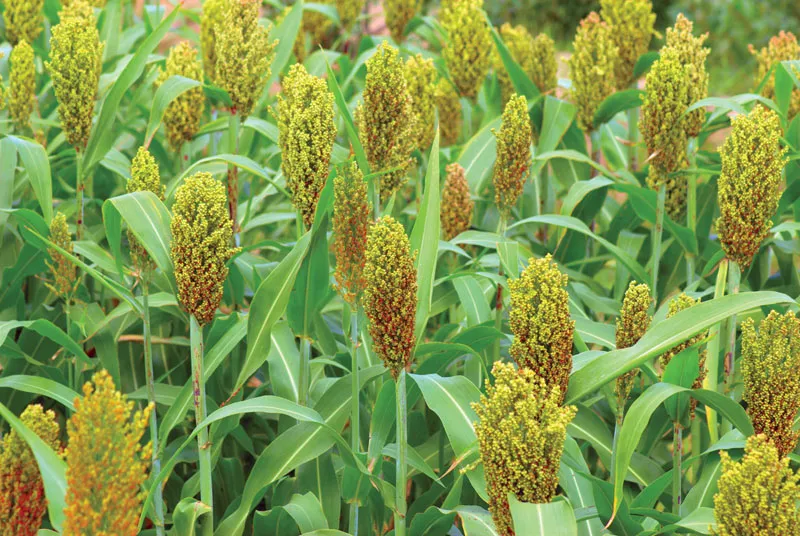
Sorghum, (Sorghum bicolor), also called great millet, Indian millet, milo, durra, or shallu, cereal grain plant of the grass family (Poaceae) and its edible starchy seeds. The plant likely originated in Africa, where it is a major food crop, and has numerous varieties, including grain sorghums, used for food; grass sorghums, grown for hay and fodder; and broomcorn, used in making brooms and brushes. In India sorghum is known as jowar, cholam, or jonna, in West Africa as Guinea corn, and in China as kaoliang. Sorghum is especially valued in hot and arid regions for its resistance to drought and heat. Sorghum is a strong grass and usually grows to a height of 0.6 to 2.4 metres (2 to 8 feet), sometimes reaching as high as 4.6 metres (15 feet). Stalks and leaves are coated with a white wax, and the pith, or central portion, of the stalks of certain varieties is juicy and sweet. The leaves are about 5 cm (2 inches) broad and 76 cm (2.5 feet) long. The tiny flowers are produced in panicles that range from loose to dense; each flower cluster bears 800–3,000 kernels.

Sorghum Soils:
Grain sorghum can be grown on many different soils. Sorghum will yield best on deep, fertile, well-drained loamy soils. However, it is quite tolerant of shallow soil and droughty conditions.
Loamy soil

Sorghum can be grown successfully on clay, clay loam, or sandy loam soils. Fertile, well-drained soils are important to optimize yield. Soils with clay loam or loam texture, having good water retention capacity are best suited for sorghum cultivation. Grain sorghum is more tolerant of wet soils than most grain crops.
Sorghum grown on deep, well drained permeable soils usually develops extensive root systems.
Mature plant roots may penetrate to depths of 4 to 6 feet in an ideal soil. Root development can be severely restricted by soil conditions such as excessively high or low soil moisture levels, hard pan and compaction. Sorghum has moderate salt tolerance – slightly less than wheat but higher than maize. It does well in pH range of 6.0-8.5 as it tolerates considerable salinity and alkalinity. Sorghum is sensitive to aluminum toxicity and soils with acid saturation higher than 20% can pose a problem.
Striga infected sorghum field-

Soils seriously infected with witch weed or striga must be avoided. In tropical and subtropical conditions of India, sorghum is extensively grown in light – textured red sandy, red loamy, alluvial and coastal – alluvial soils as well as on mixed black and red and medium black soils.
Sorghum is also grown on medium black soils, deep alluvial loams and on sandy and gravelly soils of poor fertility with low organic matter content but the yields is low.
Climatic Requirements for Sorghum:
Sorghum can grow in a wide range of ecological conditions and can still yield well even under unfavorable conditions of drought stress and high temperatures. Sorghum requires warm conditions but it can be grown under a wide range of conditions. It is also widely grown in temperate regions and at altitudes of up to 2300 m in the tropics. It can tolerate high temperature throughout its life cycle better than any other crop. Sorghum requires about 26-30oC temperature for good growth. The minimum temperature for the germination of the sorghum seed is 7 to 10oC. Grain sorghum does not germinate and grow well under cool soil conditions. Poor emergence and seedling growth may result if planted before soil temperatures reach 35oC. Sorghum is best adapted to areas having an average annual rainfall between 45 to 65 cm (17 to 25 inches). Although sorghum can respond to good moisture supplies, it is nevertheless one of the toughest, drought tolerant crops available and this tends to maintain its popularity in the regions where the weather is very unpredictable.
The ability of sorghum to grow in their environments is due to a number of physiological and morphological characteristics:
- Produces many roots compared to other cereals.
- Has reduced leaf area thus reducing water loss through transpiration.
- Can remain dormant during drought and resume growth when conditions are favorable.
- Above ground parts of plant grow only after the root system is well established.
- The leaves have a waxy coating and have the ability to roll in during drought thus effectively reducing transpiration.
- Competes favorably with most weeds.
Field Preparation for Sorghum Cultivation:
Disc Plough

The disc plough bears little resemblance to the common mould board plough. A large, revolving, concave steel disc replaces the share and the mould board. The disc turns the furrow slice to one side with a scooping action. The usual size of the disc is 60 cm in diameter and this turns a 35 to 30 cm furrow slice. The disc plough is more suitable for land in which there is much fibrous growth of weeds as the disc cuts and incorporates the weeds. The disc plough works well in soils free from stones. No harrowing is necessary to break the clods of the upturned soil as in a mould board plough.
Tractor Drawn Cultivator:

Cultivator is an implement used for finer operations like breaking clods and working the soil to a fine tilth in the preparation of seedbed. Cultivator is also known as tiller or tooth harrow. It is used to further loosen the previously ploughed land before sowing. It is also used to destroy weeds that germinate after ploughing. Cultivator has two rows of tynes attached to its frame in staggered form. The main object of providing two rows and staggering the position of tynes is to provide clearance between tynes so that clods and plant residues can freely pass through without blocking. Provision is also made in the frame by drilling holes so that tynes can be set close or apart as desirect. The number of tynes ranges from 7 to 13. The shares of the tynes can be replaced when they are worn out.
The objectives of field preparation are based on the following principles:
- Elimination and control of undesirable plants like crop volunteers and weeds to reduce competition with the established main crop.
- Provide favorable conditions for sowing, allowing germination, emergence and good plant development.
- Maintenance of fertility and productivity over the long term by preserving the soil organic matter and avoiding erosion.
- Breaking of hard pans or compacted layers to increase water infiltration through the soil whilst avoiding erosion.
- Facilitating mixing of fertilizers, lime, or agro-chemical products into the soil.
- Incorporation of organic and agricultural residues.
Timely field preparation facilitates timely sowing which ensures higher yield. Land preparation should ensure that all crop residues, crop volunteers and weeds are completely buried.Summer ploughing is advantageous to kill the weed seeds and hibernating insects and disease organisms by exposing them to the heat of summer. Initial ploughing should be carried out at optimum moisture range to get good tilth and should avoid when moisture is in excess.
Number and depth of ploughings depends on weed intensity. For rainy season crop, with onset of rains in May-June, the field is ploughed once or twice to obtain a good tilth. Harrowing of soil should invariably follow after each ploughing to reduce the clod size. After the initial ploughing, the subsequent ploughings and harrowings are carried out when the moisture content of the clods are reduced.The number of ploughings are to be minimized to reduce the cost of cultivation.
Tillage operations should be repeated when the weed seeds are just germinated. When the soils are heavily infested with perennial weeds like Cynodon or Cyperus, deep ploughing is needed.
Moisture is a critical element in good seedbed preparation and is essential for the successful establishment of the crop.
Field preparation depends on the system of sorghum sowing.
Three systems of sorghum sowing are followed:
- Sowing on a flat surface.
- Using ridge-and-furrow system.
- On a broad bed-and-furrow system.
In ridge and furrow system, ridges are made using either tractor drawn or animal drawn ridge ploughs.
Preparation of land One deep ploughing with mould board plough in summer followed by 3 to 4 harrowings to maintain weed free conditions. Making compartmental bunds of 10m × 10m in the month of August for soil moisture conservation
Selection of high yielding hybrids and varieties

| Region/state | Production condition | Recommended Hybrid | Recommended Variety |
| Maharashtra | Medium to heavy soil areas | CSH 16, CSH 18, SPH 388, CSH 23, CSH 25, CSH 30 | CSV 15, PVK 400, CSV 17, CSV 20, CSV 23 |
| Karnataka | Low rainfall areas | CSH 14, CSH 17, CSH 30 | CSV 17 |
| Normal rainfall areas | CSH 16, CSH 13, CSH 18, CSH 23, CSH 30 | CSV 15, DSV 2, DSV 3 | |
| Andhra Pradesh | Low rainfall areas | CSH 14, PSH 1 | CSV 15, CSV 17, CSV 20, CSV 23 |
| Normal rainfall areas | CSH 23, CSH 25, CSH 30 | CSV 15, CSV 20, CSV 23 | |
| Madhya Pradesh | Entire state | CSH 16, CSH 17, CSH 18 , CSH 23, CSH 25 | CSV 15, CSV 17SPV 235, JJ 741, JJ 938 |
| Gujarat | Normal rainfall areas | CSH 16, CSH 17, CSH 18, CSH 23, CSH 27 | CSV 15, GJ 38, GJ 40 |
| Low rainfall areas (North Gujarat and Saurashtra) | CSH 17, CSH 13, CSH 16, CSH 18 | CSV 15, CSV 17, GJ 38, GJ 39, GJ 40, GJ 41 | |
| Rajasthan | Medium to heavy soil zone | CSH 14, CSH 23, CSH 25, CSH 27 | CSV 15, CSV 17, CSV 20, CSV 23 |
| Semi arid & transitional zones | CSH 16, CSH 18, CSH 23 | ||
| Tamil Nadu | Coimbatore & Madurai districts | CSH 14, CSH 17 | CO 26, CSV 15 , CSV 17, CSV 20, CSV 23 |
| Entire state | CSH 16, CSH 17, CSH 18, COH 2, COH 4, CSH 27 | ||
| Uttar Pradesh | Entire State | CSH 14, CSH 16, CSH 18, CSH 23, CSH 25, CSH 27 | CSV 15 , CSV 17, CSV 20, CSV 23 |
| Sweet Sorghum All India | All above sorghum growing states | CSH 22 SS | SSV 84, CSV 19 SS |
| Forage sorghum All India | All above sorghum growing states | SSG 59‐3, PC 106, CSH 20 MF, CSH 24 MF | HC 308, HC 171, HC 136, HC 260, CSV 15, CSV 20 (SPV 1616) |
Method of sowing


The crop is sown by bullock drawn seed drills with 2 or 3 coulters at 7 cm depth in the soil. The seeds are covered by one harrowing after sowing by seed drill. It is also sown by tractor drown seed drill with 4 coulters with simultaneous covering of seeds by blade attached to the seed drill.
Time of sowing
The optimum sowing time for Kharif sorghum is Last week of May to2nd fortnight of July.
Seed rate spacing and plant population
Seed rate 8‐10 kg/ha
Spacing

Row to row 45 cm and plant to plant 15 cm
Plant population 2.1 to 2.2 lakh /ha
Nutrient management


- 80 kg N, 40 kg P2O5/ ha.
- 50% N and full P2O5 at sowing, balance 50% 30 days after sowing.
Inter‐cultivation and weed control

Intercultivation 2 or 3 time at 3, 5 and 7 weeks after sowing to check the weed growth and also helps conserve soil moisture by providing top soil mulch.
Weed management

Application of Atrazine @ 0.5 kg a.l/ha is recommended for spraying on the soil as pre‐emergence application ie., on 2nd or 3rd day of sowing.
Insect pests and disease management
Insect‐pests
- Shoot fly

Damage symptoms:
It is a seedling pest and normally occurs in the 1st‐ 4th week after germination. Maggot feeds on the growing tip causing wilting of leaf and later drying of central leaf giving a typical appearance of ‘dead heart’ symptoms. If the infestation occurs a little later, damaged plants produce side tillers which again are infested increasing the population build up. To schedule the chemical control, the shoot fly infestation can be monitored by checking the egg‐laying on the lower surface of the seedling leaves before the formation of dead heart.
Cultural control:
Shoot fly can be avoided by suitable adjustment of the planting time so that the vulnerable stage of the crop does not coincide with its active period. In rabi, planting towards the September end to October first week is ideal to escape shoot fly damage. Another important practice is to increase the seed rate and destroy the ‘deadheart’ seedlings after removal, to maintain the optimum plant stand.
Chemical control:
When planted late, the pest can effectively be controlled by seed treatment with Furadan 50 SP @ 100 g/kg seed. Under moderate levels of infestation, a mixture of 60% treated and 40% untreated seed could be used. Besides, any of the granular formulations of Furadan 3G or Phorate 10 G at the time of sowing as soil application in the seed furrows @ 20 kg/ha can also effectively check the pest incidence. In case soil granular application is not done, damage can be minimized by spraying seedling at 7 and 14 days stages with endosulfan @ 2 ml/liter water.
Stem borer

Damage symptoms:
It infests the crop from 2nd week till maturity. Initially, the larvae feed on the upper surface of whorl leaves leaving the lower surface intact as transparent windows. As the severity of the feeding increases, blend of punctures and scratches of epidermal feeding appears prominently. Sometimes ‘dead heart’ symptoms also develop in younger plants due to early attack. Subsequently, the larvae bore into the stem resulting in extensive stem tunneling. Peduncle tunneling results in either breakage or complete or partial chaffy panicles.
Cultural control:
The carryover of the pest form one season to another is through stubbles left in the field as well as the stems/stalks kept for use as fodder after harvest. Uprooting and burning of stubbles and chopping of stems prevent its carryover.
Chemical control:
Effective control of the borer can be achieved by application of any of the following insecticides in to the whorl i.e. Endosulfan 4G / 4D, Carbaryl 3G, Malathion 10D or Furadan 3 G @ 8‐12 kg/ha at 20 and 35 days after emergence. The treatment should only be given after ascertaining the infestation levels as evidenced by leaf injury symptoms.
Shoot bug

Damage symptoms:
Being a sporadic pest, under favourable conditions, it produces several generations and can cause heavy damage to sorghum. However, heavy infestation is seen on the rabi crop, when rain occurs at seedling stage. Both the adult type (Branchypterous and Macropterous) and nymphs suck the plant sap causing reduced plant vigour and yellowing. In severe cases, the younger leaves start dryling and gradually extens to older leaves. Sometimes, complete plant death occurs. Heavy infestation at vegetative stage may twist the top leaves and prevent either the formation or emergence of panicles.
Chemical control:
Application of Endosulfan 4G or Carbaryl 3G @ 8 kg/ha in the whorls can effectively check the incidence of the pest. Aphids
Damage symptoms:
Occasionally, they cause damage to seedling sorghum. Attack during boot stage may result in poor panicle exertion. However, after panicle emergence, their population rapidly declines. Bigger plants in boot and later stages generally tolerate larger populations without any significant damage. Both the adults and nymphs suck the sap and heavily infested leaves show yellowish blotches and necrosis may occur on leaf edges. They produce abundant honeydew which predisposes the plant to sooty and other sporadic fungal pathogens. The honeydew excretion hinders harvesting process and result in poor quality grain. Severe damage was noticed under moisture stress conditions resulting in drying of leaves as well as plant death. Unlike the corn leaf aphid, sugarcane aphid predominantly is a serious pest in rabi and prefers to feed on older leaves and also infest younger leaves including panicle at flowering stage. Adults are yellow to buff coloured. Both adults and nymphs suck the plant sap and cause stunted growth.
Chemical control:
Spraying of Metasystox 35 EC (@ 1 lt/ha in 500 lt water) effectively control aphids.
Diseases
Grain-mold

Damage:
Grain molds are severe during the years of prolonged rainfall at the time of grain maturity. It results in discoloration of grain, but severity of infection reduces grain weight and size leading to considerable loss of yields even upto 100%; reduces germination and acceptability of the harvested grain, nutritive value and market price. The toxins produced are harmful to animals.
Cultural control:
Avoiding cultivars that mature when there is likelihood of rains is a precaution that can be used to avoid grain molds. Harvesting of genotypes at physiological maturity and drying also reduces mold incidence. Delay in harvesting of matured crop should be avoided.
Chemical control:
Effective control can be obtained by three sprays on the Earheads with Aureofungin (200ppm) and 0.2% Captan, starting from flowering with 10 days interval. But it is impracticable and uneconomical, except in seed plots. Spraying three times with Captan (0.3%) + Dithane M‐45 (0.3%) at 10 days interval from flowering period can also control grain molds.
IPM Technology for shoot fly-
Under IPM the following are the recommended practices-
Cultural control:
- Deep Ploughing to expose the larval and pupal stages of shoot fly.
- Early Sowing within 7 to 10 days of the onset of monsoon in kharif and rabi between last week of September to first week of October.
- High seed rate @ 10 to 12 kg/ha is recommended while normal seed rate is 8 – 10 kg/ha.
- Inter cropping of sorghum + redgram in 2:2 ratio in Kharif and sorghum + safflower in 2:1 ratio in rabi.
Chemical control
- Seed Treatment: Seed treatment with imidacloprid @14 ml/kg of seed is recommended or alternativly Furadan/Carbofuran 50SP@100 g/kg of seed may also be used.
- Soil and Foliar application: Soil application of Carbofuran 3G granules@20kg/ha in furrows at the time of sowing or spraying the seedlings
Biological Control:
- Releasing egg parasite, Trichogramma chilonis Ishii@ 12.5 lakh/ha is reported to reduce shootfly incidence.
Botanical insecticides:
- Spraying the crop with 5% neem kernel extract.
Potential niches
Introduction of sorghum in rice fallows
Introduction of sorghum in rice fallows, especially in non‐conventional areas when water is insufficient for second crop of rice, appears to be potentially promising with planting in late December to January ensuring high quality fodder yield and much gain for feed industry.
Summer sorghum cultivation
There is an emerging trend for summer cultivation of sorghum apart from traditional kharif and rabi sorghum as an irrigated crop. It is being taken up with much enthusiasm in Nanded and Pune districts of Maharashtra and Bidar district of Karnataka. Usually kharif hybrids are opted for its cultivation which results in higher yields and the quality of the grain is high due to clean without any moisture its grain is highly priced owing to its good quality. It has tremendous scope for export purposes. Summer sorghum essentially caters the needs of fodder during peak shortages.
Red sorghum for feed and exports

Specialized red kharif sorghum farming for grain export to international market is another emerging option. In order to meet the feed demand in high rainfall regions red grain sorghum may be targeted as potential raw material for poultry which imparts rich yellowness to yolk of egg. The red grain types have good demand in many countries for feed purposes. Red grain sorghums are relatively more tolerant to grain-molds because of the presence of phenols and red pericarp. At NRCS we are screening and developing red grain sorghum cultivars with early maturity combining tolerance to grain-molds as well as resistance to major pests in high yield background.
Sweet‐stalk sorghum

Demand for renewable energy sources and biofuel which would minimize pollution are expected to rise rapidly in coming years. Sorghum, by virtue of its C4 photosynthetic system and rapid dry matter accumulation is an excellent bioenergy crop. Therefore, sorghum is expected to gain importance in the coming years in bioenergy farming. Ethanol is a clean burning fuel with high octane rating and it can be blended easily with petrol to the extent of 15‐20%. Juice from sweet sorghum stalks can be competitive raw material to molasses for producing ethanol. This can also be profitable crop during summer with irrigation or during monsoon season. Till date the SSV 84 and CSV 19SS were the only national released sweet‐ stalked varieties at national level. Realizing the importance of high yielding superior sweet sorghum hybrid, the national programme could release the first sweet stalked sorghum hybrid CSH 20SS which has attracted much attention internationally. Efforts are on for development of sweet stalked sorghums for various specific end‐users such as production of alcohol, ethanol, and syrup.
Harvesting Grain Sorghum

Grain sorghum can be one of the more challenging grains to harvest. Time should be taken to properly adjust and operate the combine to achieve a harvest efficiency of 95% of the total grain.

Grain sorghum can be harvested once the grain has reached physiological maturity and is no longer accumulating dry matter within the grain. Grain sorghum matures from the top of the head and progresses downward to the base. Considering this, it is important to check the grain at the bottom of the head to determine whether the grain is mature. Initially, hard starch accumulates at the top or crown of each kernel. The grain is considered mature once the hard starch has filled to the base of the kernel. Mature grain will be hard to penetrate when pinching the bottom of the kernel between your fingernails and should have a black spot at its base.
Grain sorghum is harvested with a combine using a grain header with a rigid cutter bar, a flex header in the rigid position or a row crop header. Guards that help pick up heads are recommended if heads are drooping or stalks are lodged. Sorghum stalks are generally much wetter than corn stalks at harvest, and they may be sticky from sugars. Stalk and green leaf material pulled into the harvester is more likely to clump in the combine, thus increasing harvest losses, and residue can also collect in the hopper with grain. Stalk material mixed in with grain can cause problems with drying and storing. To avoid these problems with standing sorghum, raise and lower the header as needed to harvest as little of the stalk and leaves as possible.
Producers may want to consider harvest aids to dry down the leaves and stalks for easier threshing or to dry out the late-emerging non-productive sucker-head tillers.
Moisture Content
At maturity, grain moisture is typically between 25-30%. Grain will often be discounted at the elevator if the moisture content is above 14% due to the cost of drying the grain. For this reason, growers often wait for the grain to naturally dry down in the field or will apply a harvest aid to speed up the process. When drying conditions are favorable i.e., temperatures greater than 75 F, breezy, low humidity, grain may lose 1% moisture per day. In many of the humid areas where sorghum is grown, growers will often elect to harvest the grain between 17-20% moisture. This tends to result in a higher quality grain, although it must be dried prior to storage.
Minimizing Harvest Loss
- Preharvest loss is typically weather related and can be minimized by timely harvesting. Crops left in the field too long can be damaged by birds or field shatter. Severe weather before or during harvest can cause lodging, which makes the crop difficult to harvest. Combine size, crop acreage and available work days dictate timeliness.
- Header loss includes shattered kernels, dropped heads and uncut heads. If a conventional reel is used, the speed of the reel bats should be slightly faster than ground speed. Operating the reel too fast will increase shatter losses while operating too slow will cause dropped heads. Several attachments are available to improve gathering efficiency. Flexible guard extensions on grain platforms substantially reduce gathering losses in standing-crop conditions. Row attachments on grain platforms or using a row-crop head reduces losses in both standing and lodged conditions.
- Cylinder loss or unthreshed grain can be a major problem with grain sorghum. It is often necessary to compromise between adequate threshing and excessive kernel cracking. Cracking can be caused by either too little clearance or a too rapid cylinder speed, but speed is usually the cause. Severe threshing action can pulverize the stalks and overload the cleaning shoe and walker. It is often necessary to leave up to 2% of the grain in the head to achieve the best overall harvesting results. In high-moisture grain sorghum, cylinder speed and concave-clearance adjustments are critical. As the head passes through the cylinder area, rolling it, rather than a shearing, provides maximum threshing with minimum kernel and stalk damage. The cylinder-concave clearance should be set so the stalks are not crushed, and cylinder speed should be increased until thorough threshing occurs. This often requires wider cylinder-concave clearance than harvesting sorghum at lower moisture contents.
- Shoe loss is grain carried or blown across the shoe. Kansas State University research indicates it may be the most serious and most overlooked source of harvesting loss in grain sorghum. In most modern combines, the shoe and not the cylinder is the first component of the combine to overload in grain sorghum. If the combine operator pushes the machine as fast as the cylinder can go, the shoe is usually losing large quantities of grain. In one series of tests, a 33% increase in ground speed caused shoe loss to increase by more than 4% of the total yield. Shoe losses also are increased when operating on hillsides. The amount of air blown on the shoe is important, as is the opening of the louvers. Closing the chaffer louvers will increase the air velocity through the opening. Air opening or fan speed should be reduced as the louver opening is closed.
- Walker loss can be caused by excessive speed also, but, in most combines the walkers’ overload after the shoe. Therefore, walker overloading is of secondary importance when combining grain sorghum.
Drying
Producers should be extremely cautious in holding high-moisture grain sorghum prior to drying. High-moisture grain sorghum packs much tighter than high-moisture corn. This inhibits air circulation within the grain and can result in heating, molding and sprouting problems. Never hold wet sorghum longer than 2-4 hours unless aeration is provided.
Continuous flow or batch dryers are the preferred methods for drying grain sorghum. If it must be dried in a bin, the bin should be used as a batch-in bin dryer, limiting the drying depth of each batch to 4 feet. After drying, cool the grain and move it to another storage bin before the next day’s harvest. A 3-foot depth of sorghum is equivalent in resistance to a 4-foot depth of corn at an airflow rate of 10 cfm. An individual seed of grain sorghum will dry faster than an individual seed of corn, but greater flow resistance from a bin of sorghum will reduce the airflow. As a result, the drying time for grain sorghum is longer than for corn. Cooling time is also longer.
Optimum drying temperature depends on the type of dryer, airflow rate, end use i.e., feed, market, seed, and initial and final moisture contents. The maximum temperature for drying grain sorghum for use as seed should not exceed 110 F. Dry for milling below 140 F in high airflow batch and continuous flow dryers and 120 F in bin dryers. If used for feed, drying temperatures can be up to 180 F. Always cool grain to within 5-10 degrees of the average outside air temperature after drying. Natural, unheated air may be used when the relative humidity is 55% or less and the grain moisture is 15% or less.
Natural, unheated air drying can be used to dry grain sorghum if the moisture content is 16% or below and the drying depth is less than 10 feet. Drying fans must be capable of delivering at least 1-2 cfm/bushel. Because the drying process is slow, it is important to start the fans immediately after the floor is covered.
Storing Grain Sorghum

Aeration is one of the most important management tools available to producers for maintaining grain quality in sorghum storage. Aeration extends the storage life of grain by removing odors, preventing moisture accumulation and controlling conditions conducive to mold growth and insect activity.
Grain should be aerated after it is dried and in the fall, winter and spring. Begin aeration when the average outdoor temperature is 10-15°F lower than the grain temperature. Average outside temperature can be taken as the average of the high and low temperatures over a 3-5 day period. Check grain temperatures at various locations in the bin with a probe and thermometer.
Inspect all grain in storage at least once a week. Check for indications of moisture such as crusting or condensation on the bin roof. Check and record the temperature at several points in the stored grain. Any increase in temperature indicates a problem unless outside temperatures are warmer than the grain. Probe the grain to check for insects or other problems. If problems are noticed, run the aeration fans.

Leave a Reply to Sitamber Cancel reply